The Prone Y Raise is the ultimate corrective-performance hybrid, designed to wake up the lower traps and rear delts that your desk job has put to sleep.
This is the 2026 blueprint for a resilient upper back. We aren’t just moving our arms; we are isolating the muscles responsible for scapular health and overhead stability. If you want a massive Standing Barbell Overhead Press or just want to stop looking like a question mark, this is your primary tool.
Disclaimer: Consult a physician before starting any new training protocol. This guide is built for high-performance aesthetic and functional results and is for educational purposes only.
Prone Y Raise: The Scapular Power Drill
The Prone Y Raise is a bodyweight or lightly loaded movement where you lie face down and raise your arms into a “Y” position to engage the mid and lower traps. Unlike the Band Pull-Apart, which focuses heavily on the rhomboids, the Y-angle specifically targets the muscles that assist in upward scapular rotation. It’s the difference between having “shoulders” and having an “integrated upper body.”
- Primary Focus: Lower Traps, Rear Delts, Serratus Anterior.
- Equipment Needed: Floor mat (Light dumbbells optional).
- Skill Level: Beginner to Advanced.
- Key Purpose: Fix postural imbalances, improve overhead mobility, and bulletproof the rotator cuff.
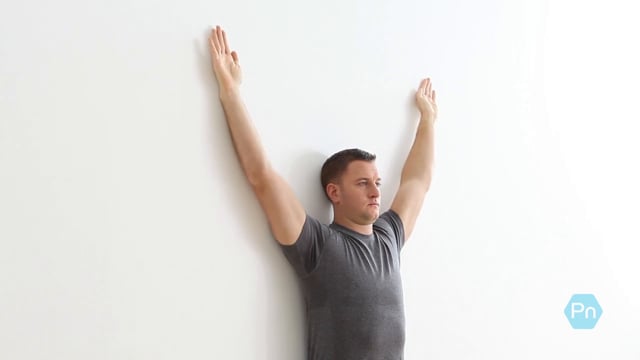
Prone Y Raise instructional video. Note the thumbs-up position and controlled eccentric.
Why the Y Raise is Your Posture’s Best Friend
If you can’t raise your arms without shrugging your ears to your shoulders, your mechanics are broken. The Y Raise forces the lower traps to act as an anchor. This is non-negotiable for anyone doing heavy Weighted Pushups or overhead work.
- Unlocks Overhead Range: By training the lower traps, you allow the humerus to move freely in the socket.
- Aesthetic V-Taper: It builds the “thickness” in the mid-back that makes your waist look smaller and your shoulders broader.
- Shoulder Longevity: It balances out the anterior dominance of heavy benching and pushing.
- Core Synergy: To do this right, you must maintain a rigid trunk. Pair this with an Ab Wheel Iso for total torso stability.
Step-by-Step Form: The 5-Point Checklist
- Setup: Lie face down on the floor. Legs straight, toes tucked. Extend your arms out at a 45-degree angle to your body, forming a “Y.”
- The Grip: Make a fist with your thumbs pointing toward the ceiling (external rotation). This is critical for joint clearance.
- The Brace: Squeeze your glutes and press your shoelaces into the floor. This prevents you from using your lower back to lift your arms.
- The Lift: Exhale and lift your arms as high as possible without shrugging. Think about “sliding” your shoulder blades down toward your back pockets.
- The Hold: Pause at the top for 2 seconds. Squeeze the mid-back. Lower slowly under control.
“The magic of the Y Raise isn’t in the height of the lift; it’s in the scapular control. If you feel this in your upper traps or neck, you’re missing the point. You want to feel the muscles beneath the shoulder blades doing the heavy lifting. It’s the foundational stability required for every heavy Barbell Bench Press.”
— Eugene Thong, CSCS
3 Common Mistakes & How to Fix Them
Using too much weight or momentum turns a precision tool into a shoulder-wrecker.
1. The “Ego” Shrug
The Mistake: Using the upper traps to “heave” the arms up. The Fix: Keep your ears away from your shoulders. If you can’t lift your arms without shrugging, you need to work on Thoracic Mobilization on Foam Roller first to open up the rib cage.
2. The Lower Back Arch
The Mistake: Arching the lumbar spine to get more height. The Fix: Squeeze the glutes and keep your forehead tucked toward the floor. The movement should come from the shoulder blades, not the spine.
3. Internal Rotation
The Mistake: Palms facing down or thumbs pointing at each other. The Fix: Thumbs MUST point up. This puts the shoulder in the safest position for the “Y” angle.
“Correct shoulder positioning allows for better expansion of the ribcage, which directly impacts your respiratory efficiency. When you open up the chest and engage the posterior chain, you’re not just moving better; you’re optimizing oxygen delivery and joint lubrication. This is high-level biology in action.”
— Charles Damiano, B.S. Clinical Nutrition
Programming & Integration
This is a high-rep, high-frequency movement.
- Warm-Up Primer: 2 sets of 15 reps. Focus on the 2-second hold at the top.
- Post-Pressing Corrective: 3 sets of 12 reps after benching to reset the scapulae.
- Systemic Stability: Superset with 90/90 Wall Balloon-Breathing to pair scapular health with core pressure.
Variations to Progress the “Y”
- Incline Bench Y Raise: Perform the movement lying chest-down on an incline bench to increase the range of motion.
- Weighted Y Raise: Use very light dumbbells (1-5 lbs). Warning: A small weight goes a long way here.
- Stability Challenge: Move to a Bear Crawl to integrate shoulder stability with locomotion.
The Verdict
The Prone Y Raise is the invisible work that makes the visible work possible. It fixes the posture your lifestyle is trying to destroy and prepares your shoulders for elite-level loading. Stop ignoring the small stuff—build the foundation.
Prone Y Raise FAQ
Should my head stay on the floor?
Keep your forehead slightly hovered or resting on a small towel to maintain a neutral neck. Do not look up.
Can I do these every day?
Yes. Because they are low-load and focus on postural muscles, they are excellent for daily “desk-reset” sessions.
Why do these feel so heavy with no weight?
Because the lever arm (your entire arm) is long, and the lower traps are often very weak. It’s a humbling exercise. Own the struggle.