You want size and strength. Fast. Not in six months of “maybe.” You want to pack on muscle and add plates to the bar before your gym bro renews his membership. The brutal truth: there is no magic pill. But there is a blueprint. This guide compresses decades of training wisdom into a no‑fluff roadmap. Follow it, and you will outpace 90% of the guys still doing 20 variations of cable curls. Stop spinning your wheels. Let’s build.
Health & Safety: For educational purposes only. Not FDA evaluated. These products and exercises carry inherent risks; results are not guaranteed and vary by individual. Always consult a professional before starting any new diet, supplement, or physical regimen.
The Reality: Speed Requires Intensity, Not Shortcuts
“Fast” in strength and size means 8‑12 weeks of focused, brutal consistency. It does not mean two weeks. If someone promises you 20 pounds of muscle in a month, they are selling snake oil. But you can see measurable changes—in the mirror, on the bar, and in your sleeves—within 90 days if you do everything right.
The formula is simple: progressive overload + caloric surplus + adequate protein + quality sleep. That is 90% of it. The remaining 10% is exercise selection, recovery tactics, and supplement leverage. Most guys fail because they chase complexity while neglecting the basics.
For a deep understanding of the physiological drivers, read our science behind muscle growth and strength training fundamentals.
“Guys want speed but train like they have forever. They do 10 sets of curls and wonder why their arms don’t grow. The secret is not more volume—it’s more effective volume on the right exercises, with a relentless focus on adding weight or reps.”
Charles Damiano, B.S. Clinical Nutrition
The Non‑Negotiable Principles for Rapid Gains
⚡ The Velocity Protocol™
Speed demands focus. The Velocity Protocol is built on three pillars: compound‑first training, linear or undulating progression, and metabolic surplus. You will prioritize movements that give the most return per unit of time: squat, deadlift, bench press, overhead press, row, chin‑up. Accessories are for finishing, not foundation.
You will add weight to the bar every 1‑2 weeks or add reps until you can increase load. You will eat in a surplus of 300‑500 calories daily. And you will sleep at least 7 hours. Miss any of these, and you slow the process.
Progressive Overload – Your Only Job
If you are not adding weight or reps, you are not growing. Progressive overload is the engine. Period. Read our progressive overload guide for the mechanics.
Compound Lifts – The Foundation
Isolation work has its place, but it is the seasoning, not the steak. Focus on the big 5 compound lifts: squat, deadlift, bench press, overhead press, and row. These recruit the most muscle mass, spike anabolic hormones, and allow the heaviest loads.
Frequency – Hit Muscles Twice a Week
Research shows that training a muscle group 2‑3 times per week yields superior growth compared to once. Use a full‑body, upper/lower, or push/pull/legs split to achieve this.
Recovery – Where the Magic Happens
You do not grow in the gym. You grow when you sleep. Prioritize sleep, manage stress, and schedule deload weeks. See our strategic deload guide and sleep optimization guide.
Training: The Fast‑Track Blueprint
Exercise Selection – Do This, Not That
| Muscle Group | Primary Lift | Accessory (1‑2 per session) | Why |
|---|---|---|---|
| Legs | Barbell Squat | Romanian Deadlift, Leg Press | Full systemic load, highest hormone response |
| Back | Deadlift or Chest‑Supported Row | Pull‑Up, Face Pull | Deadlift builds total body, rows thicken |
| Chest | Barbell Bench Press | Incline Dumbbell Press, Dips | Bench builds strength, incline balances upper chest |
| Shoulders | Overhead Press | Lateral Raises, Upright Row | OHP builds mass and overhead strength |
| Arms | Barbell Curl + Close‑Grip Bench | Skullcrushers, Hammer Curls | Compounds for arms: curls and CGBP add mass quickly |
Programming for Speed – A Sample 4‑Day Upper/Lower Split
This split hits every muscle twice a week with a mix of strength and hypertrophy.
Day 1: Upper Strength
- Bench Press: 3 sets x 5 reps (heavy)
- Barbell Row: 3 x 5
- Overhead Press: 3 x 5
- Weighted Pull‑Up: 3 x 5
- Accessory: Barbell Curl 2 x 8‑10, Close‑Grip Bench 2 x 8‑10
Day 2: Lower Strength
- Squat: 3 x 5
- Deadlift: 1 x 5 (or 3 x 3 if advanced)
- Romanian Deadlift: 3 x 8
- Accessory: Leg Press 2 x 10, Hanging Leg Raise 3 x 10
Day 3: Upper Hypertrophy
- Incline Dumbbell Press: 3 x 8‑10
- Seated Cable Row: 3 x 8‑10
- Dumbbell Overhead Press: 3 x 8‑10
- Lat Pulldown: 3 x 8‑10
- Accessory: Dumbbell Curl, Cable Triceps Extension 3 x 10‑12 each
Day 4: Lower Hypertrophy
- Front Squat or High‑Bar Squat: 3 x 8‑10
- Trap Bar Deadlift: 3 x 8
- Walking Lunges: 3 x 10 per leg
- Accessory: Leg Curl, Calf Raises 3 x 12‑15
Progression: Add 2.5‑5 lbs each session for strength days. For hypertrophy days, add reps until you hit the top of the range, then increase weight.
For more structured programs, check 12‑week arm growth plan and calisthenics challenge.
Nutrition: Fuel the Machine
Caloric Surplus – The Non‑Negotiable
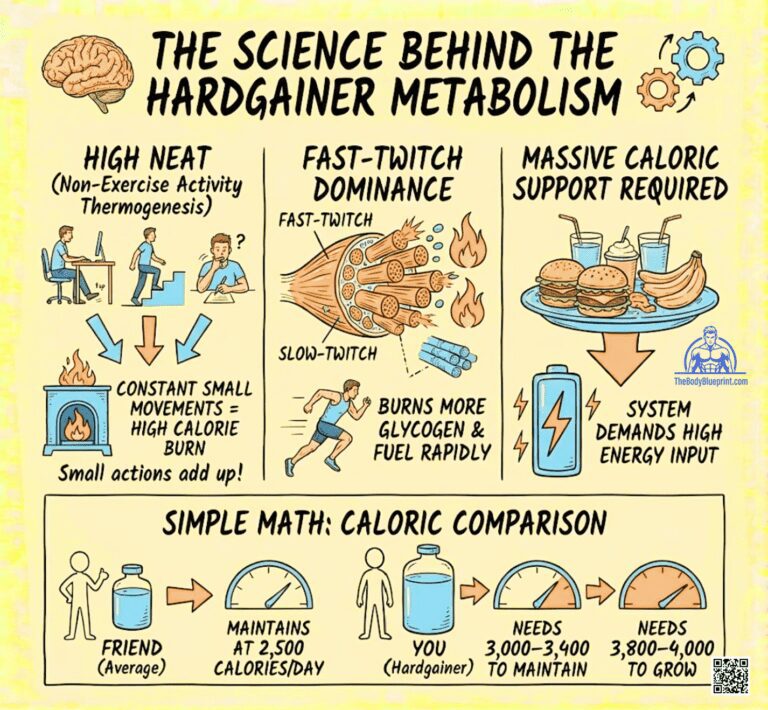
You cannot build muscle from nothing. Aim for a surplus of 300‑500 calories above maintenance. For hardgainers, this may need to be 500‑700. See our calorie guide for muscle gain and hardgainer meal plan.
Protein – The Building Block
1.6‑2.2 grams per kg of bodyweight. Spread across 3‑5 meals. Prioritize whole foods, but use whey protein and casein strategically. Read protein timing guide.
Carbohydrates – The Fuel
Carbs drive performance and recovery. Around 4‑7 g/kg. Focus on pre‑ and post‑workout carbs. See best workout carbs and HBCD carb timing.
Fats – Hormonal Support
0.8‑1.2 g/kg. Essential for testosterone production. Don’t drop too low.
Hydration
Dehydration kills strength. Drink enough water. See hydration guide.
Recovery: The Accelerator
- Sleep: 7‑9 hours. Non‑negotiable. See sleep optimization and best sleep supplements.
- Deload Weeks: Every 4‑8 weeks, reduce volume by 40‑60%. See deload guide.
- Soft Tissue Work: Foam rolling and percussion massage. See best foam rollers and percussion massage hub.
- Stress Management: Chronic cortisol affects recovery. See adaptogens guide.
Supplements: The Force Multipliers
- Creatine Monohydrate: 5g daily. Most researched, most effective. See loading guide.
- Whey Protein: Convenient, fast‑digesting. See best post‑workout whey.
- Beta‑Alanine: For high‑rep sets. See beta‑alanine guide.
- Citrulline Malate: Improves pump and endurance. See citrulline guide.
- Fish Oil: Supports joint health and healthy inflammatory response. See omega‑3 for joints.
Fast Gains: The Raw Truth
A: For beginners or those returning from a layoff, yes (body recomposition). For experienced lifters, it is very slow. For fastest strength and size gains, focus on a surplus first, then cut. See weight loss without cardio for cutting strategies.
A: Strength gains appear in 2‑4 weeks (neural adaptation). Visible muscle size changes typically take 8‑12 weeks of consistent training and nutrition. Patience with consistency is key.
A: Eat more. Aim for a bigger surplus. Prioritize compound lifts and lower volume per session, but hit each muscle 2‑3 times a week. See ectomorph arm workout and skinny guys muscle guide.
A: Strength: 1‑5 reps. Hypertrophy: 6‑12 reps. But you need both. Use periodization or combine with an upper/lower split that includes strength and hypertrophy days. See best rep range for hypertrophy.
A: No. For strength, leave 1‑3 reps in reserve. For hypertrophy, occasional failure on the last set is fine. Constant failure will fry your CNS. See volume vs. intensity.
Final Verdict: Speed Demands Discipline
Fast gains are possible, but they are not easy. You cannot half‑ass your way to a bigger squat or sleeves that split. The path is clear: compound lifts, progressive overload, caloric surplus, adequate protein, quality sleep, and recovery management.
Most guys will read this guide and nod along. A few will actually do it. The ones who do will be the ones getting asked, “What are you taking?” in the locker room.
Buy this if: You are ready to stop making excuses, track your lifts, eat more than you think you need, and show up consistently.
Skip this if: You are looking for a secret routine that works without effort, or you think “overtraining” is a bigger risk than undertraining.
For more actionable programs, dive into the complete muscle building guide, strength training for beginners, and progressive overload explained.
The Bottom Line: Put in the Work, Get the Results.
You now have the blueprint. The only variable left is your execution. Add weight or reps every week. Eat in a surplus. Sleep. Repeat. The iron does not lie. Go earn your gains.
The Strength & Size Lexicon
- Progressive Overload
- The systematic increase of stress (weight, reps, volume) to force adaptation. The primary driver of growth.
- Caloric Surplus
- Consuming more calories than your body burns. Required for significant muscle gain.
- Compound Lift
- A multi‑joint movement that recruits multiple muscle groups (e.g., squat, deadlift, bench press).
- Time Under Tension (TUT)
- The total duration a muscle is under load during a set. Manipulated for hypertrophy.
- Rate of Perceived Exertion (RPE)
- A scale (1‑10) rating how hard a set felt. Used to autoregulate training intensity.
- Deload
- A planned period of reduced training volume to allow full recovery and prevent overreaching.
- Neuromuscular Adaptation
- Early strength gains from improved neural efficiency, not muscle size. Happens in the first weeks of training.