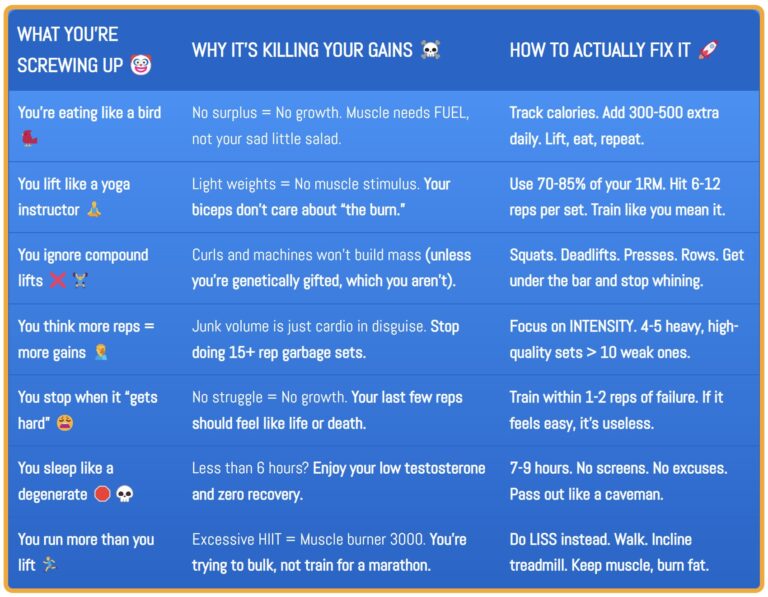
Progressive overload is the governing mechanical law behind every strength adaptation your musculoskeletal system has ever made. Not a method. Not a philosophy. A law. Your neuromuscular system either receives a sufficient mechanical stimulus to trigger remodeling, or it does not. You are either building or you are stagnating. This is our 2026 breakdown of the science, the variables, and the exact framework that separates athletes who compound gains from athletes who plateau inside 90 days.
Medical Disclaimer: Not FDA evaluated. Not intended to treat, cure, or prevent disease. Consult a physician before beginning any new training program.
What Is Progressive Overload?
Progressive overload is the systematic escalation of mechanical tension, training volume, and neuromuscular demand placed on skeletal muscle tissue over time. Your body adapts to stress. Once it adapts, that stress stops working. Comfort is the biological enemy of remodeling.
Dr. Thomas DeLorme codified the principle using progressive resistance exercise protocols at Walter Reed Army Hospital in the 1940s. He proved that escalating external load produced superior strength outcomes compared to static resistance protocols. Hundreds of randomized controlled trials have confirmed it since. The mechanism has not changed in 80 years.
A 2024 randomized controlled trial compared load progression versus repetition progression across two legs of 39 untrained subjects over 10 weeks. One leg increased external load. The other increased repetitions at fixed load. Both produced equivalent gains in one-repetition maximum strength and quadriceps cross-sectional area. The delivery differed. The overload signal was identical. The muscle does not read the program. It reads the tension.
Think of your skeletal muscle like a suspension bridge cable. Under consistent load, the cable holds its current tensile specification and never upgrades. Increase the load beyond its current spec, and the engineering team has to rework the entire cable. Progressive overload is how you keep filing engineering change orders on your own physiology. Stop filing, and the bridge never gets stronger.
The Science: Four Mechanisms Inside Your Muscle
Progressive overload drives adaptation through four mechanisms: mechanical tension, myofibrillar damage and repair, metabolic stress accumulation, and ribosome biogenesis. Each operates on a different timescale. Each responds to a different training variable.
- Mechanical Tension and mTOR Signaling: Mechanosensitive pathways in the muscle fiber membrane detect tensile load and activate the mTOR signaling cascade. mTOR is the upstream switch for muscle protein synthesis. No tension. No mTOR. No growth. Research consistently identifies mechanical tension as the primary hypertrophic driver in natural lifters. Protect this variable above all others.
- Myofibrillar Damage, Satellite Cell Activation, and Myonuclear Addition: Eccentric loading creates microtrauma at the sarcomere level, specifically at Z-disc structures within each myofibril. This recruits muscle satellite cells from beneath the basal lamina. They proliferate, fuse to the damaged fiber, and donate new myonuclei. More myonuclei means a higher protein synthesis ceiling. Each repair cycle leaves the fiber more capable than before.
- Metabolic Stress and Anabolic Hormone Response: High-repetition, short-rest training accumulates lactate, inorganic phosphate, and hydrogen ions locally. This triggers a secondary anabolic hormone response and cellular swelling. Research ranks it third behind mechanical tension and satellite cell activity. It still matters, especially in hypertrophy-specific blocks where time under tension is the primary variable.
- Ribosome Biogenesis and Long-Term Synthesis Capacity: Each progressive stimulus drives muscle cells to build additional ribosomes. Ribosomes are the organelle-level machinery that translate mRNA into contractile proteins. More ribosomes means a higher structural ceiling for protein output. This is why advanced athletes build muscle faster than novices at equivalent loads. Their cellular infrastructure has been commissioned over years of consistent overload.
| Mechanism | Primary Trigger | Structural Outcome |
|---|---|---|
| Mechanical Tension | Heavy load. Full ROM. Progressive resistance escalation. | mTOR activation. Muscle protein synthesis. Strength and size gains. |
| Myofibrillar Damage and Repair | Eccentric loading. Novel movement patterns. Volume increases. | Satellite cell activation. Myonuclear addition. Structural fiber remodeling. |
| Metabolic Stress | Higher reps. Shorter rest intervals. Sustained time under tension. | Anabolic hormone response. Cellular swelling. Secondary hypertrophic signaling. |
| Ribosome Biogenesis | Consistent long-term progressive stimulus over weeks and months. | Expanded protein synthesis infrastructure. Higher ceiling for future growth. |
The Progressive Overload Stack™: 5 Manipulable Variables
External load, repetition volume, training frequency, time under tension, and range of motion are the five variables in your Progressive Overload Stack™. Most athletes use one. Elite programmers cycle all five across training blocks. Adding load is the most direct application. It is also the first to stall. When it does, the remaining four keep the adaptation signal alive.
- Variable 1: External Load (Primary Mechanical Overload Driver): Add load to the resistance implement and neuromuscular demand increases proportionally. Increments as small as 1.25kg per side constitute legitimate overload when applied consistently. This is the primary strength variable. Exhaust it before rotating. Micro-plates exist for exactly this reason.
- Variable 2: Repetition Volume (Secondary Hypertrophy Driver): The 2024 RCT confirmed that repetition increases at fixed external load produce equivalent cross-sectional area adaptations to load increases. Moving from 3 sets of 8 to 3 sets of 10 is measurable progressive overload. When you hit the top of your rep range consistently, add load and drop back to the lower boundary. This is the Double Progression Model™. It is the most reliable system for intermediate lifters who have outgrown linear loading.
- Variable 3: Training Volume (Block-Level Overload): Volume is total weekly sets multiplied by reps multiplied by external load. Adding a fourth working set to a movement previously performed for three is a meaningful increase. Research confirms a dose-response relationship between weekly volume and hypertrophic adaptation. Exceed your maximum recoverable volume (MRV) and additional work produces regression, not progress.
- Variable 4: Training Density (Temporal Compression Overload): Density is total work relative to total training time. Completing identical sets and reps in a shorter window is progressive overload that primarily drives metabolic stress adaptations. Compress rest intervals by 15 to 30 seconds per session. Once your target density is achieved, escalate load or volume before compressing further. Do not chase both simultaneously.
- Variable 5: Range of Motion and Technique Quality (Moment Arm Overload): A technically superior repetition with full range of motion places greater mechanical tension through a longer moment arm than a partial repetition at identical load. A full-depth squat is categorically more demanding than a quarter-squat at the same bar weight. Better technique is not just injury prevention. It is a legitimate overload variable that most athletes never audit.
Your five overload variables are like the burners on a professional range. Most home cooks only ever use the front-left burner. Everything else sits cold. A professional chef runs all five simultaneously, rotating heat as each dish demands. Master all five and you will never run out of a way to make progress.
5 Mistakes That Kill Adaptation
Ego loading, primary exercise rotation, absent training logs, simultaneous multi-variable manipulation, and insufficient recovery are the five errors that neutralize progressive overload entirely. Most plateaus are not physiological ceilings. They are self-inflicted programming errors dressed up as bad genetics.
- Ego Loading (Mechanical Tension Fraud): Adding external load while reducing range of motion is not progressive overload. The target musculature receives less mechanical tension per repetition, not more. You are not getting stronger. You are getting better at avoiding the stimulus. Form and full ROM are non-negotiable constraints on load selection.
- Primary Exercise Rotation (Neural Adaptation Reset): Your neuromuscular system requires repeated exposure to a movement pattern before efficiently recruiting the target musculature. Rotating primary compound movements weekly resets neural adaptation. Fix your primary movements for minimum 4 to 8 week blocks. Rotate accessory work freely. Never rotate primary overload movements mid-block.
- Absent Training Log (Blind Progression Protocol): You cannot progressively overload what you cannot measure. Training by feel is training by self-deception. Perceived effort is an unreliable proxy for actual overload stimulus. Log your sets, reps, and load every session. Without records, progression is accidental at best.
- Simultaneous Multi-Variable Manipulation (Uncontrolled Programming Chaos): Increasing external load, weekly volume, training frequency, and session density in the same week is not aggressive overload. It is an uncontrolled experiment with no interpretable data. When progress stalls or injury occurs, you have nothing to diagnose. One variable per training block. Rotate at the block boundary. That is periodization.
- Insufficient Recovery (Stimulus Without Adaptation Window): Skeletal muscle remodeling, satellite cell proliferation, and myonuclear addition occur during recovery. Not during training. Progressive overload without adequate sleep, caloric intake, and inter-session rest is accumulated damage without a repair phase. The stimulus exists. The adaptation cannot.
| Mistake | What It Looks Like | The Fix |
|---|---|---|
| Ego Loading | Load increases while ROM and form degrade. | Full ROM is non-negotiable. Add load only when both form and range are intact. |
| Exercise Rotation | New primary movements every week. No baseline established. | Fix primary movements for 4 to 8 week blocks. Neural adaptation requires repetition. |
| No Training Log | Estimating last session from memory and perceived effort. | Log every set, rep, and load. Measurable progression is intentional progression. |
| Multi-Variable Chaos | Increasing load, volume, density, and frequency simultaneously. | One variable per block. Periodize the stimulus. Keep everything else fixed. |
| Insufficient Recovery | High training load on poor sleep, low calories, no rest days. | Recovery is where adaptation is manufactured. Treat it as a training variable. |
Your Framework: The Double Progression Model™
The Double Progression Model™ is a two-variable overload system that alternates between repetition accumulation and external load escalation within a fixed rep range boundary. It gives you a clear, objective trigger for load increases. No guesswork. No feel. Just earned progression.
- Step 1: Establish your rep range boundary. Select a working rep range for each primary movement. The 8 to 12 repetition range is well-supported for hypertrophy. The 3 to 6 range suits strength-dominant blocks. The range matters less than staying within it consistently for the full block.
- Step 2: Set your starting load conservatively. Load so you can complete the bottom of your rep range with 2 to 3 repetitions remaining in reserve (RIR). Do not start at your ceiling. Starting conservatively creates the runway the model needs.
- Step 3: Accumulate repetitions across sessions. Add 1 to 2 reps per working set each session. Track everything. Do not increase external load until all working sets consistently hit the top of your rep range boundary. The trigger must be earned. Not estimated.
- Step 4: Execute the load trigger. When you hit the top of the rep range across all sets, increase load by the smallest available increment. Drop back to the bottom of the range. Restart. This trigger is objective and non-negotiable. You hit the ceiling or you did not.
- Step 5: Log every session without exception. The training log is the operating system of the Double Progression Model™. Without accurate records, the trigger mechanism is blind. Every set. Every rep. Every load. Every session.
Your training log is a compound interest account, and most lifters never open one. Athletes who log consistently earn interest on every session ever completed. Athletes who train by feel spend from a balance they cannot see, wondering every six months why they are always broke.
A meta-analysis published in Frontiers in Physiology found that structured progressive overload protocols produced up to a 40% greater increase in strength compared to non-progressive programs across equivalent intervention periods. That is not a marginal difference. It is the difference between a program that builds and one that keeps you busy.
The Bottom Line
Progressive overload is the non-negotiable mechanical law governing skeletal muscle adaptation, neuromuscular remodeling, and long-term strength accumulation. Every program that has ever produced a real result applied this principle. Deliberately or accidentally.
The Double Progression Model™, a consistent training log, and a protected recovery window are the three structural requirements for making it work. The biology is already set up in your favor. Satellite cells are ready. mTOR is waiting. Progressive overload is the instruction your body needs before it executes the upgrade.
Pick your variable. Apply it systematically. Log it honestly. Protect your recovery. Repeat for years.
Verdict: You Are Either Progressing or Paying Rent on a Plateau.
The biology does not negotiate. The training log does not lie. Apply the Double Progression Model™, protect your recovery window, and let the mechanism do the rest.
*Verified 2026 technical review. Sources: Plotkin et al. (2022) PeerJ, Frontiers in Physiology (2025), Food Chemistry: Molecular Sciences (2025), DeLorme & Watkins (1948).