The Fitness Reality 810XLT Power Cage is an ASTM-tested, 800-pound-capacity squat rack built from 2″ x 2″ 14-gauge steel tubing with 19 adjustable safety pin levels, a multi-grip pull-up bar, and an optional lat pulldown attachment, for roughly the price of a year of gym dues. This is not a commercial-grade rack. It does not pretend to be. It is the budget workhorse that does exactly what it says, and nothing more.
Affiliate Disclosure: This article contains affiliate links. As an Amazon Associate, I earn from qualifying purchases at no extra cost to you. We evaluate home gym equipment based on published specs, materials, and real-world use cases.
Safety Disclaimer: Power racks are heavy-load safety equipment. Always bolt your rack to the floor or use a properly anchored platform when lifting heavy. Inspect hardware monthly. No piece of steel replaces good judgment under a loaded barbell.
Price Disclaimer: Prices shown are approximate and may vary. Check current pricing and availability on Amazon.
The Spec Sheet: 2″x2″ 14-Gauge Steel, 800 lbs ASTM-Tested, Walk-In Design
The Fitness Reality 810XLT Power Cage uses 14-gauge tubular steel in a 2″ by 2″ configuration, stands 83.5 inches tall, and carries an ASTM-tested 800-pound weight capacity rating with a 50.5″ by 46.5″ footprint. The walk-in design means you step inside the cage, set the 19-position adjustable safety bars, and lift without a spotter. That is the entire value proposition: solo safety, budget price, no frills.
- 800-lb ASTM-Tested Capacity: Not an inflated marketing number. The ASTM International testing standard means the rack has been independently verified to hold 800 pounds in a controlled test environment. For context, that is a 500-pound squat plus a 300-pound lifter with room to spare. Most home lifters will never approach the limit.
- 2″x2″ 14-Gauge Steel Frame: This is the standard budget-rack steel spec. Thicker than the 16-gauge junk at the bottom of the market, thinner than the 11-gauge 3″x3″ steel on racks costing three times as much. It is adequate, not overkill. Know the difference.
- 19 Adjustable Safety Pin Levels: The safety bars span 19 height positions, from just above the floor to near the top of the rack. That granularity matters when you are benching alone at 6 a.m. and need the pins set precisely at chest height — high enough to catch the bar, low enough not to clip your chest on every rep.
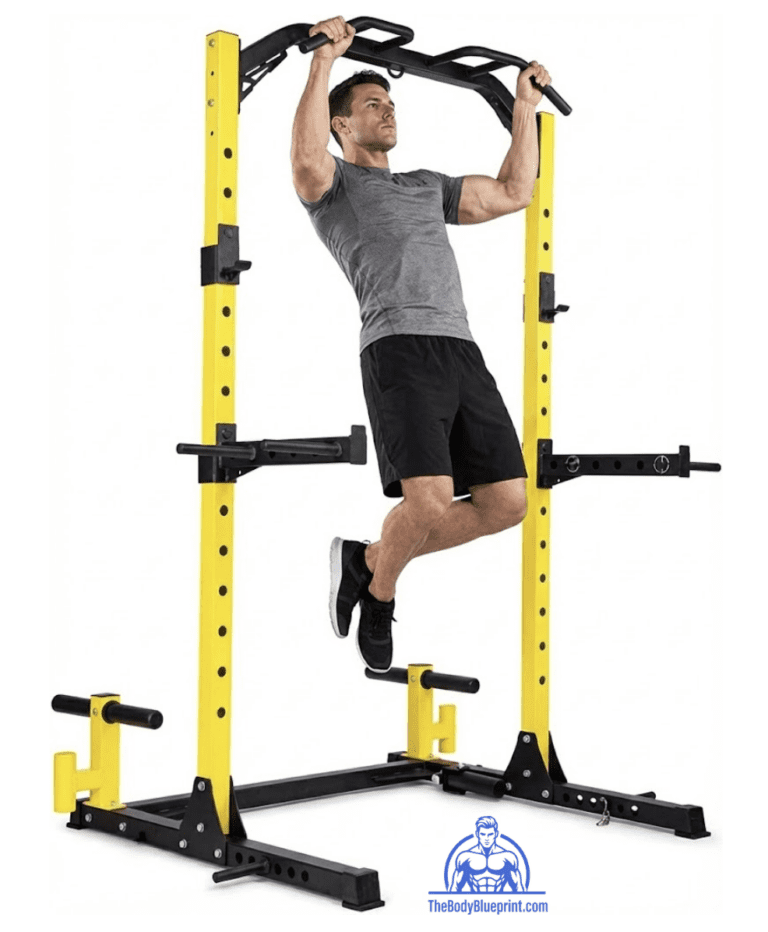
- Multi-Grip Pull-Up Bar: The angled and neutral-grip pull-up bar is welded into the top of the frame. Wide grip, neutral grip, chin-up grip. No extra purchase required. It is part of the cage.
- Footprint: 50.5 inches long by 46.5 inches wide. That is roughly the size of a yoga mat laid sideways. For home gym equipment that handles full squats and bench press, it is compact.
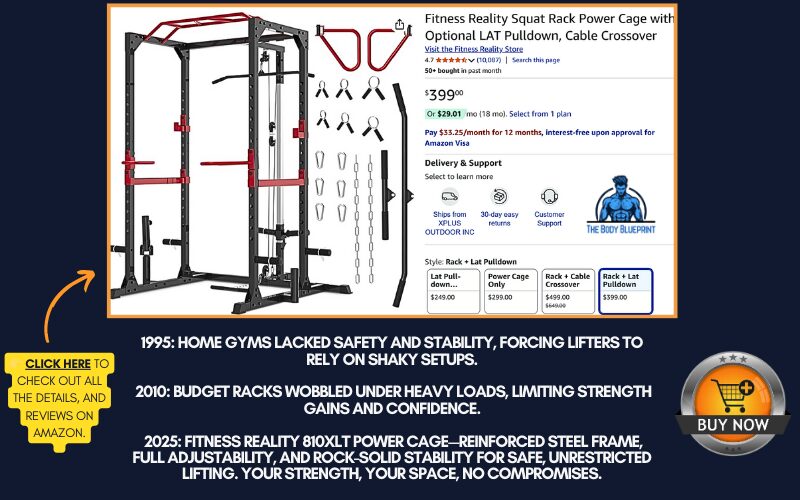
- Optional Lat Pulldown Attachment: Sold separately for roughly \$149. Bolts onto the rear of the cage, adding a cable pulley system for lat pulldowns, tricep pushdowns, and seated rows. More on this below.
The pickup truck analogy: The 810XLT is the Toyota Tacoma of squat racks. It is not the biggest, not the shiniest, and it will not impress anyone who spent roughly \$2,000 on a Rogue Monster Lite. But it shows up, does the job, and refuses to die. Some people want a Ford Raptor. Most people just need to haul lumber.
Who It’s For, and Who Should Spend More Elsewhere
The 810XLT is the right rack for a specific buyer and the wrong rack for another. Find your row.
- The Budget-Conscious First-Time Home Gym Builder: You want to build muscle without a gym membership and you need a rack that costs less than two years of monthly dues. The 810XLT is it. Pay once, squat forever.
- The Solo Garage Lifter: You train alone. You squat heavy. You bench heavy. The 19-position safety bar system is your spotter. No missed lift becomes a hospital visit. For anyone running smarter muscle workouts with high-intensity sets, safety pins are non-negotiable.
- The Space-Conscious Lifter: Your garage still needs to fit a car, or your basement ceiling is low. At 83.5 inches tall with a 50.5″ x 46.5″ footprint, this rack fits where larger cages will not. Measure your ceiling before you order. Standard basement height is 84 to 96 inches. You need clearance for pull-ups.
- The Progressive Overload Purist: You want to squat, bench, deadlift (off the safeties), overhead press, and row. You do not need a cable crossover station with 14 attachment points. You need a cage that holds the bar and catches it when you fail. Proven strength and mass strategies start with the basics, and the 810XLT delivers exactly the basics.
Skip it if you are:
- Pulling 700+ pounds regularly: The 800-pound rating is a static load test, not a dynamic-dropping-a-600-pound-deadlift-onto-the-safeties rating. If you are at elite numbers, buy a rack rated for at least 1,000 pounds. Steel flexes under repeated impact. Ratings degrade with use.
- Chasing attachment ecosystems: The 2″x2″ frame accepts most third-party attachments, but the Fitness Reality attachment catalog is not as deep as Rogue or Rep. If you want lever arms, belt squats, and monolift attachments, look at higher-end home gym racks with broader ecosystems.
- Over 6’4″ and squatting heavy inside the cage: The 83.5-inch height clears most frames, but if you are built like a redwood and squat with a wide stance, your head may brush the pull-up bar. Squat outside the rack using spotter arms.
- Chasing Instagram aesthetics: The 810XLT is matte black powder-coated steel. It looks like a squat rack. It does not look like a boutique fitness installation. No chrome. No color options. No apologies.
Pros and Cons: The Honest Breakdown
The Advantages
- ASTM-tested 800-lb capacity: Verified static load rating, not a guess. Enough for 95% of home lifters.
- 19 safety pin positions: Fine-grained adjustability for solo benching, squatting, and rack pulls. Your chest thanks you.
- Compact footprint: 50.5″ x 46.5″. Fits in a one-car garage or standard basement without dominating the room.
- Multi-grip pull-up bar included: Wide, neutral, and chin-up grips welded in. No extra purchase, no bolt-on wobble.
- Optional lat pulldown: \$149 adds cable work. Not commercial-smooth, but functional.
- Pre-drilled bolt holes: Anchor it to a platform or concrete floor for maximum stability during power-focused lifts.
- Price: The cheapest ASTM-tested cage in its class. You are paying for steel, not branding.
The Trade-offs
- 2″x2″ steel, not 3″x3″: Adequate, not invincible. Heavier lifters feel frame flex during aggressive reracking.
- Basic J-hooks included: Functional, but no UHMW plastic lining. Bar knurling will rub. Most owners upgrade hooks within a year.
- Assembly takes 2-3 hours: Solo assembly is doable but tedious. The included wrench is barely functional. Use your own socket set.
- Limited attachment ecosystem: Dip bars, landmine, and weight horns exist, but the catalog is shallow compared to 3″x3″ ecosystems.
- 1-year warranty: Standard for budget racks. Not the lifetime warranty you get from premium brands. Inspect hardware monthly.
- Lat pulldown not included: The cable attachment is sold separately. The rack does not come cable-ready out of the box.
The Field: How the 810XLT Stacks Against the Budget Rack Competition
Steel spec, weight capacity, footprint, and price separate the budget power rack category. No single rack wins every column.
| Rack | Steel | Capacity | Footprint | Core Edge |
|---|---|---|---|---|
| Fitness Reality 810XLT | 2″x2″, 14-gauge | 800 lbs (ASTM) | 50.5″ x 46.5″ | Best price-to-capacity ratio, 19 safety pin positions |
| CAP Barbell FM-CS | 2″x2″, 14-gauge | 500 lbs | 45″ x 43″ | Slightly smaller footprint, lower capacity |
| Rep Fitness PR-1000 | 2″x2″, 14-gauge | 700 lbs | 48″ x 48″ | Better attachment ecosystem, higher price |
| Titan T-2 Series | 2″x2″, 12-gauge | 850 lbs | 48″ x 48″ | Thicker steel, higher capacity, costs more |
| Rogue R-3 | 2″x3″, 11-gauge | 1,000+ lbs | 53″ x 48″ | Commercial-grade, 3x the price, lifetime warranty |
The 810XLT wins on price-to-capacity and safety pin granularity. The Titan T-2 wins on steel thickness. Rogue wins on everything except price. Pick the column you actually need, not the one that looks best in a spec sheet showdown.
The ugly truth about budget racks: A $200 rack and a $1,000 rack both hold the bar. The difference is what happens when you drop 400 pounds on the safeties from 18 inches up. The roughly $1,000 rack absorbs it. The roughly $200 rack survives it — once. The 810XLT sits in the middle: built to handle the load, but not built to laugh at it for a decade.
The Optional Lat Pulldown: Function Over Flawless
The $149 lat pulldown attachment bolts to the rear uprights and adds a cable pulley system for lat pulldowns, tricep pushdowns, seated rows, and face pulls. The pulleys are nylon, not commercial ball-bearing units. The weight carriage uses standard 1-inch plates or Olympic adapters depending on the version. It works. It does not feel like a $2,000 functional trainer.
- The upside: Adds vertical pulling and cable isolation work to a rack that otherwise does squats, bench, and pull-ups. For a complete arm-building arsenal, cables are mandatory, and this attachment is the cheapest way to get them into a power rack setup.
- The downside: The pulley system adds roughly 18 inches of depth to the rack. What was a 50.5-inch footprint becomes a 68-inch footprint. Measure twice, buy once. The cables are not commercial-smooth and can feel jerky at lighter weights. Lubricating the pulleys helps.
- Also available separately: Dip bar attachment, landmine attachment, and weight plate storage horns. All bolt onto the 2″x2″ uprights. Third-party 2″x2″ attachments generally fit, but verify hole spacing before you buy.
Assembly: 2-3 Hours, a Socket Set, and One Cold Drink
Set aside a Saturday morning, a 14mm and 17mm socket wrench, and a rubber mallet. The included stamped-steel wrench is functional but punishing. Use your own tools. The instructions are pictogram-heavy and text-light. Functional, not foolproof.
- Bolt incrementally: Do not fully tighten any bolt until the entire frame is standing. Loosely assemble all four uprights and both crossmembers, then tighten in a star pattern. This eliminates frame wobble before it starts.
- Get help for the pull-up bar: The multi-grip bar is heavy and awkward to align solo. A second set of hands saves 30 minutes and one dented drywall panel.
- Bolt it down: The pre-drilled feet accept 3/8″ concrete anchors or lag bolts into a wooden platform. Even if the rack feels stable, heavy reracking produces lateral force that can walk an unbolted rack across the floor over weeks of use.
The assembly reality: The first side takes an hour while you figure out which bolt goes where. The second side takes 20 minutes. Do not start assembly at 9 p.m. on a weeknight. You will hate yourself.
FAQ
- Can I bolt the 810XLT to the floor?
- Yes, the feet have pre-drilled holes. Use 3/8″ concrete wedge anchors for concrete floors or 3/8″ lag screws for a wooden lifting platform. Bolting is not strictly required for squats under 300 pounds, but for anything heavier or for high-intensity power work with aggressive reracking, it is the difference between stable and slowly migrating across the garage.
- Will the 810XLT fit in my basement with an 84-inch ceiling?
- At 83.5 inches, the rack clears an 84-inch ceiling by half an inch. That leaves zero room for pull-ups. You can skip the pull-up bar during assembly or mount it lower, but you lose overhead clearance. For basements, measure before you order.
- Does the 2″x2″ steel hold up to heavy use?
- Yes, for the rated 800-pound capacity under static load. Under dynamic load — dropping a heavy squat onto the safeties — the frame flexes but does not fail. It is rated for it. But 2″x2″ tubing will never feel as immovable as 3″x3″ 11-gauge steel. If you want zero perceptible movement under load, spend more.
- Can I bench inside the cage?
- Yes. The 46.5-inch width accommodates most flat benches. If you are broad-shouldered, the clearance between the uprights and the bar feels snug but functional. For lifters working on progressive overload for bench and arm growth, the 19 safety positions let you set pins precisely for chest-level catches.
- Do third-party attachments fit?
- Most 2″x2″ attachments with 1-inch hole spacing will fit. Fitness Reality’s proprietary attachments use the same spec. Measure hole size and spacing before buying third-party gear. J-hooks, dip bars, landmines, and weight horns from brands like Yes4All and CAP generally work.
- How does the powder coating hold up?
- The matte black powder coat resists chalk, sweat, and moderate humidity. Wipe it down monthly. Do not use abrasive cleaners. If you train in an unconditioned garage in a humid climate, expect surface rust around bolt holes and J-hook contact points within 12 to 18 months. This is cosmetic, not structural.
Final Verdict: The Rack That Earns Its Price, Not Its Hype
The Fitness Reality 810XLT Power Cage is the budget rack that refuses to cut the one corner that matters: safety under load. The 800-pound ASTM-tested rating, 19 safety pin positions, and compact walk-in design make it the right call for the solo lifter who wants to squat, bench, and pull-up at home without a second mortgage. It is not the best rack. It is the best rack for the money.
Know what you are buying: The J-hooks are basic. The steel is 2″x2″, not 3″x3″. The lat pulldown is functional, not buttery. The warranty is one year, not a lifetime. But if you train under 600 pounds, train alone, and want a cage that catches the bar when you miss, the 810XLT does exactly that for less than the cost of a two-year gym membership. Pair it with a quality post-workout protein and a proper periodized training program, and you have a muscle-building setup that pays for itself in under 18 months. The rest is just showing up.
800 lbs ASTM-Tested. 19 Safety Positions. One Cage. Zero Gym Dues.
Fitness Reality 810XLT Power Cage. The budget workhorse for solo lifters who want to squat heavy and sleep well. Your garage is the gym now.
*Price and specs subject to change. Verify on the live listing. Always bolt your rack to the floor or platform. No piece of steel replaces good judgment under load.
The Lexicon: Power Cage Edition
- ASTM Testing
- The ASTM International standard for static load testing. A rack that claims an “800-lb ASTM-tested capacity” has been verified under controlled conditions to hold that weight without structural failure. A rack that claims “800-lb capacity” without ASTM may be using the manufacturer’s guess. The difference is third-party verification versus marketing optimism.
- 14-Gauge Steel
- The wall thickness of the tubing. Lower gauge numbers mean thicker steel. 14-gauge is approximately 0.075 inch thick. 11-gauge is approximately 0.120 inch thick. 16-gauge is approximately 0.060 inch thick. For a squat rack, 14-gauge is the minimum acceptable spec. Below that, you are buying a laundry rack that happens to hold a barbell.
- Walk-In Design
- A power cage with four uprights and open rear access. The lifter walks into the cage from the back, sets the safeties, and lifts. Contrast with a half-rack, which has only two uprights and requires lifting outside the frame.
- Safety Pin / Spotter Arm
- The horizontal bars that catch a failed lift. Pin-style safeties slide through holes in the uprights. Spotter arms clamp onto the outside of uprights. Pin-style safeties are included with the 810XLT. Spotter arms are sold separately.
- UHMW (Ultra-High Molecular Weight Polyethylene)
- A dense plastic liner found on premium J-hooks. It protects bar knurling from metal-on-metal contact. The 810XLT’s stock J-hooks do not include UHMW lining. Aftermarket J-hooks with UHMW are the most common first upgrade.
- Powder Coating
- An electrostatically applied dry finish baked onto steel. More durable than paint, less durable than cerakote. Resists scratches and minor rust but will wear where metal contacts metal repeatedly — J-hook contact points, safety pin contact points, and bolt holes.