Golden Era bodybuilders like Arnold Schwarzenegger, Lou Ferrigno, and Franco Columbu didn’t just lift weights; they lifted entire film genres onto their shoulders. The crossover from competitive bodybuilding to Hollywood stardom was a calculated, camera-aware phenomenon. This is the story of how the stage became the screen, and why the blueprint still works today.
Affiliate Disclosure: This article contains affiliate links. As an Amazon Associate, I earn from qualifying purchases at no extra cost to you. We analyze training methodologies and film history based on published facts, not hype.
Editorial Note: This article explores the intersection of bodybuilding history and cinema. Training results and career outcomes vary. No regulatory claims are made regarding the fitness or dietary products discussed herein.
Price Disclaimer: Prices shown are approximate and may vary. Check current pricing and availability on Amazon.
Arnold’s Archetype: The Austrian Oak Becomes the American Action Star
Arnold Schwarzenegger’s transition from 7x Mr. Olympia to Hollywood’s highest-paid actor is the single most successful crossover in bodybuilding history. The blueprint was simple but brutal: win everything in bodybuilding, then leave it behind before the audience gets bored. He retired from competition at 32, exactly when his film career needed his full attention.
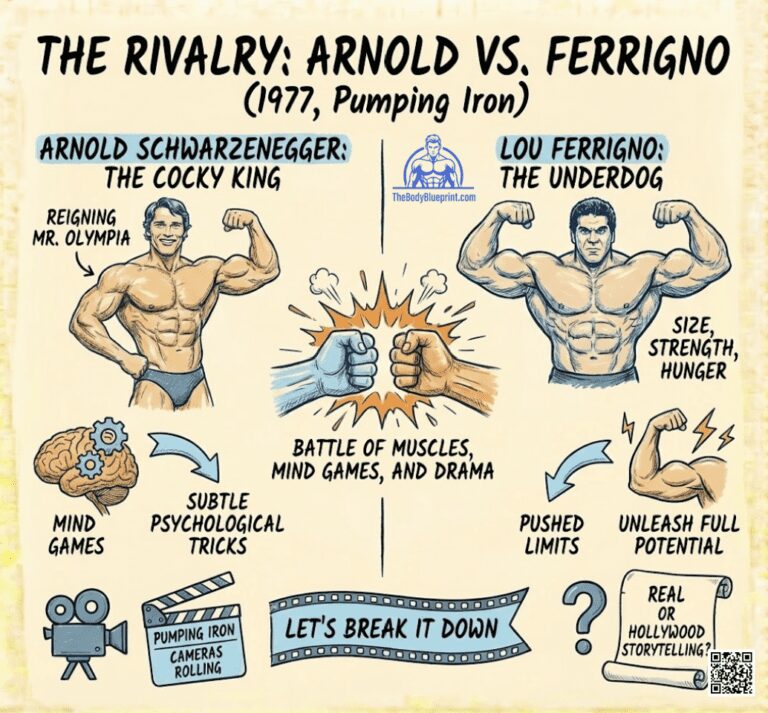
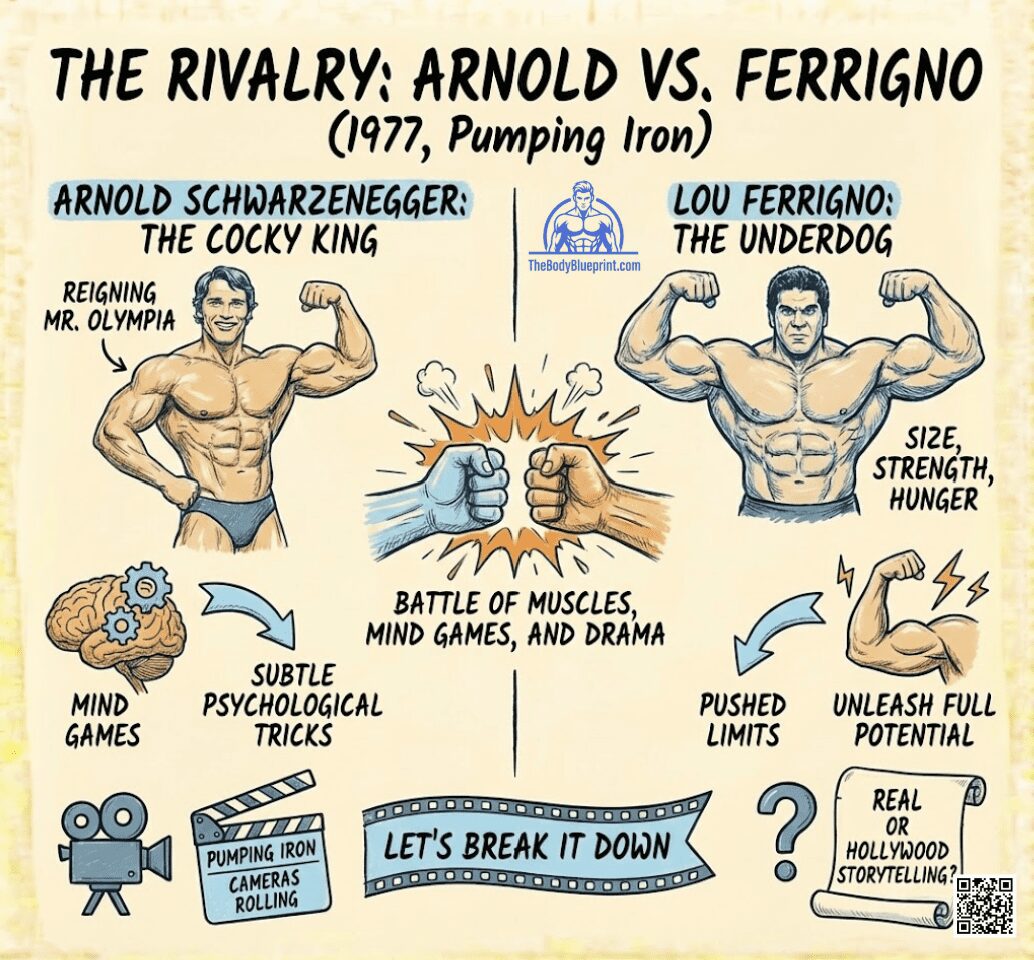
The key inflection point was “Pumping Iron” (1977). That documentary did not just capture Arnold winning his sixth Mr. Olympia, but it introduced mainstream America to the idea that bodybuilders were charismatic, funny, and marketable. Arnold’s on-camera personality was a revelation. The gym bro with a German accent and a godlike physique turned out to be the most charming guy in the room.
From there, the path was pure grind. He took small roles in “Stay Hungry” (1976) and “The Villain” (1979), then landed the role that changed everything: Conan the Barbarian (1982). The casting directors needed someone who looked like he could crush a skull with his bare hands. Arnold was the only person who didn’t need special effects to pull that off.
Then came “The Terminator” (1984). James Cameron wrote a role that weaponized Arnold’s physicality and minimal dialogue requirements. The result was a roughly $78 million box office hit that launched a franchise spanning six films. Arnold proved what we now discuss in modern bodybuilding cross-training: a specific and narrow strength, deployed correctly, beats a broad but shallow skill set every time.
The Arnold analogy, in his own words: “To this day, when I look at the bodybuilding competitions, I feel that the training is exactly the same as what an actor has to go through for a movie. You have to train so hard. You have to be willing to suffer.“
Arnold’s performance methodology was never just about weights. He approached Hollywood with the same systematic, periodized discipline he applied to his proven strategies for building strength and mass. He learned lines like he learned rep schemes. He charmed directors like he charmed judges. The man treated show business like a muscle: train it, recover it, overload it.
His filmography after 1984 reads like a greatest-hits of the action genre. “Predator” (1987), “The Running Man” (1987), “Twins” (1988), “Total Recall” (1990), “Kindergarten Cop” (1990), “Terminator 2: Judgment Day” (1991). By the early 1990s, Arnold was the highest-paid actor in the world, commanding roughly $15 million per film plus backend. He took the muscular physique that some dismissed as a gimmick and turned it into the most bankable asset in Hollywood.
The lesson for modern lifters is direct. Arnold’s approach to building muscle was never just about size. It was about presentation, confidence, and the ability to command attention. Those same traits translate directly to any room, whether it’s a boardroom or a casting call.

GO TO THE SOURCE
Arnold told the crossover story himself. Read his account of the training, the mindset, and the leap from the Olympia stage to the screen.
Lou Ferrigno: The Incredible Hulk Who Couldn’t Be Hidden
Lou Ferrigno’s path to Hollywood was different from Arnold’s. He didn’t need to charm his way into a role. He needed to be cast as a monster, and no one looked more like one. At 6’5″ and 275 pounds of Golden Era mass, Ferrigno was the visual embodiment of the Incredible Hulk long before CGI existed. The green paint was the only special effect required.
Ferrigno’s story is documented in the 1977 documentary that also featured Arnold. His relationship with his father, his hearing loss (he was born 80% deaf), and his relentless drive made him a sympathetic figure. But Hollywood didn’t want a sympathetic figure; they wanted a raging green giant. Ferrigno gave them exactly that.
The Incredible Hulk TV series (1978–1982) ran for five seasons and 82 episodes. Bill Bixby played Dr. David Banner, the tortured scientist. Ferrigno played the Hulk. He had no dialogue. He grunted, smashed, and ripped shirts. It was the most physically demanding non-speaking role in television history.
Ferrigno’s training for the Hulk role was a masterclass in maintaining mass while staying mobile enough to perform stunts. He combined heavy compound lifts with the kind of high-intensity, low-volume work that aligns with principles found in sledgehammer vs. scalpel muscle growth approaches. You cannot fake 275 pounds of functional muscle on a TV budget.
Unlike Arnold, Ferrigno never achieved leading-man status. His post-Hulk career included roles in “Pumping Iron II” (1985), “The Adventures of Hercules” (1985), and “Sinbad of the Seven Seas” (1989). He voiced the Hulk in animated series and made cameo appearances. But he never broke the typecast ceiling. The industry saw him as a physical specimen, not an actor.
The Ferrigno paradox is instructive. He had the physique, the name recognition, and the work ethic. What he lacked was Arnold’s political intelligence and linguistic adaptability. Arnold learned to lose his accent for roles. Ferrigno leaned into his physicality. One strategy led to global superstardom. The other led to a cult-classic legacy and a career in fitness conventions.
The Ferrigno reality: “I didn’t choose the Hulk. The Hulk chose me. I was a quiet kid who couldn’t hear well, and I turned that anger into muscle. When they painted me green, I finally had a voice.“
Ferrigno’s later career pivoted to fitness and personal training, a path many skinny guys looking to build muscle could learn from. He became a sought-after speaker on overcoming adversity, leveraging his hearing loss story and bodybuilding success. The man who couldn’t hear became one of the most recognizable faces in fitness history.
Modern high-intensity interval training enthusiasts often credit Ferrigno’s old-school methods. His training philosophy, heavy weights, low reps, high intensity, mirrors the principles that drive modern muscle growth research. The Hulk wasn’t built with machines. He was built with iron, sweat, and an unbreakable will.
The Full Roster: Who Crossed Over and Who Stayed on Stage
The Golden Era produced dozens of elite bodybuilders, but only a handful successfully crossed into Hollywood. The ones who made it shared a common trait: they understood the camera before the camera understood them.
- Arnold Schwarzenegger: The ceiling. 7x Mr. Olympia, then the biggest movie star on earth. No bodybuilder has matched his crossover success. His approach to arm day vs. full body splits in training mirrored his approach to career building: specialize ruthlessly, then generalize once the foundation is laid.
- Lou Ferrigno: The icon. 2x Mr. Universe, 1x Mr. Olympia runner-up. Ferrigno became the definitive Hulk, a role that outlives his competitive career. His training for the role prioritized maximizing power through high-intensity training for fast-twitch fibers.
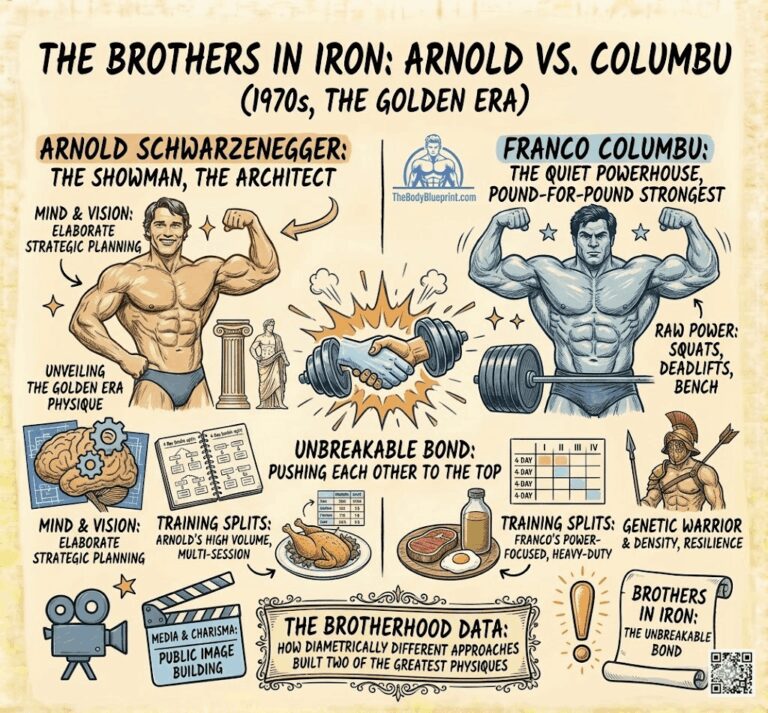
- Franco Columbu: The character actor. 2x Mr. Olympia, Arnold’s training partner and lifelong friend. Franco appeared in “The Terminator,” “Conan the Barbarian,” and “Pumping Iron.” He was the reliable sidekick, smaller than Arnold but arguably more shredded. His drop sets for hypertrophy were legendary in the Gold’s Gym days.
- Mike Mentzer: The philosopher. Mr. Universe winner, but never a mainstream film actor. Mentzer appeared in documentaries and training films, but his legacy is the Heavy Duty system, not the silver screen. His full body vs. split routines debate still rages in gyms today.
- Serge Nubret: The dark horse. Mr. Olympia runner-up, French bodybuilder with a massive cult following. He appeared in French films and “Pumping Iron II” but never broke into mainstream Hollywood. His aesthetic, density-focused training is studied in how to build big arms guides worldwide.
- Reg Park: The original. 3x Mr. Universe, Arnold’s idol. Park starred in Italian Hercules films in the 1960s, proving a bodybuilder could carry a movie before Arnold made it look easy. His skinny to strong muscle transformation inspired an entire generation.
The root question: Why did Arnold succeed where others stalled? The answer is not just muscle. It is marketability. Arnold understood that bodybuilding was the product, but he was the brand. Every whey muscle growth guide on your shelf exists because Arnold proved that muscles could be monetized beyond the stage.
The Trade-Offs: Bodybuilding Stardom vs. Hollywood Credibility
Why the Crossover Worked
- Instant physical credibility: No CGI required. A bodybuilder’s physique on screen was a special effect that cost nothing.
- Built-in fanbase: Millions of muscle magazine readers became ticket buyers. The best whey protein post-workout brands of the era sponsored the same guys appearing in theaters.
- Discipline transfer: The work ethic required for 6-hour training sessions translated directly to 18-hour filming days. Bodybuilders were the most durable actors on set.
- Unique market niche: In the 1980s, action films needed heroes who looked like they could actually hurt someone. Bodybuilders owned that lane.
- Training as marketing: Every magazine feature about their best protein for post-workout habits was free advertising for their next film.
Where the System Failed
- Typecasting trap: Most bodybuilders could only play monsters or strongmen. Dialogue-heavy roles were off the table.
- Linguistic barriers: Thick accents limited range. Arnold worked obsessively to reduce his. Others did not. The best whey protein for recovery cannot fix a delivery that sounds like a cartoon villain.
- Short career windows: Peak physique is time-limited. By 40, most bodybuilders lose the proportions that made them visually stunning.
- Industry skepticism: Directors and producers viewed bodybuilders as novelties, not actors. Arnold had to prove himself over a decade before the industry took him seriously.
- Physical toll: Maintaining contest-ready conditioning while filming 12-hour days is nearly impossible. Many muscle recovery tools on the market today exist because of the demands these actors faced.
Eras Compared: The Golden Age Then and the Modern Crossroads Now
The 1970s and 1980s crossover model relied on physical mass, magazine exposure, and the novelty of seeing a living statue move on screen. The modern era requires Instagram followers, acting training, and a willingness to be a character rather than a spectacle.
| Factor | Golden Era (1970s–1980s) | Modern Era (2010s–Present) |
|---|---|---|
| Primary exposure | Magazine covers, documentaries | Instagram, YouTube, TikTok |
| Entry role type | Monster, strongman, barbarian | Action hero, superhero, or comic relief |
| Required physique | Massive, blocky, intimidating | Lean, vascular, aesthetically pleasing |
| Training style | High volume, heavy compounds | Periodized, functional, often with best high EPA fish oil supplements |
| Career ceiling | Arnold (global superstar) | Alan Ritchson (Reacher, DC) |
| Longevity factor | Short (limited by physique maintenance) | Potentially longer (acting skills matter more) |
The takeaway is brutal but clear: Arnold was a once-in-a-generation talent. He had the physique, the charisma, the work ethic, and the timing. The Golden Era produced many great bodybuilders. It produced exactly one global movie star.
Modern bodybuilders trying to crack Hollywood face a different landscape. The whey vs. whole food post-workout debate matters less than whether you can cry on command. The industry has evolved. The mass-monster look is no longer an automatic ticket to casting calls.
FAQ
- Why did Arnold succeed in Hollywood when other bodybuilders failed?
- Arnold combined peak physique with peak charisma, a rare overlap. He learned English obsessively, took acting lessons, and understood that the camera rewards personality, not just mass. He also had the timing of the action-film boom on his side. His training periodization for muscle and strength was matched only by his career periodization.
- Did Lou Ferrigno ever get a speaking role as the Hulk?
- No. The Hulk was a non-speaking role in the TV series. Ferrigno grunted, roared, and smashed. He did eventually speak as the Hulk in animated series, but the live-action Hulk remained silent. His physicality was the entire performance, a testament to the whey protein concentrate powders that fueled his massive frame.
- What was the first film to feature a bodybuilder as a lead?
- Reg Park’s Italian Hercules films in the early 1960s are widely considered the first. Park was a 3x Mr. Universe and Arnold’s childhood idol. Those low-budget sword-and-sandal epics proved a bodybuilder could carry a film. Park’s methods are still referenced in best whey protein post-workout discussions for their emphasis on whole-food recovery.
- Did “Pumping Iron” directly lead to Arnold’s film career?
- Yes, indirectly. The documentary introduced Hollywood to Arnold’s personality. Industry insiders saw that the Mr. Olympia could be funny, articulate, and camera-ready. Without “Pumping Iron,” there is no “Conan the Barbarian.” The film remains essential viewing for anyone interested in building muscle without a gym, thanks to its raw, unfiltered training footage.
- Are any Golden Era bodybuilders still acting today?
- Arnold is the only one with a consistent modern acting career, though he has shifted to streaming and franchise cameos. Lou Ferrigno makes occasional appearances. Most Golden Era bodybuilders transitioned to training, supplement branding, or fitness event appearances. The endurance required for a modern arm training recovery strategies routine is no match for the endurance required to sustain a 40-year film career.
Final Verdict: The Stage Was the Launchpad, but the Screen Was the Destination
Golden Era bodybuilders proved that a world-class physique was not just a trophy on a shelf. It was a marketable asset that could command millions of dollars and global attention. Arnold Schwarzenegger remains the only bodybuilder to achieve true A-list Hollywood stardom, but the path he carved changed fitness culture forever. Every Instagram fitness influencer with a camera phone owes a debt to the men who first proved that muscles look good on film.
The legacy is not just cinematic. It is behavioral. The discipline required to train for the Mr. Olympia stage, the progressive overload, the exacting nutrition, the mental fortitude, turned out to be perfect preparation for the grind of film production. The same qualities that built a champion built a career.
Modern lifters can learn from this crossover in a specific way. Your physique is not just for you. It is a communication tool. It signals discipline, strength, and presence. The men who became stars understood that their bodies were their résumés. Whether you are pursuing best fast-digesting protein for muscle gains or the perfect split routine, remember that the goal is not just size. It is the story your physique tells when you walk into a room.
The Golden Era is over. But its lessons are permanent. Train like the stage is a screen. Recover like the next scene depends on it. And when the camera points at you, be ready to deliver.
From Stage to Screen: The Blueprint That Changed Fitness Forever
Seven Mr. Olympia titles. A once-in-a-generation crossover. Zero shortcuts. The Golden Era bodybuilders proved that the gym is the best acting school in the world.
*Price and availability subject to change. Verify on the live listing. This article is for informational purposes and does not constitute career, medical, or financial advice. Results vary.
The Lexicon: Golden Era Hollywood Edition
- The Crossover
- The transition from competitive bodybuilding to mainstream acting, most famously executed by Arnold Schwarzenegger. A rare feat that requires physique, charisma, timing, and relentless work ethic.
- Typecast Physique
- A body that audiences and casting directors associate exclusively with strongman, monster, or action roles. Lou Ferrigno was typecast as the Hulk. Arnold broke the typecast by proving he could do comedy.
- The “Pumping Iron” Effect
- The phenomenon where a documentary or behind-the-scenes exposure reveals a bodybuilder’s personality, leading to broader career opportunities. The film that turned muscles into charisma.
- Physical Credibility
- The audience’s instinctive belief that an actor could actually perform the physical feats shown on screen. Bodybuilders had it automatically. CG actors have to earn it.
- Muscle Memory (Career Context)
- The ability to return to a peak physique after a period of reduced training, often required for sequels or franchise reboots. Arnold’s return for “Terminator: Dark Fate” required months of targeted arm training mistakes to avoid preparation.