Sergio Oliva wasn’t just a bodybuilder. He was a genetic anomaly. The Cuban immigrant who walked into a Chicago gym and walked out as the only man to beat Arnold Schwarzenegger on an Olympia stage, twice. His training wasn’t fancy. It was brutal, intuitive, and built on a foundation of pure power. This guide strips down the Oliva method. No myths. Just the iron truth on how “The Myth” built a physique that still haunts the sport.
Medical Disclaimer: This guide is for educational purposes. The statements regarding any supplements have not been evaluated by the Food and Drug Administration. These products are not intended to diagnose, treat, cure, or prevent any disease. Always consult a qualified professional before starting a new regimen.
Sergio Oliva: The Myth, The Genetic Marvel
Born in Cuba, forged in Chicago. Sergio Oliva escaped Castro’s regime, worked as a foundry laborer, and walked into a gym where he discovered his purpose. Within years, he became Mr. Olympia three times (1967–1969), and the only man to defeat Arnold Schwarzenegger in a direct Olympia showdown—twice.
His physique was almost inhuman. Wide shoulders, a narrow waist, and muscle bellies so full they looked inflated. He had the complete package before “complete” was a category. Arnold famously said, “I looked at Sergio and thought, ‘How am I going to beat that?’”
For a full overview of his Olympia reign, see Sergio Oliva’s Mr. Olympia legacy. To understand why he was called “The Myth,” read the myth of Sergio Oliva.
“Sergio was built like a comic book character come to life. His muscle insertions were perfect, his shape was flawless, and his strength was freakish. He didn’t need to pose; he just had to stand there.”
Charles Damiano, B.S. Clinical Nutrition
The Oliva Training Philosophy: Brutal Simplicity
🔬 The Myth’s Method™
Low volume. High intensity. Heavy basics. Sergio trained like a powerlifter who happened to have perfect genetics. He didn’t believe in endless sets or “muscle confusion” gimmicks. He focused on compound movements, pushed them heavy, and got out of the gym.
His typical workout lasted 45–60 minutes. He used a 4‑day split, often training chest/shoulders, back, legs, arms, with occasional doubles. He didn’t track reps meticulously—he went by feel, stopping when the muscle was fully worked. For a deeper dive into Golden Era training splits, see bro splits of the Golden Era.
The Iron Arsenal: Sergio’s Go‑to Movements
Sergio didn’t waste time on machines or cables. He lived in the free‑weight section, using heavy barbells and dumbbells. His exercises were simple, but his execution was perfect.
| Body Part | Key Exercise | Why Sergio Used It | Sets/Reps (Typical) |
|---|---|---|---|
| Chest | Incline Barbell Press | Built his massive upper chest. He believed the incline was superior for overall chest development. | 4 x 6‑8 |
| Shoulders | Behind‑the‑Neck Press | Developed his legendary shoulder width. (Modern caution: requires good mobility.) | 4 x 6‑8 |
| Back | Barbell Rows | Thickness and width. He used a heavy, explosive row with a controlled negative. | 4 x 8‑10 |
| Legs | Squat (Full Depth) | Built his powerful thighs. He squatted deep, often with heavy weight for low reps. | 5 x 5‑6 |
| Arms | Standing Barbell Curl / Close‑Grip Bench | Basic, heavy movements built his 19‑inch arms without isolation fluff. | 3‑4 x 8‑10 |
For more on the classic compound lifts that built the Golden Era, see our guides on compound exercises for mass and barbell deadlifts.
The Myth’s Workout: A Sample Training Day
Sergio’s training was flexible, but a typical chest/shoulders day looked like this:
- Incline Barbell Press: 4 x 6‑8. Warm up gradually. Focus on a full stretch and controlled reps.
- Behind‑the‑Neck Press: 4 x 6‑8. Use a shoulder‑width grip. Keep the bar in a straight line.
- Dumbbell Lateral Raises: 3 x 8‑10. For side delt width. Sergio used heavy weight but strict form.
- Parallel Bar Dips: 3 x to failure. Bodyweight or added weight. Chest emphasis.
Progression: Sergio didn’t obsess over progressive overload on paper, but he consistently tried to add weight or reps. He believed in listening to the body—pushing hard when strong, backing off when joints screamed. For a modern take on progression, see progressive overload principles.
Eating Like a Myth: Sergio’s Diet
Sergio ate like a laborer—because he was one. His Cuban background influenced his diet: rice, beans, eggs, chicken, and plenty of steak. He wasn’t a supplement guy. He believed in real food and massive portions.
A typical day included:
- Breakfast: 6–8 eggs, oatmeal, fruit
- Lunch: Steak or chicken, rice, beans, vegetables
- Dinner: Similar to lunch, often with more protein
- Between meals: Protein shakes (milk, eggs, fruit) blended at home
He ate 5–6 meals a day to maintain his 220‑230 pound stage weight. For a broader look at Golden Era nutrition, see Golden Era diet principles and diets of legendary bodybuilders.
Legacy: The Man Who Made Arnold Nervous
Sergio Oliva’s legacy is complicated. He was the first great mass monster, the bridge between Reg Park’s era and Arnold’s. He possessed a physique that many still consider the best in bodybuilding history—in terms of pure shape and proportion.
But he never achieved the mainstream fame of Arnold. He lacked the marketing machine, the Hollywood smile, the political savvy. Yet, in the gym, he was untouchable. His three Mr. Olympia titles (1967–1969) and his victory over Arnold in 1969 remain legendary. For a detailed account, read Arnold as Golden Era king and the myth of Sergio Oliva.
“When Sergio walked on stage, you knew you were in the presence of something special. He had the kind of muscle shape that doesn’t come from training—it comes from God.”
Charles Damiano, B.S. Clinical Nutrition
Sergio Oliva Training: The Raw Truth
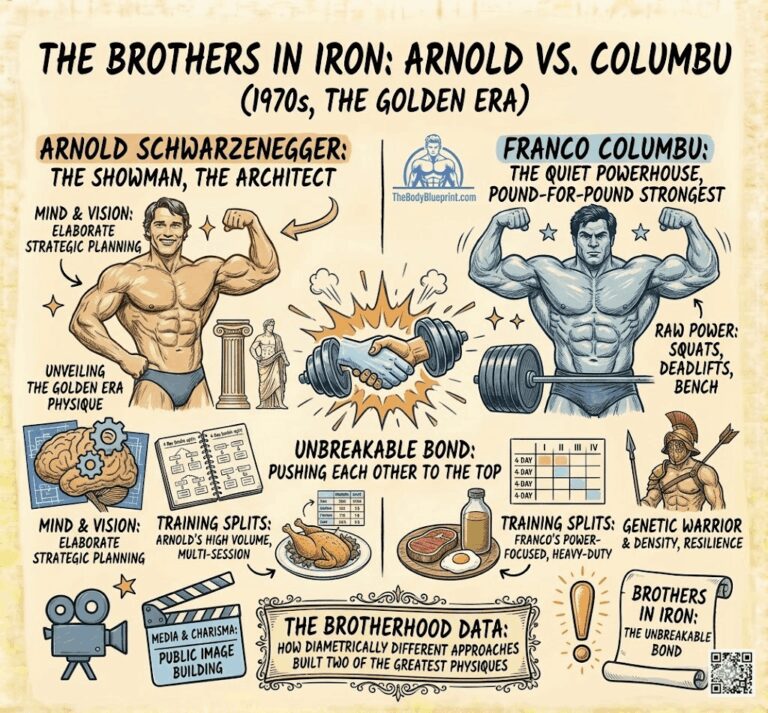
A: Arnold used higher volume, double splits, and a more varied approach. Sergio kept it simple—fewer exercises, heavier weights, and a focus on basic compound movements. Arnold was a sculptor; Sergio was a blacksmith.
A: Like almost all competitive bodybuilders of the era, yes. But his genetic response was extraordinary. The same drugs used by his peers didn’t produce the same results. His unique muscle insertions and shape were genetic gifts.
A: His core principles—heavy compound lifts, low volume, high intensity—are timeless. But avoid behind‑the‑neck pressing if you have shoulder issues. Adapt his philosophy to modern joint safety. See old‑school vs. modern training.
A: His chest and shoulders were legendary. The combination of a wide clavicle, full muscle bellies, and low body fat made his upper body look like a comic book illustration. Some argue his back was underrated.
Final Verdict: The Myth Stands Alone
Sergio Oliva proved that genetics can’t be outworked, but they also can’t be ignored. He trained hard, ate big, and relied on the basics. His legacy is a reminder that sometimes the simplest approach—when paired with freakish genetics—produces the most awe‑inspiring results.
For the average lifter, his methods offer a blueprint: focus on heavy compounds, don’t overcomplicate your workouts, and let progressive overload do its job. You won’t become Sergio—no one will—but you’ll build real, functional muscle.
Train like Sergio if: You want to strip away fluff and focus on heavy basics. You believe in low‑volume, high‑intensity training. You have healthy joints and a willingness to push compound lifts.
Skip this if: You prefer machine‑based training, need higher volume to stimulate growth, or have mobility restrictions that make certain free‑weight movements unsafe.
For more insights on training like the legends, explore our Golden Era bodybuilding guide and icons of strength from the 1950s‑1980s.
The Bottom Line: Simplicity, Intensity, Consistency.
Sergio Oliva didn’t need gimmicks. He used heavy weights, basic exercises, and a relentless work ethic. Apply that same mindset to your training—not to be Sergio, but to become the best version of yourself. The iron doesn’t care about your excuses.
The Supplement Lexicon: Myth Edition
- The Myth
- Sergio Oliva’s nickname, earned for his seemingly impossible physique. He was called “The Myth” because many doubted such a physique could exist.
- Compound Movement
- An exercise that engages multiple joints and muscle groups. Sergio’s training was built on these—squats, presses, rows, deadlifts.
- Behind‑the‑Neck Press
- An overhead press variation where the bar is lowered behind the head. Popular in the Golden Era for shoulder width, but requires good mobility to avoid impingement.
- Full Squat
- Descending until the hip crease is below the top of the knee. Sergio squatted deep to build his powerful thighs.
- Golden Era
- The period from roughly 1960–1980 when bodybuilding gained mainstream attention, characterized by aesthetic physiques and the rise of icons like Sergio and Arnold.