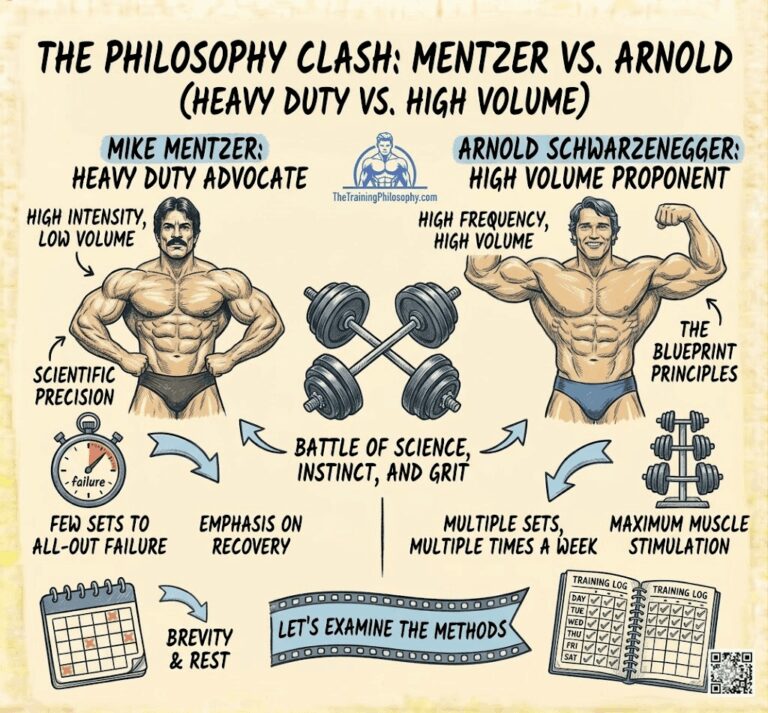
Arnold Schwarzenegger, Reg Park, and Frank Zane built Mr. Olympia physiques on whole eggs, steak, full-fat dairy, and zero macro-tracking apps. Modern bodybuilding diets run on whey isolate, carb cycling, and a supplement spreadsheet that needs its own filing system. The tools changed. The question is whether the results improved or just the complexity did.
Editorial Disclosure: We compare and analyze published training, historical bodybuilding frameworks, and nutritional methodologies objectively rather than write motivational fluff. This educational review contains internal reference links to our structured guides and contains no commercial affiliate product links.
Health & Safety Disclaimer: This content is strictly for informational and entertainment purposes. Consult a qualified medical or nutrition professional before making any changes to your diet, training, or supplement regimen. Statements regarding dietary supplements have not been evaluated by the FDA and are not intended to diagnose, treat, cure, or prevent any disease or health condition.
Old-School Diet Architecture: Whole Eggs, Fatty Steak, Full-Fat Milk, and Zero Tracking Apps
Whole eggs, ribeye steak, full-fat cottage cheese, whole milk, butter, potatoes, and oatmeal formed the nutritional backbone of golden-era bodybuilding, and not a single gram was weighed on a digital scale. The old-school diet operated on three principles: eat real food, eat enough of it to fuel the training, and repeat. No macro spreadsheet. No carb-cycling calendar. No myfitnesspal notification interrupting dinner. The approach was simple enough to explain in ten words and hard enough to execute consistently that most people never did. The ones who did — Arnold, Zane, Park, Reeves — built physiques that still hold up against modern competitive standards.
- Protein Came From Animals, Not Tubs: Steak, whole eggs, chicken, fish, and cottage cheese were the primary protein vehicles. A dozen eggs a day was not a headline. It was breakfast. The yolk was not the villain in 1965 because no one had invented a reason to fear it yet.
- Dietary Fat Was Not a Boogeyman: Butter, heavy cream, fatty cuts of red meat, and whole milk were staples. Fat was understood as a structural requirement for hormone production and energy density. Nobody was separating yolks. Nobody was trimming every millimeter of fat off a ribeye. They ate the whole animal because the whole animal had the nutrients.
- Carbohydrates Were Consistent, Not Cycled: Potatoes, rice, oatmeal, and whole-grain bread supplied the glycogen that heavy squat sessions demanded. No carb-cycling protocol. No three-day depletion phase followed by a refeed. Just consistent intake matched to training volume.
- Meal Frequency Was 3-4 Large Feedings: Breakfast, lunch, dinner, and sometimes a fourth meal. No six-meal Tupperware spread. No alarm going off every two-and-a-half hours reminding you to eat another chicken breast. They ate when hungry and trained when fresh.
“Vince Gironda called the modern bulk-cut cycle a ‘metabolic ransom note.’ His point was not that calories do not matter. His point was that if you have to starve yourself into shape after every off-season, your off-season diet was the problem, not the solution. Old-school bodybuilders stayed within striking distance of contest shape year-round by eating real food in real amounts every single day.”
Modern Bodybuilding Diet Architecture: Macro Precision, Carb Cycling, and the Supplement Spreadsheet
Chicken breast, egg whites, whey protein isolate, white rice, and precisely weighed avocado grams define the modern bodybuilding nutrition stack, where every macronutrient is tracked to the decimal and meal timing operates on a by-the-hour protocol. The modern approach is not wrong. It is different, built on a level of nutritional precision that was not possible before digital food databases and affordable supplement manufacturing. The question is whether the additional complexity produces proportionally better results, or whether it mostly produces more things to optimize and more anxiety about whether you are optimizing them correctly.
- Lean Protein Dominance: Chicken breast, 99% lean turkey, egg whites, and whey isolate replaced steak, whole eggs, and whole milk as the default protein sources. The fat was stripped out and sold separately as fish oil softgels. Efficient. Also ironic.
- Carb Cycling as Default Strategy: High-carb training days, low-carb rest days, moderate-carb everything-else days. Glygogen is manipulated like a bank account with daily deposits and withdrawals. Effective for contest prep. Exhausting for everyday life.
- Five to Seven Meals Per Day: The six-meal spread became industry standard — breakfast, mid-morning, lunch, pre-workout, post-workout, dinner. More meals means more opportunities to hit protein targets. It also means more Tupperware and more time spent chewing.
- Supplementation at Scale: Whey isolate, casein, creatine monohydrate, BCAAs, EAAs, pre-workout, intra-workout, post-workout, fish oil, vitamin D, magnesium, zinc. The modern supplement shelf has more SKUs than a small pharmacy. Some of them earn their spot. Many do not.
- Pre-Contest Extremes: Carb depletion, water loading, sodium manipulation, and peak-week protocols that look like a chemistry experiment more than a meal plan. The old-school approach was “eat slightly less for a few weeks.” The modern approach is a multi-phase protocol with spreadsheets and checklists.
“The modern bodybuilding diet has a funny problem. It solved for precision and accidentally created fragility. When you track every gram, you can optimize every gram. But when you track every gram, you also stress about every gram. Old-school lifters stressed about the weight on the bar, not whether their avocado was exactly 28 grams. Sometimes the mental load of precision costs more than the nutritional benefit it delivers.”
Head-to-Head Spec Sheet: Old-School vs Modern Bodybuilding Diets
| Aspect | Old-School (1950s-1970s) | Modern (2000s-2026) |
|---|---|---|
| Protein Sources | Whole eggs, steak, full-fat milk, cottage cheese | Chicken breast, egg whites, whey isolate, casein |
| Carbohydrate Strategy | Consistent, moderate (oats, potatoes, rice, bread) | Carb cycling: high, low, and moderate days programmed |
| Dietary Fat | Butter, cream, fatty meats, whole milk, egg yolks | Measured avocado, nuts, olive oil, fish oil softgels |
| Meal Frequency | 3-4 meals per day | 5-7 meals per day, timed to the hour |
| Supplement Count | 3-4 products (liver tablets, milk protein, multivitamin) | 10-20+ products (pre, intra, post, health, performance) |
| Pre-Contest Method | Slight carb and fat reduction, maintain training intensity | Carb depletion, water loading, sodium manipulation, peak week |
| Tracking Method | Mirror, tape measure, strength benchmarks | Macro apps, food scales, DEXA scans, HRV wearables |
| Food Philosophy | Eat real food. Eat enough. Repeat. | Track every gram. Optimize every variable. Adjust weekly. |
Old-school wins on simplicity, sustainability, and mental bandwidth. Modern wins on precision, contest-peak optimization, and the ability to fine-tune body composition to levels that were not possible in 1970. Pick the column that matches your goal. Neither column is wrong. But one column takes about ten fewer hours of mental energy per week.
Old-School Principles That Still Win: Whole Food, Caloric Sufficiency, Protein Quality
Whole-food protein sources, caloric sufficiency over micro-optimization, and dietary fat from animal sources are three old-school nutritional principles that the published evidence still supports more strongly than most modern supplementation protocols. The golden-era approach was not perfect. But several of its core principles have aged better than the low-fat, high-carb, egg-white-only era that followed it. Here is what still applies and what you can steal without buying a time machine.
Whole Foods Beat Processed Every Time
Steak, eggs, potatoes, oats, and full-fat dairy are single-ingredient foods with complete amino acid profiles, bioavailable micronutrients, and zero grams of marketing per serving. Whole-food protein sources deliver cofactors — iron, zinc, B vitamins, fat-soluble vitamins — that isolated protein powders leave behind. Whey isolate is 90% protein by weight and roughly 0% micronutrient density. Steak is lower protein percentage but carries heme iron, creatine, zinc, and B12 in the same package. The label math favors whey. The nutritional density favors steak.
Caloric Sufficiency Matters More Than Macro Precision
The old-school approach prioritized eating enough total calories to support training and recovery over hitting a perfect 40-40-20 macro split. A caloric surplus from whole food builds mass even when the macro ratios are not optimized to the gram. Precision is a luxury. Sufficiency is a requirement. You can build an impressive physique on three meals of steak, potatoes, and vegetables without ever opening a tracking app. You cannot build one on perfectly-tracked macros that total 1,800 calories.
Protein Quality Over Protein Supplement Volume
Old-school lifters valued complete protein sources — whole eggs, milk, meat — that deliver all essential amino acids in bioavailable form. They did not have hydrolyzed whey isolate or precise amino acid profiles printed on a tub. What they had was eggs and steak, which happen to have some of the most favorable amino acid profiles in the food supply. Sometimes the best supplement is the one that existed before supplements existed.
The GOMAD reality check: The Reg Park gallon-of-milk-a-day protocol worked for Reg Park because Reg Park squatted 500 pounds for reps and had the recovery capacity of a mythological figure. It is not a current nutritional recommendation. What it demonstrates — that caloric surplus from nutrient-dense whole foods drives mass gain — is the timeless principle. Steal the principle. Leave the gallon of milk to the genetic outliers.
Old-School Foods Worth Adding to a Modern Diet
Whole eggs, red meat, full-fat cottage cheese, steel-cut oats, and whole milk are five golden-era staples that plug into a nutrition plan without requiring a vintage wardrobe change. These foods are nutrient-dense, widely available, and cost-effective per gram of usable protein. They also taste better than an unflavored scoop of milk-and-egg powder from 1968, which is a low bar but worth acknowledging.
- Whole Eggs: Six grams of complete protein per egg, plus choline, vitamin D, and healthy fats. The yolk has the nutrients. The white has the protein. Eating both is not a compromise. It is the whole point.
- Red Meat: Heme iron, creatine, zinc, B12, and a full amino acid profile in a single ingredient. A ribeye and a scoop of whey isolate both deliver protein. Only one delivers carnosine precursors, carnitine, and bioavailable iron.
- Full-Fat Cottage Cheese: Slow-digesting casein protein ideal for overnight amino acid delivery. The old-school approach to bedtime protein intake was a bowl of cottage cheese, not a flavored casein shake. Both work. One existed before 1990.
- Steel-Cut Oats: A slow-digesting carbohydrate that supplies steady glycogen without the insulin spike of refined grains. The same oat source that fueled golden-era training sessions. The oats did not change. The marketing around them did.
- Whole Milk: Complete protein, calcium, and fat-soluble vitamins in liquid form. Skim milk removes the fat and half the nutritional justification. The golden-era lifters drank it whole because that is how milk comes out of the cow.
Bridging Old and New: Whole-Food Foundation, Modern Precision on Top
Using whey protein as a convenience tool rather than a meal replacement, moderating carb intake around training sessions, and keeping dietary fat from whole-food sources are three ways to weld old-school principles onto a modern nutrition structure. You do not have to pick a side. You can build a nutrition architecture that steals the best of both eras while discarding the baggage neither era has fully shed.
- Whole Food Base, Powder as Supplement: Build meals around steak, eggs, potatoes, and vegetables. Use whey protein to fill gaps, not to replace whole-food meals. The powder is the tool. The plate is the foundation. Do not confuse the two.
- Carb Timing Without Carb Obsession: Consume carbohydrates around training when glycogen demand is highest. Do not build a seven-day carb-cycling spreadsheet unless you are stepping on stage. Most people do not need carb cycling. Most people need consistent carb intake and consistent training.
- Dietary Fat From Food, Not Just Softgels: Eat whole eggs, cook with butter, include fatty fish. Take fish oil as insurance, not as the primary fat source. Omega-3 softgels are a supplement. A salmon fillet is a meal. The meal wins.
- Three to Four Meals Works for Most People: The science does not support the six-meal mandate as categorically superior for body composition. Eat when it fits your schedule. Hit your protein and calorie targets over the day. The timing window is wider than the supplement industry wants you to believe.
Old-School vs Modern Diet FAQ
- Did old-school bodybuilders eat the egg yolk or just the white?
- The whole egg, every time. The yolk was respected for its cholesterol content, which supports testosterone production, and its full fat-soluble vitamin profile. Egg-white-only culture arrived decades later when dietary fat became the villain. Golden-era lifters ate the whole egg because the whole egg is the nutrient-dense package. They were right.
- What role did desiccated liver tablets actually play?
- Liver tablets supplied heme iron, B vitamins, and amino acids in a concentrated form. Larry Scott famously took dozens daily. They were the closest thing to a performance supplement the golden era had. A historical curiosity now, replaced by modern B-complex and iron formulations that taste less like a barnyard.
- Why did old-school bodybuilders drink whole milk instead of skim?
- Because skim milk was not widely available, and fat was not a dietary villain yet. Whole milk delivers fat-soluble vitamins A and D, conjugated linoleic acid, and a favorable protein-to-energy ratio for mass gain. Skim milk is protein water. Whole milk is a meal. Different tools for different goals.
- Did old-school bodybuilders track calories?
- No. They tracked the mirror, the tape measure around the waist, and the weight on the bar. If the waist stayed tight and the squat climbed, the diet was working. Three data points. Zero apps. It worked because the diet was built on whole foods that are difficult to overeat.
- How did they handle hydration without electrolyte supplements?
- Water, whole milk, fruit juice, and potassium-rich whole foods like bananas and potatoes. They also salted their food liberally because sodium was understood as essential for muscle contraction, not as a dietary enemy. No electrolyte tablets needed. A salted potato and a glass of water covered the bases.
- Did old-school bodybuilders use intermittent fasting?
- No. Intermittent fasting was not part of the golden-era playbook. They prioritized consistent meal frequency to keep amino acids circulating and energy available for training. Breakfast was steak and eggs, not black coffee and a twelve-hour waiting window. Different era, different priorities, different tool for a different job.
- Why did old-school diets include so much red meat?
- Red meat is a complete protein source with heme iron, creatine, carnitine, zinc, and B12 — all in one ingredient, no processing required. It was also affordable relative to other protein sources at the time. Modern bodybuilding replaced red meat with chicken breast and whey isolate, then added creatine, zinc, and B12 back as separate supplements. Efficient. Also circular.
- How did they manage digestive health without probiotic supplements?
- Fermented foods like yogurt, kefir, and sauerkraut, plus whole-food fiber from vegetables and oats. They also chewed their food thoroughly, which sounds like a joke but is not. Digestion starts in the mouth. Chewing is the free digestive aid nobody uses because nobody has time, and yet somehow the golden-era guys found the time.
Final Verdict: Whole Food Won Then. Whole Food Still Wins Now.
Old-school bodybuilding diets built legendary physiques on steak, whole eggs, full-fat dairy, potatoes, and oats — a whole-food architecture that required no macro tracking, no carb cycling, and no supplement spreadsheet, and the core principles still apply because the human digestive system did not get a software update. Modern precision nutrition adds tools that the golden era did not have. Whey isolate makes hitting high protein targets easier. Creatine monohydrate is the most researched performance supplement available. Macro tracking provides data that a tape measure cannot. But the foundation — whole-food protein, caloric sufficiency, dietary fat from real sources, and consistent meal structure — never changed because the biology never changed. The apps got better. The steak stayed the same.
What to steal from the old-school playbook and apply today:
- Build meals around whole-food protein sources. Steak, eggs, chicken, fish, and dairy first. Protein powder fills gaps, not meals.
- Eat enough total calories to support training. Precision is a luxury. Sufficiency is a requirement. You cannot optimize what you are not eating enough of.
- Do not fear dietary fat from whole food. Egg yolks, butter, fatty meat, and whole milk are not the enemy. They are the delivery system for fat-soluble vitamins and hormone precursors.
- Keep the supplement shelf small. If the golden era built Mr. Olympia physiques on three products, you probably do not need seventeen. Add only what fills a documented gap.
- Track the mirror and the barbell before the app. If the waist is tightening and the squat is climbing, the nutrition is working. The data confirms what the mirror and the bar already told you.
Steak, Eggs, Potatoes, and Oats. The Golden-Era Grocery List Still Works.
The apps and the powders got better. The whole-food foundation never needed an update. Eat real food. Eat enough. Train hard. The formula did not change.
*This content is for historical, informational, and entertainment purposes only and does not constitute medical advice. Consult a qualified professional before changing your diet, exercise, or supplement regimen. Statements regarding dietary supplements have not been evaluated by the FDA and are not intended to diagnose, treat, cure, or prevent any disease.
The Nutrition Lexicon: Old-School vs Modern Edition
- Complete Protein
- A protein source containing all nine essential amino acids in sufficient quantities. Whole eggs, red meat, milk, and fish qualify. Whey isolate qualifies. Old-school lifters ate complete proteins because that is what food provides. They did not need the term because the food selection made the term redundant.
- Desiccated Liver Tablets
- Dehydrated animal liver compressed into tablet form. Dense in heme iron, B vitamins, and amino acids. A staple of the golden-era supplement shelf. Replaced by modern B-complex and iron supplements that do not require overcoming the taste of dehydrated organ meat.
- Carb Cycling
- A modern strategy that manipulates carbohydrate intake across days — high on training days, low on rest days — to optimize glycogen storage and body composition. Effective. Also exhausting to maintain for months. The old-school approach of consistent moderate carbs plus consistent hard training produced similar results with less mental math.
- GOMAD (Gallon of Milk a Day)
- A mass-gain protocol combining a gallon of whole milk with heavy compound lifting. Popularized by Reg Park. A historical case study in caloric surplus, not a dynamic modern nutritional protocol. The principle is timeless. The lactose tolerance is not.
- Macronutrient Tracking
- The modern practice of measuring protein, carbohydrate, and fat intake in grams, usually via a digital food database. Useful for contest prep. Overkill for the average lifter eating whole foods consistently.
- Fermented Foods
- Yogurt, kefir, sauerkraut, and similar products containing natural probiotics that supported gut health before probiotic capsules existed. The old-school digestive support was food. The modern version is a capsule. Both work. One also tastes like something.