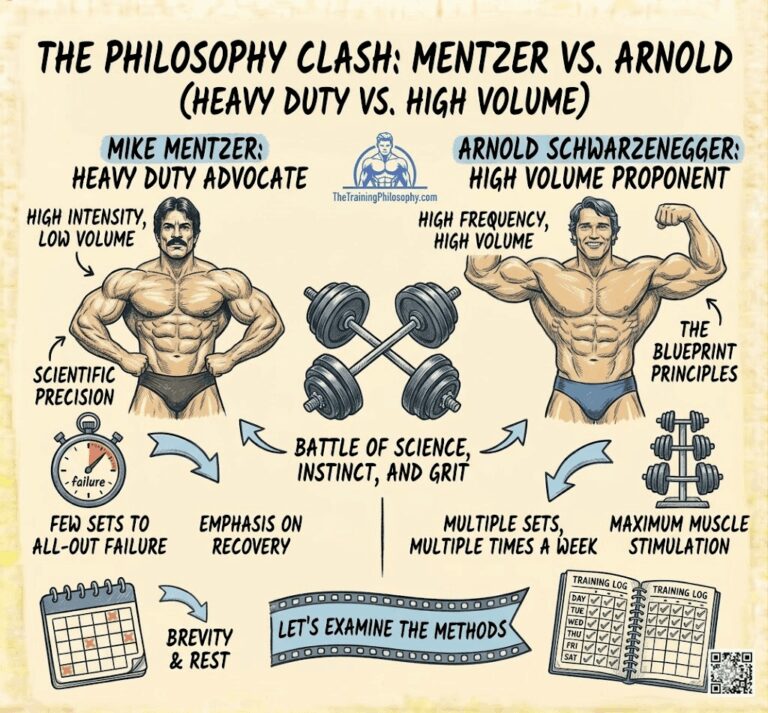
Golden-era bodybuilders like Arnold Schwarzenegger and Franco Columbu competed at an estimated 7-10% body fat with dense, rounded muscle bellies, while modern physiques push sub-5% leanness with nitric-oxide-driven vascularity. The difference is not genetics. It is training philosophy, nutritional strategy, and judging criteria that shifted in the 1990s. We compare the published methods so you can see exactly which aesthetic fits your goals.
Affiliate Disclosure: This article contains affiliate links. As an Amazon Associate, I earn from qualifying purchases at no extra cost to you. We compare and analyze published methods rather than write advertorial fluff.
The Aesthetic Specs: Body Fat, Carbs, and the Vein Equation
Golden-era physiques operated at a conditioned 7-10% body fat with moderate carbohydrate intake and functional hypertrophy, while modern competitors push 4-7% leanness with intense carb-depletion protocols and nitric oxide boosters. The veins snaking across today’s arms are not a sign of superiority. They are a sign of a different game. One prioritizes fullness and strength. The other prioritizes dryness and definition.
- Body Fat Percentage: The golden-era stage standard was roughly 7-10%. That is lean by any normal measure, allowing muscles to look full, rounded, and dense. The modern standard is 4-7%. That is stage-ready for today’s eyes—completely shredded. Fat layers act like velvet drapes over vascularity. Remove the drapes completely, and the deep veins appear.
- Carbohydrate Intake: The old-school approach was moderate carbs with a focus on whole foods. Intramuscular glycogen stores plump muscle bellies and slightly mask superficial veins. The modern approach uses aggressive carb timing and depletion protocols. Strip the glycogen, clear the water, and the veins pop. Carbs are a double-edged sword. They fuel growth but hide extreme definition.
- Sodium Management: The golden-era diet avoided ultra-processed options, which naturally restricted systemic sodium retention. Excess sodium pulls water under the skin, blurring fine vascular lines. The modern approach manipulates sodium strategically—loading and then depleting pre-show to create a dry, paper-thin look. It is an exact science. It is also a logistical headache.
- Nitric Oxide Boosters: The old-school supplement stack was basic: liver tablets, raw milk, and simple aminos. The modern stack includes citrulline malate, beetroot extract, and arginine—all designed to force blood into every capillary. Pre-1990s, these were not in play. Now they are standard.
- Training Focus: The golden-era emphasis was strength and symmetry. Heavy compound lifts and functional hypertrophy built mountains. The modern emphasis is hyper-definition and localized pump work. High reps, drop sets, and isolation movements carve them out.
Think of it this way: Old-school physiques are like marble statues—thick, dense, and timeless. Modern physiques are like anatomy charts—every vein, every striation, every fiber laid bare. Neither is “better.” They are just different aesthetics built by different methods. Your job is to pick the one that matches your goals.
Who It’s For
The old-school aesthetic fits the strength-focused lifter who wants functional muscle and year-round sustainability, and it repels the competitor who needs stage-ready dryness or the health-conscious individual who values longevity over extremes. Find your row.
- The Strength-Focused Lifter: Wants functional hypertrophy and raw power. The golden-era approach prioritizes heavy compounds and muscle fullness over shredded veins. You lift to be strong, not just to look strong.
- The Sustainable Aesthetic: Wants a physique that is lean but maintainable. 7-10% body fat is achievable year-round for many without the hormone crashes, joint pain, and perpetual hunger of sub-5% leanness. Sustainability is the point.
- The Vintage Enthusiast: Appreciates the classic proportions of the 70s and 80s. Wide shoulders, narrow waist, dense muscle bellies. Think Arnold. Think Franco. Think density over dryness.
- The Performance Athlete: Needs fuel for training, not just a stage look. Carbohydrates are performance. Extreme leanness saps power. Building muscle requires energy, and energy comes from food. You cannot fuel a Ferrari on a teaspoon of gas.
Skip it if you are:
- A competitive bodybuilder: Modern judging criteria reward extreme leanness and vascularity. If you want to win on today’s stage, you need to play today’s game. The old-school look does not win modern open bodybuilding shows.
- An aesthetic maximalist: If your goal is road-map veins and paper-thin skin, the old-school approach will not get you there. You need the modern playbook.
- A beginner: Do not chase vascularity before you have muscle. Vascularity without muscle is just skinny. Build the foundation first. Start with size, then worry about definition.
Pros and Cons
The Advantages
- Sustainable year-round: 7-10% body fat is maintainable without extreme deprivation. No massive hormone crashes or constant starvation.
- Functional strength: Heavy compound lifts build real-world power, not just stage aesthetics.
- Fuller muscle bellies: Adequate glycogen stores plump muscles, creating a denser, more rounded appearance.
- Lower injury risk: Balanced dieting means better joint health, fluid retention, and recovery. Recovery is key.
- Timeless aesthetic: The golden-era look never goes out of style. Thick, dense, and proportional.
The Trade-offs
- Less superficial vascularity: Veins will not pop like modern competitors. That is a byproduct of the body fat level, not a flaw.
- Not competitive on modern stages: Modern open division judging criteria reward paper-thin dryness.
- Less “shredded” appearance: Muscles look full and hard, not strictly cross-striated.
- Requires deep patience: Building dense, functional muscle takes time. No shortcuts. Progressive overload is the path.
The Field: Old-School vs. New-School
Body fat percentage, training focus, and dietary approach separate the two aesthetics. No method wins every column.
| Factor | Old-School (70s-80s) | New-School (90s-Present) | Core Edge |
|---|---|---|---|
| Body Fat | 7-10% | 4-7% | Sustainability vs. definition |
| Training Focus | Strength, symmetry | Hyper-definition, pump | Function vs. aesthetics |
| Diet | Whole foods, moderate carbs | Calculated macros, carb timing | Simplicity vs. precision |
| Supplement Stack | Protein, basics | Citrulline, beetroot, NO boosters | Minimalist vs. maximized |
| Primary Goal | Dense muscle mass | Extreme definition | Size vs. shreds |
Old-school wins on sustainability and functional strength. New-school wins on definition and stage-readiness. Pick the column that matches your goals, not the one that looks coolest on Instagram.
FAQ
- Did old-school bodybuilders avoid cardio to stay less vascular?
- Not exactly. Golden-era lifters used cardio primarily for cardiorespiratory health and baseline caloric output, not extreme fat-stripping. Their focus was heavy lifting and whole food for growth, not hours of daily low-intensity steady-state work. Efficiency was the goal.
- Were there any old-school bodybuilders known for being unusually vascular?
- Yes. Frank Zane and Sergio Oliva had standout vascularity for their era, but it was the exception, not the rule. Their genetics and meticulous conditioning made them outliers in a time when “thick and dense” was the ideal. They were the exceptions that proved the rule.
- Does higher body fat in old-school guys mean they were less healthy?
- Nope. 7-10% body fat is still incredibly lean by normal biological standards—just not stage-shredded by modern extremes. Many modern pros dip into unsustainable, dangerous body fat levels for competition, while old-school conditioning was far more realistic to maintain. Sustainable trumps extreme.
- Did steroids play a role in the shift toward extreme vascularity?
- Indirectly. As the pharmacology evolved, so did the ability to preserve lean tissue while dieting down to record-low body fat percentages. However, the real driver was changing judging criteria—judges started rewarding bone-dry conditioning and paper-thin skin over classic fullness in the 1990s. The sport changed the rules, and the athletes adapted.
- Can you build an old-school physique with today’s training methods?
- Absolutely. Lift heavy, eat for growth, and do not fear carbohydrates. The key difference is intent—old-school training prioritized strength and overall skeletal proportions, not just “getting peeled.” Building muscle follows the same physiological process it always did. The principles do not change. Only the aesthetics.
- Why do some modern lifters still prefer the classic, less-veiny look?
- Because hyper-vascularity is not an indicator of absolute strength. Many powerlifters, strongmen, and functional athletes avoid extreme leanness because it can sap raw leverage, stress joint capsules, and decrease energy levels. For them, performance trumps the stage aesthetic. Training periodization is about performance, not just looks. Function over form.
Final Verdict: Pick Your Aesthetic, Own Your Game
Old-school bodybuilders were not “less dedicated”—they played a different game with different rules, and their 7-10% body fat, functional hypertrophy, and whole-food nutrition produced some of the most iconic physiques in history. Vascularity became an absolute requirement only when the sport’s aesthetic ideal shifted from classical strength to paper-thin anatomy charts. Whether you chase veins or vintage mass, remember: your goals should mirror your values, not just the trends. The gym is a tool. You are the architect. Build accordingly.
Dense Muscle. Sustainable Leanness. Timeless Aesthetics.
The old-school blueprint. Build like a marble statue, not an anatomy chart.
The Lexicon: Golden-Era Edition
- Functional Hypertrophy
- Muscle built for strength and performance, not just aesthetics. Heavy compound lifts, moderate reps, dense muscle bellies.
- Vascularity
- The visibility of veins beneath the skin, driven by low body fat, hydration levels, and nitric oxide. A modern aesthetic priority.
- Body Fat Percentage
- The proportion of fat mass to total body mass. Golden-era: ~7-10%. Modern: 4-7%. The lower the number, the more the veins show.
- Carb Depletion
- A strategy of reducing carbohydrate intake to strip glycogen from muscles, creating a flat, dry, paper-thin look. Used by modern competitors.
- Nitric Oxide (NO) Boosters
- Supplements like citrulline, arginine, and beetroot extract that increase blood flow and vasodilation, enhancing the pump and vascularity.
- Glycogen
- The stored form of carbohydrates in muscle tissue. Plumps muscles, masks veins. Carbs are fuel, not the enemy.
- Drop Sets
- A training technique where you reduce weight mid-set to extend time under tension and increase blood flow. A modern staple for pump and definition. Drop sets for hypertrophy are a proven tool.
Explore more: Dorian Yates Blood and Guts | Build Muscle Guide | Full Body vs Split Routines | Training Periodization | Skinny Guy Muscle Guide | Progressive Overload for Arm Growth | Drop Sets Hypertrophy Guide | Home Workout Equipment Reviews | Best Protein for Post-Workout | Build Muscle Without a Gym | Arm Training Mistakes to Avoid