A Golden Era bodybuilding diet ran on steak and eggs, whole milk, cottage cheese, and canned tuna. Zero whey isolate. Zero pre-workout powders. Zero creatine monohydrate. Arnold Schwarzenegger, Frank Zane, Dave Draper, and Franco Columbu built some of the most aesthetic physiques in history without a single scoop of modern supplementation. We broke down exactly what they ate, when they ate it, and how the Golden Era diet stacks against modern bodybuilding nutrition in 2026.
Overview: What Defined the Golden Era Bodybuilding Diet
The Golden Era bodybuilding diet, roughly 1965 to 1979, was built on whole food protein sources, high saturated fat intake, and zero supplementation. Whey protein isolate did not exist. Creatine monohydrate was not commercially available until 1993. Pre-workout powders were decades away. The only tools a Golden Era bodybuilder had were a stove, a skillet, a fork, and a gallon of whole milk. The physiques that came out of Gold’s Gym Venice under the California sun remain some of the most aesthetic in the sport’s history. For the full story of the era and the men who defined it, read our guide to the Golden Era bodybuilders and the Venice Beach Golden Era.
The Cast Iron Pan vs. The Shaker Bottle Analogy
Golden Era bodybuilders cooked everything in a cast iron pan. Modern lifters shake everything in a plastic bottle. Both approaches build muscle. The difference is nutrient density, satiety, and how many ingredients are listed on the package. Steak has one ingredient. Whey isolate has four. Pick the tool that matches your kitchen and your label standards.
The Core Foods: What Golden Era Bodybuilders Actually Ate
Steak, whole eggs, whole milk, cottage cheese, canned tuna, chicken breast, white rice, potatoes, oatmeal, and liver tablets were the ten foods that built nearly every Mr. Olympia physique from 1965 to 1979. There were no protein bars. No mass gainer shakes. No BCAAs. Every gram of protein came from a whole food source. Every gram of carbohydrate came from rice, potatoes, oatmeal, or fruit. Every gram of fat came from egg yolks, red meat, and whole dairy.
- Steak: The centerpiece. Arnold, Franco, and Draper all built meals around red meat. A 16-ounce sirloin delivers roughly 80g of protein and 40g of fat. This was not a side dish. It was the meal. The saturated fat content was not a concern. It was fuel.
- Whole Eggs: Not egg whites. Whole eggs. Yolks included. Arnold was documented eating 10-15 whole eggs per day during bulking phases. The cholesterol panic of the 1980s had not yet arrived. Eggs were cheap, complete protein with a full fat matrix that supported hormone production.
- Whole Milk: A gallon of whole milk delivers roughly 2,400 calories, 128g of protein, 128g of fat, and 192g of carbohydrates. Golden Era lifters drank it by the glass, not the ounce. It was the original mass gainer, minus the maltodextrin and artificial sweetener.
- Cottage Cheese: The original slow-digesting casein source. Eaten before bed. Eaten between meals. Dry curd cottage cheese delivers casein in its least processed form. No gums. No emulsifiers. See our best micellar casein guide for how modern casein compares.
- Canned Tuna: The portable protein. Dave Draper, the Blond Bomber, was famously photographed eating tuna straight from the can. Water-packed tuna delivers roughly 40g of protein per can with near-zero fat. It was the closest thing the Golden Era had to a whey isolate shake.
- Chicken Breast: The lean protein anchor. Less common than steak among the mass-focused lifters, but Frank Zane favored it during his contest prep cuts.
- White Rice and Potatoes: The carbohydrate backbone. No brown rice. No quinoa. No sweet potato obsession. White rice was cheap, digestible, and available in bulk. Potatoes were boiled or baked. Both provided the glycogen fuel that filled out muscles on stage.
- Oatmeal: The breakfast carbohydrate. Cooked with whole milk. Often paired with eggs.
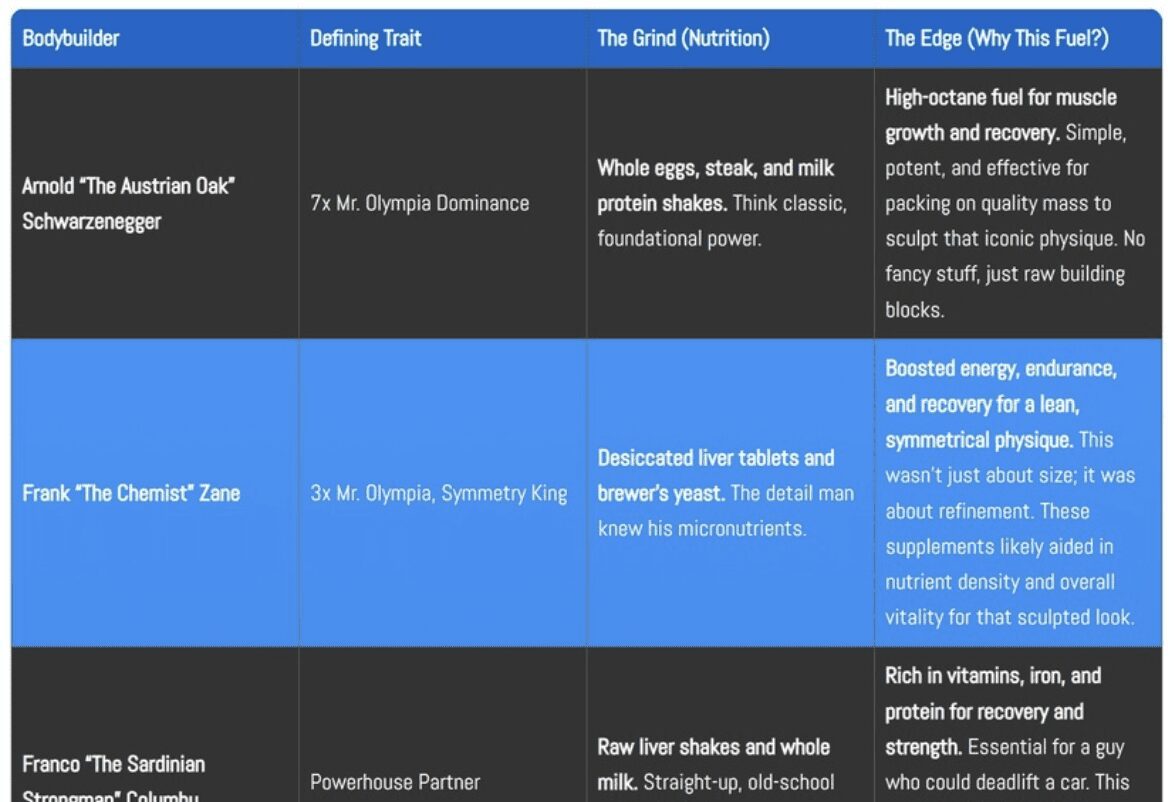
- Liver Tablets: The closest thing to a supplement in the Golden Era. Desiccated liver tablets were popularized by Vince Gironda and taken by Arnold, Zane, and nearly every competitor at Gold’s Gym. They were whole food in pill form. Not synthetic. Not isolated. For a modern organ supplement comparison, see our Ancestral Supplements beef organs review.
Arnold Schwarzenegger’s Diet: The Austrian Oak Method
Arnold Schwarzenegger during his 1974-1975 Mr. Olympia run ate roughly 4,000 to 5,000 calories per day from whole eggs, steak, chicken, cottage cheese, whole milk, rice, and vegetables. He did not count macros. He counted plates. Three to four large meals per day. No six-meal grazing. No Tupperware. No protein timing alarm on an iPhone.
- Breakfast: 5-6 whole eggs scrambled in butter, oatmeal cooked with whole milk, toast, and a glass of whole milk. Roughly 1,200 calories before 8 a.m.
- Lunch: A large steak or two chicken breasts, rice or potatoes, and vegetables. A full plate. Not a weighed portion.
- Dinner: Similar to lunch. Red meat or poultry. Rice or potatoes. Vegetables.
- Before Bed: Cottage cheese. The original slow-digesting casein feed during the overnight fast.
- Protein Powders? Arnold used Rheo Blair protein powder, a milk-and-egg-based blend sold through mail order. It was one of the only protein supplements available in the 1960s and 1970s. It was closer to powdered milk with egg white than to modern microfiltered whey isolate. No artificial sweeteners. No gums. No flavor systems beyond vanilla or plain.
Frank Zane’s Diet: Precision and Leanness
Frank Zane, the three-time Mr. Olympia known as the Chemist, took a more measured, calculated approach than Arnold. Zane was not interested in sheer mass. His physique was built on symmetry, proportion, and a vacuum pose that required a tight waist. His diet reflected that priority.
- Protein: Chicken breast, fish, eggs, and cottage cheese. Red meat was limited. Zane prioritized leaner protein sources than Arnold or Franco.
- Carbohydrates: Rice, potatoes, and oatmeal. Cycled based on training days. Zane was one of the earliest advocates of what would later become carb cycling. He manipulated intake based on mirror feedback, not a spreadsheet.
- Vegetables: Zane emphasized vegetables more than most Golden Era lifters. Salads, green beans, broccoli. The fiber and micronutrient density mattered for his waistline.
- Portion Control: Zane ate less than Arnold. He was roughly 190 lbs on stage versus Arnold’s 235. His caloric intake was proportionally lower. Quality mattered more than quantity.
- Supplements: Zane used desiccated liver tablets, vitamin and mineral supplements, and the occasional protein powder. But the foundation was whole food. Always. For more on Zane’s full approach, read our Frank Zane training philosophy guide and the Frank Zane profile.
Bulking and Cutting: The Golden Era Off-Season vs Contest Prep
Golden Era bulking was not a license to eat garbage. It was more of the same whole foods, with whole milk and red meat driving the calorie surplus. The concept of a “dirty bulk” with pizza, donuts, and fast food was not part of the Gold’s Gym culture. The bulk was clean by default because the food supply was clean by default. Processed food existed but was not the default.
- Off-Season (Bulking): 4,000-5,000 calories. Steak, whole eggs, whole milk, rice, potatoes, oatmeal. Three to four large meals per day. No calorie tracking. No macro apps. The mirror and the scale were the only feedback tools. For a comparison with the mass era of the 1990s, see our mass era 90s bodybuilders breakdown.
- Contest Prep (Cutting): Calories dropped. Carbohydrates were reduced. Milk was removed first. Then rice and potatoes were tapered. Protein stayed high from chicken, fish, egg whites, and cottage cheese. Vegetables increased for satiety. Sodium and water were manipulated in the final week. No diuretics. No fat burners. No stimulants beyond coffee.
- The Gallon of Water: Golden Era bodybuilders drank water by the gallon during prep. This was the original “hydration protocol.” No electrolyte packets. No LMNT. Just water and salt manipulation. For a modern clean hydration comparison, see our Transparent Labs Hydrate review.
The Fire Hose vs. The Garden Sprinkler Analogy
The Golden Era bulk was a fire hose of whole food calories. Steak. Eggs. Milk. Rice. Repeat. Three meals a day. No snacks. No grazing. The modern bulk is a garden sprinkler. Six meals. Tupperware. Timed shakes. Both deliver water to the lawn. One floods it fast. The other keeps it damp all day. The result depends on how your grass grows.
Golden Era Diet vs Modern Bodybuilding Diet
Whole food versus supplementation, three meals versus six, whole milk fats versus isolated proteins are the three structural differences between the Golden Era diet and the modern bodybuilding diet. Neither is objectively wrong. They are different delivery systems for the same macronutrients. For the full evolution timeline, read our bodybuilding nutrition evolution guide.
| Variable | Golden Era (1965-1979) | Modern Era (2020s) |
|---|---|---|
| Protein Sources | Steak, whole eggs, whole milk, cottage cheese, tuna, chicken. One-ingredient foods. | Whey isolate, casein powder, protein bars, RTD shakes. Multi-ingredient products. |
| Meal Frequency | 3-4 large meals per day. No snacks. | 5-6 smaller meals per day. Timed feeding windows. |
| Fat Intake | High. Saturated fat from egg yolks, red meat, whole dairy. Not feared. | Moderate. Fat sources often tracked. Emphasis on unsaturated fats. |
| Supplementation | Liver tablets, basic multivitamins, Rheo Blair protein powder. Near-zero supplementation. | Whey, casein, creatine, pre-workout, EAAs, BCAAs, fish oil, vitamin D, ZMA. |
| Carbohydrate Sources | White rice, potatoes, oatmeal. No sweet potatoes. No quinoa. | White rice, sweet potatoes, oats, quinoa, ezekiel bread, rice cakes. |
| Caloric Surplus Strategy | Whole milk, extra steak, more eggs. Clean surplus by default. | Tracked surplus via apps. Mass gainer shakes. Calorie counting. |
| Contest Prep | Taper carbs, remove milk, increase fish and chicken. Mirror feedback. | Macro tracking, carb cycling protocols, water manipulation, peak week formulas. |
| Cost | Food only. Grocery budget was the only line item. | Food plus supplements. Monthly supplement spend can exceed $100-$200 easily. |
The Golden Era diet wins on food quality by default. Every ingredient was a single whole food. The modern diet wins on convenience and precision. A scoop of whey in a shaker is faster than cooking steak and eggs. A macro tracking app is more precise than a mirror. For the deeper comparison, see our old school vs modern bodybuilding diets breakdown and old school physiques with no supplements.
Who the Golden Era Diet Is For (and Not For)
Whole food tolerance, kitchen access, and supplement philosophy decide whether a Golden Era approach fits your life or fights it.
Good Fit
- Lifters who prefer whole food over powders
- Anyone who enjoys cooking and meal prep
- Those with good digestion for red meat, eggs, and dairy
- Lifters targeting a classic, aesthetic physique rather than maximum mass
- People who want the shortest possible ingredient list on their plate
- Those who do not want to spend $100+ per month on supplements
Not the Best Fit
- Lifters who need post-workout speed (whey isolate hits faster than steak)
- Anyone with dairy intolerance (whole milk is non-negotiable in this diet)
- People who hate cooking or have limited kitchen access
- Those who want precise macro tracking and data-driven adjustments
- Vegans and vegetarians (the Golden Era diet is heavily animal-based)
- Competitive bodybuilders in tested federations with strict dietary protocols
Golden Era Diet FAQ
- What was the typical Golden Era bodybuilder meal?
- A 16-ounce steak or two chicken breasts, a large portion of white rice or potatoes, and steamed vegetables. Three meals like this per day. Plus whole eggs at breakfast and cottage cheese before bed. A gallon of whole milk was consumed across the day.
- How many calories did Golden Era bodybuilders eat?
- During bulking, 4,000 to 5,000 calories per day from whole food sources. During contest prep, calories dropped as carbs were tapered and milk was removed. Exact numbers were not tracked. The mirror and the scale guided adjustments. No macro apps. No spreadsheets.
- Did Golden Era bodybuilders use protein powder?
- Rheo Blair protein powder was used by Arnold and others. It was a milk-and-egg-based blend, not a modern microfiltered whey isolate. It was one of the only protein supplements available in the 1960s and 1970s. Most protein came from steak, eggs, milk, and cottage cheese. For how modern protein has evolved, see our bodybuilding nutrition evolution timeline.
- Why did Golden Era bodybuilders drink so much whole milk?
- Whole milk was the original mass gainer. A gallon provides 2,400 calories, 128g of protein, 128g of fat, and 192g of carbohydrates. It was cheap, available everywhere, and required no preparation. For lifters who struggled to eat enough solid food, milk bridged the calorie gap. No maltodextrin. No artificial ingredients.
- Did Golden Era bodybuilders count macros?
- No. Macros were not tracked. Calories were not counted. Food was measured by the plate, not the gram. The food quality made the surplus clean by default. Processed food was less prevalent. The 1980s and 1990s introduced macro tracking, fat phobia, and the shift toward supplementation. For that timeline, see our mass era 90s bodybuilders guide.
- Can you build muscle eating like a Golden Era bodybuilder today?
- Yes. Whole food protein builds muscle as effectively as whey isolate when total daily protein intake is matched. The practical difference is digestion speed. A steak takes hours to digest. Whey isolate hits the bloodstream in 60-90 minutes. For post-workout speed, whey has the edge. For total daily intake, whole food closes the gap. See our best whey protein for easy digestion guide for modern options.
- What supplements would a Golden Era bodybuilder take today?
- If limited to a 1970s-era supplement stack: desiccated liver tablets, a basic multivitamin, and Rheo Blair protein powder. If updating to modern tools while keeping the whole food philosophy: creatine monohydrate (5g daily), whey protein isolate (post-workout only), and fish oil. See our Momentous creatine review for a clean modern option.
Final Verdict
The Golden Era bodybuilding diet built some of the most aesthetic physiques in history on steak, whole eggs, whole milk, cottage cheese, canned tuna, white rice, and potatoes. Zero whey isolate. Zero pre-workout powders. Zero creatine. The diet was simple, repetitive, and built on single-ingredient foods. Three to four large meals per day. No grazing. No Tupperware. The mirror was the only tracking tool.
The modern bodybuilding diet wins on convenience, precision, and post-workout speed. A whey isolate shake hits amino acids faster than a steak. A macro tracking app is more precise than a mirror. A pre-workout powder delivers stimulants and pump ingredients that coffee and whole food cannot replicate. The modern lifter has tools the Golden Era lifter did not. For the full modern diet breakdown, see old school vs modern bodybuilding diets.
The Golden Era diet is the right approach for the lifter who wants the shortest possible ingredient list on the plate and is willing to spend time in the kitchen. It is the wrong approach for the lifter who wants post-workout convenience, precise macro tracking, or a vegan/vegetarian plan. The Golden Era bodybuilders proved what whole food alone can build. Modern lifters can borrow that foundation and add the tools that close the remaining gaps.
The Golden Era diet is not magic. It is steak, eggs, milk, rice, and consistency. That is the entire formula. The physiques were built on food quality, not food complexity. One ingredient per food. Three meals per day. Years of repetition under the bar and at the table. That is what built Arnold. That is what built Zane. The same formula still works today.
Verdict: Whole Food Builds Muscle. Golden Era Proved It.
Steak, eggs, whole milk, cottage cheese, rice. Three meals a day. Zero supplements. The Golden Era diet built Arnold, Zane, and Franco. It still works. Add modern tools like whey and creatine if you want the convenience. Keep the whole food foundation either way.
Related Golden Era and Bodybuilding Nutrition Guides
- Golden Era Bodybuilders: The Complete Guide
- Venice Beach Golden Era: Gold’s Gym and the Culture
- Frank Zane: The Chemist Profile
- Frank Zane Training Philosophy
- Mass Era 90s Bodybuilders vs Golden Era
- Old School Bulking Diets for Muscle Mass
- Old School vs Modern Bodybuilding Diets
- Old School Physiques With No Supplements
- Bodybuilding Nutrition Evolution
- Best Whey Protein for Easy Digestion
- Best Micellar Casein
- Momentous Creatine Monohydrate Review
- Ancestral Supplements Beef Organs Review
- Classic Strength Training
- Heavy Duty Training Guide
- Transparent Labs Hydrate Review