A grilled chicken breast, a cup of steamed broccoli, and a half-cup of brown rice clock in at roughly 400 calories. An active 200-pound individual aiming to add body mass may need approximately 3,200 calories daily as a starting estimate. That is eight plates of chicken, broccoli, and rice. Every single day. The food quality is not the issue. The calorie math, protein-per-meal distribution, and dietary fat intake are where clean eating often falls short for individuals with muscle-building goals. We ran the numbers on calorie density, protein timing, and fat minimums to identify where clean eating patterns may need recalibration for those pursuing muscle growth.
The Problem: Clean Eating Was Not Designed for Muscle Growth Goals
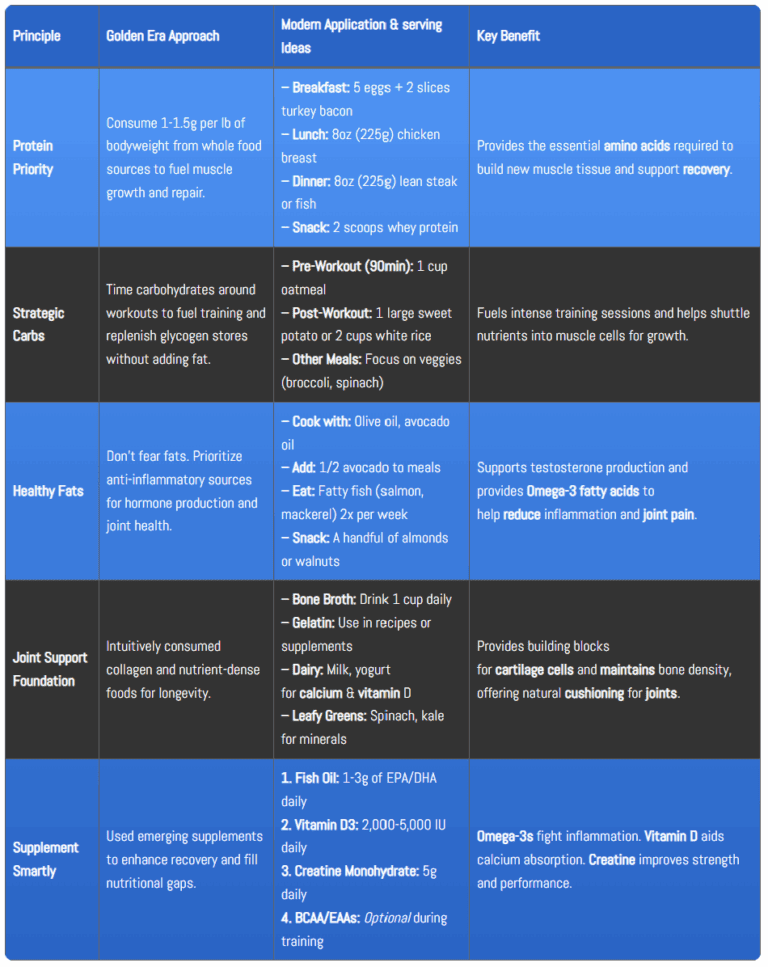
Clean eating as a dietary framework was built around whole-food ingredient quality and avoiding ultra-processed foods. It was not designed to guarantee a calorie surplus or specific protein-per-meal targets. The rules are straightforward: eat whole foods, avoid processed items, keep ingredients recognizable. Those rules work for general health. They cut out seed oils, refined sugar, and ultra-processed snacks. They do nothing to ensure total calorie intake, total protein intake, or dietary fat intake are sufficient for individuals pursuing muscle growth. The result is often a person who eats clean, trains consistently, and sees minimal change in body composition over time. The food quality is high. The food quantity may not align with their goals. For historical context on how bodybuilders approached this differently, see old school bulking diets for muscle mass.
The Prius vs. The Pickup Truck Analogy
Clean eating is a Prius. Fuel-efficient. Low emissions. Runs forever on a single tank. Hauling heavy loads up a hill is a different job. The Prius was not built for that job. You do not throw the Prius away. You just stop using it to haul heavy cargo. Match the vehicle to the job. The dietary pattern that supports general wellness may need recalibration when the goal shifts to adding significant body mass.
Error One: The Calorie Deficit Hidden by Food Volume
Whole foods are calorically dilute by design. A 500-calorie meal of clean food fills a large plate. A 500-calorie meal of processed food fits in a small wrapper. This is the first common challenge. Clean eaters often feel physically full before reaching their target calorie intake for the day. The stomach sends the satiety signal. The fork drops. The calorie total for the day may land significantly below what is needed for body mass goals.
- Volume vs. Density: A pound of broccoli is roughly 150 calories. A pound of ribeye steak is roughly 1,200 calories. Both are whole foods. Both are clean. An individual who fills half the plate with broccoli at every meal may feel physically full at a lower calorie total. An individual who includes more calorie-dense whole foods may reach a higher total without feeling overfull. The difference is not food quality. It is the energy density of the specific whole foods chosen.
- An Illustrative Example: A plate of grilled chicken breast (6 oz, approximately 280 calories), steamed broccoli (1 cup, approximately 55 calories), and brown rice (1 cup cooked, approximately 215 calories) totals around 550 calories. Eaten four times per day, that is approximately 2,200 calories. An active 200-pound individual may need roughly 3,200-3,400 calories daily as a starting estimate for muscle growth, depending on individual factors. The food is clean. The calorie total may not align with the goal. This is a mathematical gap, not a food-quality problem.
Error Two: The Protein Quantity and Per-Meal Distribution Gap
Clean eating patterns often land at roughly 0.6-0.8 grams of protein per pound of bodyweight while many individuals pursuing muscle growth aim for 0.8-1.0 grams per pound as a general target. An active 200-pound individual may aim for approximately 160-200 grams of protein daily as a general guideline. A single chicken breast delivers roughly 40-45 grams. Four chicken breasts across four meals approaches that target. But many clean eaters replace one or two of those meals with a salad, a smoothie bowl, or oatmeal. The total protein may drop to 100-120 grams. The food choices are objectively healthy. The protein-per-meal total may be lower than what some individuals aim for.
- Leucine and Muscle Protein Synthesis: Leucine is an essential amino acid that plays a key role in the body’s muscle protein synthesis process. Some nutritional scientists have observed that approximately 2.5-3 grams of leucine per meal may contribute to this process. That translates to roughly 30-40 grams of complete protein from animal sources. A salad with four ounces of grilled chicken provides roughly 25 grams of protein. The meal is clean. The leucine content per meal may differ from what some individuals target. For more on amino acid profiles, see BCAA vs EAA for recovery.
- Protein Timing Across the Day: Clean eaters often eat three meals per day, sometimes two if intermittent fasting is layered on top. Three meals of 40 grams provides 120 grams total. Four meals of 45-50 grams approaches 180-200 grams. The difference is often a fourth meal or a protein supplement. A scoop of whey protein isolate post-workout adds approximately 25-28 grams of complete protein and requires no cooking. For clean protein options, see our best protein for muscle growth rankings. This is not a prescription. It is an observation about how some individuals close the gap between three whole-food meals and four-meal protein targets.
Error Three: Dietary Fat Intake Often Falls Below Common General Guidelines
Dietary fat plays a role in the body’s general physiological processes, including fat-soluble vitamin absorption (vitamins A, D, E, and K) and providing essential fatty acids the body cannot produce on its own. Clean eating culture favored low-fat dietary patterns for decades. Egg whites replaced whole eggs. Skinless chicken breast replaced thighs. Fat-free Greek yogurt replaced full-fat dairy. The result can be a dietary pattern that provides less fat than some general nutritional guidelines suggest for active individuals.
- Dietary Fat and General Nutritional Guidelines: General nutritional guidelines often suggest that dietary fat should comprise roughly 20-35% of total daily calories. For an individual consuming approximately 3,200 calories daily, that represents roughly 70-125 grams of fat. A clean diet built primarily on chicken breast, egg whites, brown rice, and broccoli may provide significantly less. This is an observation about food composition, not a claim about health outcomes. The food quality is high. Some individuals may choose to adjust the fat content of their food selections based on their personal goals and professional guidance.
- Fat-Soluble Vitamin Absorption: Vitamins A, D, E, and K are absorbed more efficiently when consumed alongside dietary fat. A spinach salad with fat-free dressing still provides the vitamins. Adding olive oil, avocado, or full-fat cheese provides the dietary fat that may support absorption. The instinct to reduce dietary fat can also reduce the efficiency of vitamin uptake. For more on vitamin D specifically, see Nature Made Vitamin D3 review and Sports Research D3 + K2 review.
- Fat Sources Compatible with Clean Eating: Whole eggs, avocado, olive oil, grass-fed butter, fatty fish like salmon, and full-fat Greek yogurt are all whole foods. They match the clean-eating ingredient philosophy. They also provide dietary fat. The adjustment is not adding processed foods. It is choosing different whole-food sources within the same eating framework.
The Brick Wall Without Mortar Analogy
Protein is the bricks. Training is the bricklayer. Calories and dietary fat are the mortar. You can stack bricks without mortar. The wall may stand for a while. It may not reach full height. Clean eating can deliver perfect bricks and minimal mortar. Fat is not the enemy of a muscle-building diet. It is the energy density that supports the body’s natural processes. Add the mortar. The wall gets taller. This is an analogy about energy balance, not a claim about specific outcomes.
Error Four: Clean Eating’s Accidental Meal-Timing Gap
Whole foods digest slower than processed foods. A six-ounce chicken breast with one cup of brown rice and one tablespoon of olive oil can take three to four hours to clear the stomach. This is a feature for satiety. It can be a challenge for meal frequency. A clean eater who finishes breakfast at 8 a.m. may not feel hungry again until noon. That is a four-hour gap. If lunch is delayed until 1 p.m., the gap stretches to five hours. For individuals aiming for four protein feedings per day, a five-hour gap between meals reduces the total number of feedings possible in a waking day.
- Meal Frequency Observation: Four meals spaced three to four hours apart with 40-50 grams of protein each approaches roughly 160-200 grams daily. Three meals spaced five to six hours apart with 40-50 grams each approaches roughly 120-150 grams. The difference is often an additional meal. Clean eating’s high satiety can make that fourth meal feel unnecessary. The appetite signal says stop. Some individuals pursuing muscle growth choose to eat the additional meal regardless of appetite. This is a personal choice, not a recommendation.
- Post-Workout Nutrition Timing: A clean whole-food meal takes 30-45 minutes to prepare and 20 minutes to eat. A whey protein shake takes under a minute to mix and consume. Some individuals choose to consume protein within 60-90 minutes of training as part of their personal approach. A shaker with whey isolate in the gym bag is a tool some people use. For more on timing strategies, see creatine beta-alanine stack guide.
Recalibration: How Some Individuals Adjust Clean Eating for Muscle Growth
Clean eating does not need to be abandoned. Some individuals choose to recalibrate it for calorie density, protein-per-meal totals, dietary fat content, and meal frequency based on their personal goals. The food quality stays high. The food quantity and composition shift. These are general observations, not prescriptions.
Recalibrate the Calories
- Consider more calorie-dense whole-food carbs. White rice, potatoes, oats, and sourdough bread provide more energy per bite than broccoli or leafy greens. Same clean label. Higher energy density.
- Some individuals add a liquid calorie source. A post-workout shake with whey, banana, oats, and whole milk provides additional energy in a format that adds minimal stomach volume. This is a tool some people use, not a universal recommendation.
- Tracking for awareness. Some individuals find it useful to track intake using a food scale and an app for a short period to compare perceived intake against actual totals. The scale provides data. Individuals then decide what adjustments to make.
Recalibrate the Protein
- Some individuals aim for 40-50 grams per meal as a general target. Four meals of approximately 45 grams each approaches roughly 180 grams daily. Individual needs vary. This is an observation, not a prescription.
- A whey isolate scoop is a tool some people use. 25-28 grams of complete protein in under a minute. This is one way some individuals add a protein feeding to a three-meal day. See best proteins for muscle growth.
- Animal protein sources provide complete amino acid profiles. Plant proteins typically provide lower leucine per gram. A 30-gram scoop of pea protein is not equivalent to a 30-gram scoop of whey in terms of amino acid composition. See Isopure plant-based protein review.
Recalibrate the Dietary Fat
- Whole eggs instead of egg whites. Four whole eggs provide roughly 28 grams of protein and 20 grams of fat. Four egg whites provide roughly 14 grams of protein and minimal fat. The yolk provides dietary fat and additional micronutrients.
- Olive oil or butter for cooking. One tablespoon adds roughly 14 grams of fat and 120 calories. Adds no preparation time.
- Fattier whole-food protein sources. Chicken thighs instead of breast. Ribeye instead of sirloin. Salmon instead of tilapia. Same food category. Different fat content. Same clean-eating philosophy.
Recalibrate the Meal Timing
- Some individuals add a fourth meal. A pre-bed option of Greek yogurt, whey, and almond butter takes under a minute to assemble and provides roughly 40-50 grams of protein. This is an approach some people choose.
- A shaker in the gym bag is a tool. Post-workout protein within approximately 60 minutes is a practice some individuals follow. See Gold Standard Whey review.
- Intermittent fasting may make higher calorie totals more challenging. An 8-hour feeding window can make it harder to consume the total daily energy and protein some individuals aim for. It is not impossible. Some people find it more difficult. For historical context on eating patterns, see old school vs modern bodybuilding diets.
Clean Eating and Muscle Growth FAQ
- Is clean eating incompatible with building muscle?
- No. Clean eating as a food-quality framework is not incompatible with muscle growth. The challenge is that some clean-eating patterns may provide fewer total calories, less protein per meal, and less dietary fat than some individuals aim for. A clean-eating approach that includes calorie-dense whole foods, adequate protein across enough meals, and sufficient dietary fat is one dietary pattern among many. The food quality is not the issue. The total energy, protein distribution, and fat content may differ from what some individuals target. This is a mathematical observation, not a claim about outcomes.
- How many calories might an individual consider for muscle growth?
- As a general reference point, some active individuals use a figure of roughly 16-18 calories per pound of current bodyweight as a maintenance estimate, with an additional modest surplus for those pursuing body mass goals. For example, a 200-pound individual might use approximately 3,200-3,400 calories daily as a trial starting point. A 170-pound individual might use approximately 2,720-2,890. These are rough estimates based on widely available reference data, not individual prescriptions. Needs vary dramatically. Tracking results over time and consulting a qualified professional is the appropriate next step. For historical context, see old school bulking diets.
- How much protein per meal do some individuals target?
- Some individuals pursuing muscle growth aim for roughly 40-50 grams of complete protein per meal, spread across four meals daily, as a way to approach a total of approximately 160-200 grams. This is an observation about common practices, not a universal prescription. Individual protein needs vary based on bodyweight, training intensity, age, and overall health. For protein supplement options, see best proteins for muscle growth and best whey for easy digestion.
- Why do some individuals include more dietary fat when pursuing muscle growth?
- Dietary fat plays a role in the body’s general physiological processes. It supports the absorption of fat-soluble vitamins A, D, E, and K and provides essential fatty acids the body cannot produce on its own. General nutritional guidelines often suggest dietary fat comprise roughly 20-35% of total daily calories. A clean-eating pattern built primarily on very lean protein sources and vegetables may provide less fat than some individuals choose to include. Adding whole-food fat sources like eggs, avocado, olive oil, and fatty fish is one approach some people use. This is general nutritional information. For more on dietary fat in the context of general nutrition, see collagen and joint health guide.
- Can an individual build muscle eating only whole foods?
- Whole foods are an excellent nutritional base. The practical challenge some individuals encounter is food volume. A clean-eating pattern providing roughly 3,200 calories may require a significant physical volume of food. Some individuals find that volume difficult to consume consistently. A whey protein supplement is one tool some people use to add protein and calories in a more concentrated format. It is not a replacement for whole food. It is an additional option. For clean-label whey options, see our protein powder rankings.
- Why might someone not see weight gain on a clean-eating pattern?
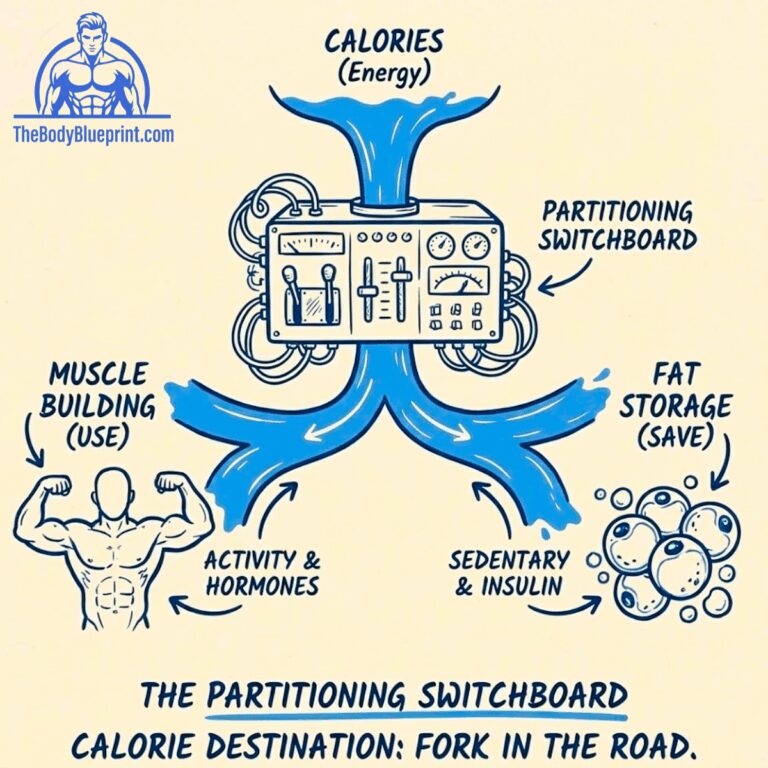
- One common observation is that whole foods are calorically dilute. A plate that looks large may contain fewer calories than expected. Some individuals find it useful to track intake with a food scale for a short period to compare perceived intake against actual totals. The discrepancy between perceived and actual intake can be significant. Some individuals then choose to adjust their food selections to include more calorie-dense whole foods. This is observational information. Individual circumstances vary. For more on nutrition strategies, see nutrient partitioning guide.
The Verdict
Clean eating as a food-quality framework is not incompatible with muscle growth. The challenge arises when the pattern provides fewer total calories, less protein per meal, lower dietary fat, and fewer daily feedings than some individuals aim for. The recalibration is not adding processed foods. It is choosing different foods within the same clean-eating philosophy. More calorie-dense carbohydrates. Fattier protein sources. Whole eggs instead of whites. An additional meal. A post-workout whey shake. The ingredient quality remains high. The numbers shift.
Muscle growth generally requires a calorie surplus, sufficient protein distributed across the day, adequate dietary fat, and meal frequency that supports the individual’s goals. Clean eating delivers food quality. It does not automatically deliver those four variables. The solution is not abandoning the philosophy. It is recalibrating the plate. Same ingredient standards. Different numbers. Individual results vary. Consult a qualified professional for guidance tailored to your circumstances.
Verdict: Recalibrate the Numbers, Keep the Food Quality
Clean eating is not the issue. The calorie total, protein distribution, dietary fat content, and meal frequency are variables some individuals choose to adjust. Same food philosophy. Different numbers. Individual needs vary. Consult a professional.
Related Nutrition and Training Guides
- Best Protein Powders for Muscle Growth
- Old School Bulking Diets for Muscle Mass
- Old School vs Modern Bodybuilding Diets
- BCAA vs EAA for Recovery
- Best Whey Protein for Easy Digestion
- Nutrient Partitioning Guide
- Bodybuilding Nutrition Evolution
- Best Protein for a Cutting Phase
- Optimum Nutrition Gold Standard Whey Review
- Whey Protein for Fat Loss Guide
- Creatine Beta-Alanine Stack Guide
- Golden Era Bodybuilders
- Frank Zane Training Philosophy
- Heavy Duty Training Guide
- Classic Strength Training