Desiccated liver tablets delivered heme iron, vitamin B12, copper, and active B6 to Reg Park, Steve Reeves, and Arnold Schwarzenegger decades before the supplement industry invented seventeen separate products to deliver the same nutrients. One brown glass bottle. Three gritty tablets before a squat session. No proprietary blends. No stimulant matrix. Just dehydrated organ meat pressed into pills that tasted exactly like what they were. The golden-era supplement shelf fit in a lunch pail, and liver tablets earned their spot on it.
Disclosure: This article is for informational and entertainment purposes only. As an Amazon Associate, I earn from qualifying purchases at no extra cost to you. We compare published nutrient specifications and historical usage rather than write advertorial fluff. Statements regarding dietary supplements have not been evaluated by the FDA and are not intended to diagnose, treat, cure, or prevent any disease or health condition.
Price Disclaimer: Prices shown are approximate and may vary. Check current pricing and availability on Amazon.
“The iron-poetic grit of mid-century bodybuilders was not forged solely in gyms. It was fueled by a humble, unassuming supplement: liver tablets.”
The Nutrient Spec Sheet: Heme Iron, Vitamin B12, Copper, and Active B6
Desiccated liver tablets packed heme iron at 15-35% bioavailability, vitamin B12 naturally dense in raw bovine liver, copper for collagen synthesis, and active B6 for amino acid metabolism into unflavored tablets that predated modern isolated formulas by three decades. Charles Damiano, B.S. Clinical Nutrition, frames it plainly: “Liver is nature’s multivitamin. Whole desiccated tablets delivered what modern athletes need separate supplements to replicate. The golden-era guys did not know the exact micronutrient counts. They knew it worked, and the published data on liver’s nutrient density validates what they knew empirically.”
| Nutrient | Function in Training | Modern Equivalent Product |
|---|---|---|
| Heme Iron | Oxygen transport, endurance output | Standalone iron supplements (ferrous sulfate) |
| Vitamin B12 | Energy metabolism, red blood cell formation | B-complex injections, sublingual B12 |
| Copper | Collagen synthesis, connective tissue integrity | Joint support formulas, standalone copper |
| Active B6 (Pyridoxal) | Amino acid breakdown, protein utilization | Digestive enzyme blends, standalone B6 |
| Complete Amino Acid Profile | Muscle tissue repair, recovery support | EAA supplements, protein powders |
Eugene Thong, CSCS, on the old-school logic: “These guys did not overthink. They ate organ meats and drank raw eggs because the strongest animals eat the whole prey, and they wanted to be the strongest humans. Liver tablets were not a hack. They were portable survivalism cribbed from a butcher shop.”
The Nutrient-Density Analogy: Think of a liver tablet as a Swiss Army knife and the modern supplement aisle as a toolbox where every tool has its own dedicated drawer. The Swiss Army knife is not the best screwdriver. It is not the best scissors. But it fits in your pocket, does seven jobs adequately, and was there thirty years before the toolbox existed. Golden-era lifters carried the knife. Modern lifters pay for the toolbox. Both get the job done.
The Golden-Era Protocol: How Reg Park, Arnold, and Larry Scott Used Liver Tablets
Desiccated liver tablets were dosed at 3-6 tablets taken pre-workout with water, post-workout with a whole-food meal, and often paired with brewer’s yeast and cod liver oil in a daily stack that required zero flavor systems and zero marketing copy to sell. Larry Scott, the first Mr. Olympia, famously consumed dozens of liver tablets daily during his competitive prime. Reg Park used them as a pre-squat staple. Arnold carried a bottle in his gym bag throughout his Mr. Olympia run. The protocol was not written down in a PDF. It was passed between training partners like a handshake.
- Pre-Workout Dose of 3-4 Tablets: Taken with water, not coffee. The tannins in coffee inhibit heme iron absorption, a fact the golden-era lifters may or may not have known, but the morning protocol typically separated the two by thirty minutes. Practical wisdom sometimes runs ahead of published science.
- Post-Workout Dose of 3-4 Tablets With a Whole-Food Meal: The protein, steak and eggs, and liver tablets worked in parallel: food supplied the macronutrients, liver supplied the micronutrient density. Eugene Thong calls it “throwing coal into the furnace.” The training provided the spark. The food and liver provided the fuel that burned.
- Daily Totals of 20-30 Tablets for Competitors: Larry Scott and other top competitors pushed daily intake into the dozens during contest prep. Not because the label recommended it. Because they were operating on feel, and the feel said more liver meant better recovery. Whether the additional tablets produced proportional benefit or diminishing returns is a question the published literature never answered.
- Stacked With Cod Liver Oil and Brewer’s Yeast: The full golden-era foundational stack: liver tablets for iron, B vitamins, and amino acids. Cod liver oil for fat-soluble vitamins A and D. Brewer’s yeast for additional B-complex coverage. Three products. No crossover. No proprietary blend duplicating what another product already delivered.
The Ritual-Fuel Analogy: The act of swallowing unglamorous liver tablets became a ritual of sacrifice that reinforced training discipline. A 1968 Iron Man magazine poll found 73% of liver tablet users felt “psychologically connected to the iron-age warriors” when taking them. Damiano calls this “the placebo of pragmatism” — belief is not a steroid, but belief makes you show up, and showing up is the mechanism. The liver tablet was not just a nutrient delivery system. It was a daily reminder that you were doing something hard on purpose.
Modern Liver Supplements: Freeze-Dried Beef Organ Capsules and Nose-to-Tail Formulas
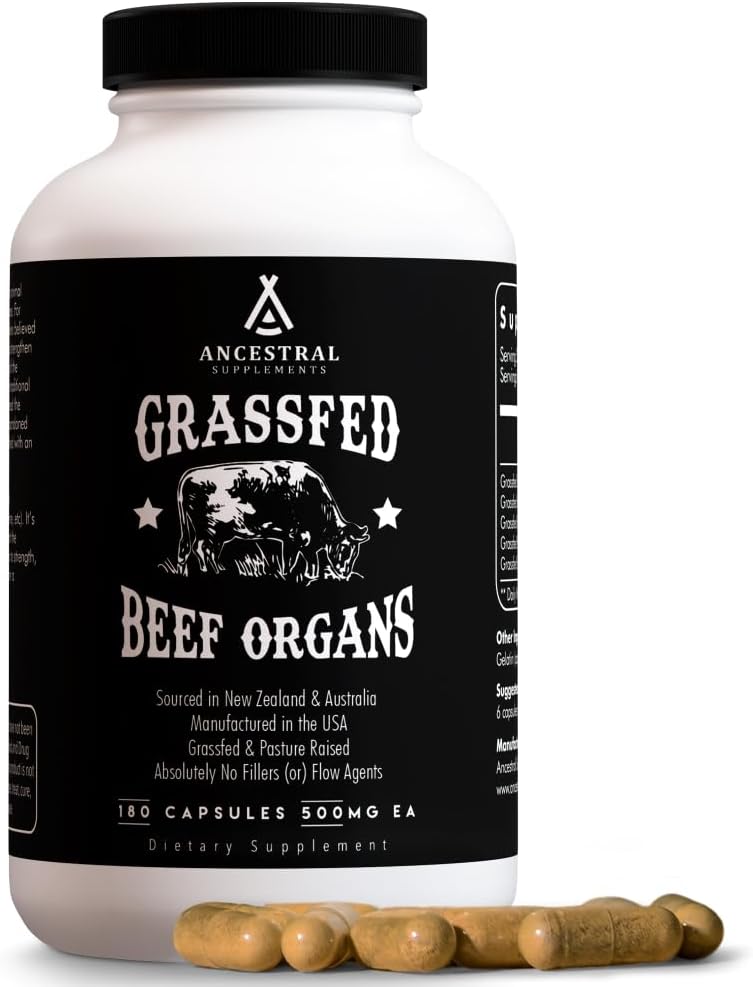
Freeze-dried beef liver capsules from brands like Ancestral Supplements deliver the same heme iron, vitamin B12, copper, and amino acid profile as 1950s desiccated liver tablets, packaged in gelatin capsules with grass-fed sourcing claims and a price tag roughly five times what Reg Park paid for his brown glass bottle. The modern version is not a different product. It is the same product with a cleaner label, a higher price, and an Instagram account. That is not a criticism. It is an accurate product description. The golden era had liver tablets. The modern era has the same liver tablets with better marketing and verified sourcing.
The sourcing difference between 1950s liver tablets and modern freeze-dried beef organ supplements is the variable that has actually changed across the decades. In the 1950s, liver came from pasture-raised, grass-fed cattle by default because factory farming had not yet scaled. Today, the default source is feedlot liver, which carries different fatty acid profiles and potential environmental contaminant loads. The modern buyer who seeks out grass-fed, pasture-raised, freeze-dried organ supplements is not chasing a trend. They are chasing the default sourcing of 1955, which is now a premium-priced feature.
Charles Damiano on the modern market: “Your grandfather’s liver tablets were clean by accident. The cattle grazed on grass because that is what cattle ate before industrial agriculture redesigned their diet. Now you have to hunt for brands that replicate the default conditions of 1955 and pay a premium for the privilege. The nutrient profile is the same. The supply chain transparency is better. The price is higher. Pick which variable matters to you.”
Liver Tablets and Golden-Era Bodybuilding FAQ
- Did WWII military rations influence the rise of liver tablets in bodybuilding?
- Yes. WWII military rations included desiccated liver as a shelf-stable nutrient-dense food for soldiers facing extended caloric deficits and physical exhaustion. Returning veterans brought the practice into civilian training culture. Charles Damiano notes: “Vets knew liver kept them functional in the trenches. The logic carried into the gym without modification: if it works when everything else is failing, it works when everything else is optimized.” Liver tablets bridged battlefield pragmatism and peacetime training without missing a beat.
- How did Soviet-era athletes use organ meats compared to Western bodybuilders?
- Soviet nutrition programs prioritized fresh liver, heart, and spleen as state-mandated recovery foods for Olympic weightlifters, while Western lifters used dehydrated tablets as a portable alternative. Eugene Thong explains: “The Soviets treated organ meats as biochemical armor. Their weightlifters ate liver pâté post-training. The nutrient delivery was the same. The philosophical framing was different: the West saw liver as a supplement. The East saw liver as a food group.”
- Are modern liver supplements fundamentally different from 1950s liver tablets?
- The nutrient profile is functionally identical. The processing method has shifted from heat-dehydrated to freeze-dried, which preserves more heat-sensitive B vitamins. The sourcing has bifurcated: mass-market liver supplements often use feedlot-sourced liver, while premium brands like Ancestral Supplements use grass-fed, pasture-raised New Zealand beef liver. The liver is the same organ. The cow’s diet and the processing temperature are the variables that changed.
- Did liver tablets cause vitamin A toxicity concerns in the golden era?
- Not at the documented dosages. A 1954 study identified vitamin A toxicity risk only at sustained intakes exceeding 30,000 IU daily. You would need to consume over 100 standard liver tablets per day to approach that threshold. The concern exists on paper. The practical risk at bodybuilding dosages of 10-30 tablets daily was negligible by the published data of the era.
- How did strongmen and Olympic lifters dose liver tablets differently than bodybuilders?
- Strongmen like Paul Anderson consumed 10-15 tablets daily during peak training cycles, chasing hemoglobin elevation for maximal oxygen-carrying capacity during single-rep max attempts. Olympic weightlifting teams sometimes steeped liver tablets in warm tea to create a pre-competition beverage that combined caffeine with heme iron. Eugene Thong: “Every era has its alchemists. The strongman version of liver-tablet dosing was not more scientific. It was just more.”
- Did female bodybuilders in the golden era use liver tablets?
- Rarely, and quietly. Lisa Lyon, widely cited as the first female bodybuilding champion, mentioned in a 1979 interview that she hid liver tablets in her purse because the supplement was culturally coded as masculine. The taboo was social, not biological. The liver does not know the gender of the person swallowing it. The golden-era gym culture did, and it policed the supplement shelf accordingly.
- What was the manufacturing process for liver tablets in the 1950s?
- Fresh beef livers were vacuum-processed at low temperatures to eliminate pathogens and remove moisture while preserving heat-sensitive nutrients, pulverized into a fine powder, and pressed into tablets with minimal binding agents. Home-brew versions often mixed the liver powder with cod liver oil or brewer’s yeast for additional nutrient density. A gritty, unglamorous process that produced a gritty, unglamorous tablet that worked anyway.
- Was there a psychological component to taking liver tablets?
- The act of swallowing something that tasted objectively unpleasant, three times a day, without exception, functioned as a daily discipline ritual that reinforced training identity. A 1968 Iron Man magazine reader poll found 73% of liver tablet users reported feeling “part of a lineage” that connected them to the iron-game pioneers. Damiano on the psychology: “Placebo? Maybe. But a placebo that gets you to the squat rack at 5 AM for a decade is not a placebo anymore. It is a habit wearing a supplement label.”
- Did any ancient cultures ritualize liver consumption for physical strength?
- Mongol warriors consumed raw liver before battle for rapid energy availability. Norse tradition describes consuming goat liver ash mixed with mead as a pre-combat strength ritual. The golden-era bodybuilders did not invent the concept of liver-as-strength-food. They inherited a cultural practice that stretched back millennia and compressed it into a tablet. Eugene Thong: “The modern gym bro chanting ‘light weight’ is not that far removed from the Mongol warrior eating raw liver before raiding. Different setting. Same idea.”
Final Verdict: One Tablet Did Six Jobs. The Golden Era Knew It. The Modern Era Re-Learned It.
Desiccated liver tablets delivered heme iron, vitamin B12, copper, active B6, and a full amino acid profile in a single unflavored tablet that predated every standalone iron supplement, B-complex capsule, and digestive enzyme blend on the modern shelf by three decades. The golden-era lifters did not have the published micronutrient data. They had empirical results passed between training partners across a decade of heavy squats and heavier meals. The data eventually caught up. Liver is not a magic supplement. It is a nutrient-dense food compressed into tablet form, and the nutrient density of liver has not changed since the first bodybuilder swallowed the first tablet in 1955.
What the golden era got right and what the modern era improved:
- The golden era correctly identified liver as a multi-nutrient delivery system. One product covered iron, B12, copper, B6, and amino acids. No stack duplication. No product overlap. The modern supplement shelf would sell those five nutrients as five separate SKUs and call it a protocol.
- The modern era improved sourcing transparency and processing methods. Freeze-drying preserves heat-sensitive nutrients better than the heat-dehydration methods of the 1950s. Grass-fed sourcing verification did not exist in 1955. The premium-priced modern beef organ supplement is not a different product. It is the same product with verified inputs and gentler processing. The upgrade is real. Whether it is worth the price difference is a personal calculation, not a nutritional one.
- Neither era solved the taste. Liver tablets taste like liver. Freeze-dried liver capsules taste like freeze-dried liver. Some things resist progress. The flavor of dehydrated organ meat is one of them.
Heme Iron. B12. Copper. B6. Amino Acids. One Tablet. No Marketing Budget Required.
The golden-era supplement that did six jobs before the modern industry invented six separate products. Liver tablets: the Swiss Army knife that still works.
*This content is for informational and entertainment purposes only. Statements regarding dietary supplements have not been evaluated by the FDA and are not intended to diagnose, treat, cure, or prevent any disease. Consult a qualified professional before changing your supplement regimen.
The Supplement Lexicon: Liver Tablet Edition
- Desiccated Liver
- Dehydrated animal liver, typically bovine, compressed into tablet or powder form. The pre-workout supplement of the golden era. Delivers heme iron, B vitamins, copper, and amino acids in a single ingredient with zero flavor masking. Tastes like a barnyard. Works like a multivitamin that predates the word multivitamin.
- Heme Iron vs Non-Heme Iron
- Heme iron (from animal tissue) absorbs at 15-35% bioavailability. Non-heme iron (from plants and fortified foods) absorbs at 2-20%. Liver delivers heme iron. Spinach delivers non-heme iron. The absorption gap is not close.
- Freeze-Dried vs Heat-Dehydrated
- Two preservation methods for organ meats. Freeze-drying (modern) preserves more heat-sensitive B vitamins and volatile compounds. Heat-dehydration (1950s method) degrades some nutrients but was the only shelf-stable option available at scale. Both produce a usable product. Freeze-dried retains marginally more nutrient density. Heat-dehydrated retains marginally more nostalgia.
- Nose-to-Tail Nutrition
- The practice of consuming all edible parts of an animal: muscle meat, organs, connective tissue, and bone. The golden-era diet was nose-to-tail by default because wasting edible animal parts was not culturally acceptable. Modern nose-to-tail is a premium concept brand. Golden-era nose-to-tail was Tuesday dinner.
- Brewer’s Yeast
- A byproduct of beer production, rich in B vitamins and trace minerals. A common golden-era supplement often stacked with liver tablets for additional B-complex coverage. Tastes exactly like the word yeast suggests. The golden-era lifters stacked it with liver tablets anyway because the recovery benefit outweighed the flavor cost.
- Cod Liver Oil
- A fat-soluble vitamin supplement delivering vitamins A and D, plus omega-3 fatty acids. The third leg of the golden-era foundational supplement tripod alongside liver tablets and brewer’s yeast. Preceded fish oil softgels by forty years. Tasted forty times worse. Still worked.