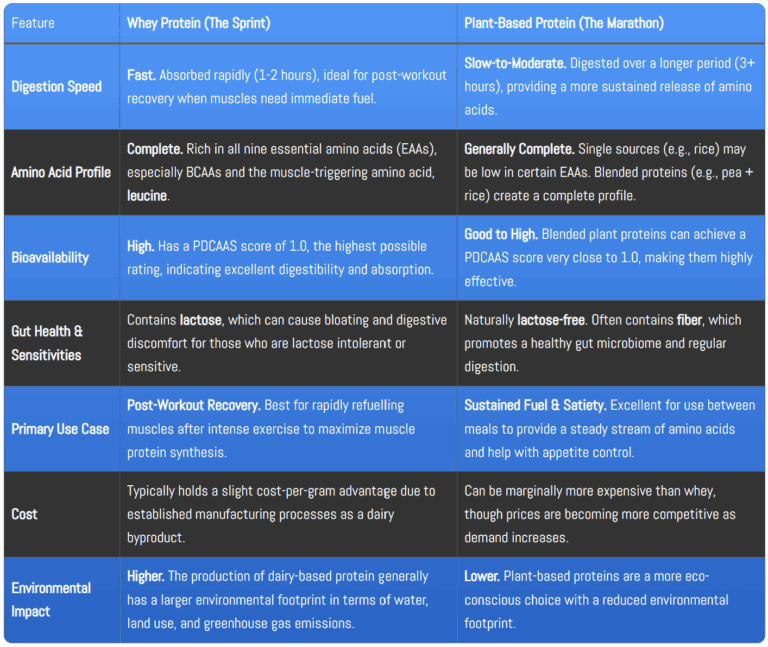
Whey protein and plant protein both print “protein” on the label. The similarity ends there. Whey protein isolate delivers a complete amino acid profile with 2.5-3g of leucine per scoop. Most plant proteins need blending to hit that number. One is a sprint. The other is a relay race where you need multiple runners to finish the lap. We put whey and plant head-to-head on leucine content, EAA completeness, cost per gram of usable protein, and mixability to see which tub earns its shelf space.

Overview: Not All “Protein” Means the Same Thing
Whey protein isolate prints 25-28g of protein per scoop with a PDCAAS score of 1.0. Pea protein prints 21-24g with a PDCAAS of roughly 0.7-0.8 unless blended with rice protein to patch the amino acid gaps. The gram count on the front label is not the full story. What matters is the amino acid breakdown on the back panel. Specifically leucine, isoleucine, valine, and whether all nine essential amino acids are present in sufficient quantities. Whey is a complete protein. Most single-source plant proteins are not. That is the first domino. Everything else — cost, mixability, ingredient-list length — falls from there. For a deep dive on whey formats, see our best whey protein for easy digestion guide. For the plant-based side, see our Isopure Plant-Based Protein review.
The Brick Wall vs. The Brick Pile Analogy
Whey is a finished brick wall. All nine EAAs are stacked, mortared, and ready. Single-source plant protein is a pile of bricks with two or three missing. You can still build the wall. You just need a second pile — rice protein to supply the lysine, pea protein to supply the methionine — and now you have two tubs, two scoops, and a blending math problem. Both walls stand. One took more work. Pick the construction method that fits your schedule.
The Amino Acid Showdown: Leucine Is the Buy-In
Leucine is the amino acid that triggers muscle protein synthesis. Whey protein isolate delivers 2.5-3g of leucine per 25-28g scoop. Most plant proteins need more grams to hit the same threshold. This is the single biggest difference between whey and plant protein, and it is printed on the label of every tub. You just have to look.
- Whey Protein Isolate (28g scoop): Roughly 2.5-3g leucine, 1.5-2g isoleucine, 1.5-2g valine. All nine EAAs present. BCAA total around 5.5-7g. PDCAAS of 1.0. Leucine hits the threshold in one scoop.
- Whey Protein Concentrate (25g scoop): Roughly 2-2.5g leucine. Slightly less than isolate due to lower protein percentage (70-80% vs 85%+). Still complete. Still hits.
- Pea Protein (21-24g scoop): Roughly 1.7-2g leucine. Low in methionine. PDCAAS of ~0.7. Needs blending with rice protein or an extra half-scoop to approach the leucine threshold.
- Brown Rice Protein (20-24g scoop): Roughly 1.5-1.8g leucine. Low in lysine. PDCAAS of ~0.5-0.6 alone. Must be blended to complete the EAA profile.
- Soy Protein Isolate (25g scoop): Roughly 2-2.3g leucine. The exception among plant proteins. Complete EAA profile. PDCAAS of ~0.95-1.0. The closest plant rival to whey on amino paper.
- Pea-Rice Blend (25-28g combined): Roughly 2-2.5g leucine when properly blended at a 70:30 or 60:40 ratio. Complete EAA profile. This is the standard plant-protein workaround — and it works, but requires two protein sources in one tub.
“The leucine threshold is not a mystery. It is a number. 2.5-3g per serving is the target. Whey hits it in one scoop. Pea protein needs 30-35g of powder to get there. Rice needs even more. That is not marketing. It is math. Count the leucine grams, not the protein grams.”
— Charles Damiano, B.S. Clinical Nutrition
Cost Per Gram of Usable Protein: The Brutal Math
Whey protein isolate costs roughly $1.50-$2.00 per 25-28g serving of complete, high-leucine protein. Pea-rice blends run $1.20-$1.80 per serving, but you often need more grams to hit the same leucine target. The cost gap narrows fast when you adjust for amino acid completeness.
- Whey Isolate (Transparent Labs): ~roughly $2.00 per 28g serving. 2.5-3g leucine. Complete EAA profile in one scoop. Cost per gram of complete protein: ~$0.07.
- Whey Concentrate (Optimum Nutrition Gold Standard): ~$0.90-$1.10 per 24g serving. ~2-2.5g leucine. Isolate-concentrate blend. Complete. Cost per gram of complete protein: ~$0.04. The value champion. See our Gold Standard Whey review for the full breakdown.
- Pea Protein (Naked Pea): ~roughly $1.00 per 27g serving. ~1.7-2g leucine. Low methionine. Not complete alone. Cost per gram of complete-adjusted protein rises when you factor in the blending requirement.
- Pea-Rice Blend (Orgain): ~$1.30-$1.60 per 21g serving. ~2g leucine. Complete EAA profile. More expensive per gram of leucine than budget whey. See our plant-based protein comparison.
- Soy Isolate: ~$0.80-$1.20 per 25g serving. ~2-2.3g leucine. Complete. The cheapest complete plant protein. Frequently overlooked because people conflate soy isolate with heavily processed soy junk food.
The myth is that plant protein is cheaper. It is not, once you correct for leucine. A roughly $1.00 scoop of pea protein that delivers 1.7g of leucine is less cost-efficient than a $1.00 scoop of whey concentrate that delivers 2.5g of leucine. You need ~35g of pea powder to match the leucine payload of 25g of whey concentrate. That pushes the effective cost per leucine-equivalent serving above budget whey. For the professional who needs meal replacement efficiency, see best protein for busy professionals. For cutting-phase protein economics, see best protein for cutting phase.
Whey vs Plant Protein: The Honest Trade-off
Whey wins on leucine density, EAA completeness, and cost-per-leucine efficiency. Plant protein wins on dairy-free compatibility, allergen avoidance, and, in the case of soy, comparable completeness at a lower price. Neither category sweeps the board.
Whey Protein (Advantages)
- 2.5-3g Leucine Per Scoop: Hits the threshold in one serving. No blending math required.
- Complete EAA Profile (PDCAAS 1.0): All nine EAAs present in sufficient quantities.
- Fastest Cost Per Gram of Complete Protein: Whey concentrate runs ~$0.04/gram.
- Short Ingredient Lists Possible: Pure whey isolate can be one ingredient. No gums, no blends, no compromises.
- Cold-Processed, Microfiltered Formats Exist: See isolates from Transparent Labs, Isopure, and Dymatize.
Whey Protein (Disadvantages)
- Dairy Allergen: Non-starter for lactose-intolerant or dairy-allergic lifters.
- Not Vegan: Animal-derived. Full stop.
- Some Isolates Hit $2.00/Serving: Premium clean-label whey gets expensive fast.
Plant Protein (Advantages)
- Dairy-Free and Vegan: The entire category exists for this reason.
- Hypoallergenic Options: Pea and rice avoid dairy, soy, and gluten allergens.
- Soy Isolate Competes on Leucine: ~2.3g leucine per 25g scoop. Complete EAA profile. PDCAAS near 1.0.
- Pea-Rice Blends Work: A well-formulated blend is a complete protein. The problem is solved, just with more ingredients.
Plant Protein (Disadvantages)
- Lower Leucine Per Gram: You need more powder to hit the same threshold.
- Often Needs Blending: Single-source pea or rice is incomplete. Blending adds ingredients.
- Grittier Texture: Plant proteins often need gums and emulsifiers to mask graininess. Ingredient lists grow.
- Higher Effective Cost Per Leucine: Once you correct for amino acid gaps, budget plant protein is not always budget.
Who Each Protein Is For (And Who Should Walk Away)
Match the protein source to your priority. Leucine efficiency, dietary restriction, cost-per-gram tolerance, and label-length preference all point different buyers in different directions.
Choose Whey If…
- You want the highest leucine payload per scoop.
- You tolerate dairy with zero issues.
- Cost-per-leucine efficiency is your primary metric.
- You want the shortest possible ingredient label (one-ingredient isolates exist).
- You are not vegan or dairy-restricted.
Choose Plant Protein If…
- You are vegan, vegetarian, or dairy-allergic.
- You want to avoid animal-derived ingredients entirely.
- You tolerate the texture trade-off of pea, rice, or soy powders.
- You are willing to blend sources (or buy a pre-blended tub) to complete the EAA profile.
- You specifically want soy isolate, the closest plant rival to whey on paper.
Choose Whey Over Plant When…
- Leucine-per-scoop is the priority. Whey wins every time.
- Ingredient minimalism matters. See best whey for easy digestion.
- You want one scoop, one goal. No blending, no amino acid math.
Choose Plant Over Whey When…
- Dairy is a non-starter. Lactose intolerance or allergy ends the conversation.
- Vegan sourcing is the non-negotiable. No animal inputs.
- You want soy isolate specifically. The closest plant rival to whey on amino acid completeness. See plant-based protein review.
Head-to-Head: Whey vs Plant Protein Specs (2026)
Each protein source has a different balance of leucine per scoop, EAA completeness, cost per gram of effective protein, and ingredient-list length. No single source wins every column.
| Protein Source | Leucine/25g Scoop | EAA Completeness | PDCAAS | Cost/Gram Effective Protein |
|---|---|---|---|---|
| Whey Isolate | 2.5-3g | Complete | 1.0 | ~$0.07 |
| Whey Concentrate | 2-2.5g | Complete | ~0.95 | ~$0.04 |
| Soy Isolate | 2-2.3g | Complete | ~0.95-1.0 | ~$0.04-0.05 |
| Pea Protein (Single Source) | 1.7-2g | Incomplete (low methionine) | ~0.7 | ~$0.05 (unadjusted for incompleteness) |
| Brown Rice Protein (Single) | 1.5-1.8g | Incomplete (low lysine) | ~0.5-0.6 | ~$0.05-0.06 (unadjusted) |
| Pea-Rice Blend (60:40 or 70:30) | 2-2.5g | Complete (blended) | ~0.85-0.95 | ~$0.06-0.08 |
The table does not lie. Whey concentrate and soy isolate are the two most cost-efficient complete proteins. Whey isolate wins on leucine density. Pea-rice blends solve the completeness problem but cost more per effective gram. Single-source pea or rice should not be relied on as a standalone protein without blending. For the broader evolution of how these protein sources entered the supplement market, see bodybuilding nutrition evolution. For the EAA versus BCAA angle on recovery, see BCAA vs EAA for recovery.
Digestion Speed, Texture, and the Ingredient List Problem
Whey protein isolate digests rapidly with no fiber slowdown. Pea and rice proteins digest slower, often with added gums and emulsifiers to fix mixability issues inherent to plant powders. This is not a small detail. It affects ingredient-label length and the daily experience of drinking the shake.
- Whey Isolate Mixability: Pure whey isolate without lecithin clumps briefly, then dissolves. You can buy it with zero additives. One ingredient. The texture is smooth once shaken. No grit.
- Plant Protein Mixability: Pea protein is naturally grainy. Rice protein is chalky. Manufacturers fix this with xanthan gum, guar gum, sunflower lecithin, and natural thickeners. These are not toxins. They are functional ingredients. But they push the ingredient count from one or two lines to ten or twelve. For the label auditor, this matters. See our protein powders with digestive enzymes guide for the enzyme angle.
- Digestion Speed: Whey isolate digests fast. No fiber. No anti-nutritional factors. Plant proteins carry residual fiber and sometimes phytates from the source material. This slows digestion. For some, that is a feature (satiety). For others, it is a bug (bloating, fullness that overstays its welcome).
- Lactose: Whey isolate contains less than 1g of lactose per scoop. Lactose-intolerant lifters often tolerate isolate. Concentrate has more residual lactose and is riskier. Plant proteins have zero lactose. This is the entire reason many people switch.
Whey vs Plant Protein FAQ
- Why does whey protein have more leucine than plant protein?
- Whey is an animal-derived protein naturally rich in branched-chain amino acids. Leucine makes up roughly 10-11% of whey’s total protein content. Pea protein is roughly 7-8% leucine. Rice protein is lower. The numbers are printed on the supplement facts panel. Whey simply starts with a higher baseline leucine density per gram.
- Can plant protein match whey if I just take more of it?
- Yes. The math works. If pea protein delivers 1.7g of leucine per 25g scoop, you need roughly 35-37g of pea powder to reach 2.5g of leucine. That is an extra half-scoop. The cost increases proportionally. Plant protein can match whey on leucine. It just takes more powder and more money to get there.
- Is pea-rice blend a complete protein?
- Yes. Pea is low in methionine but high in lysine. Rice is low in lysine but adequate in methionine. A 60:40 or 70:30 pea-to-rice blend fills both gaps and creates a complete EAA profile. This is why most plant protein tubs on the shelf are blends, not single-source. Verify the blend ratio on the label.
- Is soy protein isolate as good as whey?
- On paper, soy isolate is the closest plant rival to whey. PDCAAS near 1.0. Complete EAA profile. Leucine around 2-2.3g per 25g scoop. Slightly less leucine-dense than whey, but complete and often cheaper per gram. Soy isolate is the most overlooked plant protein in the conversation.
- Do I need to take digestive enzymes with plant protein?
- Not necessarily. But some plant proteins carry residual fiber and anti-nutritional factors that can cause bloating. If you experience digestive discomfort, a digestive enzyme blend may help. See our protein powders with digestive enzymes guide for the full breakdown.
- Which is cheaper: whey or plant protein?
- On raw cost per scoop, whey concentrate wins (~$0.90-$1.10 per serving). On cost per gram of complete protein adjusted for leucine, whey concentrate still wins. Soy isolate competes closely. Pea-rice blends cost more per effective gram than budget whey. The “plant protein is cheaper” narrative collapses when you correct for amino acid completeness.
Final Verdict
Whey protein — specifically whey isolate or whey concentrate — is the objectively superior protein source for leucine density, EAA completeness, cost-per-effective-gram efficiency, and ingredient-label minimalism. The numbers on the supplement facts panel do not require interpretation. 2.5-3g of leucine in one scoop. PDCAAS of 1.0. Complete EAA profile. No blending required. The only reason to avoid whey is a dairy allergy, lactose intolerance that isolates do not resolve, or a vegan dietary commitment.
Plant protein works. It just takes more work. A well-formulated pea-rice blend is a complete protein. Soy isolate is complete straight out of the tub. Single-source pea or rice alone is not enough without blending. The cost-per-effective-gram math narrows the gap between plant and whey when you correct for leucine, and in some cases eliminates the plant protein price advantage entirely.
For the dairy-tolerant lifter chasing leucine efficiency, whey wins. For the vegan lifter or the lactose-intolerant lifter who cannot tolerate even isolate, a pea-rice blend or soy isolate is the answer. Neither choice is wrong. One choice is just more efficient on paper. Read the leucine number. Do the math per scoop. Pick the tub that hits the target with the fewest grams and the fewest ingredients.
Verdict: Whey Wins on Leucine Density. Plant Wins on Dietary Fit.
Whey delivers 2.5-3g leucine in one scoop with a complete EAA profile. Plant proteins need blending or extra grams to match. Pick whey for leucine efficiency. Pick plant for dairy-free or vegan needs. Both work. One works faster per scoop.
Related Protein Guides
- Best Whey Protein for Easy Digestion
- Optimum Nutrition Gold Standard Whey Review
- Isopure Plant-Based Protein Review
- Best Protein for Busy Professionals
- Best Protein for a Cutting Phase
- Best Collagen Supplements for Lifters
- Best Micellar Casein
- Protein Powders with Digestive Enzymes
- BCAA vs EAA for Recovery
- Bodybuilding Nutrition Evolution
- Old School vs Modern Bodybuilding Diets
- Whey Protein for Fat Loss Guide