For men focused on fitness and physique, the core question of plant-based protein vs whey protein digestion is not about marketing hype—it’s a practical matter of fuel, performance, and results. This article cuts through the noise to provide a scientific, nuanced comparison of how these two major protein sources are processed by your body, who they are best suited for, and how your choice impacts your goals from the weight room to overall wellness.
You’re dialed in. Your training is consistent, your nutrition is on point, but that one question lingers in the supplement aisle or during your late-night research: What’s the real deal with my protein powder?
It’s not just about grams per scoop. It’s about what happens after the shake goes down. The journey from ingestion to absorption is where the true battle between plant-based and whey protein is fought—a battle of speed, efficiency, and biochemical nuance. This isn’t about declaring a winner; it’s about understanding the machinery so you can make the choice that’s right for your engine.
The Digestive Clock: Speed, Amino Acids, and the Anabolic Window
Let’s get to the heart of the matter. Digestion isn’t just breakdown; it’s a timed release of building blocks into your bloodstream.
Whey Protein: The Sprint Runner
Whey is famously a fast-digesting protein. Derived from milk, it’s a complete protein (containing all nine essential amino acids) and is particularly rich in Branched-Chain Amino Acids (BCAAs) and Leucine, the key amino acid responsible for triggering muscle protein synthesis (MPS).
- Digestion Rate: Hits the bloodstream rapidly, often within 1-2 hours.
- The Leucine Trigger: Its high leucine content makes it exceptionally potent at signaling your muscles to start rebuilding, especially after a workout.
- Ideal Use: The post-workout slam. When your muscles are craving immediate fuel, whey’s rapid delivery system is hard to beat.
Plant-Based Protein: The Marathoner
Plant proteins (like pea, rice, or hemp) have a different digestive profile. They are often, though not always, slower-digesting. This isn’t a disadvantage—it’s a different strategy.
- Digestion Rate: Generally digested over a longer period, providing a more sustained release of amino acids.
- The Completeness Puzzle: Historically, a critique of plant proteins was that they were “incomplete” (lacking one or more essential amino acids). This is largely outdated. The power of blending (e.g., pea and rice protein) creates a complete amino acid profile that rivals whey.
- Ideal Use: All-day fuel and satiety. A plant-based shake can keep you feeling fuller longer and provide a steady trickle of aminos for ongoing recovery.
Breaking Down the Science: A Side-by-Side Look
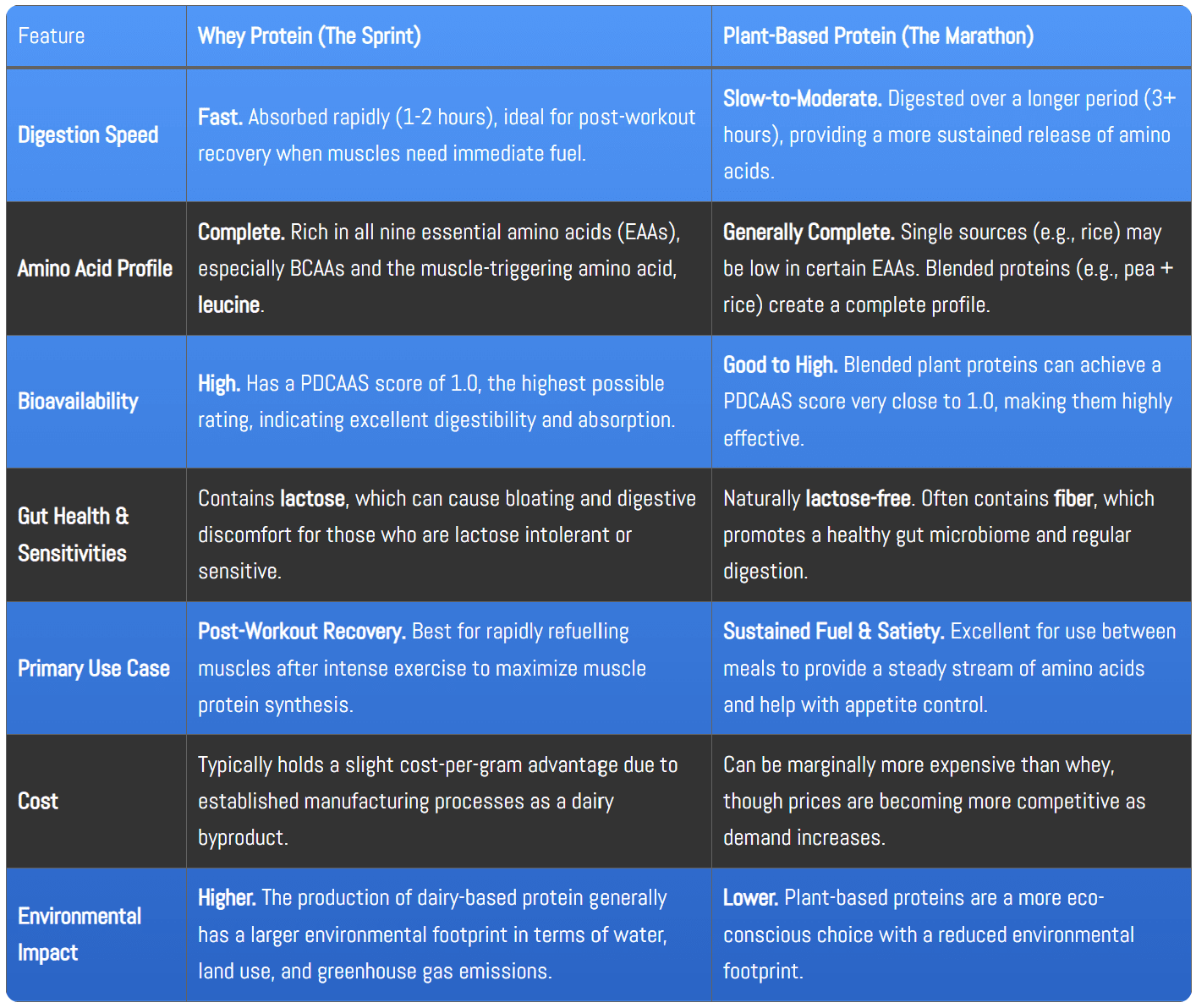
This table lays out the core differences in how your body handles these two protein powerhouses.
| Digestion Factor | Whey Protein (The Sprint) | Plant-Based Protein (The Marathon) |
|---|---|---|
| Digestion Speed | Fast – Rapidly absorbed in the gut. | Moderate to Slow – Often contains fiber, slowing absorption. |
| Amino Acid Profile | Complete – High in all EAAs, especially BCAAs and Leucine. | Varies – Blended sources (Pea+Rice) are complete. Single sources may be lower in certain EAAs. |
| Bioavailability | High – PDCAAS score of 1.0 (the highest possible). | Good to High – Blended proteins can achieve a PDCAAS very close to 1.0. |
| Common Sensitivities | Contains lactose, which can cause bloating in some. | Naturally lactose-free. Some may have sensitivities to legumes (pea) or other sources. |
| Satiety (Fullness) | Less filling due to rapid digestion. | Typically more filling due to slower digestion and often higher fiber content. |
The Nuances Beyond the Basics
This is where the conversation gets interesting. It’s not just fast vs. slow.
- The Fiber Factor: Many plant-based proteins contain dietary fiber. This is a huge plus for gut health and satiety, but it’s also the primary reason digestion is slower. Fiber slows gastric emptying, which is great for steady energy but less ideal for that immediate post-workout spike.
- The Leucine Threshold: Research suggests there’s a “leucine threshold” that must be met to maximally stimulate MPS—roughly 2-3 grams per meal. This is supported by studies in the Journal of Applied Physiology, which highlight leucine’s critical role in initiating muscle repair. Whey naturally clears this hurdle with ease. With plant-based protein, you may need to consume a slightly larger serving to hit that same leucine trigger, making your scoop size an important consideration.
- The “Heavy Feel”: Some guys report whey makes them feel bloated or heavy. This is often down to lactose intolerance (even a mild one). Plant proteins, being dairy-free, typically avoid this issue entirely, offering a “lighter” digestive experience.
Beyond Digestion: Other Factors to Consider
Your choice isn’t made in a vacuum. While digestion is paramount, real-world decisions involve other variables.
- Cost: Whey protein often holds a slight edge in cost-per-gram of protein, as its production is a well-established industry byproduct of cheese manufacturing. High-quality blended plant proteins can be marginally more expensive.
- Sustainability & Ethics: For many, this is a deciding factor. Plant-based proteins generally have a lower environmental footprint in terms of water usage, land use, and greenhouse gas emissions compared to dairy-based whey. This aligns with a more eco-conscious approach to nutrition.
Making the Call: Which Protein is Your Co-Pilot?
So, which one should you choose? The answer lives in your goals and your gut.
Choose WHEY Protein if:
- Your primary goal is rapid post-workout recovery.
- You want the most efficient way to hit the leucine threshold.
- You have no issues digesting dairy.
- You’re looking for the most researched, clinically proven option for muscle growth.
Choose PLANT-BASED Protein if:
- You follow a vegan or vegetarian lifestyle.
- You are lactose intolerant or find dairy causes bloating.
- You value sustained energy and appetite control throughout the day.
- You prioritize a whole-food approach and want the added benefit of fiber and other phytonutrients.
- Environmental impact is a significant factor in your purchasing decisions.
The Final Rep
The debate between plant-based and whey protein digestion doesn’t end with a knockout punch. It ends with a strategic choice.
Think of whey as your precision tool—deployed for specific, rapid-response missions after intense training. Think of plant-based as your strategic partner—providing sustained support, better gut health, and a foundation that aligns with a cleaner, plant-forward diet.
The best protein is the one you’ll consistently use, that aligns with your body’s signals, and that fuels the specific results you’re chasing. Now you have the data. The rest is up to you.
Ultimate Protein Comparison Table – Whey vs Plant-Based (DOWNLOAD)