Protease, amylase, and lactase are the biological shears inside enzyme-spiked protein powders. They eliminate post-shake fermentation. They squeeze every gram of amino acid into circulation. This is our 2026 technical baseline. No marketing spin. Just the biochemistry of the 15 to 25 percent price premium. You either need it, or you are burning cash.
Price Disclaimer: Prices shown are approximate and may vary. Check current pricing and availability on Amazon.
Digestive Enzymes 101: Four Catalysts, Four Jobs
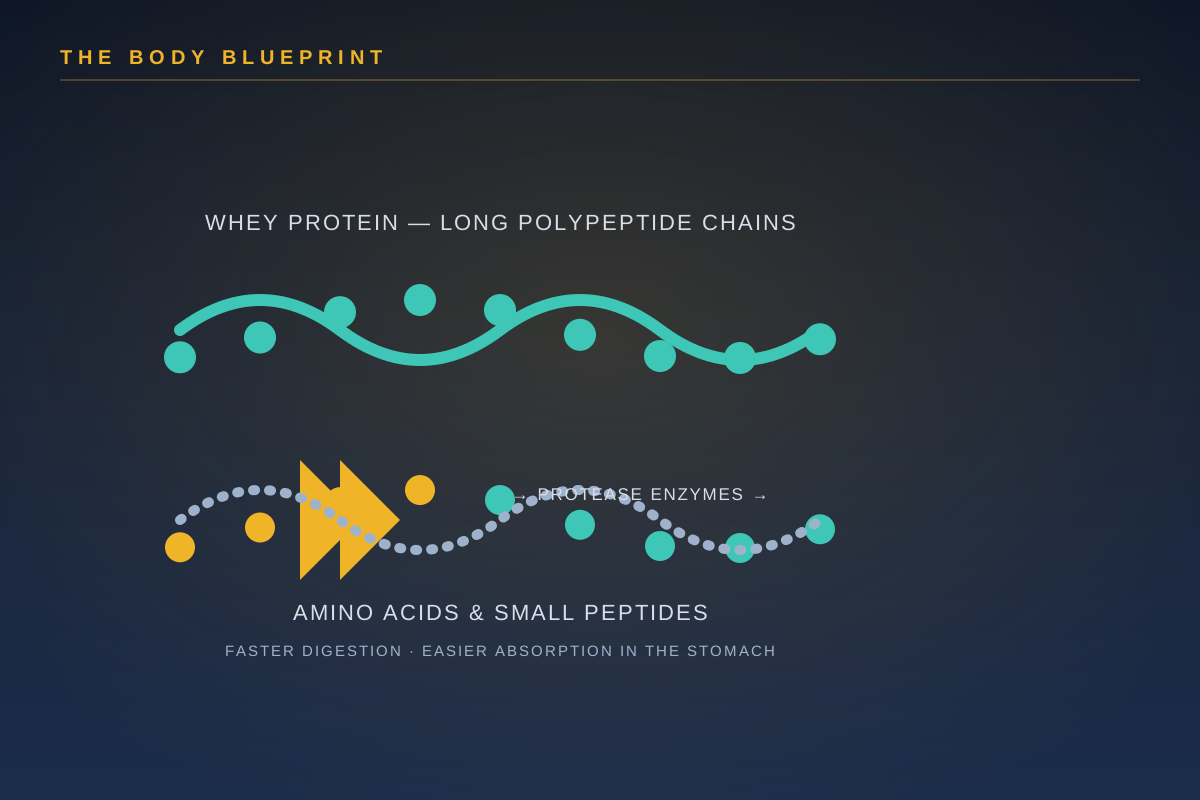
Digestive enzymes are specialized protein molecules. They act as biological catalysts. They cleave intact macronutrients into transportable subunits. These subunits cross the intestinal epithelium. Without them, even the cleanest whey isolate becomes a fermenting brick in your colon.
Protease is the heavy lifter. It snips long-chain whey and casein proteins. It breaks them down into di-peptides, tri-peptides, and free amino acids.
Zero protease activity means undigested protein hits the colon intact. Colonic bacteria feast on it. The byproduct: hydrogen, methane, and hydrogen sulfide gas. This is the biochemical origin of protein farts. It clears gym floors. It ruins meetings.
Amylase dismantles residual starches. It targets maltodextrins. These act as cheap carriers in whey concentrates and mass gainers. It is less critical if you run pure whey isolate. It becomes mandatory the second carbohydrate fillers enter the matrix.
Lipase hydrolyzes triglycerides. It breaks them into free fatty acids and monoglycerides. This matters when powders contain MCT oil, sunflower lecithin, or whole-food fat fractions. Without lipase, those fats linger. Digestion stalls.
Lactase is the single most clinically relevant enzyme for lifters. An estimated 68 percent of the global population exhibits lactose malabsorption.
Lactase cleaves lactose into glucose and galactose. It spares you the osmotic diarrhea that destroys training blocks. Lactose-free isolates strip most lactose via microfiltration. But standard whey concentrate without lactase hits your gut like a milk grenade within 30 minutes.
“Think of digestive enzymes like pre-drilling a pilot hole before driving a screw. Without the pilot hole, you apply brute force. You hope the wood doesn’t split. With enzymes, the protein slides straight into your bloodstream without the gastrointestinal blowback.”
— Charles Damiano, B.S. Clinical Nutrition
Three Mechanistic Benefits: Absorption, Comfort, Tolerance
Enzyme-enhanced powders deliver three distinct physiological upgrades. Standard powders cannot guarantee these. They are not marketing adjectives. They are measurable outcomes. You can trace them through the digestive cascade.
1. Accelerated Amino Acid Kinetics
Protease supplementation increases protein hydrolysis in the stomach and duodenum. It shuttles leucine into blood plasma faster. Peak concentrations hit harder.
Yes, the anabolic window myth has been debunked. But amino acid kinetics still govern muscle protein synthesis (MPS) signaling. Faster hydrolysis equals faster repair initiation. This is enzyme kinetics applied to a post-workout shaker.
2. Reduced Post-Shake Fermentation
Undigested whey protein ferments in the large intestine. The abdomen distends. Digestive enzymes intercept this cascade upstream. Protease breaks protein into fragments before it reaches the colon. Lipase handles the fat fraction.
For lifters battling protein powder gut distress, the difference is mechanical. You skip the 2 PM boardroom bloat. You stop regretting the 11 AM shake.
3. Lactose Salvage for Dairy-Sensitive Lifters
A powder containing 3,000 to 9,000 FCC ALU units of lactase per serving changes the math. It functionally converts a lactose-intolerant lifter into a whey-tolerant one. For that single serving window.
This matters. Whey concentrate costs 30 to 40 percent less than isolate. If a $0.03 enzyme inclusion lets you tolerate a $1.00 concentrate over a $1.50 isolate, the financial arbitrage is compelling. However, severely intolerant individuals produce zero endogenous lactase. Skip the band-aid. Go straight to pure whey isolate or plant-based protein.
The “Worth It?” Calculation: Who Wins, Who Burns Cash
Enzyme-enhanced protein powders carry a 15 to 25 percent price premium. That translates to roughly $8 to $15 more per 2 lb container. The question is not whether enzymes work. They demonstrably do. The question is whether your digestive infrastructure needs the support. Here is the neutral breakdown:
| Scenario | Verdict | The Biochemistry |
|---|---|---|
| You bloat or cramp after every whey shake | BUY IT | Enzyme-induced pre-digestion neutralizes the mechanism. Undigested protein feeding colonic bacteria stops immediately. |
| You’re mildly lactose intolerant | BUY IT | Lactase inclusion salvages your ability to process cheap whey concentrate. The enzyme surcharge is smaller than the isolate upgrade. |
| You consume 3+ shakes daily | BUY IT | High protein throughput amplifies digestive burden. Cumulative protease support reduces intestinal fatigue over the mesocycle. |
| You digest standard whey perfectly | SKIP IT | Your endogenous protease and lactase production is sufficient. You are paying for enzymes your pancreas makes for free. |
| You already use whey isolate or plant protein | SKIP IT | Isolates are already low-fat and low-lactose via microfiltration. Exogenous enzymes provide marginal additional benefit. |
| You’re on a tight supplement budget | SKIP IT | Buy budget whey. Add a standalone digestive enzyme capsule. It triggers the exact same biochemical effect for less total cost. |
The Brutal Truth: Enzyme-spiked protein is a solution to a specific problem. It is not a universal upgrade. If you don’t have the problem, you don’t need the solution. The supplement industry banks on you buying solutions to problems you don’t have. Don’t be that customer.
How to Choose: The Four-Point Litmus Test
A protein powder with digestive enzymes is only as effective as its base protein matrix. Enzyme names on a label mean nothing without potency data. Here is the non-negotiable four-point screen.
“Enzymes cannot fix a garbage protein matrix. If the powder is loaded with maltodextrin, cheap gums, and soy oil, adding protease just means you absorb the garbage faster.”
— Eugene Thong, CSCS
| Screening Factor | Demand This | Red Flag (Walk Away) |
|---|---|---|
| Protein Source Quality | Whey isolate (>90% protein), clean concentrate (>80%), or a transparent plant blend with full amino acid yields. | “Proprietary protein matrix.” No percentage breakdown. You are buying mystery macros. |
| Enzyme Panel Transparency | Each enzyme listed with activity units: FCC, USP, HUT, DU, or FIP. | “Digestive enzyme blend: 50mg”. No activity breakdown. This is label confetti. It is not a functional dose. |
| Lactase Dose (If Dairy) | Minimum 3,000 FCC ALU lactase units per serving. | Whey concentrate with zero lactase. For 68% of the population, this is intestinal roulette. |
| Additive Load | No artificial sweeteners. No carrageenan. No maltodextrin fillers. Minimal gums. | The ingredient deck reads like a polysorbate convention. Enzymes cannot fix an inflammatory formula. |
The standalone enzyme stack is a legitimate cost-arbitrage strategy. Buy a clean, fast-digesting whey isolate. Pair it with a titrated digestive enzyme capsule. Take it simultaneously.
You get precise enzyme dosing without paying the blended-product markup. You adjust enzyme intake based on meal size. More protease with a 50g shake. Less with a 25g shake. Pre-blended products cannot match this flexibility.
Pro-Tip: If you go the standalone route, secure a broad-spectrum enzyme. Demand minimum 50,000 HUT protease, 5,000 DU amylase, and 3,000 FIP lipase per capsule. Take it with the first sip of your shake. Not 20 minutes after. Enzymes require co-ingestion with the substrate. Timing is non-negotiable.
Enzyme-Spiked vs. Standard Protein: Side by Side
| Metric | Enzyme-Spiked | Standard Whey |
|---|---|---|
| Absorption Velocity | Faster. Exogenous enzymes drive hydrolysis in the stomach. | Relies purely on endogenous pepsin and pancreatic proteases. Slower. |
| Bloating & Gas Risk | Low. Colonic protein fermentation is neutralized. | Moderate to high. Especially acute with whey concentrates and casein. |
| Lactose Handling | Protected. Assuming lactase sits at 3,000+ FCC ALU. | No enzymatic buffer. Isolate required for lactose-sensitive users. |
| Cost per Serving | $1.50 – $2.50 | $1.00 – $1.80 |
| Ideal Target User | Sensitive stomachs. High-volume consumers. Lactose-intolerant athletes. | Digestively robust lifters. Budget-constrained trainees. |
The Bottom Line
Protein powders with digestive enzymes are not a marketing gimmick. They solve a biochemical bottleneck for a specific subset of lifters. If you ever unbutton your pants after a shake, pray the gas stays internal, or feel like your roughly $60 tub of whey passes unabsorbed, this is a legitimate upgrade. Protease reduces fermentation. Lactase salvages dairy tolerance. Amylase and lipase clear the carbohydrates and fats.
But if your gut handles standard whey like a blast furnace, you are burning cash. Your pancreas and intestinal brush border already synthesize sufficient endogenous enzymes. The smart financial play: buy clean hydrolyzed whey. Add standalone digestive enzymes only when needed. You unbundle the enzyme from the protein. You gain precision. You save $5 to $10 a month.
Enzyme-spiked protein serves a distinct tactical purpose. Know your gut architecture. Buy accordingly. Do not fix a system that is not broken.
Verdict: Stop Fermenting. Start Absorbing.
Ready to eliminate post-shake bloat with a protein matrix that respects your intestinal epithelium? Explore our top-rated, easy-digesting protein picks below.
*Verified 2026 review. Individual results vary based on endogenous enzyme status, gut microbiome composition, and specific protein sources.