Daily pushup routine: the highest-ROI strength tool most men already own. Pushups build chest, triceps, shoulders, core, and even biceps with zero equipment and zero gym membership. Done right, a daily plan compounds into serious strength and definition; done wrong, it is a fast track to joint pain. We broke down the level system, the variations, and the form fixes that separate progress from plateaus.
The Daily Plan: Pushup Volume by Level
Pushup volume is the dial you turn to make progress, and the level system below is the honest starting point. Match your current max, not your ego. Spread reps across the day when needed, because consistency beats heroics every time.
Beginner Routine (0 to 20 pushups max):
- Week 1-2: 5 sets of 6 pushups, spread throughout the day if needed.
- Week 3-4: 6 sets of 10 pushups.
- Goal: hit 50 pushups in one session before moving up a level.
Intermediate Routine (20 to 50 pushups max):
- Week 1-2: 4 sets of 20 pushups, one minute of rest between sets.
- Week 3-4: 6 sets of 20 pushups.
- Goal: push toward 100 total reps daily.
Advanced Routine (50+ pushups max):
- Week 1-2: 3 sets of 50 pushups.
- Week 3-4: 5 sets of 50 pushups.
- Goal: add variations, explosive reps, and one-arm pushups.
| Level | Sets x Reps (Weeks 3-4) | Daily Volume | Rest Between Sets |
|---|---|---|---|
| Beginner | 6 x 10 | 60 | Up to 2 minutes |
| Intermediate | 6 x 20 | 120 | 1 minute |
| Advanced | 5 x 50 | 250 | 90 seconds |
The key rule is simple: do not do them all at once. Morning, post-workout, before bed, the clock does not care when you train. It only cares that you train. Ten reps before your shower, twenty at lunch, and twenty after dinner still totals fifty, and it never feels like a workout.
Level-up trigger: two consecutive sessions at your top volume with clean form means it is time to add five reps to each set. That is progressive overload in its purest, most boring, most effective form. Boring on purpose, and brutally effective because of it.
Muscle Groups Targeted
A standard pushup is a full upper body chain: chest, triceps, front shoulders, core, and even a biceps assist. Here is who does what in every rep.
| Muscle | Role | Activation Peak |
|---|---|---|
| Chest (Pectoralis Major) | Primary press driver | Bottom to mid-range |
| Triceps | Elbow extension | Lockout phase |
| Front Shoulders (Anterior Deltoid) | Shoulder flexion | Bottom position |
| Core (Abs, Obliques, TVA) | Anti-sag stabilization | Held throughout |
| Biceps (Assist) | Elbow stability | Eccentric descent |
The core work is the hidden bonus. Pushups force your midsection to brace against sag, so you train abs without a single crunch. Film one set from the side and you will see exactly where your chain breaks.
Pushup Variations That Maximize Gains
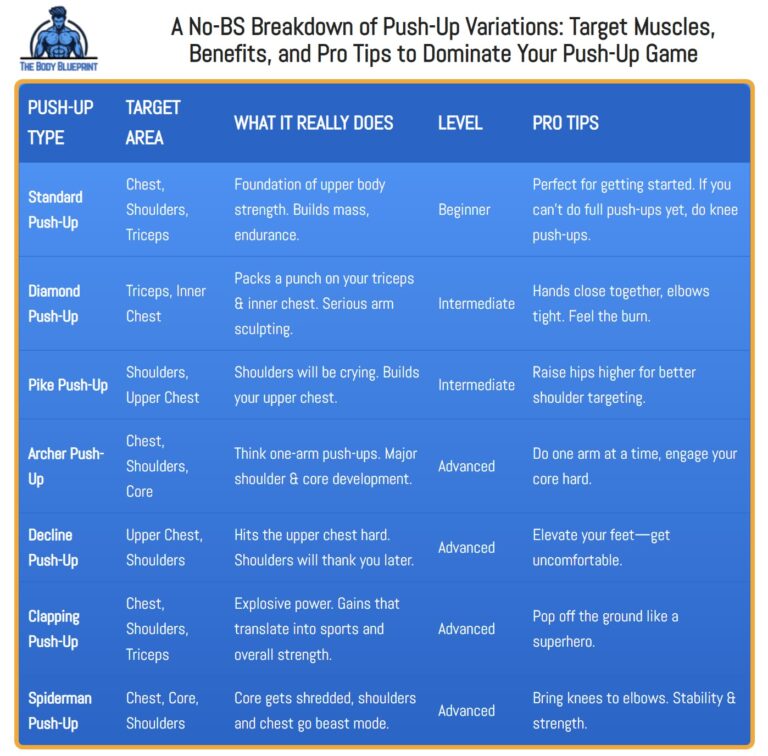
Standard pushups are the foundation; standard pushups forever is a plateau with a mirror. Variations shift the load to different muscles and keep the nervous system adapting, which is exactly what long-term progress requires.
| Variation | What It Works | Why You Should Do It |
|---|---|---|
| Incline Pushups | Lower chest, shoulders | The on-ramp for anyone who cannot do a full rep yet. |
| Decline Pushups | Upper chest, shoulders, triceps | Adds difficulty and forces more muscle engagement. |
| Archer Pushups | Chest, shoulders, stabilizers | Builds one-arm strength and coordination. |
| Diamond Pushups | Triceps, inner chest | Forces stronger triceps activation, ideal for arm mass. |
| Explosive Pushups | Fast-twitch fibers, core, chest | Develops power for athletes and fighters. |
Rotate two or three variations into your weekly rotation. Standard pushups build the base; variations build the athlete. One practical pattern: standard and diamond through the week, decline or explosive on your strongest day, archer reserved for the day you feel invincible. Pair the pressing work with a pull movement like chin-ups so the upper body stays balanced.
The Benefits Beyond the Mirror
A daily pushup habit pays out in strength, stability, and metabolic work, not just a fuller chest. The returns stack quietly, then show up when you least expect them.
- Builds strength and endurance: every rep contributes to muscle growth and pressing power, and the endurance transfer is why pushups are a military staple.
- Enhances core stability: a proper pushup forces your core to brace against sag, no crunches required.
- Boosts metabolism: higher rep work keeps the furnace lit, and daily frequency means the effect compounds instead of fading between Monday workouts.
- Fits any schedule: hotel room, park bench, airport gate, zero excuses available, and no warm-up time to justify.
- Low injury risk when done right: joint-friendly versus heavy bench pressing, sustainable for decades instead of seasons.
Pushups are the gateway to the entire bodyweight arsenal: rows, dips, pull-ups, and hinges. The complete zero-gear movement library lives in the bodyweight training hub.
Mistakes That Ruin Your Gains
Bad form is the silent tax on every pushup you have ever done. Fix these five and your results will look like you hired a coach.
- Bad form equals zero results: hands shoulder-width apart, body in a straight line from head to heels, elbows at a 45 degree angle. Full range of motion or nothing.
- Same rep count every day: if you are not adding reps or difficulty, you are not growing. The body adapts to what you repeat, so repeat something harder.
- Ignoring variations: standard-only pushups plateau fast. Variety is what keeps the adaptation coming.
- Skipping rest and recovery: daily does not mean non-stop. If your muscles feel like garbage, take the day off. Rest is part of the program, not a failure of it.
- Neglecting other muscles: balance pushups with rows, dips, and pull-ups for a complete upper body, or you build a press without a pull.
“Pushup form is a straight line from head to heel, and the elbows should track at roughly 45 degrees, not flare out. The moment your hips sag or your elbows wing out, the chest stops working and the shoulders start paying.”
Eugene Thong, CSCS
Progression rule of thumb: add reps, cut rest time, or add difficulty. When 50 pushups feel easy, that is not the finish line. That is the signal to make them harder.
Pushup FAQ: The Questions That Matter
Will doing pushups every day mess up my joints? Only if you rush reps, skip rest, and ignore pain. That combination is how you earn tendinitis. Focus on form, listen to your body, and cut volume when recovery lags.
Can a daily pushup routine replace weightlifting? For pure mass, no. For functional strength, endurance, and definition, pushups deliver. Add weighted pushups or resistance bands and they become a legit strength tool. For a full strength program, see our beginner resistance training guide.
Should I do pushups in the morning or at night? Whenever you will actually do them. Morning pushups wake up the nervous system; night pushups cement the habit. Pick a time and stop negotiating with yourself.
How do I keep progressing without burning out? Progressive overload: add reps, cut rest, add difficulty, one small step at a time. A slow, consistent climb beats a heroic push that ends in injury.
Can pushups build an athletic, functional physique? Yes. Military and fighter programs use pushups as a foundation because they build explosiveness, endurance, and control that transfer directly to performance.
The Bottom Line
The verdict is simple: a daily pushup routine is one of the highest-ROI strength investments you can make without a gym. The plan works because it is specific, the variations work because they force adaptation, and the habit works because it travels with you.
- Do it if: you want strength, endurance, and definition without equipment, gym time, or excuses.
- Skip it if: you refuse to progress, hate tracking reps, or expect results from half-reps.
Pair it with a lower-body staple like box squats and you have a complete no-gym foundation. Upper body, lower body, zero excuses.
Verdict: The Daily Pushup Edge
You have the plan. Match your level, track your reps, and push past plateaus. The results are guaranteed by the math of progressive overload.
Scientific Anchors:
- Pushup capacity is associated with cardiovascular endurance in adult men (Yang et al., JAMA Network Open, 2019).
- Hand position shifts muscle activation during pushups, with wide and narrow grips changing triceps and deltoid emphasis (Cogley et al., Journal of Strength and Conditioning Research, 2005).
- Progressive overload remains the primary driver of muscular adaptation (Schoenfeld, 2016).
The Pushup Lexicon: Terms That Matter
Progressive Overload
Gradually increasing reps, sets, or difficulty so the muscles are forced to adapt and grow.
Eccentric (Lowering Phase)
The controlled descent of the pushup. Slow it down to build more strength and control.
Range of Motion
Full reps lower your chest to the floor and press all the way up. Partial reps are how plateaus happen.
Tempo
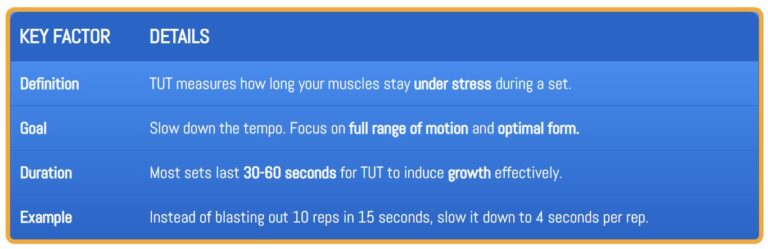
The speed of each rep. A controlled two-second descent with an explosive press builds more power.
Reps and Sets
A rep is one pushup; a set is a group of reps. Total volume is what drives adaptation.