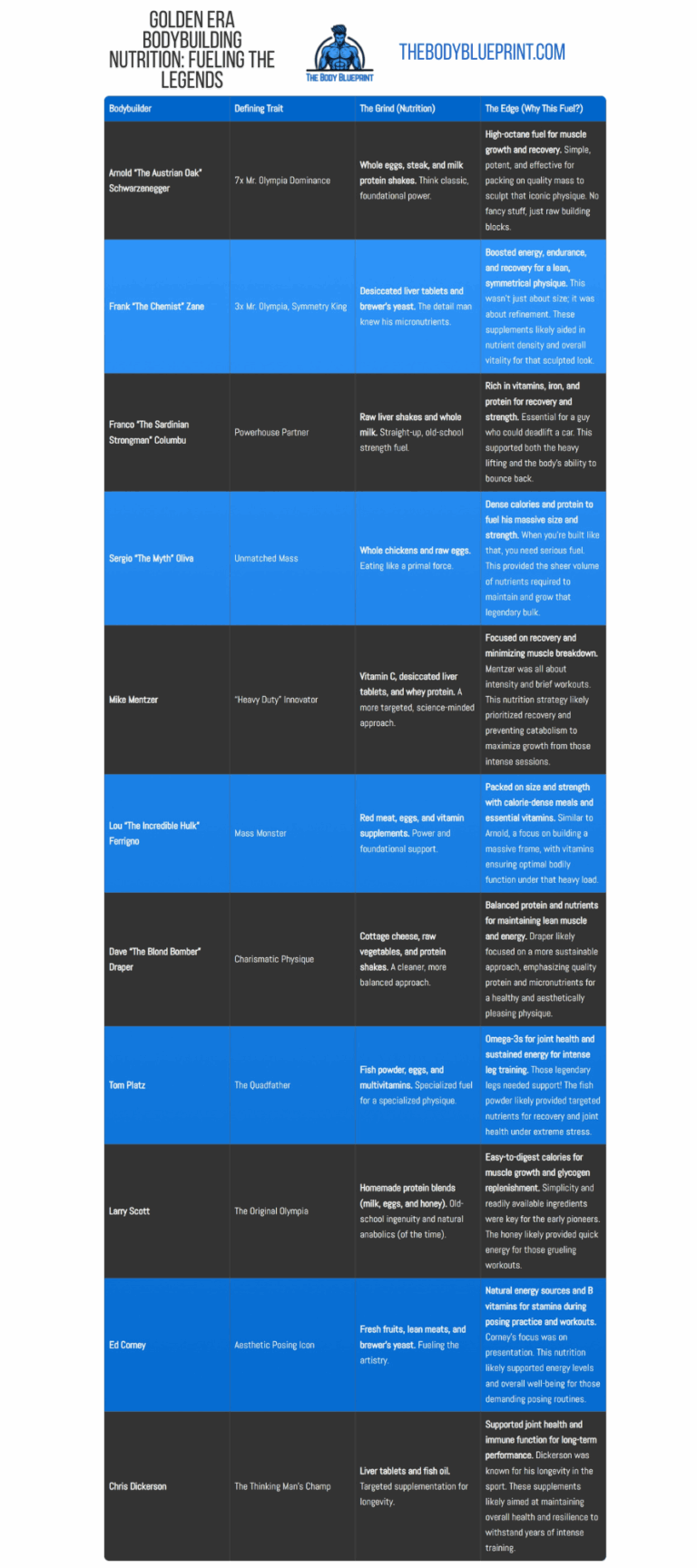
Golden-era bodybuilders built Mr. Olympia physiques on a macro architecture of 1-1.5 grams of protein per pound of bodyweight, 2-4 grams of carbohydrates per pound, and 20-30% of total calories from whole-food dietary fat — without modern ultra-processed powders, tracking apps, or spreadsheets. The ratios worked because the food sources were single-ingredient and the compliance was involuntary. You eat what is in front of you when the alternative is losing to Sergio Oliva on stage.
Disclosure: This article is for informational and entertainment purposes only, not medical advice. As an Amazon Associate, I earn from qualifying purchases at no extra cost to you. We analyze published nutritional methodologies rather than write advertorial fluff. Statements regarding dietary supplements have not been evaluated by the FDA and are not intended to diagnose, treat, cure, or prevent any disease or health condition.
Price Disclaimer: Prices shown are approximate and may vary. Check current pricing and availability on Amazon.

Protein Architecture: 1-1.5g Per Pound From Whole Eggs, Steak, Cottage Cheese, and Whole Milk
Whole eggs, ribeye steak, full-fat cottage cheese, and whole milk delivered 1 to 1.5 grams of protein per pound of bodyweight for golden-era bodybuilders, with nitrogen balance as the north star and zero grams of whey isolate involved in the calculation. The protein target was not a decimal point. It was a range, and the range was built on whole-food sources that carried micronutrients alongside the amino acids. A dozen eggs delivered 72 grams of complete protein plus choline, vitamin D, and saturated fat for hormone production. A scoop of modern whey isolate delivers 25 grams of protein and roughly nothing else. The math on the label favors whey. The nutritional density favors eggs.
- 1-1.5g Per Pound of Bodyweight: A 200-pound lifter consumed 200-300 grams of protein daily, split across three to four meals. No six-meal Tupperware protocol. Just large feedings of whole food spaced across the day.
- Casein at Bedtime From Cottage Cheese: Slow-digesting casein protein supplied amino acids through the overnight fast. Modern micellar casein powders replicate this mechanism. Golden-era lifters used cottage cheese. Same amino acid delivery, different century, identical principle.
- Post-Workout Protein From Whole Milk: Whole milk contains roughly 80% casein and 20% whey by protein fraction. Drinking milk after training delivered both fast and slow protein fractions without anyone knowing the terms “casein” and “whey” yet. The milk did not come with a scoop. It came in a glass.
- Organ Meats as the Multivitamin: Liver, heart, and kidney appeared two to three times weekly. Liver alone delivers heme iron, B12, zinc, and copper at concentrations muscle meat cannot match. It tasted like punishment. They ate it anyway because the alternative was losing.
“Without enough protein, you are rebuilding a house with half the bricks. Golden-era lifters did not know their exact nitrogen balance. They knew that if the steak was finished and the eggs were gone, they were probably short. So they ate more. Crude, effective, and weirdly more accurate than most people’s MyFitnessPal entries.”
— Charles Damiano, B.S. Clinical Nutrition
Carbohydrate Strategy: 2-4g Per Pound From Oats, Rice, Potatoes, and Fruit
Steel-cut oats, white rice, potatoes, and whole fruit supplied 2 to 4 grams of carbohydrates per pound of bodyweight, with intake clustered around training sessions and tapered on rest days through intuition rather than a spreadsheet-based cycling protocol. Insulin was the anabolic lever, and golden-era lifters understood that carbohydrates shuttled amino acids into muscle tissue after training without anyone needing to draw a diagram of the mTOR pathway. Eat carbs around the workout. Eat fewer carbs when you are not training. The principle is simple. The discipline to execute it daily is not.
- Pre-Workout Carbohydrates for Training Fuel: Oats, bananas, and potatoes supplied glycogen for heavy squat and deadlift sessions. A bowl of oatmeal and a banana before squatting 400 pounds. No pre-workout powder. No carb gel. Real food doing the same job.
- Post-Workout Carbohydrates for Glycogen Replenishment: Mashed potatoes, white rice, and pineapple delivered fast-digesting carbohydrates when insulin sensitivity was highest. The post-workout window was not called a window. It was called “dinner.” Same mechanism, different branding.
- Rest-Day Carbohydrate Reduction: Carbohydrate intake dropped naturally on rest days because training was not driving hunger and glycogen demand was lower. No carb-cycling spreadsheet. Just eating less when you need less. Radical concept.
- No Carbohydrate Fear: Potatoes, bread, rice, and oats were staples, not villains. The anti-carb movement had not been invented yet. The physiques that resulted from this approach were the leanest and most aesthetic in the sport’s history. Let that sit for a moment.
“Carbs after 6 PM? Sure — if you are burning them, not storing them. The golden-era guys did not have a carbohydrate curfew. They had a training session that justified the potato on the plate. When you squat 400 for reps, your body does not check the clock before deciding where to put the glucose. It puts it in the muscle because the muscle is screaming for it.”
— Eugene Thong, CSCS
Dietary Fat Ratios: 20-30% of Calories From Egg Yolks, Butter, and Fatty Meat
Egg yolks, butter, heavy cream, fatty cuts of red meat, and whole milk supplied 20 to 30 percent of total daily calories from dietary fat, with saturated fat functioning as the substrate for testosterone production and fat-soluble vitamin absorption. The golden era did not have a fat phobia. The low-fat dogma that dominated the 1980s and 1990s had not arrived. Egg yolks were not the enemy. Butter was not a cheat food. Whole milk was not a compromise. These were the staples, and the physiques that resulted set the standard that the low-fat era could not match.
- Whole Eggs, Not Egg Whites: The yolk contains choline, vitamin D, vitamin A, and the saturated fat required for steroid hormone synthesis. Golden-era lifters ate the whole egg because the whole egg is the nutrient-dense package. Egg-white-only culture arrived decades later and produced physiques that, on average, looked worse.
- Butter and Heavy Cream as Caloric Density Tools: A tablespoon of butter contains roughly 100 calories and fat-soluble vitamins. Heavy cream added to shakes delivered slow-burning energy without increasing food volume. Caloric sufficiency without stomach distension. Practical, not dogmatic.
- Fatty Cuts of Red Meat for Micronutrient Density: Ribeye, sirloin, and organ meats delivered zinc, heme iron, and B12 in a matrix that enhanced absorption. Modern bodybuilding replaced fatty steak with chicken breast, then added zinc, iron, and B12 back as separate supplements. The circularity is expensive.
- Dietary Fat Rose Slightly During Contest Prep: When carbohydrates dropped before a show, fat intake increased modestly to preserve hormone function and energy levels. Intuitive cycling. No “hormone optimization protocol.” Just eating more fat when carbs went down because the body still needed fuel.
“Testosterone is built on a cholesterol backbone. You remove dietary cholesterol, you remove the raw material. Golden-era bodybuilders did not know the steroidogenesis pathway. They knew that the guys eating egg whites and dry chicken breast looked flat, and the guys eating whole eggs and ribeye looked full. Sometimes the results arrive before the mechanism is understood. The mechanism arrived later. The results were already on stage.”
— Charles Damiano, B.S. Clinical Nutrition
A Day on the Plate, 1975 Edition: Macro Breakdown for a 200-Pound Lifter
Six whole eggs with oats at breakfast, cottage cheese on sourdough mid-morning, an eight-ounce sirloin with rice and avocado at lunch, and salmon with sweet potato at dinner formed the daily macro architecture that delivered roughly 250 grams of protein, 400 grams of carbohydrates, and 100 grams of dietary fat across three to four sittings. No six-meal alarm schedule. No macro app. Just real food, consistent timing, and enough total calories to support the training.
| Meal | Protein Source | Carb Source | Fat Source | Estimated Macros |
|---|---|---|---|---|
| Breakfast (7 AM) | 6 whole eggs, 2 slices bacon | 1 cup oats, 1 banana | Egg yolks, bacon fat | ~55g P / ~80g C / ~35g F |
| Mid-Morning (10 AM) | 1 cup cottage cheese | 2 slices sourdough | 1 tbsp butter | ~35g P / ~45g C / ~15g F |
| Lunch (1 PM) | 8 oz sirloin steak | 2 cups white rice | 1 avocado | ~60g P / ~90g C / ~30g F |
| Pre-Workout (4 PM) | 1 cup Greek yogurt | 1 cup pineapple | 1 tbsp coconut oil | ~25g P / ~40g C / ~14g F |
| Post-Workout (7 PM) | 8 oz salmon | 1 large sweet potato | 2 tbsp butter | ~50g P / ~60g C / ~28g F |
| Bedtime (10 PM) | 1 cup cottage cheese | 1/2 cup berries | 1 tbsp peanut butter | ~30g P / ~20g C / ~12g F |
Day Total: ~255g protein, ~335g carbohydrates, ~134g fat. Roughly 3,500 calories. Protein at 1.27g per pound of bodyweight. Carbs at 1.67g per pound. Fat at 30% of total calories. The math works. No app needed to confirm it. The food selection makes the macros fall into place automatically.
The carb taper is visible without being programmed: Carbohydrates cluster around the morning and pre/post-workout windows, then drop naturally at bedtime. No one wrote “carb cycling protocol” on a napkin. The meal structure produced the taper organically because the body’s hunger and energy demands follow the training schedule. Sometimes the simplest explanation is the correct one: eat fuel when you need fuel. Eat less fuel when you are about to sleep for eight hours.
The Three Pillars: Whole Food Over Abstraction, Intuitive Cycling, and Gut-Health Integration
Whole-food protein sources over processed powders, intuitive carbohydrate cycling around training sessions, and fermented foods like sauerkraut and yogurt for digestive support formed the three nutritional pillars that made golden-era macro strategies work without a single tracking device. The principles are simple enough to explain in a paragraph. The execution requires the discipline to eat real food consistently for years.
1. Whole Foods Over Macros in Isolation
Steak, whole eggs, potatoes, oats, and full-fat dairy deliver complete amino acid profiles, bioavailable micronutrients, and the cofactors that support absorption — a nutritional package that isolated protein powders cannot replicate at any price point. Liver tablets and brewer’s yeast were the only “supplements” in regular rotation. The entire supplement shelf fit in a shoebox. The physiques that resulted from this approach remain the aesthetic benchmark fifty years later. That is not an endorsement of the approach. It is a data point.
2. Intuitive Cycling Without Spreadsheets
Carbohydrate intake rose on heavy training days and dropped on rest days, dietary fat increased slightly during contest prep when carbohydrates decreased, and protein remained constant across all phases because muscle preservation was non-negotiable. No one called it “carb cycling.” No one built a seven-day macro spreadsheet. The adjustments happened naturally because training volume drove hunger and meal size. When you squat 400 pounds for five sets, you eat more afterward. When you rest on Sunday, you eat less. The body regulates intake around energy demand when the food is whole and unprocessed.
3. Gut Health Through Fermented Foods
Sauerkraut, yogurt, kefir, and pickled vegetables supplied natural probiotics that supported digestion and nutrient absorption decades before probiotic capsules existed as a commercial category. The fiber came from oats, potatoes, vegetables, and fruit — not from a psyllium husk supplement. The gut-health protocol was a side dish, not a pill bottle. It worked because the food matrix delivered the bacteria and the fiber simultaneously, the way the digestive system expects to receive them.
“Modern lifters chase superfoods from the Amazon rainforest shipped in refrigerated containers. Golden-era bodybuilders ate liver, sauerkraut, and sardines that cost pocket change and came in cans. The superfoods were not super because they were rare. They were super because they were dense. Density is cheap. Rarity is expensive. The golden era bought density.”
— Charles Damiano, B.S. Clinical Nutrition
Golden Era Macro FAQ
- Did golden-era bodybuilders count grams or just eat until full?
- They used fixed meal templates and visual cues, not gram counting. The mirror and the tape measure provided the feedback. If the waist was tightening and the squat was climbing, the macros were right. If the abs started fading, carbs dropped. Three data points — mirror, tape, and barbell. The feedback loop was simpler and, for whole-food diets, surprisingly accurate.
- What was the bedtime protein strategy before casein powder existed?
- Cottage cheese provided slow-digesting casein protein for overnight amino acid delivery. A cup of full-fat cottage cheese contains roughly 28 grams of casein-dominant protein plus dietary fat to slow gastric emptying further. The modern bedtime shake is flavored and powdered. The mechanism is identical to what cottage cheese did in 1972.
- How did they handle hydration and electrolytes without sports drinks?
- Water with lemon juice, honey, and sea salt functioned as a proto-electrolyte drink. Bananas and potatoes supplied potassium post-workout. Sodium was liberally applied to food because it was understood as essential for muscle contraction, not as a dietary villain. A salted potato and a glass of water covered the same bases as a modern electrolyte packet at roughly zero additional cost.
- Did they eat organ meats regularly, and did it matter?
- Liver, heart, and kidney appeared two to three times weekly. Liver alone delivers heme iron at concentrations muscle meat cannot approach, plus B12, zinc, and copper. “Liver was their multivitamin,” Damiano notes. They hated the taste. They ate it anyway because the recovery benefit was measurable and the alternative was nothing.
- Did macro ratios shift between off-season and contest prep?
- Protein remained constant at 1-1.5g per pound. Carbohydrates dropped from 3g to roughly 1.5g per pound. Dietary fat increased slightly to preserve hormone function. The shifts were gradual, not extreme. No peak-week spreadsheet. No water-manipulation protocol that looked like a chemistry experiment. Just eating slightly less for a few weeks while keeping training intensity high.
- What food combinations did they use to improve nutrient absorption?
- Steak with bell peppers for vitamin C-enhanced iron absorption. Carrots with butter for fat-soluble vitamin A uptake. Oats soaked overnight to reduce phytic acid. These were not studied protocols. They were kitchen habits passed between lifters that happened to align with what the published research would later confirm. Sometimes the practice arrives before the mechanism is understood. The mechanism showed up later. The practice was already producing results.
- How did they stay consistent while traveling for competitions?
- Hard-boiled eggs, beef jerky, dried fruit, and canned tuna formed the travel nutrition kit. If a steak was not available, two chicken breasts were. The mindset was pragmatic: find protein, find carbohydrates, do not make excuses. No one was shipping meal-prep containers ahead to the hotel. The standard was lower and, paradoxically, the compliance was higher.
- Did they use “cheat meals” or structured refeeds?
- Strategic indulgence, not reckless binging. Steve Reeves ate vanilla ice cream after long runs — fast-digesting carbs plus fat to blunt cortisol. The occasional calorie spike prevented metabolic adaptation during extended deficits. “They did not ‘refeed.’ They rewarded. But it was calculated. No one got fat on a scoop of butter pecan,” Thong notes.
Final Verdict: The Ratios Worked Because the Food Sources Were Single-Ingredient
The golden-era macro architecture — 1-1.5g protein per pound from whole eggs and steak, 2-4g carbohydrates per pound from oats and potatoes, 20-30% dietary fat from egg yolks and butter — built Mr. Olympia physiques not because the ratios were magical, but because the food sources made the ratios self-regulating. You cannot easily overeat steak and potatoes. Ultra-processed food did not exist at scale. The food selection enforced the macro targets automatically because whole food is satiating, nutrient-dense, and difficult to consume in the quantities that would exceed caloric requirements. The golden era did not have better ratios. It had better food. The ratios were downstream of the food quality, and the physiques were downstream of the ratios. Fix the food, and the macros fix themselves.
Whole Eggs. Steak. Oats. Potatoes. Butter. Repeat. The Ratio Takes Care of Itself.
The golden-era macro architecture was not built on a spreadsheet. It was built on food that did the math for you. Fix the food quality. The ratios follow.
*This content is for informational and entertainment purposes only. Not medical advice. Consult a qualified professional before changing your diet, exercise, or supplement regimen. Statements regarding dietary supplements have not been evaluated by the FDA.
The Macro Lexicon: Golden Era Edition
- Nitrogen Balance
- The relationship between nitrogen consumed through dietary protein and nitrogen excreted. Positive nitrogen balance indicates an anabolic state where protein synthesis exceeds breakdown. Golden-era lifters did not measure it. They ate until the steak was gone and assumed it was positive. Crude. Also effective.
- Casein
- The slow-digesting protein fraction that forms roughly 80% of the protein in whole milk. Delivers a sustained amino acid release ideal for overnight recovery. Golden-era lifters consumed casein via cottage cheese at bedtime. Same mechanism as modern micellar casein powder. Different century.
- Insulin
- The anabolic hormone released in response to carbohydrate intake that shuttles glucose and amino acids into muscle tissue. Golden-era lifters leveraged insulin by consuming carbohydrates around training sessions. No one explained the mechanism. They observed the effect and repeated what worked.
- Glycogen
- Stored carbohydrate in muscle and liver tissue that fuels training. Heavy squat and deadlift sessions depleted glycogen. Post-workout potatoes and rice replenished it. The cycle was visible in the mirror and measurable on the barbell. No glycogen-tracking app required.
- Heme Iron
- The highly bioavailable form of iron found in animal tissue, particularly red meat and organ meats. Supports oxygen transport and energy metabolism. Liver delivered heme iron at concentrations that make spinach look like a rounding error.
- Fermented Foods
- Sauerkraut, yogurt, kefir, and pickled vegetables containing natural probiotic bacteria that support gut health and nutrient absorption. The golden-era gut-health protocol was a side dish. Probiotic capsules are a modern convenience. Fermented cabbage did the same job in 1972.