Nutricost L-Arginine delivers 5,000mg of unflavored L-arginine powder per serving, 100 servings per 500g tub, as a single-ingredient nitric oxide precursor with no fillers or blend. The pitch is simple: a high per-serving dose of one amino acid at a low price. We compare the published label so you can see whether a standalone arginine powder earns a spot in your stack or whether citrulline does the job better.
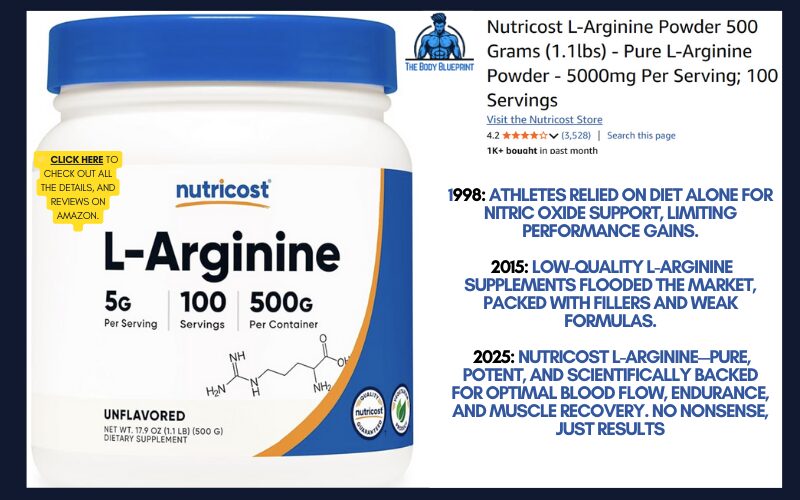
The Spec Sheet: 5,000mg L-Arginine, 100 Servings, No Fillers
One scoop delivers 5,000mg of L-arginine in an unflavored powder, with 100 servings per 500g tub and no added blend, sweetener, or filler. That per-serving dose sits at the high end of the category, and the powder format means you can adjust it down if you want less. The entire product is one amino acid and a scoop, which is the whole pitch.
- 5,000mg Per Serving: A high standalone dose of L-arginine compared to capsule products that often deliver 500 to 1,000mg and require multiple pills. Powder lets you dose flexibly, down to a smaller amount if 5g is more than you want.
- 100 Servings, 500g Tub: A long supply that pushes the per-serving cost low. Do the division against capsule arginine and the powder wins on price per gram every time.
- Unflavored Powder: No sweeteners or flavoring agents, which keeps the label to a single active. The trade-off is a plain, slightly bitter taste that needs mixing into a flavored drink.
- Single Ingredient, No Blend: Just L-arginine, with no proprietary blend hiding the dose. What the label says is what the scoop delivers, which is the transparency case for buying it standalone.
The plain-English version: L-arginine is a raw material, not a finished pump product. Buying it as a single-ingredient powder is like buying flour instead of a boxed cake mix. You control the dose and pay less per gram, but you have to know what you’re doing with it. Nutricost’s only real move here is selling that raw material cheaply and cleanly.
How It Works: Nitric Oxide’s Quiet Precursor
L-arginine is a conditionally essential amino acid and a direct precursor to nitric oxide, the signaling molecule that relaxes blood vessel walls and supports blood flow. Your body makes some on its own, but hard training raises demand. The nitric oxide pathway is the entire reason arginine shows up in pump-focused supplements.
The catch is bioavailability: a meaningful share of oral L-arginine is broken down in the gut before it reaches the bloodstream, which is why it works better paired than solo. This is the well-documented limitation of standalone arginine, and it’s the reason many formulators reach for citrulline instead. The molecule is a precursor. It is not a guaranteed pump in a scoop.
L-arginine’s real value isn’t in overnight miracles. It’s in the subtle uptick in endurance when you’re pushing rep 8, then 9, then 10. Treat it as a small, consistent input on top of solid training, not a switch that flips your workout into a different gear. The people who benefit are the ones already doing the work. — Eugene Thong, CSCS
Who It’s For
Training style, tolerance for marginal gains, and a few medical conditions decide whether standalone L-arginine belongs in your stack. This is a marginal-gains tool, not a transformation supplement, and it repels a few buyers outright.
Built For
- The marginal-gains realist who wants better pumps and vascularity and knows the effect is small, not dramatic.
- Endurance-focused trainees whose sport rewards blood flow and oxygen efficiency.
- Supplement tinkerers who already dial in protein, sleep, and hydration and want one more small input to test.
Skip It If
- You’re pregnant or managing diabetes. Arginine can affect insulin response and is a talk-to-your-doctor item during pregnancy.
- You expect dramatic muscle growth. This is a nitric oxide precursor, not an anabolic. It won’t rewrite your results.
- You want a guaranteed pump. Standalone arginine’s gut breakdown makes the effect inconsistent between people. Citrulline is often the better buy.
Pros and Cons
The Advantages
- Single-ingredient formula: Just L-arginine, no blend or filler hiding the dose.
- High per-serving dose: 5,000mg, at the top of the category, adjustable down in powder form.
- Low cost per gram: The 100-serving tub is budget-friendly for the amount of active.
- Flexible dosing: Powder lets you scale the serving to your own tolerance.
The Trade-offs
- Possible GI upset: High-dose arginine taken solo can cause stomach discomfort for some users.
- Inconsistent effect: Gut breakdown means results vary widely person to person.
- Plain, bitter taste: Unflavored powder needs mixing into a flavored drink.
- Not a standalone hero: Works best stacked with citrulline and backed by hydration and diet.
Arginine vs. Citrulline: The Comparison That Actually Matters
Absorption pathway, nitric oxide durability, and GI tolerance separate L-arginine from L-citrulline, and this is the real decision, not arginine brand vs. arginine brand. Citrulline actually converts to arginine in the kidneys, bypassing the gut breakdown that limits oral arginine. Understanding this comparison tells you whether to buy this product at all.
| Spec | L-Arginine (Nutricost) | L-Citrulline / Citrulline Malate |
|---|---|---|
| Nitric Oxide Pathway | Direct precursor, but heavy gut breakdown | Converts to arginine post-gut, higher blood levels |
| Oral Bioavailability | Lower, much is metabolized before absorption | Higher, bypasses first-pass gut breakdown |
| GI Tolerance | Can cause upset at high solo doses | Generally better tolerated |
| Typical Dose | 3,000 to 6,000mg | 6,000 to 8,000mg |
| Best Use Case | Cheap, flexible, stacked with citrulline | Standalone pump and endurance support |
Short version: citrulline generally raises blood arginine more reliably than arginine itself, because it sidesteps the gut. The strongest case for this product is stacking it with citrulline, or using it as a cheap, flexible arginine source if you already know it works for you.
L-arginine isn’t a firework. It’s a slow-burning fuse. The people who write it off tried it once, felt nothing, and quit. The people who benefit stacked it correctly and gave it weeks. Patience isn’t exciting, but for a marginal-gains ingredient, it’s the whole game. — Charles Damiano, B.S. Clinical Nutrition
How to Use It: A Practical Protocol
Timing, stacking, and cycling are the three variables that determine whether standalone L-arginine does anything useful for you. None of this is complicated, but all of it matters more than the brand on the tub.
- Timing: Take it 30 to 60 minutes pre-workout. Some users prefer an empty stomach for absorption; test what settles well for you.
- Stack it: Pair with 3,000 to 6,000mg of L-citrulline for a more durable nitric oxide effect than either delivers alone.
- Cycle it: A common approach is 8 weeks on, 2 weeks off, though there’s no strict requirement to cycle a single amino acid.
Frequently Asked Questions
- Is L-arginine or L-citrulline better for pumps?
- For most people, L-citrulline raises blood arginine levels more reliably, because it bypasses the gut breakdown that limits oral arginine. Standalone arginine still works for some users, and it’s cheaper per gram, but citrulline is the more consistent single-ingredient pump product.
- Does the 5,000mg dose cause stomach issues?
- It can, since high-dose L-arginine taken solo causes GI discomfort for some users. Starting with a smaller scoop and taking it with a little food or a full drink usually helps. The powder format makes scaling the dose down easy.
- Can I take it with a pre-workout that already has citrulline?
- Yes, and that’s arguably the best use case, since arginine and citrulline together support the nitric oxide pathway from both ends. Just account for the total stimulant and ingredient load across everything you’re taking that session.
- Is Nutricost L-Arginine third-party tested?
- Nutricost states its products are third-party tested and manufactured in a GMP-compliant, FDA-registered facility. Confirm the current testing and manufacturing details on the live product listing before purchase, as label specifics can change.
Final Verdict: A Cheap, Clean Arginine for the Tinkerer
Nutricost L-Arginine wins on three specs: a high 5,000mg dose, a single-ingredient label, and one of the lowest costs per gram in the category. The trade-offs are real: standalone arginine has inconsistent absorption, the effect is marginal rather than dramatic, and citrulline is often the better single-ingredient buy. If you’re a supplement tinkerer who wants a cheap, flexible arginine source to stack, this is a clean pick.
If you want a guaranteed pump from one product, or you expect a transformation, this isn’t it, and no arginine powder is. This is a marginal-gains input for someone whose training, protein, and sleep are already handled. Buy it as a tool, not as a treasure. Confirm the live price at the link.
5,000mg L-Arginine. 100 Servings. Single Ingredient. No Filler.
A cheap, clean, flexible arginine powder for the stack-builder. Marginal gains for the tinkerer, not a transformation for everyone else.
*Price, dose, and formula subject to change. Verify on the live listing. Statements not evaluated by the FDA. Not intended to diagnose, treat, cure, or prevent any disease.
Related Supplement Guides
- Muscle Growth Supplements: A Lifter’s Guide to What Works
- Nutricost R-ALA Review: A No-Nonsense Alpha-Lipoic Acid
- Golden-Era Diet Principles: Meat, Grit, and the Basics
The Supplement Lexicon: Nitric Oxide Edition
- L-Arginine
- A conditionally essential amino acid and a direct precursor to nitric oxide. Demand rises during intense training. Its oral effect is limited by breakdown in the gut before absorption.
- Nitric Oxide (NO)
- A signaling molecule that relaxes the smooth muscle in blood vessel walls, widening them and supporting blood flow. The mechanism behind the “pump” effect.
- L-Citrulline
- An amino acid that converts to L-arginine in the kidneys, bypassing the gut breakdown that limits oral arginine. Often a more reliable single-ingredient nitric oxide precursor.
- Bioavailability
- The proportion of an ingested dose that actually reaches the bloodstream in active form. Oral L-arginine has lower bioavailability than citrulline due to first-pass gut metabolism.