The Offset Dumbbell Reverse Lunge From Deficit is an anti-rotation core challenge that builds brutal single-leg strength and stability.
This isn’t a casual lunge. It combines a deficit for greater range of motion with an offset load to torch your obliques and glutes. This is the 2026 guide to mastering the mechanics, programming the pain, and integrating it for bulletproof legs.
Disclaimer: You’re here to find an exercise that’ll get you results, and I’m here to help. Master bodyweight form first. Consult a physician or coach if you have existing knee, hip, or back issues. This guide is for educational purposes.
What Is The Offset Deficit Reverse Lunge?
This exercise is a three-layer complexity upgrade to the standard lunge: a reverse step, a deficit, and an offset load. Each layer solves a different problem. The reverse step is knee-friendly and glute-dominant. The deficit (standing on a plate or step) increases range of motion and stretch. The offset load (dumbbell in one hand) forces your core to resist rotation and your legs to work unevenly. The result is a comprehensive lower-body and core stabilizer drill.
- Primary Muscles: Glutes, Quadriceps (front leg), Hamstrings.
- Stabilizers & Anti-Rotation: Core, Obliques, Spinal Erectors, Glute Medius.
- Key Benefit 1: Increased single-leg strength and hypertrophy from greater range of motion.
- Key Benefit 2: Enhanced core stability and anti-rotational strength, translating to heavier squats and deadlifts.
- Key Benefit 3: Improved ankle dorsiflexion and hip mobility from the deficit.
Step-by-Step Technique & Execution
Master the static position before you move. Grip, posture, and bracing are non-negotiable. Here’s the breakdown. Watch the form video first, then follow the steps.
The Setup & Stance
- Create the Deficit: Stand on a 25-45 lb plate or a 2-4 inch step. Ensure it’s stable.
- Grip the Offset Load: Hold one dumbbell in one hand (e.g., right hand), letting it hang at your side. Do not rest it on your shoulder.
- Establish Posture: Stand tall, chest up, shoulders back. Brace your core as if bracing for a punch. Your free hand can be on your hip or out for balance.
The Movement Pattern
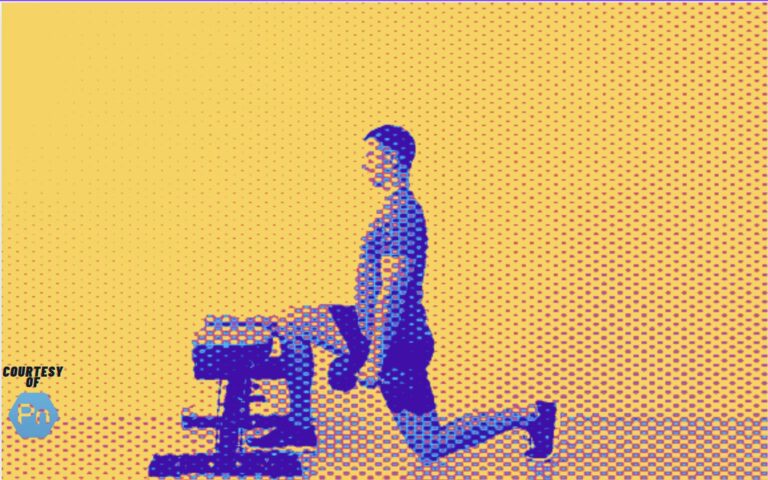
- Initiate the Reverse Step: From the deficit, step backwards with the leg on the same side as the weight (right leg back if weight is in right hand). This is the “offset” pattern.
- Control the Descent: Lower your back knee straight down towards the floor. Keep your front shin as vertical as possible. Your torso should remain upright—do not lean forward.
- Find Depth: Lower until your back knee lightly touches or hovers just above the floor. You should feel a deep stretch in the hip flexor of the back leg and tension in the glute of the front leg.
- Drive Through the Front Heel: Push through the mid-foot/heel of your front foot to return to the starting position on the deficit. Squeeze your front glute hard at the top.
- Complete Reps: Perform all reps on one side before switching the dumbbell to the other hand and repeating with the opposite leg.
“The offset deficit reverse lunge is a diagnostic tool. If you can’t maintain an upright torso and your knee caves in, you lack the requisite single-leg stability and hip strength for advanced loading. Regress to a Dumbbell Reverse Lunge or a Bodyweight Reverse Lunge with Blocked Knee before adding complexity.”
— Eugene Thong, CSCS
4 Common Form Mistakes & Fixes
These errors turn a precision tool into a backache. Film your set from the side to self-correct.
1. Leaning the Torso Forward
The Mistake: Letting the offset weight pull your torso toward the weighted side or leaning forward during the lunge.
The Fix: Actively brace your core and imagine pushing the dumbbell “away” from your body with your lat. Keep your chest proud. Think “tall spine.”
2. Inadequate Deficit Control
The Mistake: Stepping back too far or at an angle, losing balance on the deficit.
The Fix: Step straight back, not at a diagonal. Your step should be long enough for a 90-degree angle at both knees at the bottom. Practice the step without weight first.
3. Knee Valgus (Knee Cave)
The Mistake: The front knee collapsing inward during the descent or drive.
The Fix: Actively screw your front foot into the floor (external rotation) to engage the glute. Use a lighter weight and prioritize knee-over-toe alignment. Strengthen your glutes with X-Band Walks.
4. Rushing the Eccentric
The Mistake: Dropping quickly into the bottom position.
The Fix: Take 3 seconds to lower. Control is strength. The stretch under load is a key stimulus. If you can’t control it, the weight is too heavy.
Programming, Sets, Reps & Progressions
Program this as an accessory or hypertrophy movement, not a primary strength lift. It’s for building resilient muscle, not maxing out.
- For Hypertrophy & Stability: 3-4 sets of 8-12 reps per side. Use a controlled tempo (e.g., 3-1-1).
- For Strength-Endurance: 2-3 sets of 12-15 reps per side. Focus on perfect form under fatigue.
- Rest Periods: 60-90 seconds between sets.
How to Progress The Movement
- Increase Weight: Move up in 5-10 lb increments when you can cleanly hit the top of your rep range.
- Increase Deficit Height: Move from a 25 lb plate to a 45 lb plate, or add a second plate (cautiously).
- Slow the Tempo: Implement a 4-second eccentric (lowering) phase.
- Add a Pause: Pause for 2 seconds at the bottom of each rep, eliminating momentum.
Workout Integration & Related Exercises
Place this exercise in the middle of your leg day, after your primary squats or deadlifts. Pair it with other single-leg or stability work for comprehensive development. Explore our full library for a complete leg training arsenal.
Sample Lower Body Hypertrophy Block
- A. Primary Lift: Barbell Back Squat – 4×6-8
- B. Secondary Lift: Barbell Romanian Deadlift – 3×8-10
- C. Accessory 1: Offset Dumbbell Reverse Lunge from Deficit – 3×10 per side
- D. Accessory 2: Slideboard Leg Curl – 3×12-15
Exercise Alternatives & Regressions
If this variation is too advanced, master its components first.
- For Deficit Practice: Dumbbell Reverse Lunge From Deficit (weights in both hands).
- For Offset Practice: Walking Offset Dumbbell Lunge.
- For Pure Single-Leg Strength: Barbell Split Squat or Single-Leg Squat to Box.
The Bottom Line: A Tool, Not a Torture Device
The Offset Deficit Reverse Lunge is a precision tool for building athletic, resilient legs and a rock-solid core. It exposes weakness and builds stability like few other exercises. Master the form with light weight, progress deliberately, and integrate it to complement your heavy lifts—not replace them.
Exercise FAQ
Which side should I hold the weight on?
Hold the weight in the hand opposite to your weaker leg to create a greater stability challenge. Typically, hold it in your right hand and step back with your right leg. This “same-side” loading maximizes anti-rotational demand.
How high should the deficit be?
Start with a 25 lb plate (~2 inches). Master that before using a 45 lb plate (~4 inches). Never start with a deficit higher than 4 inches. Range of motion is good; losing form is not.
Should I feel this in my back?
No. If your lower back is fatigued or painful, your core is not braced and you’re likely leaning. Deload to a Goblet Reverse Lunge and rebuild your bracing pattern.
Can I do these with a kettlebell?
Yes. A kettlebell in the rack or suitcase position works well. The rack position (bell at chest) is more advanced and requires superior thoracic mobility.