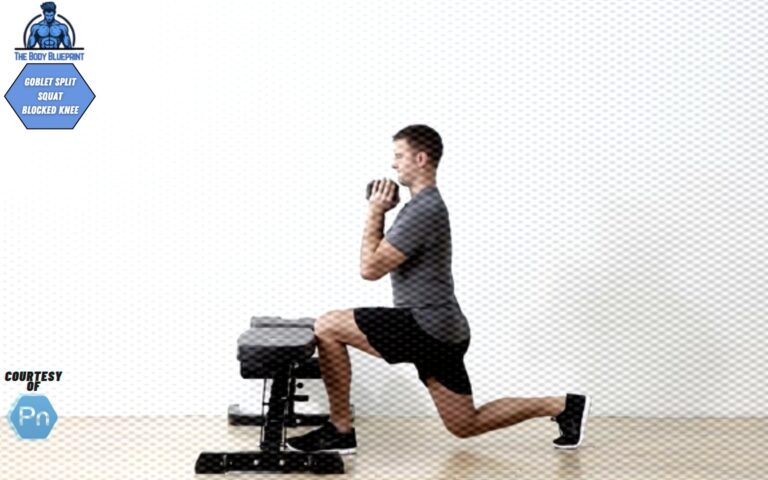
Forget balance beams and wobble boards—the Kettlebell Split Squat with a Blocked Knee is where true unilateral strength is forged. This isn’t your gym buddy’s lunge. By planting your back foot on a block, you eliminate cheating, isolate the front leg with surgical precision, and build a pillar of strength that translates to sprinting, fighting, and lifting. It’s a brutal lesson in humility and power, one leg at a time.
The Blocked Knee Split Squat (often called a Low-Elevation Split Squat) is a unilateral cornerstone. It exposes and corrects strength imbalances better than almost any other lift. It’s used by powerlifters to bulletproof their squat, runners to build explosive stride power, and anyone chasing legs that look and perform like carved granite. But with the knee fixed and tension maximized, there’s zero room for technical error—this is a precision strike, not a suggestion.
Let’s lock in the details: the setup, the execution, and how to weaponize this exercise for your goals.
How to Perform a Kettlebell Split Squat with Perfect Form
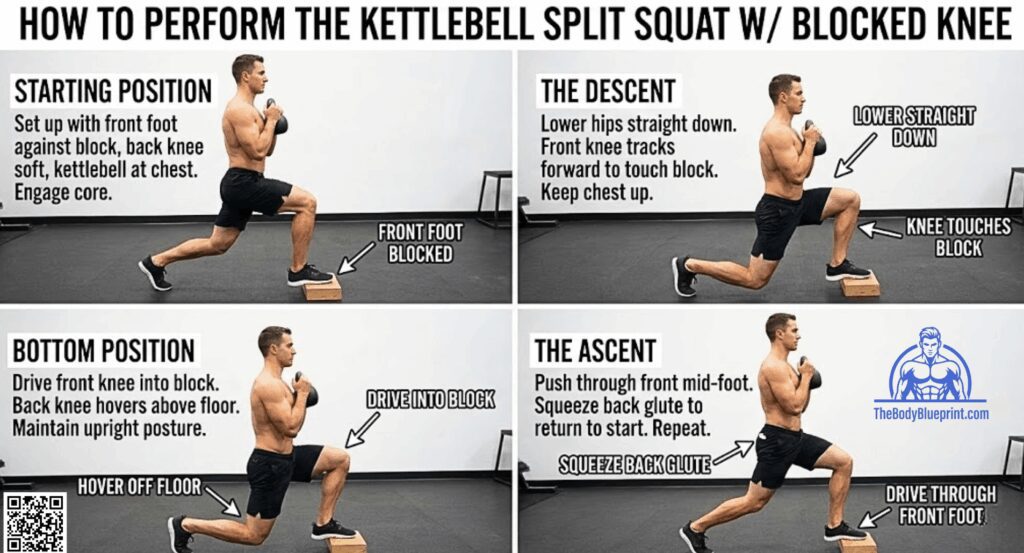
- Set Your Stance: Place a stable block or bumper plate (2-4 inches tall) behind you. Stand facing away from it, then place the top of your back foot (laces down) on the block. Your front foot should be far enough forward that your knee stays behind your toes at the bottom.
- Grip the Kettlebell: Hold a single kettlebell in the “rack” position on the same side as your front leg. Clean it to your shoulder, keeping your elbow tucked and wrist straight (think “goose neck”).
- Initiate the Descent: Brace your core and keep your torso tall. Lower your back knee straight down toward the floor, controlling the movement.
- Find the Bottom: Descend until your back knee gently touches the floor (or just above it). Your front thigh should be parallel to the ground.
- Drive Through the Heel: Without leaning forward, drive through the entire foot—emphasis on the heel—of your front leg to powerfully return to the start position. Squeeze your front glute at the top.
- Maintain Tension: Keep your entire body tight throughout. Do not relax at the top or bottom. Complete all reps on one side before switching.
“The blocked knee turns the split squat from a balancing act into a pure strength and stability drill. It tells you exactly what your lead leg is capable of, with no help from the rear.” — Eugene Thong, CSCS
Muscles Worked
| Phase of the Split Squat | Movement | Primary Muscles Worked | Secondary/Stabilizing Muscles |
|---|---|---|---|
| Descent (Eccentric) | Controlled lowering of the body | Front Leg: Quadriceps, Gluteus Maximus Back Leg: Hip Flexors (in stretch) |
Front Leg: Hamstrings (eccentric), Adductors Core: Entire Abdominal Wall, Obliques (for anti-rotation) |
| Bottom Position (Isometric) | Paused stretch at full depth | Front Leg: Gluteus Maximus (under stretch), Quadriceps Back Leg: Hip Flexors (maximal stretch), Quadriceps |
Front Leg: Soleus, Adductors Core: Stabilizers under full tension |
| Ascent (Concentric) | Driving up to start position | Front Leg: Gluteus Maximus, Quadriceps (vastus medialis emphasis) | Front Leg: Hamstrings, Adductors, Calves Core: Erector Spinae, Obliques (to maintain posture) Upper Body: Trapezius, Deltoids (to stabilize kettlebell rack) |
This variation is a masterclass in targeted tension. By fixing the back foot, you force the front leg’s quadriceps and glutes to shoulder the entire load, while the core works overtime to prevent rotation from the offset weight. It’s a brutal and beautiful display of single-leg dominance, warrior.
Who Should (and Shouldn’t) Do This Variation?
Best For:
✔ Strength Athletes looking to fix squat imbalances and boost main lift numbers.
✔ Combat & Field Sport Athletes (MMA, football, rugby) for explosive single-leg power.
✔ Physique Competitors seeking deep quad sweep and glute-hamstring tie-in detail.
✔ Anyone with ankle mobility issues—the elevated back foot allows for a greater range of motion.
Avoid If:
✖ You have acute knee pain (especially patellar tendonitis) without clearance.
✖ You lack basic hip mobility—master the bodyweight version first.
✖ You’re in the rehab phase of a back injury—the loaded unilateral stance demands high core stability.
Variations & Modifications
The Blocked Knee Split Squat is a potent base. Here’s how to scale it, intensify it, or shift its focus to keep your legs guessing and growing.
| Variation/Modification | The Tweak | Increased Challenge/Focus | Tactical Advice |
|---|---|---|---|
| Bodyweight Split Squat | Perform the movement without weight, hands on hips or in a goblet position. | Mastery of form, balance, and depth. Focus on mind-muscle connection. | The foundation. Do not add weight until you can perform 3×10 with perfect control on each leg. |
| Dumbbell Held at Sides | Hold a dumbbell in each hand, letting them hang at your sides. | Increases load while challenging grip and core stability differently than the rack position. | Keeps the center of mass lower, which can feel more stable for some. |
| Front Rack Barbell | Perform the split squat with a barbell in the front rack position. | Significantly increases total load potential. Drives upper back and core stability through the roof. | Requires excellent wrist, shoulder, and thoracic mobility. Start light. |
| Rear Foot Elevated (Bulgarian) Split Squat | Elevate the back foot on a bench instead of a low block. | Increases the range of motion and shifts even more load onto the front leg’s glute and hamstring. | A more advanced progression. Often requires less weight than the blocked knee version due to the extended range. |
| Isometric Hold at Bottom | Pause for 3-5 seconds at the bottom of each rep. | Eliminates the stretch reflex, increasing time under tension and raw strength at the weakest point. | Use 30-50% less weight. Focus on staying tight and not relaxing into the stretch. |
| Tempo Split Squat | Use a controlled tempo (e.g., 3 seconds down, 1 second pause, 1 second up). | Builds muscular control, hypertrophy, and tendon strength. Reveals weaknesses in the range of motion. | An excellent tool for beginners and advanced lifters alike to improve quality. |
| Kettlebell Overhead | Press the kettlebell overhead and hold it there throughout the set. | Transforms the exercise into a full-body stability challenge, firing the shoulders, core, and legs simultaneously. | Only attempt once you have mastered the rack position. Start with a very light weight. |
Common Mistakes to Avoid
❌ Front knee caving inward (drive it out over your pinky toe).
❌ Excessive forward torso lean (keep your chest up, core braced).
❌ Bouncing off the floor (control the descent; touch, don’t slam).
❌ Letting the back hip sag (keep both hips square and facing forward).
“The mistake I see most is people treating this like a cardio lunge. It’s a strength movement. Move with purpose, own the tension, and let the weight dictate the reps—not the clock.” — Charles Damiano, B.S. Clinical Nutrition
Programming the Blocked Knee Split Squat for Maximum Results
For Strength & Imbalance Correction:
- Heavy, low reps: 3-4 sets of 5-8 reps per leg, 2-3 min rest.
- Accumulation: Start your weaker leg first and match the reps with your strong leg.
For Hypertrophy (Muscle Size):
- Moderate weight, time under tension: 3-4 sets of 8-12 reps per leg with a 2-1-2 tempo.
- Myo-reps/Cluster Sets: After a heavy set, perform mini-sets of 3-5 reps with short rests to increase volume.
For Athletic Performance & Conditioning:
- Complexes: Pair with a kettlebell swing or clean for explosive, circuit-style training.
- Density Blocks: Perform 20 total reps per leg (in as few sets as needed) within a 4-minute window.
The Aesthetic Payoff
This isn’t just a leg exercise; it’s a sculptor’s tool. Done consistently, it will:
✅ Carve deep quad separation (especially the teardrop vastus medialis).
✅ Build rounded, powerful glutes from a stretched, loaded position.
✅ Create symmetry by erasing strength and size imbalances.
✅ Improve overall leg density and “pop” that carries over to every lower body movement.