
You’re stuck. Your squat has plateaued, your knees click when you walk upstairs, and your legs look like two different people drew them. You’ve tried every leg machine. Now try this: pick up a kettlebell, step backward, and discover why goblet reverse lunges are the single most effective correction for everything you’re doing wrong.
This is the definitive breakdown of an exercise that fixes imbalances, builds resilient knees, and forges legs that actually work. We’ll cover:
- The Biomechanical Advantage: Why stepping back beats stepping forward for knee health and glute activation.
- The Form Blueprint: The exact joint angles and cues that separate therapeutic movement from joint destruction.
- The Programming Matrix: How to use them for hypertrophy, strength, mobility, and injury prehabilitation.
- The Critical Errors: The three mistakes that turn a knee-saver into a back-wrecker.
Goblet Reverse Lunge Benefits: Why This Isn’t Just Another Lunge
The reverse lunge isn’t a variation—it’s a fundamental movement pattern your body forgot how to do. When executed with a goblet hold, it becomes a full-system diagnostic and correction tool.
| Benefit | Mechanism | Forward Lunge Comparison |
|---|---|---|
| Superior Knee Health | Stepping back reduces shear forces on the lead knee by ~40%. The tibia stays more vertical, minimizing anterior translation. | Forward lunge increases patellofemoral compression and ACL strain, especially under fatigue. |
| Enhanced Glute Activation | The hip hinge is more natural in reverse. Glute medius and maximus fire 25% harder to stabilize the pelvis and drive back to standing. | Forward lunge emphasizes quads, often with poor posterior chain engagement. |
| Core Anti-Rotation Demand | The offset load (single-leg) + anterior weight creates a rotational torque the obliques and transverse abdominis must resist. | Barbell lunges (front/back) are sagittal plane dominant with minimal anti-rotational challenge. |
| Unilateral Strength Balance | Forces each leg to work independently, exposing and correcting strength discrepancies of 15% or more between sides. | Bilateral squats allow the dominant leg to compensate, hiding imbalances until they cause injury. |
“The goblet reverse lunge is a lie detector for your movement quality. Your body can’t cheat the pattern. Either you create perfect alignment, or you fall over. It’s the single best exercise to teach people how to actually use their glutes.” — Eugene Thong, CSCS
Goblet Reverse Lunge Form: The Exact 7-Step Blueprint
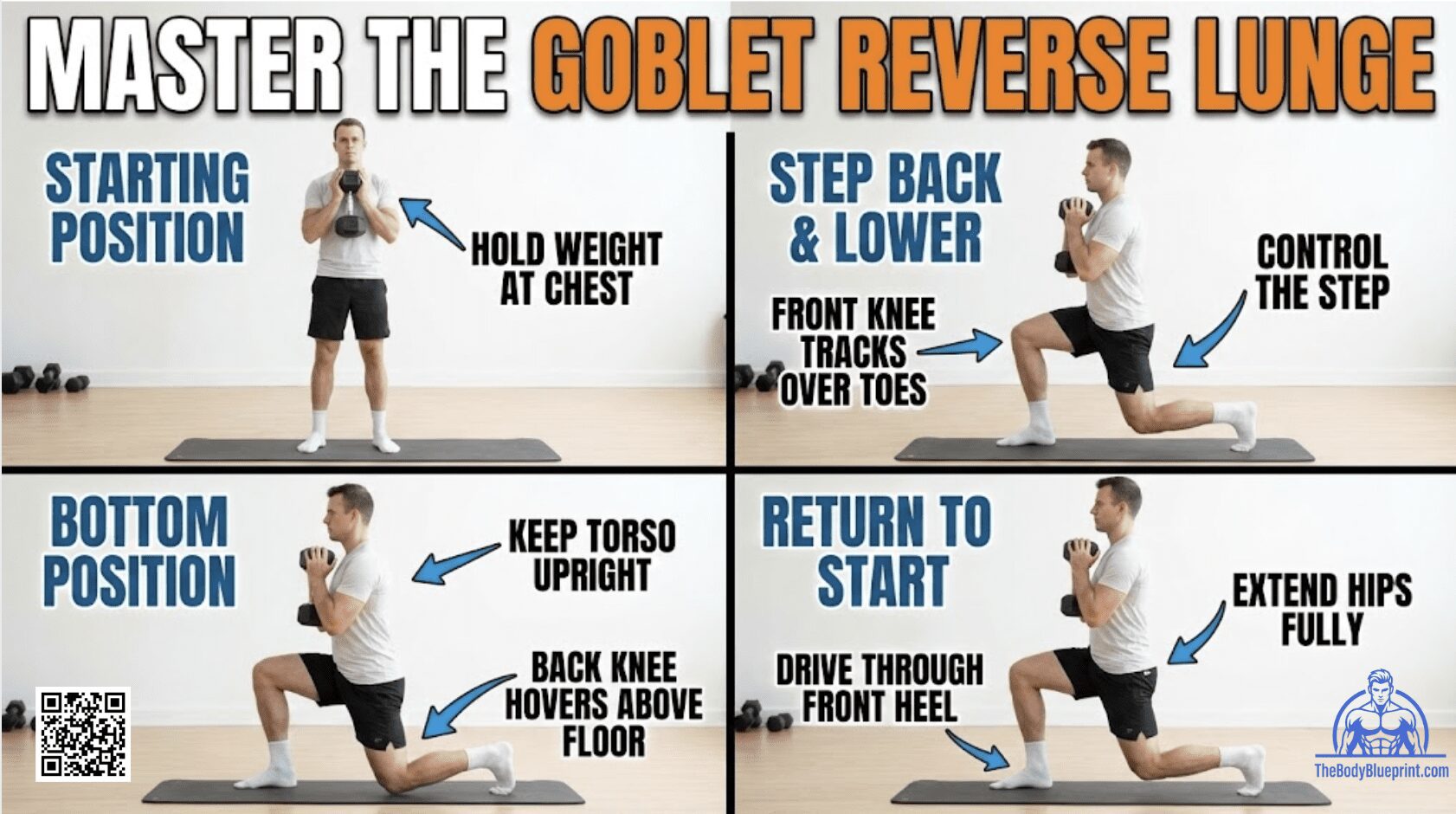
- Stand with Purpose: Feet hip-width. Hold a kettlebell or dumbbell tight to your chest (goblet position). Pull your shoulders down and back. Take a breath and brace your core as if bracing for a punch.
- Step Back, Not Down: Initiate by stepping one foot backward—not straight back, but slightly out to the side (like a kickstand). This creates a stable base of support.
- Find the Triple Flexion: As your back foot lands, simultaneously flex your front ankle, knee, and hip. Your front shin should stay vertical. Your back knee should aim for a point 2-3 inches behind your front heel.
- Control the Descent: Lower until your back knee lightly taps the floor (or just above). Your torso should remain perfectly upright—imagine your sternum reaching for the ceiling.
- Drive Through the Front Heel: Push through the entire front foot, focusing on the heel. Squeeze the glute of the front leg as if trying to imprint your heel into the floor.
- Return with Control: Bring the back foot forward to meet the front foot. Don’t rush. Re-establish your braced standing position before the next rep.
- Reset and Repeat: Complete all reps on one side before switching, or alternate if performing for conditioning. Never sacrifice form for speed.
Primary Muscles Worked
| Muscle Group | Role in the Movement | Activation Cue |
|---|---|---|
| Gluteus Maximus | Primary hip extensor. Drives the return to standing. | “Screw your front foot into the floor” to create external rotation torque. |
| Quadriceps (Front Leg) | Controls descent and initiates concentric phase. | Keep your front knee tracking over your second/third toe. |
| Adductors & Glute Medius | Stabilizes the pelvis in the frontal plane. | Imagine “spreading the floor” with both feet, even though one is in the air. |
| Core (Obliques, TVA) | Resists rotation and maintains upright torso. | Brace as if you’re about to be tackled from the side. |
| Hamstrings & Calves (Back Leg) | Eccentrically controls the step-back and provides stability. | Keep your back leg active—don’t just let it collapse. |
Goblet Reverse Lunge Programming: How to Use It for Any Goal
| Goal | Protocol | Loading | Placement in Workout |
|---|---|---|---|
| Movement Quality & Prehab | 3 sets of 6-8 reps per side, with a 3-second eccentric and 1-second pause at the bottom. | Light weight (16-24kg kettlebell). Focus is on perfect patterning. | First movement after warm-up, before heavy bilateral work. |
| Hypertrophy (Leg Focus) | 4 sets of 10-12 reps per side, moderate tempo. 60-90s rest. | Moderate weight (24-32kg). Should be challenging by rep 8. | After main squat pattern, before isolation work. |
| Strength & Power | 5 sets of 3-5 reps per side, explosive concentric. 2-3min rest. | Heavy weight (32kg+). Must maintain perfect form. | Can be primary lower body movement on light days. |
| Metabolic Conditioning | EMOM: 8-10 alternating lunges every minute for 10 minutes. | Light to moderate weight. Form must not break down. | Finisher at end of full-body or lower body day. |
Common Goblet Reverse Lunge Mistakes: The Form Killers
❌ Leaning Forward: Torso dips >10 degrees forward. Fix: Imagine a pole running from your tailbone through the crown of your head. Maintain contact. ❌ Front Knee Caving: Knee drifts inward on the drive. Fix: Actively spread the floor with your front foot. ❌ Short Stepping: Back foot lands too close to front foot, turning it into a awkward mini-squat. Fix: Step back far enough that your front shin stays vertical. ❌ Rushing the Reset: Not returning to a stable, braced stance between reps. Fix: Pause for a full second at the top. Own the position.
“People treat lunges like cardio. They speed through reps with a rounded back and call it ‘conditioning.’ That’s not conditioning—that’s teaching your body how to get injured under load. Master the tempo, master the joint alignment, then add weight.” — Charles Damiano, B.S. Clinical Nutrition
Goblet Reverse Lunge Variations: Progressions & Regressions
| Variation | How-To | Purpose |
|---|---|---|
| Bodyweight Reverse Lunge | Perform without weight, hands on hips or behind head. | Master the movement pattern. Use for high-rep technique work or warm-ups. |
| Pause Reverse Lunge | Hold the bottom position for 2-3 seconds, maintaining tension. | Builds strength out of the hole and improves stability. Eliminates momentum. |
| Deficit Reverse Lunge | Stand on a 1-2 inch plate or board. Increases range of motion. | Enhances hip mobility and glute stretch. Advanced mobility variation. |
| Walking Reverse Lunge | Instead of returning the back foot to the front, step it forward into the next lunge. | Increases metabolic demand and challenges coordination. Great for conditioning circuits. |
| Overhead Reverse Lunge | Hold a weight overhead (kettlebell, dumbbell) with locked arms. | Maximizes core and shoulder stability demand. Advanced full-body variation. |
| Bulgarian Split Squat | Elevate the back foot on a bench. This is a progression, not a direct variation. | Increases load on the front leg and removes balance assistance from the back leg. |
Goblet Reverse Lunge FAQs
1. Are Goblet Reverse Lunges Better for Knees?
Yes, unequivocally. The biomechanics of stepping backward significantly reduce anterior shear force on the lead knee. For individuals with patellofemoral pain, meniscus issues, or general knee clicking, the reverse lunge is often the only loaded single-leg pattern they can tolerate. If forward lunges hurt your knees, reverse lunges are your rehabilitation.
2. How Much Weight Should I Use?
Start with a weight that feels embarrassingly light. Your first priority is nailing the 7-step form blueprint with a 16kg kettlebell or 30lb dumbbell. The moment your torso leans or your knee caves, the weight is too heavy. Most men should master 3×8 with 24kg before progressing. Most women, 16kg. This is a skill movement first, a strength movement second.
3. Goblet Reverse Lunge vs. Bulgarian Split Squat
Different tools for different jobs. The reverse lunge is a dynamic movement pattern with a balance component; it teaches deceleration and coordination. The Bulgarian Split Squat is a static, stability-focused strength exercise that allows for heavier loading. Use reverse lunges to build movement quality and address imbalances. Use Bulgarians to build maximal single-leg strength and hypertrophy.
Tactical Goblet Reverse Lunge Q&A
1. How to Fix Hip Shift in Goblet Reverse Lunges?
Your glute medius is asleep. Drill this: Between sets, perform 10 banded lateral walks per side with a mini-band above your knees. Then, during your lunges, place two fingers on the hip bone of your working leg. Your job is to keep that hip bone level throughout the entire rep. If it hikes up, lighten the weight and re-drill the lateral walks.
2. Best Protocol for Correcting Leg Imbalances?
Start every leg session with unilateral work, leading with your weak side. Perform 2 sets on your weak leg for every 1 set on your strong leg for 3-4 weeks. Use the same weight for both. Do not let your strong leg dictate the load. The imbalance will correct faster than you think, but you must have the discipline to temporarily under-train your dominant side.
3. Should Your Back Knee Touch the Floor?
It should hover 1-2 inches above, or tap lightly with zero weight. Slamming your knee into the floor is incorrect and painful. The goal is to achieve depth where your front thigh is parallel to the floor, not to use the floor as a crutch. If you lack the mobility to reach depth without banging your knee, elevate your front foot slightly on a small plate to create clearance.
Goblet Reverse Lunge Key Takeaways
- It’s a knee-saver, not a knee-destroyer. The reverse pattern minimizes shear force, making it the single-leg exercise of choice for anyone with knee concerns or as a prehab staple.
- Form precedes load. Master the 7-step blueprint with a weight that feels too light. Your ability to keep your torso vertical and your front knee aligned is your limiting factor, not the number on the kettlebell.
- It exposes and fixes imbalances. You cannot hide a weak leg or a sleepy glute in a properly performed reverse lunge. It is both the diagnostic test and the cure.
- Programming intent dictates the outcome. Use slow tempos for mobility and prehab, moderate weight for hypertrophy, and explosive concentrics for power. Don’t just “do lunges”—execute with a purpose.
- It’s a foundational movement, not an accessory. For many trainees, especially those who sit all day, the goblet reverse lunge should be a primary lower body exercise for months before progressing to more complex or heavily loaded patterns.
Stop treating lunges as an afterthought. The goblet reverse lunge is a masterclass in single-leg mechanics, joint integrity, and honest strength. Implement it as a cornerstone of your training, and watch your squat numbers rise, your knee pain vanish, and your legs finally start working as a team.