A dad bod is not a fixed body type. It is a body-fat percentage north of 20% layered over decent muscle mass, accumulated from a mild caloric surplus, sleep deprivation, and inconsistent training across one to five years. The fix is not a juice cleanse. It is not keto for two weeks. It is a sustained caloric deficit, 160-180g of daily protein, a three-day strength split, and 10,000 daily steps. We built the exact nutrition numbers, the training template, and the weekly schedule to drop 15 pounds of body fat in 90 days without sacrificing the muscle underneath.
Overview: What a Dad Bod Actually Is
A dad bod is a body composition snapshot, not a permanent label: roughly 20-28% body fat layered over a foundation of muscle that has gone undertrained for one to five years. The muscle is still there. It is hidden under subcutaneous and visceral fat accumulated from a consistent but mild caloric surplus. An extra 200 calories per day over maintenance, sustained for 18 months, adds roughly 30 pounds. Most of it is fat. Some is water. Very little is muscle if training has been inconsistent.
The typical profile is a male aged 30 to 50 who lifted seriously in his twenties and then watched the career-kids-commute triad gut his training schedule. Diet stayed roughly the same. Daily activity dropped. Body fat crept up. Muscle mass held but went dormant underneath. This is not someone starting from zero. This is someone excavating what is already there.
The 90-day target is 15 to 20 pounds of body fat lost while preserving the existing muscle base. This is a body recomposition timeline, not a crash cut. One pound of fat loss per week is the pace when protein intake and strength training are dialed in. For broader context on how nutrition approaches have evolved, see our bodybuilding nutrition evolution timeline. For the contrast with old-school bulking, see old school bulking diets for muscle mass.
The Buried Sports Car Analogy
You parked a sports car in the garage five years ago. You threw a tarp over it. Dust accumulated. The battery died. The engine did not disappear. A dad bod is that car. You do not need to buy a new engine. You need to pull off the tarp, jump the battery, and drive it again. The muscle is under there. The plan is the jump start. You are not building from scratch. You are excavating.
The Nutrition Math: Caloric Deficit, Protein Target, Meal Structure
Caloric deficit drives fat loss. 160-180g of daily protein preserves muscle on the scale. Meal timing across three to four feedings manages hunger and training performance. That is the entire nutrition pyramid. Everything else is optimization around those three pillars.
Step 1 is finding your maintenance calories: multiply your bodyweight in pounds by 14. A 210-pound man lands at roughly 2,940 calories. Track your weight for two weeks at this intake. If the scale stays flat, that is maintenance. If it drops, you are already in a deficit. If it climbs, adjust down.
Step 2 is creating the 500-calorie deficit by subtracting 500 from maintenance. For a 210-pound man, that is roughly 2,440 calories per day. This yields approximately one pound of fat loss per week on the scale. Larger deficits accelerate the timeline but increase hunger and the risk of training performance drop-off. The 500-calorie deficit is the sustainable number. For deeper breakdown of deficit structures, see our best diet for weight loss guide.
Step 3 is setting protein at 0.8g per pound of bodyweight. For a 210-pound man, that is 168g. Round up to 170-180g. This is the muscle-preserving anchor on the nutrition label. For protein powder options that fit a cutting phase with short ingredient panels, see our best protein for cutting phase roundup and whey protein for fat loss guide.
Step 4 fills the remaining calories with carbohydrates and fats after protein is accounted for. On a 2,440-calorie target with 170g of protein (680 calories), the remaining 1,760 calories split between carbs and fats. A practical split is roughly 240g of carbs and 70g of fat. Adjust the ratio based on what keeps you full and fuels your training. Higher fat for satiety. Higher carb for workout performance. For carb-cycling strategies, see our carb cycling for men guide.
Step 5 is structuring three to four meals per day, each containing 40-50g of protein. This spacing keeps the scale moving in the right direction and manages hunger across the day. One meal can be a protein shake if convenience demands it.
| Bodyweight (lbs) | Maintenance (est.) | Cutting Calories | Protein Target | Expected Weekly Loss |
|---|---|---|---|---|
| 180 lbs | ~2,520 | ~2,020 | 144-150g | ~1 lb |
| 200 lbs | ~2,800 | ~2,300 | 160-170g | ~1 lb |
| 220 lbs | ~3,080 | ~2,580 | 176-185g | ~1 lb |
| 240 lbs | ~3,360 | ~2,860 | 192-200g | ~1 lb |
The Leaky Bucket Analogy
Your body is a bucket. Calories in is the faucet. Calories out is the holes in the bottom. A dad bod is a bucket that has been overfilled for years because the faucet was wide open and the holes were tiny. The fix is not to drill more holes with endless cardio. The fix is to turn the faucet down to a trickle and let the existing holes do their job. Caloric deficit is the faucet adjustment. Walking is the hole size. Strength training is what keeps the bucket itself from rusting. Turn the faucet. Walk more. Lift heavy. The bucket empties.
The Training Template: Three Days of Strength, Compound-First
Compound lifts at the start of each session, 3-4 sets of 8-12 reps, a push/pull/legs split across three training days per week, and progressive overload tracked by weight on the bar. This is the training architecture. It is not complicated. It is not a six-day bro split. It is three hard sessions per week built around the exercises that recruit the most muscle mass per rep.
Day 1 is Push (chest, shoulders, triceps): barbell bench press (4×8), incline dumbbell press (3×10), standing overhead press (3×8), dumbbell lateral raises (3×12), and tricep pushdowns (3×12). Add 2.5 to 5 pounds to the bar each week on the compound lifts. Track every set.
Day 2 is Pull (back, biceps, rear delts): deadlift or barbell row (4×6-8), pull-ups or lat pulldowns (4×8-10), seated cable rows (3×10), face pulls (3×12), and barbell curls (3×10). Rotate deadlifts with rack pulls or trap bar deadlifts every four weeks to manage lower-back fatigue.
Day 3 is Legs and Core: barbell back squat (4×8), Romanian deadlifts (3×10), leg press (3×12), walking lunges (3×10 per leg), and hanging knee raises (3×15). Squat depth matters more than squat weight. Hit parallel or below.
The weekly schedule runs Monday/Wednesday/Friday or Tuesday/Thursday/Saturday with two rest days between each session. This leaves four days per week for walking, recovery, and family obligations. The three-day split fits around a job and kids. For more on classic training approaches, see classic strength training and old school vs modern bodybuilding diets. For Heavy Duty methodology, see Heavy Duty training guide.
Cardio and NEAT: 10,000 Steps and One Conditioning Session
10,000 daily steps and one 20-minute conditioning session per week are the entire cardio prescription for the dad bod shred. Long-duration steady-state cardio burns calories but adds fatigue. The goal is the minimum effective dose of structured cardio to widen the caloric deficit without compromising strength output on the three training days.
Walking 10,000 steps daily is non-exercise activity thermogenesis (NEAT): pacing on phone calls, taking the stairs, a morning 20-minute walk, an evening 15-minute walk. These steps accumulate without the hunger spike or fatigue that structured cardio sessions produce. A fitness tracker or smartwatch automates step counting.
The one weekly conditioning session is 20 minutes of sled pushes, kettlebell swings, battle ropes, or assault bike intervals. Work for 30 seconds. Rest for 60 seconds. Repeat 10 rounds. This maintains cardiovascular output without the muscle-loss risk of daily long-distance running.
What to avoid: daily 5-mile runs, hour-long spin classes, and marathon training blocks. These create the caloric deficit through volume rather than diet, which adds fatigue and hunger to a plan that already runs on a deficit. For more on how different calorie sources affect body composition, see our nutrient partitioning guide.
Recovery: Sleep, Stress, and the Dad Bod’s Biggest Lever
Seven hours of sleep minimum, a 10-minute wind-down routine before bed, and two full rest days between training sessions are non-negotiable on this plan. The dad bod is partly a sleep-deprivation phenotype. New parents average four to five hours of fragmented sleep. When sleep is short and stress is high, the scale tends to stall even when calories and training are dialed in.
Sleep duration below seven hours is the single biggest variable that derails a cut. It is observable on the scale, in the gym, and in the food log. A bad night of sleep correlates with higher next-day calorie intake, lower training output, and a scale that refuses to move. The fix is a consistent bedtime and a dark, cool room. For the broader role of recovery tools, see our muscle recovery tools guide.
Stress management on this plan means a 10-minute wind-down before bed with no phone, no email, and no news. Read a book. Stretch. Breathe. The calorie deficit and the training sessions are already a stress load on the body. Adding chronic life stress on top of that is like trying to drain a flooded basement while the roof is still leaking.
Rest days are not optional filler between sessions. On a three-day split, the four non-training days are when the body adapts to the lifting stimulus. Skip the rest. Stall the progress.
The Leaking Roof Analogy
You are trying to drain a flooded basement. You have the pump running (caloric deficit). You have the buckets out (training). But the roof is still leaking. Poor sleep and chronic stress are the leak in the roof. No matter how fast you pump, the basement stays wet. Fix the roof first. Then worry about the pump speed. Seven hours of sleep is patching the roof. Without it, the rest of the plan fights a losing battle.
Supplements: Three Products That Fit a Cutting Phase
Whey protein isolate, creatine monohydrate, and caffeine are the three supplement labels with the shortest ingredient panels and the most direct application to preserving strength output and hitting protein targets during a caloric deficit. Everything else is optional.
Whey protein isolate (25-28g of protein per scoop, roughly 85% protein by weight, four ingredients or fewer on the cleanest labels) is the most convenient way to hit 170g of daily protein when appetite is suppressed from the deficit. One scoop post-workout. One scoop between meals if whole-food protein is inconvenient. Choose an isolate with stevia and monk fruit, not sucralose and gums. See our best whey protein for easy digestion guide for clean-label options.
Creatine monohydrate at 5g daily, zero calories, one ingredient on the label, taken every day regardless of training. It saturates muscle phosphocreatine stores and helps maintain strength output during the cut when glycogen is low and leverage is changing. No loading phase required for the dad bod shred. For the full protocol, see our creatine loading guide. For stacking with pre-workout, see creatine beta-alanine stack guide.
Caffeine at 100-200mg, taken 30 minutes pre-workout, delivered via black coffee or a stimulant pre-workout powder with a short ingredient label. It increases training output when energy is low from the deficit. A black coffee is the cheapest, cleanest delivery system. For pre-workout product comparisons, see our best pre-workout categories and Gorilla Mode pre-workout review.
What to skip: fat burners with proprietary blends, thermogenics with unlisted stimulant doses, and appetite suppressants. These add variables to a plan that works without them. The deficit does the work. The three supplements above support the deficit. They do not replace it.
The Honest Trade-off: What This Plan Costs You
The dad bod shred works. It also costs you three training hours per week, meal-prep discipline, and a temporary plateau in absolute strength as bodyweight decreases and leverage changes.
What You Get
- 15 pounds of fat loss in 90 days with a 500-calorie daily deficit
- Visible muscle definition as the fat layer thins
- Preserved strength base on the big three lifts
- 90 days of habit formation: discipline rewires default behavior
What It Costs
- Three hours of training per week: Non-negotiable
- Meal prep and food-scale tracking: You weigh food. You log calories. You read labels.
- Hunger: A 500-calorie deficit is noticeable. Protein and fiber blunt it. They do not eliminate it.
- Temporary strength plateau: Bench and squat numbers may stall or dip slightly as bodyweight drops
- Social friction: Saying no to pizza, beer, and dessert in social settings for 90 days
Who This Plan Is For (and Who Should Skip It)
The dad bod shred is built for the undertrained man with a muscle base, not the complete beginner or the already-lean lifter.
Good Fit
- Men 30-50 with prior lifting experience who have been inconsistent for 1-5 years
- 20-28% body fat with visible muscle underneath
- Can commit to three gym sessions and 10K steps per week for 90 days
- Willing to track calories and weigh food
- Goal is fat loss with muscle preservation, not maximum bulk
Not the Best Fit
- Complete beginners with no lifting experience (start with a basic linear progression first)
- Men under 15% body fat (you do not need a shred, you need a lean bulk)
- Anyone who cannot commit to a 500-calorie deficit for 90 days
- Those looking for a two-week water-weight flush (this is 90 days of fat loss, not a quick cut)
- Men over 30% body fat (consider medical guidance and a larger initial deficit)
Dad Bod Shred FAQ
- How fast will I see results on the scale?
- Week one: 2-4 pounds drop, mostly water weight. Weeks two through four: the scale moves 0.5-1 pound per week. Visible changes in the mirror start around week six. Before-and-after photos get dramatic around day 90. Do not judge the plan by week two.
- Can I drink alcohol on this plan?
- Alcohol is 7 calories per gram with zero protein. A single IPA is 200-250 calories. Three on a Saturday is 600-750 calories that contributed nothing to the 170g protein target. The dad bod shred does not ban alcohol. It budgets it. If you want a few drinks on Saturday, account for the calories and keep protein at 0.8g per pound. The math works. The discipline is harder.
- What if I miss a training session?
- Pick up where you left off on the next scheduled day. Do not double up. Do not add extra cardio as punishment. The plan survives one missed session per month. It does not survive two missed sessions per week. Resume the schedule on the next training day.
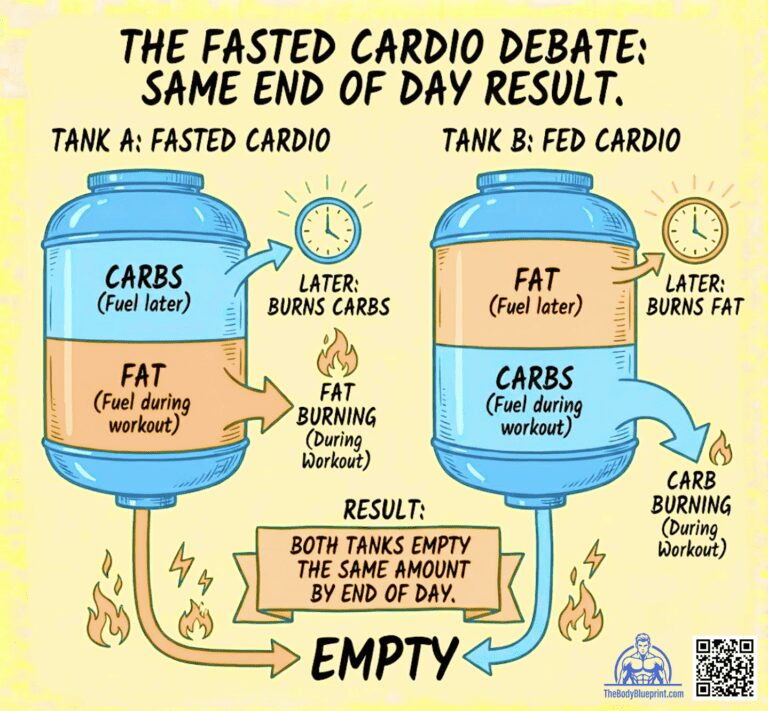
- Do I need to do fasted cardio in the morning?
- No. The 10,000 steps can be walked at any time of day. Morning, lunch break, after dinner. Total step count matters. Timing does not. For the broader approach to midsection fat loss, see our lose belly fat guide.
- Will I lose muscle on this deficit?
- At a 500-calorie deficit with 0.8g of protein per pound of bodyweight and three weekly strength sessions, the scale tends to show fat loss while strength numbers on the bar hold steady or dip only slightly. This is observable on the scale, in the mirror, and in the training log. The risk of meaningful muscle loss increases when the deficit exceeds 750 calories or when protein drops below 0.6g per pound.
- Can I do this plan without tracking calories?
- You can, but the results will be slower and less predictable. Calorie tracking is the accountability layer. Track for the first four weeks. Once you can eyeball portions and know the calorie counts of your staple meals, you can loosen the tracking without losing the deficit.
- What supplements do I actually need for this cut?
- Whey protein isolate for hitting the 170g daily protein target when whole food is inconvenient. Creatine monohydrate at 5g daily. Caffeine pre-workout for training energy. These three cover protein convenience, strength maintenance, and training output. Everything else is optional. For product picks, see our best protein for cutting phase and best pre-workout categories.
The 90-Day Dad Bod Shred: The Exact Plan
The dad bod shred is a 90-day body recomposition protocol built on a 500-calorie daily deficit, 170g of protein, three compound-first strength sessions per week, and 10,000 daily steps. It is not a crash diet. It is not keto. It is not a juice cleanse. It is the application of a sustained caloric deficit layered over consistent resistance training and walking.
The Daily Checklist has five items: 170g protein (or 0.8g per pound of bodyweight), 2,400-2,600 calories (adjusted for your bodyweight from the table above), 10,000 steps, 3-4 liters of water, and 7+ hours of sleep. Hit all five. The deficit does the work.
The Weekly Schedule is Monday: Push, Wednesday: Pull, Friday: Legs and Core, with 10K steps and rest on the four non-training days. One optional 20-minute conditioning session on Saturday. Full rest on Sunday.
The 90-Day Milestones on the scale and in the mirror: Day 30 is 4-6 pounds down, water weight gone, pants looser, training consistency becoming habit. Day 60 is 8-12 pounds down, waistline visibly smaller, arm vascularity starting during training. Day 90 is 12-18 pounds down, visible recomposition in before-and-after photos, the muscle that was buried under 20-plus percent body fat now visible. Transition to maintenance calories. Keep training.
The dad bod is not a permanent condition. It is a body composition snapshot that accumulated over years and reverses over months. Caloric deficit strips the fat. Protein preserves the muscle visible on the scale and in the mirror. Strength training keeps the bar loaded. Walking widens the deficit without adding fatigue. Sleep keeps the plan on the rails. Execute it for 90 days. The body underneath is already there.
The Dad Bod Shred: 90 Days to Visible Muscle
500-calorie daily deficit. 0.8g protein per pound. Three compound-first strength sessions. 10K steps. Seven hours of sleep. Execute for 90 days. The muscle is already there. This is the excavation plan.
Related Fat Loss and Training Guides
- How to Lose Belly Fat
- Best Diet for Weight Loss
- Carb Cycling for Men
- Best Protein for a Cutting Phase
- Whey Protein for Fat Loss Guide
- Nutrient Partitioning
- Heavy Duty Training Guide
- Classic Strength Training
- Creatine Loading Guide
- Creatine Beta-Alanine Stack
- Bodybuilding Nutrition Evolution
- Old School vs Modern Bodybuilding Diets
- Muscle Recovery Tools Guide
- Foods That Boost Testosterone
- Best Pre-Workout Categories