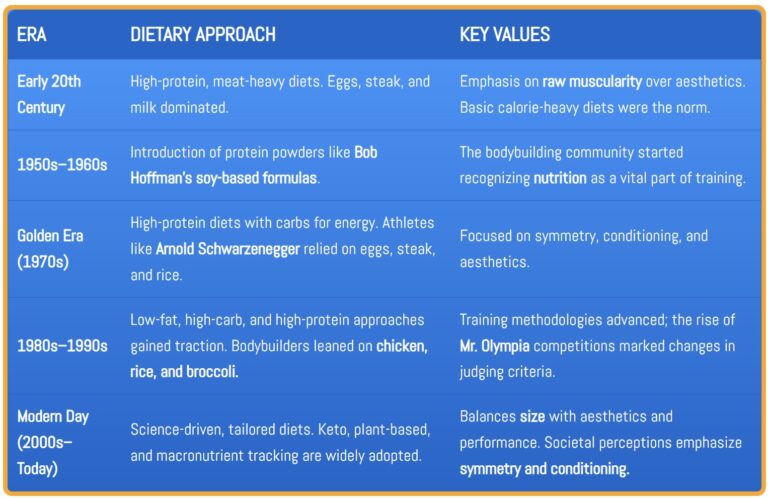
Twentieth century bodybuilding nutrition built the foundations that modern science is only now validating. Before bro science became a punchline, it was the working manual. Before supplement companies sold proprietary blends, champions ate steak, eggs, and liver. The old guard understood something the new generation often misses: whole foods, consistency, and digestion matter more than hype. This guide breaks down the evolution. The lessons that still apply. The mistakes we stopped making.
Medical Disclaimer: This guide is for educational purposes. The statements regarding any supplements have not been evaluated by the Food and Drug Administration. These products are not intended to diagnose, treat, cure, or prevent any disease. Always consult a qualified professional before starting a new regimen.
The Golden Era: Nutrition Before Supplements
Bodybuilding nutrition in the 1950s through 1970s was built on whole foods and consistency. The champions of that era—Arnold Schwarzenegger, Frank Zane, Sergio Oliva, and Franco Columbu—did not have access to hydrolyzed whey isolates or pre‑workout stimulants. They had grocery stores, blenders, and discipline.
Key characteristics of Golden Era nutrition:
- Whole food first: Eggs, beef, chicken, fish, potatoes, rice, oats, and vegetables formed the core.
- High protein, high carb: Protein intake was prioritized, but carbohydrates were not feared. Carbs fueled the punishing training volumes.
- Frequent meals: 5‑6 meals per day were standard. This was less about “stoking the metabolic fire” and more about getting enough total calories to support growth.
- Liver tablets and raw eggs: Supplements existed, but they were crude. Desiccated liver tablets were a staple. Raw eggs appeared in shakes.
For a deeper look at the era, see our Golden Era bodybuilding guide, Golden Era history, and Golden Era legends index.
“Arnold did not have a supplement stack. He had a blender, a carton of eggs, and a schedule. The magic was not in the powder. It was in the consistency.”
Charles Damiano, B.S. Clinical Nutrition
The Foods: What Golden Era Bodybuilders Actually Ate
The diet of a 1970s bodybuilder was simple. It was repetitive. It was effective. There was no carb cycling, no intermittent fasting, no “clean eating” dogma. There was food that worked.
| Food | Why It Was Used | Modern Equivalent |
|---|---|---|
| Whole Eggs | Complete protein, healthy fats, micronutrients. The perfect muscle food. | Still the gold standard. |
| Lean Beef | High bioavailability, creatine, zinc, iron. | Best protein sources still include beef. |
| Chicken Breast | Lean protein, easy to prepare in bulk. | Still a staple in bodybuilder diets. |
| Oats | Slow‑digesting carbs for sustained energy. | Still the breakfast of choice. |
| Rice and Potatoes | Clean carb sources that did not cause bloating. | Still foundational. |
| Desiccated Liver Tablets | Crude source of B vitamins, iron, and amino acids. | Modern supplements replaced them. |
For specific meal structures, see our Golden Era mass building diets, old school bulking diets, and vintage muscle building foods.
The Evolution: How Nutrition Changed from 1950 to 2000
Bodybuilding nutrition did not stand still. Each decade brought new ideas, some useful, some nonsense. Understanding the evolution helps separate lasting principles from passing fads.
- 1950s‑1960s: Whole foods, high calories, frequent meals. Vince Gironda promoted steak and eggs. Vince Gironda’s methods were ahead of their time. Supplements were minimal—liver tablets, wheat germ oil, raw eggs.
- 1970s: The Golden Era peaks. Protein powders enter the market but remain secondary to whole food. The Arnold training philosophy included massive food intake.
- 1980s: The supplement industry explodes. Whey powder becomes commercially available. Dorian Yates and the British invasion bring new intensity and simpler nutrition approaches.
- 1990s: Meal replacement powders, creatine, and protein bars become mainstream. The 90s bodybuilding legends had more tools but also more marketing noise.
For detailed decade breakdowns, see strength training milestones, evolution of strength training, and bodybuilding nutrition evolution.
“The guys in the 70s did not have our tools. But they had something we lost: the understanding that food is fuel, not a spreadsheet. They ate to grow. We sometimes forget to eat at all.”
Eugene Thong, CSCS
Lessons That Still Hold: What Modern Lifters Can Learn
Not everything from the 20th century was better. But some principles remain non‑negotiable. The old guard got these things right.
- Caloric surplus is required for growth. You cannot build muscle without enough energy. Modern calorie calculators just quantify what they knew intuitively.
- Protein timing matters less than total intake. Golden Era bodybuilders ate frequently because it was the only way to get enough food. Protein timing science now confirms that total daily intake is the primary driver.
- Whole foods beat processed supplements. A whey protein shake has its place, but it does not replace steak and eggs.
- Digestion matters. If you cannot digest it, you cannot use it. Old school lifters prioritized foods that sat well. Modern digestive enzyme guides address the same issue.
- Consistency beats perfection. They ate the same meals daily. It was boring. It worked.
For modern applications of these lessons, see our Golden Era diet hacks, dirty vs. clean bulking lessons, and old school vs. modern diets.
Final Verdict: What the 20th Century Got Right
Twentieth century bodybuilding nutrition was not perfect. But it was built on principles that still work today. Whole foods. High protein. Caloric surplus. Consistency. The tools have changed. The fundamentals have not.
The modern lifter has advantages: hydrolyzed whey, creatine monohydrate, and quality fish oil. But the foundation remains the same. Eat enough. Train hard. Recover.
The mistake is thinking new tools replace old principles. They do not. They enhance them.
The Bottom Line: Fundamentals Never Go Out of Style.
Before the supplement industry, before the influencers, there were lifters who ate steak, eggs, and rice and built physiques that still stand as the standard. The tools are better now. The principles are the same.
*Historical analysis verified 2026.
The Supplement Lexicon: Golden Era Nutrition Edition
- Desiccated Liver Tablets
- A crude supplement made from dried, powdered beef liver. Used by Golden Era bodybuilders as a source of B vitamins, iron, and amino acids before modern protein powders existed.
- Wheat Germ Oil
- A source of vitamin E and essential fatty acids. Popularized by bodybuilders in the 1950s and 1960s as a recovery aid.
- Steak and Eggs Diet
- A diet popularized by Vince Gironda. Emphasized high protein, moderate fat, and minimal carbohydrates. A precursor to modern low‑carb approaches.
- Whole Food First
- The principle that nutrition should come primarily from unprocessed sources: meat, eggs, dairy, grains, vegetables. Supplements were seen as additions, not replacements.
- Bro Science
- The informal, experience‑based knowledge passed through gyms before scientific validation. Some of it was wrong. Some of it was decades ahead of research.
- Anabolic Environment
- The combination of sufficient calories, protein, sleep, and training that supports muscle growth. Golden Era lifters prioritized this through routine and consistency.