Trying to fit a home gym into a room that is already full? Vertical storage is the cheapest square footage you will ever buy. Four moves return 30 to 40 percent of the floor: plates on a tree, the bar on the wall, dumbbells on a stand, and anything foldable stored upright. Total cost: about $150.
For Educational Purposes Only: The information provided is for informational and educational use. It is not intended as medical advice or a substitute for professional consultation. Always consult a qualified professional before beginning any new training or nutrition program. Results vary by individual. Price Disclaimer: Prices shown are approximate and may vary. Check current pricing and availability on Amazon.
The Four Rules of Home Gym Storage
Storage is not tidiness. It is the difference between a gym that gets used and a room you avoid. A plate you have to step over is a plate you stop loading. Friction is the enemy, and clutter is friction with a shape.
- Weight goes low or on the wall, never on the floor in the walkway. The heaviest things live closest to the ground, and the walkway stays clear. A 36 inch path is the number that keeps a room usable.
- Everything you touch daily belongs between your knees and your shoulders. That is the zone that costs no effort to reach. Anything you lift overhead should be light enough to lift safely.
- Anchor into studs or into a panel that spans studs. Drywall holds paint. It does not hold iron. This is the rule people break once.
- Leave one wall empty. Storage that fills every surface leaves nowhere for the thing you buy next. Our guide to building a home gym makes the same argument about layout.
Plate Storage: Trees, Pegs, and Wall Racks
Plates are the heaviest thing you own and the easiest thing to get off the floor. A full set of iron is 300 to 500 lbs, and it does not need a single square foot of it.
- Weight trees are the default. A six post tree holds most home plate sets and stands in about 2 square feet. Load the heavy plates on the bottom pegs, because a top heavy tree tips. Trees and wall pegs are also common secondhand finds, covered in our used home gym equipment guide.
- Wall mounted plate pegs save the most floor and require the best anchoring. Two pegs per stud, into a cleat or a panel. Never into drywall alone.
- Bumper plates are wider than iron and need longer pegs. Check the peg length before you buy, not after. A 45 lb bumper is about 17.7 inches across.
- Keep plates off concrete. Concrete wicks moisture and rusts whatever sits on it, which our home gym maintenance guide covers in detail. A tree solves storage and rust at the same time.
- Fractional plates and collars need a home too. A small bin or a shelf beats digging through a drawer before every session.
Barbell and Specialty Bar Storage
A barbell is 7 feet long, which makes it the most awkward object in the room and the easiest one to store vertically. One wall mount holds it in the footprint of a dinner plate.
- Vertical wall mounts are the space winner. Two lag bolts into a single stud, and the bar sits flat against the wall. Vertical storage also keeps the bar from being a trip hazard, which is worth more than the space.
- Line the hooks with rubber or UHMW. Bare metal hooks over time will chew the knurl and the finish. A $10 liner protects a $300 bar.
- Horizontal racks are for multiple bars. If you own a straight bar, a trap bar, and a curl bar, a floor rack beats three wall mounts.
- Store specialty bars low. A trap bar is heavy and awkward, and lifting it off a high hook is how people get hurt in a room where nobody is spotting.
- Never stand a loaded bar against a wall. Empty bars only. This is the storage rule that has an injury attached to it.
Dumbbell Racks and Adjustable Dumbbell Stands
Dumbbells are where floor space quietly disappears. A set of hex dumbbells spread across the floor occupies more area than a power rack, and none of it is usable.
- Three tier racks hold 5 to 25 lb sets in about 3 square feet, which is the single biggest floor recovery in this article.
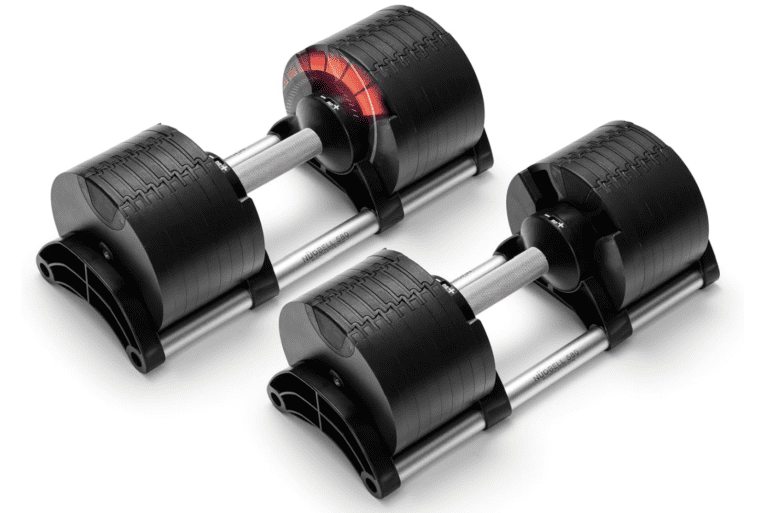
- Adjustable dumbbells need a stand, not a shelf. The cradle has to support the mechanism while you change weight, so buy the stand made for your model. Powerblock and Nuobell stands are not interchangeable, which our Nuobell vs. Powerblock comparison makes clear.
- A stand also saves the mechanism. Dumbbells picked up off the floor get dropped back onto it, and the selector pins pay for that. Waist height solves both problems at once.
- Keep the heaviest pair at waist height. Not on the top tier of a rack, and not on the floor. The middle shelf is the most used and the easiest to load.
- If you own one pair of adjustable dumbbells, skip the rack entirely and buy the stand. It costs less and does more.
Wall Panels and Vertical Real Estate
The wall is storage space you already own and have not paid for. A panel system turns an entire wall into adjustable shelving, hooks, and bins for the small things that otherwise live on the floor.
- Slatwall and wall control panels take hooks, shelves, and bins that move as your equipment changes. Best mounted across at least three studs.
- French cleats are the strongest modular option and cost a few dollars in lumber. Two angled boards, one on the wall and one on the cabinet or shelf.
- Reserve the panel for light and awkward items: collars, bands, chalk, straps, belts, jump ropes, and attachments. Plates belong on structural steel, not on a hook.
- The dead space nobody uses: above the garage door, the soffit corner, the knee wall in an attic, the gap behind the rack’s rear uprights, and the space under a bench that folds.
- Hang a mirror and hang storage on the same wall only if the storage is above head height. A hook at shoulder height near a mirror is a swung-kettlebell problem.
Folding and Stacking Equipment
The best storage decision happens at purchase. Buying the folding version of a tool costs 10 to 20 percent more and returns several square feet that you cannot get back any other way.
- Folding benches stand upright behind a door and give back 8 square feet. Check that it locks open and closed, not just closed.
- Folding wall mounted racks fold to about 6 inches of depth, which turns a rack into wall storage in a shared room.
- Foldable walking pads fold in half and slide under a bed. That single feature is why the Smug Walking Pad works in an apartment.
- Rowers stand vertically on end. Most models, including the Concept2 Model D, store in about 2 by 2 feet standing up. Always break the machine in half first, then lift from the seat end.
- Ceiling hoists lift bikes and walking pads overhead and free the entire floor underneath. Buy a hoist rated well above the machine weight, and never store anything on top of a treadmill belt or deck.
- A folding rack or cage is the upgrade path when a fixed rack will not fit a shared room.
The Storage Map: Daily, Weekly, and Seasonal
Store by how often you touch it, not by what it is. Most cluttered gyms are organized by category, which puts the collars you use every set in a drawer and the trap bar you use twice a year at waist height.
- Daily, between 24 and 48 inches:
- Collars, the working bar, the dumbbell pair you use most, chalk, a belt, and a jump rope. Zero effort to reach means zero excuses.
- Weekly, between 48 and 72 inches:
- Plates on the tree, bands, attachments, the bench, and the foam roller. Reachable without a step stool.
- Seasonal, above 72 inches or below 12 inches:
- Spare plates, specialty bars, backup bands, and storage bins. Anything overhead should be light enough to bring down safely.
Then label the bins. A labeled bin is a system. An unlabeled bin becomes a mystery box you stop opening. And leave the platform and the walkway completely clear, because that is the floor space the whole exercise was meant to protect.
Storage in Humidity and Long Term Storage
Storage is where equipment quietly rusts. A rack in daily use gets handled and wiped. A plate set on a garage floor for eight months just sits there and corrodes.
- Get plates off concrete and off the floor. A tree, a wall peg, or a rubber mat solves most of it. This is a storage decision and a rust decision at the same time.
- Oil bare steel before long term storage. A thin film of light machine oil, then leave it alone.
- Hold relative humidity between 40 and 50 percent. A $10 hygrometer tells you whether you have a problem, and a dehumidifier solves it.
- Remove batteries from monitors before storing a machine for months. Leaking cells destroy circuit boards.
- Take the tension off resistance bands. Bands stored stretched on a hook age faster than bands stored loose in a bin. See our maintenance guide for the rest of the replacement schedule.
- Never fold a rubber mat for months at a time. Roll it. A fold line in rubber becomes a crack.
- Cover the rack and the plates in a dusty garage. A cheap fitted sheet beats scrubbing a year of sawdust off a barbell.
- Store the flooring, not just the gear. The material advice in our home gym flooring guide applies to what sits on it year round.
Home Gym Storage: The Raw Truth
A: Vertically. A plate tree, a wall mounted barbell hook, and a dumbbell stand move roughly 400 lbs off the floor and onto the wall, returning 30 to 40 percent of the equipment footprint. Keep the walkway at 36 inches and the room stays usable.
A: No. Lag bolts into studs, or a French cleat spanning two studs. A 45 lb bar plus the dynamic load of lifting it on and off is not a drywall anchor job. The failure happens without warning, and it happens near your head.
A: Fold and lock it after every session, then stand it vertically if the model supports it. If not, use a wall or ceiling hoist rated well above the machine weight. Never store anything on top of the belt or deck.
A: Yes, especially bare steel sitting on concrete in a damp space. Store plates off the floor, oil bare steel, hold humidity between 40 and 50 percent, and avoid long term storage in an unheated damp garage. Storage is where corrosion does its best work.
A: Bands go out of direct sunlight and off anything that keeps them stretched, because constant tension shortens their life. Foam rollers go upright or flat with nothing stacked on them, since compression set is permanent.
A: Usually 30 to 40 percent of the equipment footprint. In a 10 by 10 room, that is enough to restore a 36 inch walkway. That is the difference between a room you train in and a room you walk around.
Final Verdict: Buy the Floor Back for $150
Storage is the only home gym purchase that gives you space instead of taking it. Every other dollar buys capability. This one buys back the room you already paid rent on. The $150 setup above scores 4.7 out of 5 under The Body Blueprint Technical Scoring Rubric, because it moves 400 lbs off the floor for the price of a single kettlebell.
Buy in this order: a plate tree, a vertical barbell mount, a dumbbell stand, then a wall panel for the small items. Add a ceiling hoist only if you own a bike or a machine that cannot stand up. Everything past that is decoration.
Do this if: Your walkway is under 36 inches, your plates live on the floor, or you share the room with anyone.
Skip it if: Your gym is a mat, two bands, and a pair of adjustable dumbbells. A stand for the dumbbells is the only item on this page you need.
For the room itself, see our guide to building a home gym, and for the equipment worth storing, the home workout equipment reviews. If you are furnishing the room on a budget, the tiers in our home gym on a budget guide cover the rest.
The Bottom Line: Clear Floor, Clear Head.
You will not train in a room you have to tidy first. Put the weight on the wall, keep the middle empty, and leave one wall alone for whatever comes next. Storage is not housekeeping. It is the difference between a gym and a storage unit.
The Storage Lexicon
- Shear Load
- Force pressing down against a fastener, which is the strongest direction for a bolt. A bar hanging vertically puts its weight in shear, which is why it is safe.
- Pull-Out Load
- Force pulling a fastener straight out of the wall, the weakest direction. A hook sticking out from drywall is a pull-out failure waiting to happen.
- French Cleat
- Two interlocking angled boards, one fixed to the wall and one to the object. Cheap, strong, and rearrangeable without new holes.
- Slatwall
- A panel with horizontal grooves that accept hooks, shelves, and bins anywhere along the wall. The modular version of a pegboard, with more load capacity.
- Dead Space
- Volume in a room that equipment cannot use, such as above a garage door or below a bench. The cheapest storage you own.
- Knee Wall
- A short wall under a sloped roof, common in attics and upstairs rooms. Usually wasted, and perfect for plate pegs and bins.
- Soffit
- The boxed section that hides ductwork or the garage door track. A storage opportunity in a ceiling that is otherwise too low.
- Ceiling Hoist
- A pulley system that lifts a bike or machine to the ceiling and holds it there. Buy one rated well above the load, and check the attachment point rather than the rope.
- Capacity Rating
- The load a rack, tree, or mount is engineered to hold. Compare it to what you actually own, and treat the number as a ceiling rather than a target.