A 100 sq ft home gym built around a foldable power rack, a 3-zone Triad layout, and a strict 60-second setup rule can out-train a garage twice its size. This isn’t about squeezing in equipment. It’s about engineering a zero-waste room where every square foot forces progress. Your constraints are your design parameters. Here’s the blueprint.
This plan requires specialized gear built to fold flat. Start with our review of the Best Foldable Strength Equipment for Apartments.
The Mindset Shift: From Square Footage to Systemic Output
A 100 sq ft home gym is not a shrunken version of a commercial facility. It’s a different machine entirely, built around equipment density instead of equipment count. The goal isn’t owning every tool. The goal is every tool working together to remove friction between you and a brutal, effective session.
- Efficiency over variety: You don’t need 10 ways to train your chest. You need 2 to 3 brutally effective methods with zero setup time.
- Vertical integration: Your walls are the real asset here. Floor space is for movement. Wall space is for storage and mounting.
- The 60-second rule: If you can’t go from normal room to first working set in under 60 seconds, the design has failed. Friction is the enemy.
In a limited space, exercise selection becomes paramount. You have to prioritize compound movements that deliver the highest neurological and metabolic return on investment. Every square foot has to justify its existence by directly contributing to strength or conditioning. There’s no room for single-joint finishers that require dedicated equipment. — Eugene Thong, CSCS
The 100 Sq Ft Battle Grid: Your Strategic Layout
A 10-by-10-foot space, run correctly, splits into three zones under what we call the Triad System: the Strength Wall, the Cardio and Mobility Zone, and the Storage Spine. This isn’t decoration. It’s a tactical floor plan, and the center of the room stays clear no matter what.
The 3-Zone System
- The Strength Wall (Primary): One full wall dedicated to your foldable power rack or squat stand. This is the anchor. Everything else supports it.
- The Cardio and Mobility Zone (Secondary): The opposite corner for a foldable rower or bike, plus a strip of floor for warm-ups, loaded carries, and recovery work.
- The Storage and Utility Spine (Tertiary): The remaining wall space for vertical storage: barbell holders, plate trees, accessory bins, and tools.
The golden rule of this layout is simple: the center of the room stays completely clear, full stop. That center strip is your movement arena. Clutter it, and you’ve already lost the design.
The Non-Negotiable Equipment List: The 80/20 Rule
Six items make up the entire core stack for a 100 sq ft home gym, split across a Foundation tier and a Force Multiplier tier. If a piece of equipment isn’t on this list, it’s a nice-to-have you probably can’t afford in space, not in dollars.
Tier 1: The Foundation
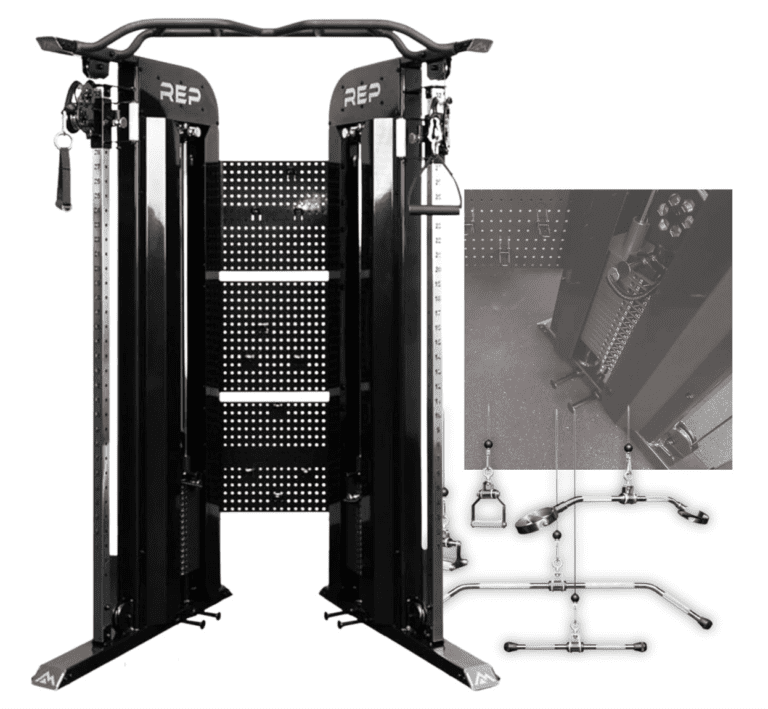
- Foldable power rack or squat stand: The single most important piece. Enables squats, presses, pull-ups, and band work. Must fold flat. Rogue RML-3WC and PRx Profile are common references.
- Olympic barbell and bumper plates, 200 to 300 lbs total: Buy once, cry once. Bumpers protect your floor and your neighbor’s patience.
- Adjustable FID bench: Must fold or stand vertically. This is your pressing, rowing, and seated work station. REP AB-4100 is a common reference point.
Tier 2: The Force Multipliers
- Foldable full-body cardio machine: A rower like the Hydrow Wave or a foldable bike. This covers your conditioning and needs to store vertically or fold flat.
- Modular floor protection: Interlocking rubber tiles or a roll-up mat. Protects floors, defines the space, and manages sound.
- Vertical storage system: Wall-mounted bar holder, plate tree, or storage pins. Get everything off the floor, permanently.
Nutrition and recovery are non-negotiable, but they start with the stimulus. This equipment list is built to deliver maximal stimulus across strength and metabolic pathways with minimal logistical drag. A more efficient setup directly reduces systemic stress, which leaves more resources for actual adaptation and growth. — Charles Damiano, B.S. Clinical Nutrition
Programming for the Space-Poor Lifter: No Wasted Movement
A 4-day split built around zone-locked supersets is what actually makes a 100 sq ft home gym work in practice, not just on paper. Training has to match the environment. Minimal equipment changeover, maximum density, every session.
The 100 Sq Ft Split
- Day 1, Lower Body Power (Rack Focus): Barbell back squat, Romanian deadlifts, walking lunges with barbell, calf raises on the rack. Everything stays at the rack.
- Day 2, Upper Body Push/Pull (Rack and Bench Focus): Standing overhead press, pull-ups on the rack, incline barbell bench, bent over rows. The bench moves in and out once.
- Day 3, Metabolic Conditioning (Cardio Zone Focus): Rower or bike intervals, kettlebell swings with a single bell, push-up and pull-up supersets. Clear the floor, hammer conditioning.
- Day 4, Full Body Density (Minimal Setup): Front squats, floor press, weighted carries, plank variations. Focus on movements that flow into each other.
The key to this split is superset pairing within a single zone, not across the room. You shouldn’t be moving the bench and the rower in the same minute. That’s wasted setup time disguised as training volume.
Small-Space Gym System Comparison: Choose Your Build
Three system builds cover most goals inside a 100 sq ft footprint: Barbell Dominant, Hybrid Athlete, and Modular and Tech. None of the three wins on every metric. Pick based on your training goal, not the gear you already own.
| System Focus | Core Equipment | Best For | Deployed Footprint | The Verdict |
|---|---|---|---|---|
| Barbell Dominant | Foldable rack, barbell, bumpers, folding bench | Maximal strength, powerlifting | ~80 sq ft | Pure strength. No fluff. |
| Hybrid Athlete | Foldable rack, foldable rower, adjustable dumbbells, mat | Strength and conditioning, general fitness | ~95 sq ft | Most versatile. Best ROI. |
| Modular and Tech | Wall-mount trainer, smart rower, foldable bench | Functional fitness, HIIT, apartments | ~70 sq ft | Ultra-clean. Low noise. |
The most common mistake in small-gym programming is trying to replicate a commercial facility’s variety. Instead, master the fundamental movement patterns with the tools you actually have. Depth of skill and progressive overload on a few key lifts will always outperform superficial variety. Your space forces this discipline. Use it. — Eugene Thong, CSCS
Who This Blueprint Fits
This system assumes a genuine 100 sq ft footprint and a serious training goal, not a casual home decor gym. Match your situation to the right build before you spend on foldable gear.
Built For
- Apartment and condo lifters who need a real strength and conditioning setup without a dedicated garage.
- Barbell trainees who want squats, presses, and pull-ups without a commercial rack footprint.
- Disciplined programmers who will actually run zone-locked supersets instead of freelancing exercise selection.
Skip It If
- You want equipment variety over efficiency. This system deliberately cuts single-joint isolation machines.
- You’re not willing to fold and unfold gear daily. The 60-second rule only works if you actually run the reset.
- You have low ceiling clearance or soft flooring that can’t support loaded barbell work. Verify both before buying a rack.
Related Home Gym Strategy Guides
The Iron Lexicon: Small Space Design Edition
- Frictionless Setup
- The time and effort required to transition from living space to training space. The primary metric of a successful small-space design. Target: under 60 seconds.
- Vertical Real Estate
- Your wall space. The most underutilized asset in small gym design, used for storage, equipment mounting, and visual organization.
- The Movement Arena
- The central, always-clear floor space reserved for training. Non-negotiable. Clutter here kills workout density and safety.
- Equipment Density
- The amount of training capability per square foot. A foldable rack carries high density. A dedicated leg curl machine carries poor density in a 100 sq ft room.
- Acoustic Management
- Strategic use of flooring, crash pads, and controlled eccentrics to minimize noise transmission. Critical for apartment gym longevity.
- The Triad System
- The 3-zone layout: Strength Wall, Cardio and Mobility Zone, and Storage Spine. The foundational blueprint for max-output small spaces.
Frequently Asked Questions
- Can you really fit a full strength and conditioning setup in 100 sq ft?
- Yes, but only with a foldable power rack and a strict Triad layout that keeps the center of the room clear. Deployed footprint for a Barbell Dominant build runs closer to 80 sq ft, leaving margin for movement.
- What’s the single most important piece of equipment?
- The foldable power rack or squat stand, since it enables squats, presses, and pull-ups from one anchor point. Every other piece of equipment in the Tier 1 list supports what the rack already covers.
- How do I keep noise down for an apartment setup?
- Modular floor protection and controlled eccentrics handle most of the acoustic management problem. Interlocking rubber tiles absorb impact, and slowing the lowering phase on lifts cuts noise transmission through the floor.
- Do I need a separate cardio machine, or can I skip it?
- A foldable rower or bike is listed as a Tier 2 Force Multiplier, not core equipment, so it depends on your goal. If conditioning matters to your programming, it earns its floor space. If not, that zone can shrink in favor of more storage.
Final Blueprint: Constraint Is the Design
A 100 sq ft home gym isn’t a limitation. It’s a focused attack vector. Ruthless efficiency removes every barrier between you and the work. The space forces discipline. The discipline forces progress.
Note: Prices subject to change. Verified 2026 strategy guide. Confirm ceiling height and floor load ratings before installing any rack system.