A pair of 50-pound adjustable dumbbells, a doorway pull-up bar, and a set of layered resistance bands are the only three pieces of equipment a lifter needs to replicate every compound and isolation movement in a commercial gym on 40 square feet of floor space. We broke down the equipment tiers, the exercise categories, and the programming by budget and square footage so you know exactly what to buy and how to deploy it.
Equipment Tiers: What to Buy by Budget and Space
A home gym is a function of budget, square footage, and training goal. Every piece of equipment earns its spot or wastes it. The four tiers below stack from zero dollars and zero square feet up to a fully equipped garage setup. Start at Tier 1 and add pieces as budget and space allow. Every tier can build muscle. The progression is about exercise variety, not efficacy. For a detailed breakdown of budget-friendly equipment that does not waste floor space, see our affordable home exercise equipment guide.
| Tier | Equipment | Cost | Space | Covers |
|---|---|---|---|---|
| Tier 1: Zero Equipment | Bodyweight only | $0 | 6×6 ft | Push, pull, legs, core |
| Tier 2: Minimalist | Pull-up bar + resistance bands | $50-$100 | 6×6 ft + doorway | Full body, loaded pull, banded resistance |
| Tier 3: Standard | Tier 2 + adjustable dumbbells | $300-$600 | 8×8 ft | Full gym replacement |
| Tier 4: Full Garage | Tier 3 + barbell, rack, cable pulley | $1,000-$2,500 | 10×12 ft | Unlimited. Commercial gym parity. |
The Toolbox vs. The Tool Analogy
A commercial gym is a fully stocked mechanic’s garage with a lift, an air compressor, and a wall of Snap-On wrenches. A Tier 1 bodyweight setup is a leatherman multi-tool on a kitchen table. Both can fix the engine. One needs more creativity. The other costs $80 a month and a 20-minute drive. Pick the toolbox that fits your garage. Master every tool inside it before you buy another drawer.
Exercise Categories by Equipment Type
Bodyweight, band, dumbbell, barbell, and cable exercises each impose a different resistance curve, stability demand, and load ceiling on the same movement pattern. A push-up, a banded chest press, a dumbbell bench press, a barbell bench press, and a cable fly all train the chest. The difference is the equipment. The movement pattern is the constant. The load profile is the variable.
Bodyweight Exercises: Tier 1, Zero Dollars, Any Floor
Bodyweight exercises use gravity and limb leverage as the sole resistance source. No equipment. No excuses. The push-up trains horizontal pressing. The inverted row trains horizontal pulling. The pistol squat trains unilateral lower body. The plank and dead bug train core stability. Bodyweight training is not a stepping stone. It is a full training category with its own progression system. For a complete library, see our bodyweight exercise library and the bodyweight programming guide.
- Push: Push-up, decline push-up, pike push-up, handstand push-up. See bodyweight push exercises.
- Pull: Inverted row, chin-up (requires bar), doorway row. See bodyweight back and pulling exercises.
- Legs: Squat, lunge, pistol squat, glute bridge, Nordic curl. See bodyweight leg and glute exercises.
- Core: Plank, side plank, dead bug, hollow body hold, mountain climber. See core stability exercises.
Resistance Band Exercises: Tier 2, $30-$50, Anywhere
Resistance bands generate variable linear resistance that increases as the band stretches, creating a different tension curve than gravity-dependent free weights. Bands are the cheapest way to add external load to bodyweight patterns. A banded push-up adds resistance at the top where bodyweight alone goes slack. A banded pull-apart trains rear delts and external rotation, movements bodyweight alone cannot replicate. For the full exercise list, see our band exercise library and banded external rotation exercises.
- Upper Push: Banded push-up, banded chest press (anchored).
- Upper Pull: Banded row, banded pulldown, band pull-apart. See home back exercises.
- Lower Body: Banded squat, banded glute bridge, banded lateral walk. See lower body exercises list.
- Shoulders: Banded lateral raise, banded face pull. See shoulder exercises.
- Kneeling Variations: See tall kneeling band exercises and tall kneeling functional exercises.
Dumbbell Exercises: Tier 3, $300-$600, 8×8 Ft
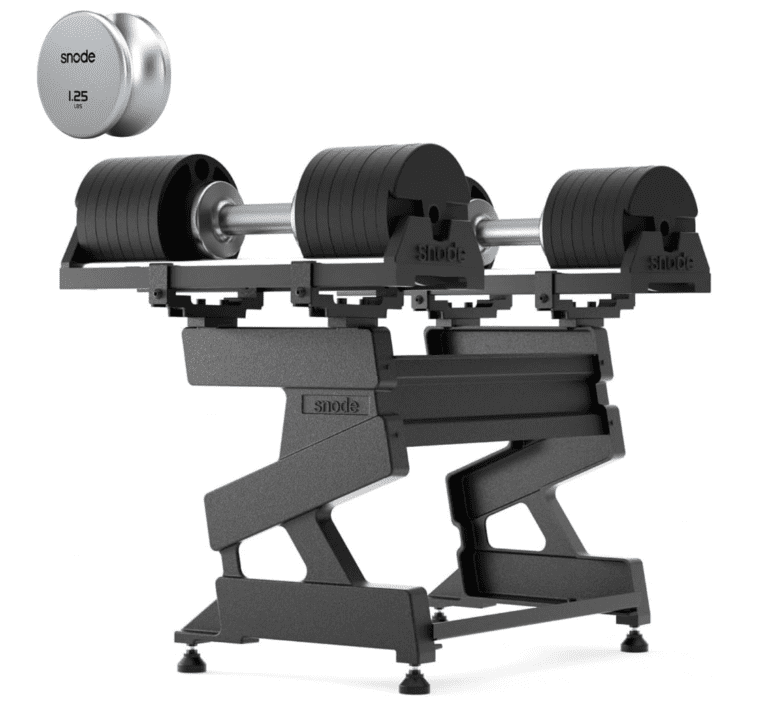
A pair of adjustable dumbbells from 5 to 50 pounds unlocks unilateral loading, independent arm training, and full range of motion on every major movement pattern. Dumbbells do not lock your hands into a fixed bar path the way a barbell does. This means more freedom at the shoulder and wrist joints. It also means more stabilizer demand. A dumbbell bench press requires more shoulder stability than a barbell bench press. A single-arm dumbbell row loads the lat through a longer range of motion than a barbell row. For the complete exercise catalog, see our dumbbell exercise library.
- Chest: Dumbbell floor press, dumbbell fly. See chest exercises list.
- Back: Single-arm row, dumbbell pullover. See dumbbell back exercises guide.
- Shoulders: Dumbbell overhead press, lateral raise. See shoulder exercises.
- Arms: Dumbbell curl, hammer curl, overhead triceps extension. See arm exercises and best biceps exercises for mass.
- Legs: Goblet squat, dumbbell Romanian deadlift, Bulgarian split squat, lunges. See leg exercises and lower body exercises.
Barbell Exercises: Tier 4, $500-$1,000, 10×10 Ft+
A 7-foot Olympic barbell and 300 pounds of iron plates sitting on a squat rack are the ceiling of home gym equipment. This is the highest load capacity available to a home lifter. Barbells lock both hands into a fixed position. The bar path is constrained. The load can be maximal. The barbell back squat, barbell deadlift, and barbell bench press are the heaviest loaded versions of the squat, hinge, and press patterns. They require more space, more flooring, and a larger budget. They reward that investment with the highest strength ceiling. For the full list, see our barbell exercise library and compound exercises.
- Lower Body: Barbell back squat, front squat, deadlift, Romanian deadlift. See deadlift exercises.
- Upper Push: Barbell bench press, overhead press.
- Upper Pull: Barbell row, landmine row. See landmine exercise benefits.
- Posterior Chain: See posterior chain development exercises.
Cable Exercises: Tier 4 Add-On, $200-$500
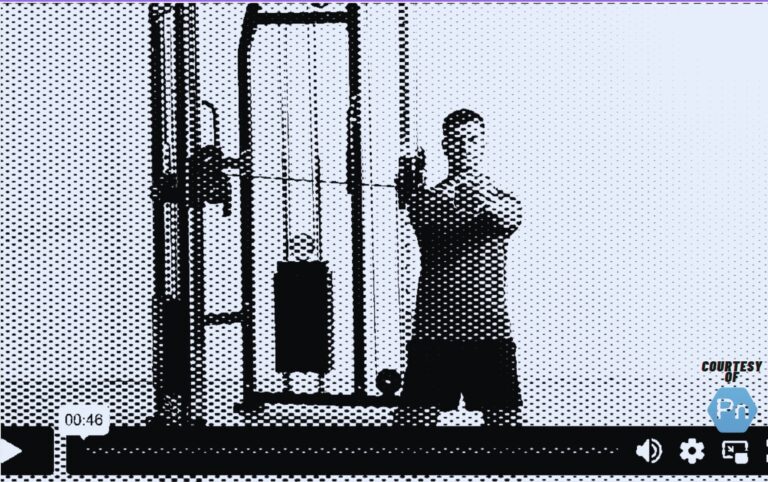
A functional trainer or plate-loaded cable pulley delivers constant mechanical tension through the entire range of motion, a resistance profile gravity-dependent free weights cannot replicate. Cables pull diagonally. Gravity pulls straight down. That difference means a cable fly maintains tension at the peak contraction where a dumbbell fly goes slack. Cable face pulls load the rear delts through a plane a dumbbell cannot reach. Cables are not a replacement for free weights. They are a complement. For the full list, see our cable exercise library and cable back exercises.
- Back: Cable row, lat pulldown, face pull. See best exercises for a V-taper back.
- Arms: Cable curl, triceps pushdown. See triceps exercises and top triceps exercises for thickness.
- Core: Pallof press, cable woodchop. See core exercises.
Full Home Workout Programs by Equipment Tier
A full-body push-pull-legs-core split done three days per week with progressive overload applied through added reps, added sets, or added resistance is the programming framework that works across every equipment tier.
Tier 1: Bodyweight Only Program
Day A (Push + Core):
Push-ups: 3x max reps
Pike push-ups: 3×8-12
Bench dips: 3×10-15
Plank: 3×30-60 sec
Dead bug: 3×10 per side
Day B (Pull + Legs):
Doorway rows: 3×10-15
Pull-ups (if bar): 3x max
Bodyweight squats: 3×20-30
Reverse lunges: 3×12 per leg
Glute bridges: 3×15-20
Day C (Full Body + Core):
Burpees: 3×10
Mountain climbers: 3×20 per side
Side plank: 3×20-30 sec per side
Hollow body hold: 3×20-30 sec
For full programming templates, see bodyweight guides and programming and bodyweight HIIT exercises.
Tier 2: Bands + Pull-Up Bar Program
Day A (Upper Push + Pull):
Banded push-ups: 3×12-15
Pull-ups or banded pulldowns: 3×8-12
Banded chest press (anchored): 3×10-15
Banded rows: 3×12-15
Band pull-aparts: 3×15-20
Day B (Lower + Core):
Banded squats: 3×15-20
Banded glute bridges: 3×15-20
Banded lateral walks: 3×10 per side
Pallof press (band anchored): 3×10 per side
See tall kneeling band exercises
See band exercise library for the full catalog.
Tier 3: Dumbbell-Only Program
Day A (Push):
Dumbbell floor press: 4×8-12
Dumbbell overhead press: 3×8-12
Dumbbell lateral raise: 3×12-15
Dumbbell skull crusher: 3×10-15
Day B (Pull):
Single-arm dumbbell row: 4×8-12 per arm
Dumbbell pullover: 3×10-12
Dumbbell curl: 3×10-12
Hammer curl: 3×10-12
Day C (Legs + Core):
Goblet squat: 4×10-15
Dumbbell Romanian deadlift: 3×10-12
Bulgarian split squat: 3×10 per leg
Dumbbell Russian twist: 3×15 per side
See dumbbell exercise library and leg exercises.
Tier 4: Barbell + Cable Program
Day A (Push):
Barbell bench press: 4×6-10
Barbell overhead press: 3×6-10
Cable fly: 3×12-15
Cable triceps pushdown: 3×12-15
Day B (Pull):
Barbell deadlift: 3×5-8
Barbell row: 4×8-12
Cable lat pulldown: 3×10-12
Cable face pull: 3×15-20
Day C (Legs):
Barbell back squat: 4×6-10
Barbell Romanian deadlift: 3×8-12
Cable pull-through: 3×12-15
Space, Budget, and Equipment: The Decision Matrix
Square footage, budget ceiling, and training goal are the three constraints that point every home lifter toward a specific equipment tier.
| Your Situation | Best Tier | Key Purchase |
|---|---|---|
| Apartment, $0 budget | Tier 1 | Nothing. Start today. See bodyweight exercise library. |
| Apartment, $100 budget | Tier 2 | Pull-up bar + band set. See band exercises. |
| Small room, $500 budget | Tier 3 | Adjustable dumbbells. See dumbbell exercises. |
| Garage, $2,000 budget | Tier 4 | Barbell + rack + plates. See barbell exercises. |
Who Each Tier Is For
Training age, space, budget, and goal specificity point different lifters toward different equipment tiers.
Tier 1: Bodyweight Only
- Beginners building the habit
- Travelers, tight apartment dwellers
- Anyone testing home training before buying gear
- Cardio and conditioning-focused lifters
- See benefits of daily exercise
Tier 2: Bands + Pull-Up Bar
- Intermediate lifters with minimal space
- Anyone who needs external load for back training
- Joint-friendly training emphasis (bands reduce joint stress)
- See bodyweight exercises for joint health
Tier 3: Dumbbells
- Muscle-building priority with limited space
- Unilateral training emphasis (fixes imbalances)
- General strength and hypertrophy
- See compound exercises for mass
Tier 4: Barbell + Cable
- Strength-focused lifters chasing max loads
- Powerlifters and Olympic lifters
- Garage gym owners with dedicated floor space
- See posterior chain development
Progressive Overload: How to Keep Growing Without a Weight Room
Adding reps, adding sets, reducing rest, slowing tempo, adding a band, and progressing to a harder variation are the six progressive overload levers available when you cannot add another plate to the bar. Progressive overload does not require heavier weight. It requires a larger stimulus over time. Any lever that increases mechanical tension or metabolic stress qualifies.
- Add Reps: 3×10 becomes 3×12. Same weight. More total volume.
- Add Sets: 3×10 becomes 4×10. Same reps. More total sets.
- Reduce Rest: 90 seconds becomes 60 seconds between sets. Higher density.
- Slow Tempo: A 3-second eccentric turns a 10-rep set into 30 seconds of continuous tension. See bodyweight programming.
- Add a Band: A push-up plus a band across the back adds resistance at the top.
- Harder Variation: A regular push-up becomes a decline push-up. A bodyweight squat becomes a pistol squat. See bodyweight exercise library for progressions.
Home Workout Guide FAQ
- What is the bare minimum equipment for a home gym?
- A doorway pull-up bar and a set of layered resistance bands. Combined cost: $50-$100. Combined space: a doorway and a 6×6 foot floor area. This Tier 2 setup covers loaded pull (pull-ups, banded rows), loaded push (banded push-ups, banded chest press), loaded legs (banded squats, banded glute bridges), and loaded core (banded Pallof press). See our affordable home exercise equipment guide.
- Can you build muscle with bodyweight exercises only?
- Yes. Push-ups, inverted rows, pistol squats, and Nordic curls are full-body bodyweight exercises that load every major movement pattern. The progression variable is leverage, not weight. A decline push-up loads more bodyweight onto the hands than a standard push-up. A pistol squat loads more bodyweight onto one leg than a two-leg squat. See our bodyweight exercise library for progressions.
- Are resistance bands enough for a full workout?
- Bands plus a pull-up bar are enough. Bands alone are not. Bands cannot replicate a loaded vertical pull. A doorway pull-up bar fills that gap. Together, bands and a pull-up bar cover every movement pattern with external resistance. See our band exercise library.
- What is better for a home gym: adjustable dumbbells or a barbell?
- For under $600 and under 100 square feet, adjustable dumbbells. Dumbbells require no rack, no bench (floor press works), and no dedicated flooring. They store in a corner. A barbell setup needs a rack, a bench, plates, and platform or rubber flooring. The barbell loads heavier. The dumbbells fit everywhere. Pick based on space and budget, not efficacy. Both build muscle. See our dumbbell exercises and barbell exercises.
- How do I progress without adding weight?
- Six levers: add reps, add sets, reduce rest, slow tempo, add a band, or progress to a harder variation. Bodyweight training uses leverage progressions. Band training uses thicker bands or doubled bands. Dumbbell training uses the same weight for more reps before moving up. The stimulus must increase over time. Weight is one lever. It is not the only lever. See our bodyweight programming guide.
- What is the best home workout split?
- Full-body, three days per week (Monday/Wednesday/Friday) for beginners through intermediates. Push/Pull/Legs, four to six days per week for advanced lifters with Tier 3 or Tier 4 equipment. Train each muscle group twice per week. Total 10-20 sets per muscle group per week. See effective muscle building exercises for exercise selection.
- How much space do I need for a home gym?
- 6×6 feet: bodyweight and bands. 8×8 feet: dumbbells. 10×12 feet: barbell and rack. A yoga mat defines the minimum. A single-car garage bay defines the maximum for most home setups. See our full exercise library sorted by equipment and space requirement.
Final Verdict
A complete home workout setup in 2026 starts with a doorway pull-up bar and a set of layered resistance bands for $50-$100 total. That Tier 2 setup covers loaded push, pull, legs, and core on 36 square feet. Add adjustable dumbbells for $300-$600 and the setup replaces a commercial gym membership for every movement pattern except maximal barbell loading. Add a barbell, rack, and plates for $1,000-$2,500 and the setup matches a commercial gym.
The equipment is the toolbox. Progressive overload is the mechanic. A roughly $50 band set with consistent overload builds more muscle than a $2,500 garage gym that collects dust. Pick your tier. Buy the minimum effective dose of equipment. Train three days per week. Add reps, sets, or resistance every session. That is the entire home workout game.
Home training is not about which equipment tier you own. It is about whether you show up, apply progressive overload, and train every movement pattern twice per week. Bodyweight on a hotel floor builds the same muscle as a barbell in a garage if the stimulus is sufficient and the consistency is there. The equipment expands your exercise library. The discipline writes the program.
Verdict: Pull-Up Bar + Bands = Minimum. Dumbbells = Standard. Barbell = Unlimited.
roughly $50 gets you started. $500 replaces a gym membership. $2,000 matches a commercial facility. Pick your tier. Train three days per week. Apply progressive overload. The equipment is the tool. The consistency is the result.
Related Home Training and Exercise Guides
- Affordable Home Exercise Equipment
- Bodyweight Exercise Library
- Band Exercise Library
- Dumbbell Exercise Library
- Barbell Exercise Library
- Cable Exercise Library
- Full Exercise Library (All Categories)
- Compound Exercises Guide
- Compound Exercises for Mass
- Bodyweight Programming Guide
- Home Back Exercises
- Chest Exercises List
- Leg Exercises
- Shoulder Exercises
- Arm Exercises
- Core Exercises
- Functional Exercises
- Benefits of Daily Exercise
- Effective Muscle Building Exercises
- Best Exercises to Keep Fit at Home
- Bodyweight Core Stability Exercises
- Bodyweight Leg and Glute Exercises
- Bodyweight Back and Pulling Exercises
- Posterior Chain Development Exercises