The Sports Research Omega-3 Fish Oil delivers 1,250mg of fish oil per softgel in triglyceride form with third-party testing. The Bronson Antarctic Krill Oil delivers 1,000mg in phospholipid form with natural astaxanthin. We ranked five omega-3 supplements by EPA content printed on the label, molecular form, third-party verification, and cost per serving to compare what is actually in each bottle in 2026.
Overview: What the Label Tells You About Omega-3 Supplements
Omega-3 supplements that print higher EPA amounts on the label, use triglyceride or phospholipid molecular forms, and carry third-party verification are commonly chosen by individuals who include omega-3s as part of a joint-comfort-focused wellness routine. This is a consumer preference observation. It is not a claim that any specific product produces any specific outcome.
Ranking Methodology: The rankings in this article are based on label-level variables only: EPA content as printed on the supplement facts panel, molecular form (triglyceride, ethyl ester, or phospholipid), third-party testing verification, and cost per serving. These rankings do not reflect product efficacy. They compare product specifications. For a deeper breakdown of omega-3 forms, see our fish oil vs krill oil guide. For the broader omega-3 product landscape, see our omega-3 product comparison roundup.
The Octane Rating Analogy
A general health fish oil is 87-octane. It runs. It checks a box. An EPA-rich triglyceride-form fish oil is 93-octane. Higher EPA milligrams printed on the label. Triglyceride molecular structure. Both say “omega-3” on the label. The EPA milligrams and the form listed in the supplement facts panel tell you which octane you are buying. Pick your fuel grade.
EPA vs DHA: What the Label Prints
EPA (eicosapentaenoic acid) and DHA (docosahexaenoic acid) are the two omega-3 fatty acids printed on every fish oil supplement facts panel. Both are long-chain marine omega-3s. The ratio between them varies by product. Some oils print higher EPA numbers. Some print higher DHA numbers. Krill oil carries both in phospholipid form. Algal oil often prints a DHA-dominant profile.
- EPA-Dominant Labels: Products like Sports Research Omega-3 and Carlson Fish Oil print higher EPA amounts on the supplement facts panel relative to DHA. This is a formulation choice. Individuals who include omega-3s as part of a joint-comfort wellness routine commonly select EPA-dominant formulas. This is a consumer preference observation. It is not a claim about biological outcomes.
- DHA-Dominant Labels: Products like Nordic Naturals Algae Omega print higher DHA amounts on the panel. DHA is found in high concentrations in brain and retinal tissue, per published nutritional science literature. This is an observation about nutrient distribution in the body. It is not a claim that DHA supplementation produces any specific cognitive or visual outcome. Some individuals add a DHA-dominant product to an EPA-dominant base for broader omega-3 coverage across the label.
- Phospholipid Form (Krill Oil): Bronson Antarctic Krill Oil delivers EPA and DHA bound to phospholipids rather than triglycerides or ethyl esters. The label numbers for EPA and DHA per softgel are typically lower than fish oil concentrates. The phospholipid structure is a different molecular delivery format printed on the label. Some individuals who report difficulty tolerating fish oil concentrates choose krill oil instead. This is a consumer preference observation.
- Triglyceride vs Ethyl Ester Form: The molecular form is sometimes printed on the label. Triglyceride form (rTG or natural TG) is the native molecular structure found in fish. Ethyl ester (EE) is a semi-synthetic form created during molecular distillation. Both forms deliver EPA and DHA. Triglyceride-form products are generally priced higher. This is a label distinction. It is not a claim about absorption or efficacy.
The 2026 Rankings: Omega-3 Supplements Compared by Label Specs
#1: Sports Research Omega-3 Fish Oil — Highest EPA in Triglyceride Form

Sports Research Omega-3 Fish Oil is a triglyceride-form (rTG) fish oil concentrate delivering 1,250mg of total fish oil per softgel sourced from wild-caught Alaskan pollock. The label prints EPA and DHA amounts directly on the supplement facts panel. No proprietary blend. The triglyceride form is the native molecular structure found in fish. Each batch is third-party tested for purity and oxidation. The softgels use a fish gelatin capsule.
- Form: Triglyceride (rTG)
- Total Fish Oil: 1,250mg per softgel
- Source: Wild-caught Alaskan pollock
- Testing: Third-party verified, non-GMO verified
- Label Highlight: Highest EPA content per softgel among the five products compared. Triglyceride form. Third-party tested.
Full Sports Research Omega-3 Review
#2: Carlson Fish Oil — Best Liquid for Flexible EPA Dosing

Carlson Fish Oil is a natural triglyceride-form liquid fish oil sourced from wild-caught Norwegian cod and packaged in a dark glass bottle to limit light exposure. The liquid format means the EPA and DHA per teaspoon are printed on the label at levels that would require multiple softgels from a standard concentrate. The product is nitrogen-flushed during bottling. The flavor system uses natural lemon. No synthetic sweeteners. No artificial preservatives.
- Form: Natural triglyceride (not re-esterified rTG; this is the native triglyceride form)
- Format: Liquid (teaspoon dosing)
- Source: Wild-caught Norwegian cod
- Packaging: Dark glass bottle, nitrogen-flushed
- Label Highlight: Liquid format enables flexible EPA and DHA intake without swallowing multiple capsules. Natural triglyceride form.
#3: Bronson Antarctic Krill Oil — Phospholipid Form, No-Burp Format
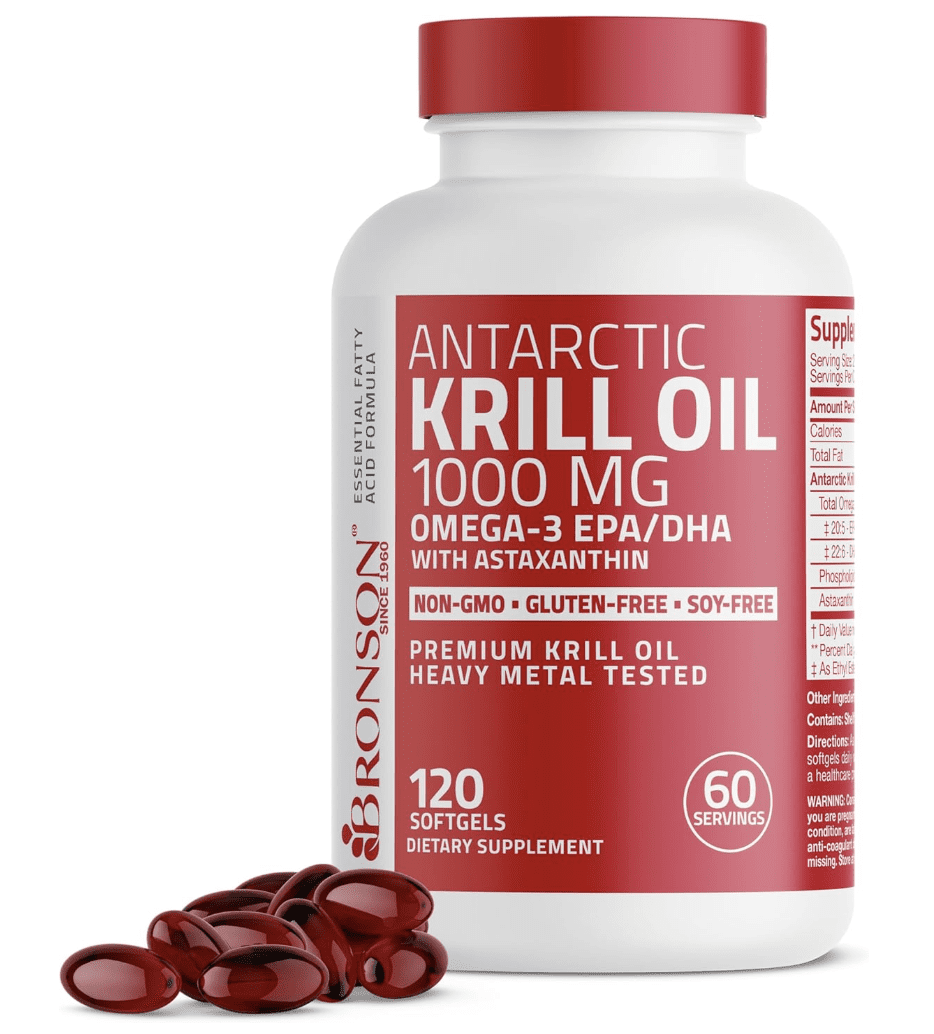
Bronson Antarctic Krill Oil delivers 1,000mg of krill oil per softgel with omega-3s bound to phospholipids rather than triglycerides or ethyl esters. The phospholipid structure is the distinguishing feature on the label. Krill oil also naturally contains astaxanthin, a carotenoid that gives the oil its red color. The EPA and DHA amounts per softgel print lower on the supplement facts panel than concentrated fish oils. The trade-off on the label is the phospholipid delivery format and the inclusion of astaxanthin. This product is commonly chosen by individuals who report difficulty tolerating fish oil concentrates.
- Form: Phospholipid (unique to krill)
- Total Krill Oil: 1,000mg per softgel
- Additional Compound: Natural astaxanthin (from krill)
- Source: Antarctic krill (Euphausia superba)
- Label Highlight: Phospholipid omega-3 delivery format. Label EPA/DHA numbers are lower than fish oil concentrates. Different molecular form.
Full Bronson Antarctic Krill Oil Review
#4: Momentous Omega-3 — NSF Certified for Sport Verification

Momentous Omega-3 carries the NSF Certified for Sport badge on the label, which means each batch undergoes third-party testing for banned substances, heavy metals, and label accuracy. The molecular form is ethyl ester (EE). Ethyl ester is a semi-synthetic form created during the molecular distillation process that concentrates EPA and DHA. The trade-off for the NSF certification is the ethyl ester form, which is generally priced higher than non-certified alternatives. This product is positioned for competitive athletes and individuals who prioritize third-party verification above all other label variables.
- Form: Ethyl ester (EE)
- Certification: NSF Certified for Sport
- Testing Scope: Banned substances, heavy metals, label accuracy
- Label Highlight: The NSF Certified for Sport badge. No other product on this list carries it. This is a specific verification standard for competitive athletes subject to drug testing.
#5: Nordic Naturals Algae Omega — DHA-Forward Plant-Based Option

Nordic Naturals Algae Omega is a plant-based omega-3 sourced from microalgae rather than fish or krill, packaged in a vegan softgel. The label prints DHA as the dominant omega-3, with a smaller EPA amount. This is the inverse profile of the fish oil concentrates on this list. Microalgae is the original source of marine omega-3s in the food chain. This product is commonly chosen by individuals who avoid marine-sourced oils or who want a DHA-forward addition to an EPA-dominant fish oil. The ingredient list is minimal: algal oil, plant-based softgel, and vitamin E as a freshness preservative.
- Form: Algal oil (plant-based triglycerides)
- Profile: DHA-dominant with smaller EPA content
- Softgel: Plant-based (vegan)
- Label Highlight: Vegan EPA and DHA source. DHA-forward profile. Commonly stacked alongside an EPA-dominant fish oil for broader omega-3 coverage across the label.
Full Nordic Naturals Algae Omega Review
How Some Individuals Include Omega-3s in a Joint Comfort Wellness Routine
Omega-3 supplements are one type of product some individuals choose to include as part of a broader wellness routine that also typically includes training, nutrition, and sleep. The following are common consumer behavior patterns observed among individuals who include omega-3s in their daily regimen. These are observations. They are not prescriptions. Individual choices vary. Always consult a qualified professional about what is appropriate for your circumstances.
- Daily Consistency Is a Common Consumer Pattern: Individuals who include omega-3 supplements typically take them daily rather than sporadically. Joint comfort is a long-term wellness objective for many individuals. Omega-3 supplements are one input some people include as part of their overall routine. This is a consumer pattern observation, not a product efficacy claim.
- EPA-Dominant Products Are Commonly Selected: Individuals who include omega-3s as part of a joint-comfort-focused wellness routine commonly select fish oils with higher EPA content printed on the label. This is a consumer preference pattern. It is not a claim that EPA produces any specific biological outcome.
- Stacking Patterns Some Individuals Follow: Some individuals combine an EPA-dominant fish oil with a krill oil for the phospholipid format. Others add a DHA-forward algal oil to an EPA-dominant base. These are stacking patterns observed among consumers. They are not recommendations.
- Liquid Formats for Flexible Intake: Some individuals choose liquid fish oil because a single teaspoon delivers the EPA and DHA printed on the label at levels that would require multiple softgels of a standard concentrate. This is a format preference. It does not imply superiority.
The Oil Change Analogy
You do not change your car’s oil once and call the engine maintained for life. Omega-3 supplementation is an oil change. It is a recurring input, not a one-time event. The EPA and DHA printed on the label are the oil grade. The molecular form is the filter type. The third-party testing is the mechanic’s signature on the invoice. Pick your oil. Change it consistently. That is the entire model. This is an analogy about maintenance inputs. It is not a claim about health outcomes.
Omega-3 Supplement Label FAQ
- What label features do individuals commonly consider when choosing an omega-3 supplement?
- Common label features individuals evaluate include the EPA amount printed on the supplement facts panel, the molecular form (triglyceride, ethyl ester, or phospholipid), third-party testing verification, the source species or organism, and the number of softgels or teaspoons required per serving. These are label-comparison variables. They are not predictors of individual experiences. For a full label comparison, see our Sports Research Omega-3 review.
- What is the difference between triglyceride form and ethyl ester form on the label?
- Triglyceride form (rTG or natural TG) is the native molecular structure found in fish. Ethyl ester (EE) is a semi-synthetic form created during molecular distillation. Both forms deliver EPA and DHA. Both forms appear on supplement facts panels. Triglyceride-form products are generally priced higher. This is a label distinction between two manufacturing formats. It is not a claim about absorption or efficacy differences.
- How do krill oil and fish oil labels differ?
- Fish oil concentrate labels typically print higher EPA and DHA amounts per softgel. Krill oil labels print omega-3s delivered in phospholipid form with natural astaxanthin. These are label distinctions between two different product categories. Some individuals who report difficulty tolerating fish oil concentrates choose krill oil. Some individuals use both product types. For a full comparison, see our fish oil vs krill oil guide.
- Can I just eat more fatty fish instead of taking a supplement?
- Fatty fish like salmon, mackerel, and sardines provide EPA and DHA in whole-food form. A supplement is a concentrated alternative with EPA and DHA amounts printed directly on the label. Some individuals use both. The choice between food and supplementation is a personal one based on dietary preferences, convenience, and individual goals. This article compares supplement labels. It does not compare supplements to whole foods.
- How long do individuals typically take omega-3 supplements before adjusting their approach?
- This varies. Some individuals report maintaining consistent daily intake over weeks before evaluating whether to continue. Others report evaluating over months. Omega-3 supplements are typically used as part of a long-term wellness routine. Individual timelines vary widely. This is not a claim about when any specific product produces any specific experience.
- Should I consult a professional before taking an omega-3 supplement?
- Yes. Consult a qualified healthcare professional before starting any new supplement, particularly if you take medication such as blood thinners, have a bleeding disorder, are scheduled for surgery, or have a health condition. Omega-3 supplements can interact with certain medications. This is general safety information. It is not a product-specific warning.
Final Verdict
Sports Research Omega-3 Fish Oil ranks first on label criteria alone for 2026: triglyceride form, EPA content per softgel as printed on the supplement facts panel, third-party testing verification, and cost per serving. This is a label comparison. It is not a claim about which product produces any specific outcome in any individual.
Carlson Fish Oil ranks first among liquid formats. The natural triglyceride form, nitrogen-flushed dark glass packaging, and EPA and DHA per teaspoon are the label highlights. Individuals who prefer liquid dosing over softgels commonly choose this format.
Bronson Antarctic Krill Oil is the phospholipid alternative. The EPA and DHA numbers per softgel are lower on the label. The molecular form is different. This is a label distinction between two product categories. It is not a hierarchy.
Momentous Omega-3 is the only NSF Certified for Sport product on this list. The ethyl ester form is the trade-off for the certification. For individuals who compete in tested sports, the NSF badge is the label variable that distinguishes this product.
Nordic Naturals Algae Omega is the only vegan product on this list. It prints a DHA-forward profile. It is commonly stacked alongside an EPA-dominant fish oil by individuals seeking broader omega-3 coverage across the label.
Omega-3 supplements are one type of product some individuals choose to include in their overall wellness routine. The EPA milligrams, molecular form, and third-party testing verification are all printed on the label. These are label-comparison variables. They do not predict individual experiences. Consult a qualified professional about whether any supplement is appropriate for your individual circumstances.
Verdict: Triglyceride Form and EPA Content Lead the Label Comparison
Sports Research Omega-3 ranks first on triglyceride form, EPA content, and third-party testing. Carlson leads on flexible liquid dosing. Bronson offers phospholipid delivery. Momentous carries NSF certification. Pick the label that matches your priorities. Consult a professional.
Related Omega-3 and Joint Support Guides
- Sports Research Omega-3 Review
- Carlson Fish Oil Review
- Momentous Omega-3 Review
- Fish Oil vs Krill Oil Guide
- Omega-3 Product Comparison
- Nordic Naturals Algae Omega Review
- UC-II Collagen Review
- Best Collagen Supplements for Lifters
- Cissus vs Collagen Comparison
- Muscle Recovery Tools Guide