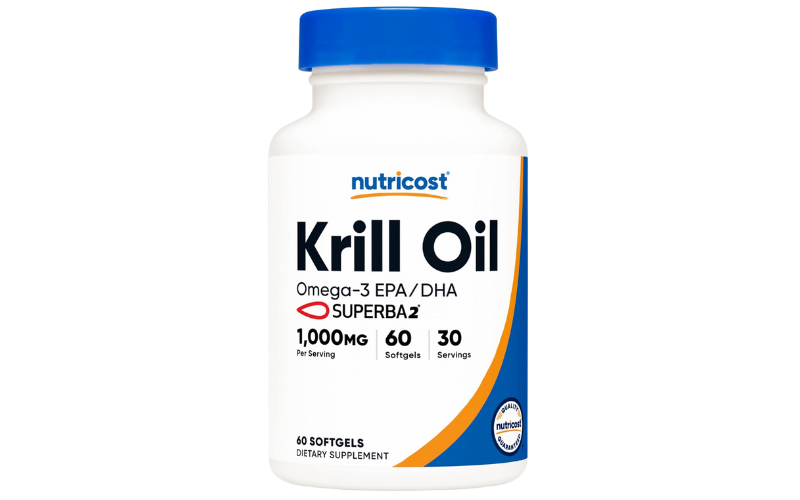
Nutricost Krill Oil 1000mg delivers 1,000mg of Antarctic krill oil per two-softgel serving with 500mg of phospholipid-bound omega-3s, naturally occurring astaxanthin as a built-in oxidation stabilizer, and a soy-free softgel shell. The phospholipid molecular format is the spec that separates this product from triglyceride fish oil on the shelf, and it is the reason for the premium price per gram. We break down the label, the molecular engineering, and the cost-per-gram math so you can decide whether phospholipid omega-3s earn their premium over standard fish oil concentrates.
The Spec Sheet: 1,000mg Krill Oil, 500mg Omega-3s, Phospholipid Form, Soy-Free Softgel
Nutricost Krill Oil 1000mg lists a two-softgel serving delivering 1,000mg of Antarctic krill oil with 500mg of total omega-3 fatty acids, made up of EPA, DHA, and phospholipid-bound omega-3s, in a softgel shell free of soy lecithin, a common filler in the krill oil category. The serving size is two softgels. The bottle holds 60, which at the label-directed serving runs 30 days. The phospholipid molecular format is the spec that separates krill oil from fish oil on a label, because it determines the fatty acid delivery structure and the absorption rate.
- Serving Size: 2 Softgels. Two softgels deliver the full 1,000mg krill oil dose with 500mg of combined omega-3s. This is a two-capsule daily protocol, not a single-pop convenience play. If you are coming from a one-capsule fish oil habit, the compliance friction increases slightly.
- Krill Oil: 1,000mg (from Antarctic Krill). Sourced from Euphausia superba, the Antarctic krill species. Krill oil naturally contains omega-3 fatty acids in phospholipid form, which is the molecular structure that published comparative research suggests is absorbed differently than the triglyceride form found in standard fish oil. The phospholipid structure is inherent to the raw material. It is not an added feature. It is what krill oil is.
- Omega-3 Fatty Acids: 500mg Total. The label specifies 500mg of combined EPA, DHA, and phospholipid-bound omega-3s per two-softgel serving. Compare this to a standard fish oil softgel: many deliver 300mg of omega-3s per 1,000mg of oil. Krill oil’s phospholipid structure means a different ratio of active-to-carrier.
- Astaxanthin: Naturally Occurring, Not Added. Krill biomass naturally contains astaxanthin, the carotenoid pigment that gives krill oil its characteristic red color. Nutricost does not add synthetic astaxanthin. The astaxanthin functions as a built-in oxidation stabilizer. It’s a preservative that comes with the raw material, not a separate ingredient line on the label.
- 60 Softgels, 30-Day Supply. At two softgels daily, the bottle runs one month. Do the cost-per-day division against fish oil and against other krill oil brands. Krill oil runs more per gram of omega-3s than fish oil. The premium is the phospholipid format and the built-in astaxanthin.
- Softgel Shell: Soy-Free. Many krill oil brands use soy lecithin in the softgel shell as an emulsifier. Nutricost specifies a soy-free shell. This is a label spec that matters for buyers avoiding soy, whether for allergy, preference, or dietary pattern reasons.
One honest note on the krill oil premium: you are paying more per gram of EPA/DHA than you would for a fish oil concentrate, because krill is a wild-harvested marine biomass with a limited annual catch quota, not a farmed feedstock. The phospholipid format and the astaxanthin content are the engineering specs that justify the price difference on paper. Whether those specs are worth the premium to you is a cost-per-unit calculation, not a review verdict.
“Krill oil is not fish oil in a smaller capsule. The molecular format is different. Phospholipids are the same type of lipid that makes up your cell membranes, which is why the absorption kinetics differ from triglycerides. It is like the difference between handing someone a key that fits the door versus handing them a key that needs to be reshaped first. The phospholipid key fits the lock. The triglyceride key needs processing. Both open the door eventually, but one gets through faster. Whether faster matters is a question for your wallet, not your physiology.”
— Charles Damiano, B.S. Clinical Nutrition
Formulation Engineering: Phospholipid vs. Triglyceride, and Why the Molecular Structure Matters
Krill oil’s omega-3 fatty acids are bound to phospholipids, while fish oil’s omega-3s are bound to triglycerides, and this molecular difference is the engineering spec that drives the absorption-rate data published in comparative research. This is not a marketing claim. It is a chemical structure difference. Phospholipids are amphipathic, meaning they have a water-soluble head and a fat-soluble tail, which means they can form micelles in the aqueous environment of the small intestine without requiring the same degree of bile-salt emulsification that triglycerides need. The phospholipid format reduces the number of digestive steps required before the fatty acids enter the enterocyte.
| Spec | Krill Oil (Nutricost) | Standard Fish Oil |
|---|---|---|
| Omega-3 Molecular Form | Phospholipid-bound | Triglyceride-bound |
| Absorption Pathway | Direct micelle formation; fewer digestive steps | Requires bile-salt emulsification and pancreatic lipase hydrolysis |
| Omega-3 per 1,000mg Oil | ~500mg | ~300mg (standard 30% concentrate) |
| Built-In Antioxidant | Yes (astaxanthin, naturally occurring) | Typically none; vitamin E often added as preservative |
| Softgel Size | Smaller (phospholipid density is lower) | Larger (triglyceride oil volume is higher) |
| Fish Burp Incidence | Low (phospholipids emulsify in stomach) | Higher (triglycerides can separate and float) |
The table describes engineering and formulation differences between the two product categories. It does not make claims about physiological outcomes. The absorption pathway difference is a molecular chemistry spec. The fish burp difference is a reported user-experience pattern, not a clinical endpoint.
“I look at the phospholipid-triglyceride split the way I look at whey isolate versus concentrate. Both are protein. Both work. But one is filtered further, which changes the absorption rate and the digestive experience. Krill oil is the isolate of the omega-3 world, more processed by nature, less processing required by your gut. Whether the premium is worth it depends on whether you notice a difference in how you feel after taking it, and that is individual, not universal.”
— Eugene Thong, CSCS
Astaxanthin: The Built-In Oxidation Stabilizer, Not a Marketing Line Item
Astaxanthin is a carotenoid pigment that gives krill oil its deep red color, and it functions as a natural oxidation stabilizer that protects the polyunsaturated omega-3 fatty acids from going rancid during storage and after the softgel is opened. This is not an added ingredient. This is a native component of Antarctic krill biomass. Nutricost does not list astaxanthin on the Supplement Facts panel as a separate line item because it is not added separately, it comes with the krill oil. The red color of the softgel contents is the visual indicator that astaxanthin is present. A pale or yellow krill oil softgel is a red flag for oxidation or adulteration.
- Natural Preservative Function: Polyunsaturated fatty acids like EPA and DHA are prone to lipid peroxidation, meaning they react with oxygen and degrade into compounds that smell and taste rancid. Astaxanthin is a carotenoid that quenches singlet oxygen and scavenges free radicals, which means it protects the oil from oxidation during shelf storage. Fish oil manufacturers typically add synthetic vitamin E (tocopherols) to serve this same preservative function. Krill oil comes with its own preservative built into the raw material.
- Not a Separate Ingredient Line: Nutricost does not list astaxanthin content on the label because it is not a standardized additive, it is a naturally variable component of the krill biomass. Some krill oil brands quantify astaxanthin on the label, typically 0.5 to 1.5mg per gram of oil. Nutricost does not. This is a label transparency gap for buyers who want to know the exact astaxanthin content.
- Visual Quality Indicator: A deep red softgel interior indicates astaxanthin presence and suggests the oil has not oxidized. A brown or pale softgel interior suggests oxidation has occurred and the product should be returned. This is a practical quality check that requires opening a softgel. If you are buying in-store, you cannot perform this check. If you are buying online, you can check your first softgel and decide whether to keep the bottle.
Sourcing and Certification: Antarctic Krill, Catch Quotas, and Sustainability Specs
Nutricost Krill Oil is sourced from Antarctic krill (Euphausia superba) harvested in the Southern Ocean under the Commission for the Conservation of Antarctic Marine Living Resources (CCAMLR) catch limits, which cap the annual krill harvest at roughly 0.2% of the estimated total biomass. This is the sustainability spec that matters for krill oil. The Antarctic krill biomass is estimated at 500 million metric tons, making it one of the largest single-species biomasses on the planet. The annual catch limit is set well below the theoretical maximum sustainable yield. Whether 0.2% is sustainable over 50 years is a fisheries management question, not a supplement label question. The label tells you where the krill came from. It does not tell you what the Southern Ocean ecosystem looks like in 2075.
- CCAMLR-Managed Fishery: The krill fishery in Area 48 (the Antarctic Peninsula region where most krill harvesting occurs) is regulated by CCAMLR, an international commission established in 1982. The existence of a management framework is the positive signal. Whether the framework is effectively enforced is a separate question that no supplement label answers.
- Not MSC Certified: Nutricost Krill Oil packaging does not display a Marine Stewardship Council (MSC) certification logo. Some competitors do. MSC certification is a third-party sustainability verification. Its absence on the Nutricost label means the fishery has not been independently assessed against the MSC standard, which is not the same as saying the fishery is unsustainable.
- Friend of the Sea Status: Some krill oil brands carry Friend of the Sea certification. Nutricost does not prominently display this on the label. The sustainability-conscious buyer should check the current product images on Amazon to confirm certification status before purchasing, as packaging updates may change this.
One honest note on krill sustainability discourse: krill are the base of the Antarctic food web, and every predator from blue whales to penguins to seals depends on them. The catch is currently low as a percentage of biomass, but the catch is concentrated in specific regions where predators also concentrate. This is an ecological complexity that a supplement label cannot resolve. The spec the label provides is species and origin. The rest is your own research.
Selection Matrix: Who This Bottle Fits
Nutricost Krill Oil 1000mg fits the buyer who wants the phospholipid molecular format, a soy-free softgel, and the built-in astaxanthin preservative at the lowest cost-per-softgel in the krill oil category, and it is a poor fit for the buyer who wants a quantified astaxanthin dose on the label, MSC certification, or a single-capsule daily serving. Match yourself to a row before you commit to 60 softgels.
- The Fish-Oil Burper: Finds that standard fish oil softgels produce repeat fish-tasting reflux. The phospholipid format emulsifies in the stomach rather than separating into an oil layer that floats to the top. This is a formulation characteristic, not a health claim.
- The Soy-Free Buyer: Avoids soy lecithin in supplements. Many krill oil softgels use soy lecithin as the shell emulsifier. Nutricost specifies soy-free, which is a label spec that matters for this buyer.
- The Phospholipid Format Buyer: Wants the molecular structure that published research suggests has different absorption kinetics than triglyceride fish oil. The phospholipid premium is the cost of this format. You are paying for the molecular delivery system, not for more total omega-3s per dollar.
- The Small-Softgel Buyer: Finds large fish oil capsules difficult to swallow. Krill oil softgels are typically smaller than fish oil softgels delivering comparable omega-3 content, because phospholipid-bound oil is denser in active content per unit volume.
The mismatch list.
- The Cost-Per-Gram Omega-3 Calculator: Wants the most EPA/DHA per dollar spent. Fish oil concentrate wins this column every time. Krill oil is a premium format. You are buying the phospholipid structure and the astaxanthin, not the cheapest omega-3s on the shelf.
- The Shellfish-Allergic Buyer: Krill are crustaceans. If you have a shellfish allergy, krill oil is contraindicated regardless of brand. Algal oil is the alternative omega-3 source.
- The Single-Capsule Buyer: Wants one capsule per day. Nutricost Krill Oil is a two-softgel serving. If single-capsule convenience is the gate, look at krill oil brands with a higher concentration per softgel or stay with concentrated fish oil.
- The Astaxanthin Quantifier: Wants the astaxanthin content printed on the label in milligrams. Nutricost does not standardize or quantify the astaxanthin. It is present as a native component of the krill biomass. If you want a known astaxanthin dose, buy a krill oil that lists it or add a standalone astaxanthin supplement.
Nutricost Krill Oil 1000mg: Spec Advantages and Engineering Trade-offs
The Advantages
- Phospholipid Molecular Format: Omega-3s bound to phospholipids rather than triglycerides. Different absorption pathway, fewer digestive steps required.
- Built-In Astaxanthin: Natural carotenoid preservative native to krill biomass. Protects the oil from oxidation without synthetic additives.
- Soy-Free Softgel Shell: No soy lecithin in the capsule. Addresses a common buyer preference in the krill oil category.
- Small Softgel Size: Easier to swallow than comparable fish oil capsules. Two small softgels rather than one large one.
- Low Reported Fish Burp Rate: Phospholipid emulsification in the stomach reduces the oil-separation effect that causes repeat-tasting reflux.
- Antarctic Sourcing Under CCAMLR: Harvested from a managed fishery with catch limits set as a percentage of estimated biomass.
The Trade-offs
- Higher Cost Per Gram of Omega-3s: Krill oil runs a premium over fish oil concentrate. You are paying for the phospholipid format, not for more EPA/DHA per dollar.
- Two-Softgel Serving: Not a single-capsule protocol. Compliance friction increases slightly compared to one-a-day fish oil products.
- Astaxanthin Not Quantified: Nutricost does not list the astaxanthin content per softgel. Competitors who standardize and quantify astaxanthin offer more label transparency on this spec.
- No MSC or Friend of the Sea Logo: Sustainability certifications from third-party organizations are not displayed on the current packaging. The CCAMLR framework governs the fishery, but independent certification is absent.
- 30-Day Supply Per Bottle: At two softgels daily, 60 softgels run exactly one month. Bulk-count bottles are available from competitors offering 90 or 120-count krill oil products.
- Shellfish Allergen: Krill are crustaceans. Not suitable for buyers with shellfish allergies.
Market Contrast: Krill Oil vs. Fish Oil vs. Algal Oil
Molecular format, omega-3 content per softgel, cost-per-gram, and allergen profile separate the omega-3 category. No oil wins every column.
| Format | Molecular Structure | Omega-3 per 1,000mg Oil | Built-In Preservative | Best For |
|---|---|---|---|---|
| Nutricost Krill Oil | Phospholipid | ~500mg | Astaxanthin (native) | Phospholipid format, no fish burps, soy-free |
| Standard Fish Oil (18/12) | Triglyceride | ~300mg | Vitamin E (added) | Lowest cost-per-gram omega-3s |
| Concentrated Fish Oil | Ethyl ester or re-esterified triglyceride | ~600 to 900mg | Vitamin E (added) | Highest omega-3 per softgel, mid-range cost |
| Algal Oil (Vegan) | Triglyceride | ~400 to 500mg | Vitamin E (added) | Vegan, shellfish-free, sustainable |
The table makes the trade-off explicit: krill oil wins on molecular format and the built-in astaxanthin preservative. Fish oil concentrate wins on total omega-3 per softgel and cost-per-gram. Algal oil wins on vegan sourcing and allergen profile. Pick the column you care about most. The product that wins that column is your product.
Frequently Asked Questions
- What makes krill oil different from fish oil at the molecular level?
- Krill oil’s omega-3 fatty acids (EPA and DHA) are bound to phospholipids, while fish oil’s omega-3s are bound to triglycerides. Phospholipids are amphipathic, meaning they have a water-soluble head and a fat-soluble tail, which allows them to form micelles in the small intestine with fewer digestive steps than triglycerides require. This is a molecular chemistry spec, not an efficacy claim.
- Does Nutricost Krill Oil contain added astaxanthin?
- No. The astaxanthin in Nutricost Krill Oil is naturally occurring in the krill biomass, not added separately. It functions as a built-in oxidation stabilizer that protects the polyunsaturated fatty acids from degrading. Nutricost does not quantify or standardize the astaxanthin content on the label.
- Is the softgel soy-free?
- Yes. Nutricost specifies a soy-free softgel shell. Many krill oil brands use soy lecithin as an emulsifier in the softgel. Nutricost does not, which matters for buyers avoiding soy.
- How long does one bottle last?
- 30 days at the label-directed serving of two softgels daily. The bottle contains 60 softgels total.
- Is Nutricost Krill Oil suitable for someone with a shellfish allergy?
- No. Krill are crustaceans, and krill oil is derived from shellfish. Buyers with shellfish allergies should avoid krill oil entirely and consider algal oil as an alternative omega-3 source.
Final Verdict: Phospholipid Omega-3s, Soy-Free, at the Lowest Cost-Per-Softgel in the Category
Nutricost Krill Oil 1000mg wins on three specs: the phospholipid molecular format, the soy-free softgel, and the cost-per-softgel that undercuts most branded krill oil competitors. The trade-offs are straightforward: krill oil costs more per gram of EPA/DHA than fish oil concentrate, the two-softgel serving adds a second capsule to your daily stack, and the astaxanthin content is not quantified on the label. If you want the phospholipid format and you are done with fish oil burps and soy lecithin, this bottle is the value play. If you want maximum omega-3s per dollar, buy concentrated fish oil. If you have a shellfish allergy, buy algal oil. Confirm the live price at the link.
1,000mg Krill Oil. 500mg Omega-3s. Phospholipid Format. Soy-Free Softgel.
The cost-per-softgel leader in the krill oil category. Phospholipids cost more than triglycerides. The format is the premium.
*Price, dose, and formula subject to change. Verify on the live listing. Statements not evaluated by the FDA. Not intended to diagnose, treat, cure, or prevent any disease.
Related Supplement Spec Analyses
- Nutricost K2 MK7 + D3 Review: Capsule Engineering and Cost-Per-Day Math
- Best Omega-3 for Joint Pain and Inflammation Support
- Algal Oil Benefits: The Vegan Omega-3 Alternative
- Momentous Collagen Review: Joint and Gut Support Analyzed
- Creatine Timing: When and How to Take It for Best Results
The Supplement Lexicon: Krill Oil Edition
- Phospholipid
- A lipid molecule with a water-soluble (hydrophilic) head and two fat-soluble (hydrophobic) tails. Phospholipids are the structural foundation of cell membranes. Krill oil’s omega-3 fatty acids are bound to phospholipids, which is the molecular format that distinguishes it from triglyceride-bound fish oil. The phospholipid structure allows direct micelle formation in the small intestine without requiring bile-salt emulsification.
- Triglyceride
- A lipid molecule consisting of three fatty acids bound to a glycerol backbone. Standard fish oil delivers omega-3s in triglyceride form, which requires bile-salt emulsification and pancreatic lipase hydrolysis before the fatty acids can be absorbed. Re-esterified triglyceride fish oils are processed to concentrate the EPA/DHA content and restore the triglyceride structure after molecular distillation.
- Astaxanthin
- A carotenoid pigment produced by microalgae and concentrated up the food chain into krill, salmon, and flamingo feathers. In krill oil, astaxanthin functions as a natural oxidation stabilizer that protects polyunsaturated fatty acids from lipid peroxidation. It gives krill oil its characteristic deep red color. Not to be confused with synthetic astaxanthin added as a separate ingredient.
- Euphausia superba
- The scientific name for Antarctic krill, the crustacean species harvested for krill oil production. Antarctic krill has an estimated biomass of 500 million metric tons and is the base of the Southern Ocean food web. The fishery is managed by CCAMLR with annual catch limits.
- CCAMLR
- The Commission for the Conservation of Antarctic Marine Living Resources, established in 1982 by international treaty. CCAMLR sets annual krill catch limits in the Southern Ocean, currently at approximately 0.2% of the estimated unexploited biomass in the primary fishing area (Area 48).
- Lipid Peroxidation
- The oxidative degradation of polyunsaturated fatty acids when exposed to oxygen, light, or heat. Oxidized omega-3 oils develop a rancid smell and taste. Astaxanthin in krill oil and vitamin E in fish oil function as preservatives to slow this process during shelf storage.