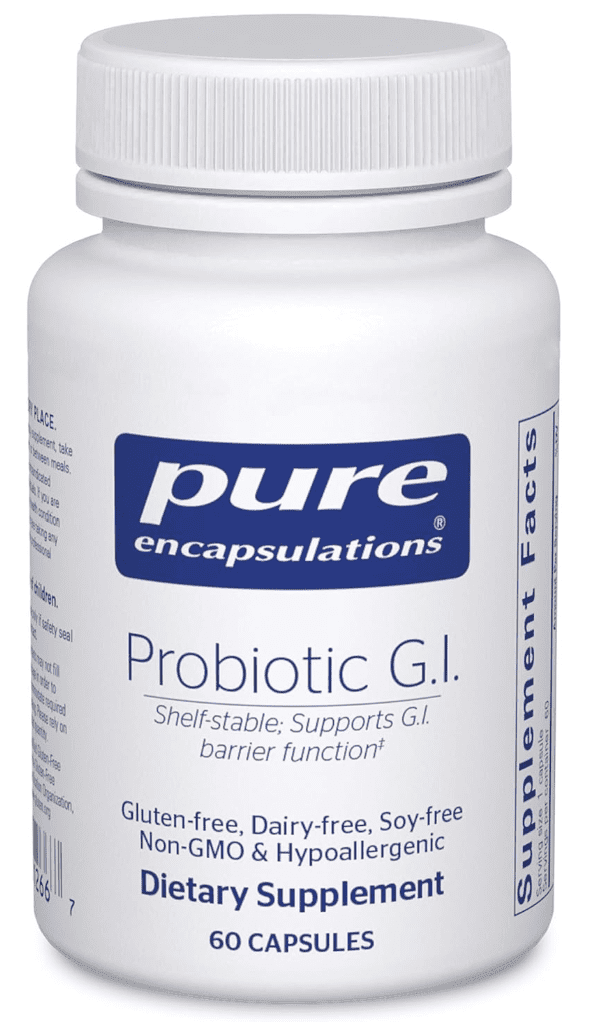
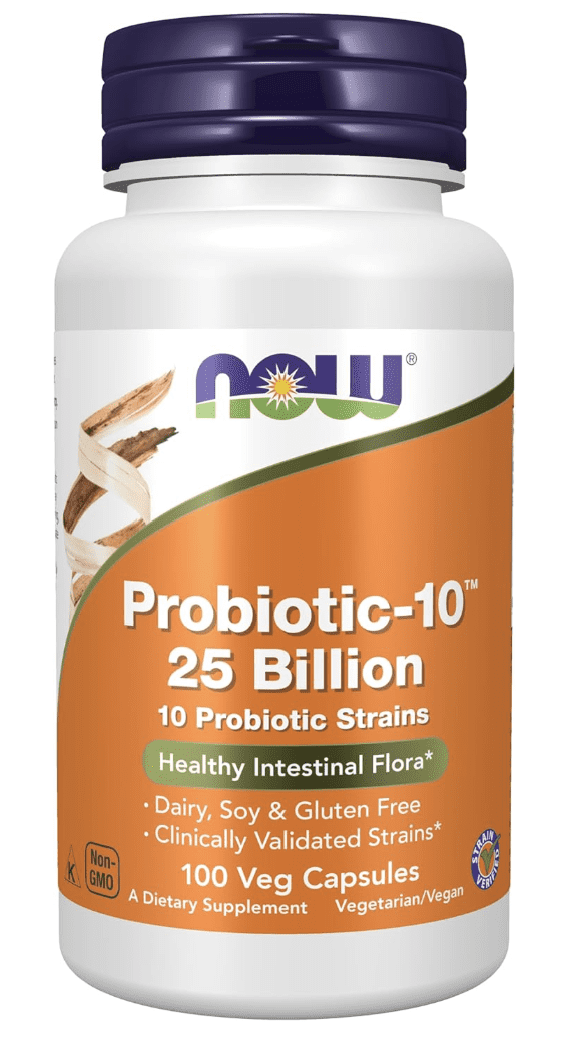
The NOW Foods Probiotic-10 packs 25 billion CFU across 10 probiotic strains inside a standard vegetarian capsule with a FOS prebiotic. No enteric coating. No spore-forming survivability tricks. Just a budget-priced, general-purpose gut health supplement from a GMP-certified manufacturer. We broke down the strain list, the capsule design, and the price-per-serving to map exactly who this bottle is for and who should spend more on survivability tech.
Overview: A Budget Probiotic From a GMP-Certified Manufacturer
NOW Foods manufactures the Probiotic-10 in GMP-certified facilities and sells it at a price point that undercuts most competitors in the multi-strain category. The bottle contains 50 vegetarian capsules. Each capsule delivers 25 billion CFU at time of manufacture across 10 bacterial strains, plus FOS as a prebiotic. The product requires refrigeration after opening. The capsule is standard cellulose. No enteric coating. No delayed-release mechanism. This is the product as printed on the label. For context on how this stacks against the broader market, see our best probiotics 2026 rankings.
- CFU Count: 25 billion at time of manufacture, per the label.
- Strain Count: 10 strains across three genera: Lactobacillus, Bifidobacterium, and Streptococcus thermophilus.
- Capsule: Vegetarian cellulose capsule. No enteric coating.
- Prebiotic: FOS (Fructooligosaccharides) included in the formula.
- Storage: Refrigeration required after opening to maintain CFU viability, per the label instructions.
- Price: Budget-to-mid range. Low cost per serving compared to delayed-release or spore-based competitors.
The Formula: 10 Strains and a FOS Prebiotic
The NOW Probiotic-10 label lists 10 bacterial strains including Lactobacillus acidophilus, Bifidobacterium lactis, Lactobacillus plantarum, Lactobacillus casei, Lactobacillus rhamnosus, Lactobacillus paracasei, Bifidobacterium breve, Bifidobacterium longum, Streptococcus thermophilus, and Lactobacillus salivarius. That is the full strain lineup as printed. The formula also includes Fructooligosaccharides, a prebiotic fiber, which serves as a food source for the probiotic organisms in the capsule.
- Strain Diversity: Ten strains across three genera is a broad blend for a budget probiotic. Many competitors at this price point list three to five strains. The inclusion of Bifidobacterium longum and Lactobacillus rhamnosus — two of the more frequently cited strains in published research — is notable at this price. This is an observation about what is in the capsule. It is not a claim about what those strains do inside any individual’s body.
- FOS Prebiotic: Fructooligosaccharides are a soluble fiber added to the capsule blend. The label lists it as a separate ingredient from the probiotic blend. This is a value-adding inclusion at the budget tier. Many competitors skip the prebiotic and sell only the probiotic organisms.
- CFU Decline: The label states 25 billion CFU at time of manufacture. The viable CFU count at the time of consumption will be lower. The rate of decline depends on storage temperature, time since manufacture, and exposure to heat during shipping. The label does not guarantee a CFU count at expiration. It guarantees the count at manufacture. This is standard for the category, not unique to NOW Foods, but worth noting when comparing against shelf-stable spore-based products that are less sensitive to temperature.
The 10-Pack of Seeds vs. The Sprouted Plant Analogy
The NOW Probiotic-10 is a 10-pack of seeds wrapped in a basic paper envelope. The envelope says 25 seeds inside when it left the factory. How many seeds actually germinate depends on how hot the envelope got in the mail truck and whether the soil pH dissolves the paper. A spore-based probiotic is a sprouted plant shipped in a sealed greenhouse with its own soil. Both arrive at your door. Only one is ready to grow the moment you open the package. The seed pack costs less. The greenhouse costs more. Pick the delivery method that matches your tolerance for uncertainty.
The Capsule: Standard Vegetarian Cellulose, No Enteric Protection
The vegetarian cellulose capsule on the NOW Probiotic-10 is the single biggest design limitation on the spec sheet. It dissolves in the stomach. It provides no acid protection. It does not delay release. It does not shield the probiotic organisms from gastric pH. This is not a defect. It is a design choice that keeps the product cheap to manufacture. The trade-off is that an unknown percentage of the 25 billion CFU will not survive transit through the stomach.
- What the Capsule Is: Vegetarian cellulose. Standard dissolution profile. Dissolves in gastric fluid.
- What the Capsule Is Not: Enteric-coated. Acid-resistant. Delayed-release. Spore-based. It is the least expensive capsule technology available for probiotic delivery.
- Why It Matters: Probiotic organisms are sensitive to pH. Gastric acid kills a portion of ingested bacteria. Enteric-coated capsules, spore-forming strains, and 2-in-1 capsule systems are designed to protect organisms through the stomach and release them in the intestinal tract. The NOW Probiotic-10 uses none of these technologies. The viable CFU count that reaches the intestines is lower than the 25 billion printed on the label. The specific percentage is unknowable from the label alone.
“A budget probiotic like this can be a reasonable entry point. It introduces a variety of strains without the financial commitment of a high-CFU, advanced-delivery product. Think of it as foundational, not optimized.”
— Charles Damiano, B.S. Clinical Nutrition
The Value: What the Money Buys and What It Doesn’t
The NOW Probiotic-10 price per serving is among the lowest in the multi-strain probiotic category. What the price buys: 10 strains, 25 billion CFU at manufacture, a FOS prebiotic, and manufacturing in a GMP-certified facility from a brand with decades of presence in the health food channel. What the price does not buy: acid-resistant capsule technology, guaranteed CFU at expiration, a refrigerated supply chain guarantee, or strain-specific documentation for each organism in the blend.
- What You Pay For: Raw materials, blending 10 strains, basic encapsulation, GMP facility overhead, and the NOW Foods brand quality-control system.
- What You Do Not Pay For: Enteric coating R&D, spore-formation processing, refrigerated cold-chain logistics with temperature monitoring, or organism-specific stability data printed on the label.
The value proposition is straightforward. If the goal is to add a multi-strain probiotic to a daily routine at the lowest possible cost from a known manufacturer, the Probiotic-10 fits. If the goal is to maximize the percentage of CFUs that survive gastric transit, the value equation shifts toward products with acid-protection technology. For a deeper dive on survivability, see our comparison of Thorne FloraMend Prime which uses a spore-forming strain that does not require enteric coating.
NOW Probiotic-10 Pros and Cons
The trade-off is 10 strains at a budget price against a standard vegetarian capsule with no acid protection and refrigeration requirement.
Pros
- 10 strains, 25 billion CFU: Broad diversity for a budget-priced probiotic.
- FOS prebiotic included: Adds a food source for the probiotic organisms at no extra cost.
- GMP-certified manufacturer: NOW Foods operates FDA-registered GMP facilities.
- 50 capsules per bottle: A 50-day supply at one capsule per day.
- Low cost per serving: Among the most affordable multi-strain probiotics from a known brand.
- Vegetarian capsule: No gelatin. Compatible with vegetarian dietary preferences.
Cons
- No enteric coating: Standard cellulose capsule dissolves in stomach acid. No protection against gastric pH.
- Refrigeration required: Not shelf-stable after opening. Travel-unfriendly. Label specifies refrigeration.
- CFU at manufacture, not at expiration: Viable count at time of consumption is lower than 25 billion. The specific percentage is not on the label.
- No spore-forming strains: All 10 strains are standard vegetative organisms sensitive to heat and acid.
- Not a targeted formula: General-purpose blend. No strain-specific documentation for particular digestive concerns on the label.
Who NOW Probiotic-10 Is For (and Not For)
Match the product to your priority. Budget, strain diversity, survivability requirements, and storage preferences point different buyers toward different bottles.
Good Fit
- First-time probiotic users wanting a low-cost entry point
- General daily gut-health supplementation at the lowest possible price from a known brand
- People who already refrigerate supplements and do not travel frequently with them
- Buyers who prioritize strain diversity over survivability technology
- Individuals testing tolerance before moving to a higher-CFU product
- Those comfortable with the CFU-at-manufacture labeling standard
Not the Best Fit
- Buyers who want guaranteed acid survivability or enteric-coated capsules
- People who travel frequently and cannot guarantee refrigeration
- Anyone who has tried budget probiotics without noticeable effect and wants to try a different delivery technology
- Individuals with specific digestive concerns who may want a product developed for those concerns
- Buyers seeking the lowest-allergen, most minimal-ingredient capsule (see Garden of Life Probiotics Men or Goli Probiotic)
“For the lifter who just wants to cover the basics, this can be a sensible add. It is not the product that will overhaul your digestive experience, but it is a cost-effective piece of a broader health picture. Pair it with a diet rich in fiber and fermented foods, and you are ahead of most.”
— Eugene Thong, CSCS
What Are the Alternatives at Higher Price Points?
If the standard capsule and refrigeration requirement give you pause, here is what the next tier up buys you in survivability technology and CFU at expiration guarantees.
| If You Want… | Then Consider… | Key Upgrade Over NOW Probiotic-10 |
|---|---|---|
| Higher CFU at a similar price | Physician’s Choice 60 Billion | 60 billion CFU with a delayed-release capsule. More strains. Acid-resistant design. |
| No refrigeration, spore-based survivability | Thorne FloraMend Prime | Spore-forming Bacillus coagulans strain. Shelf-stable. No refrigeration. Survives gastric acid without enteric coating. |
| Patented delivery technology | Seed DS-01 Daily Synbiotic | 2-in-1 capsule with inner probiotic core and outer prebiotic shell. Designed to survive gastric transit. |
| Higher CFU with prebiotic at mid-tier price | Sports Research Daily Probiotic | 60 billion CFU, prebiotic fiber, delayed-release vegetarian capsule. |
For the full market landscape, see our best probiotics 2026 rankings. For a product with a different approach to gut health, see our Garden of Life Probiotics for Men review.
NOW Probiotic-10 FAQ
- Does NOW Probiotic-10 require refrigeration?
- Yes. The label instructs refrigeration after opening to maintain potency, per the manufacturer’s storage directions. The probiotic organisms are standard vegetative strains, which are sensitive to heat and degrade faster at room temperature. This is a product specification, not a defect. Some retailers ship the product with cold packs. Check with the specific seller before ordering.
- Does the capsule protect the probiotics from stomach acid?
- No. The capsule is standard vegetarian cellulose. It dissolves in gastric fluid. It is not enteric-coated. It is not acid-resistant. It is not a delayed-release design. The capsule’s job is to hold the powder blend together until it reaches the stomach, where it dissolves. Some percentage of the CFUs will not survive gastric transit. The label does not specify what percentage survives. This is the most significant design limitation of the product versus competitors with enteric or spore-based delivery.
- How many CFUs are actually viable at expiration?
- The label states 25 billion CFU at time of manufacture. It does not guarantee a CFU count at expiration. The viable count declines over time. The rate of decline depends on storage temperature, humidity, and time since manufacture. This is standard labeling for the category and is not unique to NOW Foods. Products that guarantee CFU at expiration typically print that guarantee on the label. The NOW Probiotic-10 does not.
- What strains are in NOW Probiotic-10?
- The label lists 10 strains: Lactobacillus acidophilus, Bifidobacterium lactis, Lactobacillus plantarum, Lactobacillus casei, Lactobacillus rhamnosus, Lactobacillus paracasei, Bifidobacterium breve, Bifidobacterium longum, Streptococcus thermophilus, and Lactobacillus salivarius. Each strain is listed at the genus and species level on the supplement facts panel. No strain-specific CFU counts per organism are provided. The 25 billion CFU figure is for the total blend.
- Is NOW Probiotic-10 manufactured in a GMP facility?
- Yes. NOW Foods manufactures products in GMP-certified facilities that are registered with the FDA. GMP stands for Good Manufacturing Practices. It is a quality-control standard for supplement manufacturing, not a guarantee of product efficacy.
- Should I consult a professional before taking a probiotic?
- Yes. Consult a qualified healthcare professional before starting any new supplement, particularly if you have a health condition, are immunocompromised, are pregnant or nursing, or are taking medication. Probiotics are live organisms. An individual with a compromised immune system should not take them without explicit medical guidance. This is general safety information, not product-specific advice.
Final Verdict
The NOW Foods Probiotic-10 is a 10-strain, 25-billion-CFU probiotic with a FOS prebiotic in a standard vegetarian capsule at a budget price from a GMP-certified manufacturer. It is the Honda Civic of probiotics. Reliable manufacturing. Affordable entry price. Gets the job done for general daily supplementation. It is not a performance machine. It lacks the survivability engineering of enteric-coated or spore-based competitors. For the buyer who wants to add a multi-strain probiotic at the lowest possible cost from a known brand, it is a defensible choice. For the buyer who wants to maximize the percentage of CFUs that survive gastric transit, the extra investment in acid-protection technology is worth considering.
A probiotic supplement is a delivery system. The capsule matters as much as the strains inside it. The NOW Probiotic-10 label lists 10 strains and 25 billion CFU at manufacture. The capsule provides no acid protection. The viable count at consumption is lower than the label number. How much lower is unknowable from the label alone. This is the product. Know what you are buying. Adjust your expectations to the capsule design. Consult a professional before starting any new supplement.
Verdict: Solid Budget Probiotic, No Survivability Tech
10 strains. 25 billion CFU at manufacture. FOS prebiotic. GMP facility. Standard vegetarian capsule with no enteric coating. Refrigeration required. The right pick for budget-first buyers. The wrong pick for anyone who wants guaranteed acid survivability.
Related Probiotic and Gut Health Guides
- Best Probiotics 2026: Complete Rankings
- Thorne FloraMend Prime Review
- Garden of Life Probiotics for Men Review
- Goli Zero Sugar Probiotic Review
- Gruns Super Greens Review
- Protein Powders with Digestive Enzymes
- Pure Encapsulations Digestive Enzymes Ultra Review
Keep Building
Pure Encapsulations Probiotic G.I. Review: LP299v + S.
Pure Encapsulations Probiotic G.I. is a two-organism capsule containing Lactobacillus plantarum 299v and Saccharomyces boulardii at 10 billion CFU in a hypoallergenic vegetable shell. No magnesium stearate. No wheat. No gluten. No eggs. No peanuts. No shellfish. No soy. No artificial anything. Two organisms. One capsule. That is the entire formula. Overview Label Audit What’s…
Physician’s Choice 60 Billion CFU Probiotic Review
Physician’s Choice 60 Billion CFU is a 10-strain Lactobacillus and Bifidobacterium synbiotic with an organic prebiotic matrix, acid-resistant delayed-release capsule delivery, and third-party verified potency. It is the highest-volume, lowest-cost-per-billion option in the category. The trade-off is equally clear: no alphanumeric strain codes, no spore-based delivery, no organism-specific clinical trial data. Here is the full…