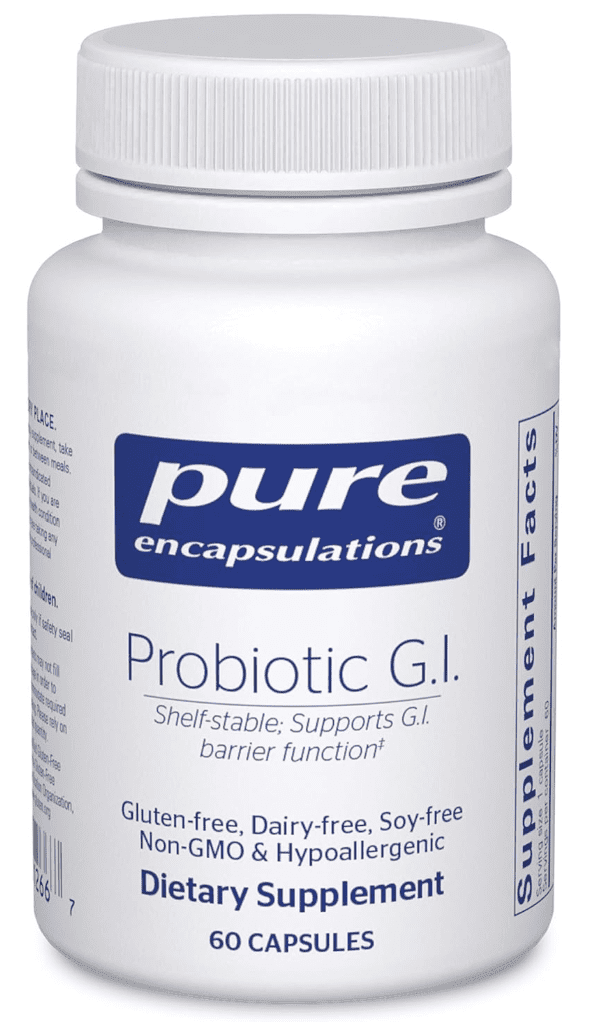
Pure Encapsulations Probiotic G.I. is a two-organism capsule containing Lactobacillus plantarum 299v and Saccharomyces boulardii at 10 billion CFU in a hypoallergenic vegetable shell. No magnesium stearate. No wheat. No gluten. No eggs. No peanuts. No shellfish. No soy. No artificial anything. Two organisms. One capsule. That is the entire formula.
For the full probiotic landscape, see our 2026 Guide to the Best Probiotics. For a spore-forming alternative, see Thorne FloraMend Prime review.
Overview: A Two-Ingredient Probiotic in a Category That Loves Thirty
Pure Encapsulations Probiotic G.I. lists two organisms on the entire supplement facts panel: Lactobacillus plantarum 299v and Saccharomyces boulardii. Ten billion CFU total. One vegetable cellulose capsule. That is the product. Most drugstore probiotics throw 14 strains and 50 billion CFU at the label and call it a day. This one goes the other direction. Two organisms. Zero filler organisms. Zero flow agents. Zero allergen ingredients. The brand is Pure Encapsulations, a practitioner-grade manufacturer that sells through healthcare professional channels and Amazon. The product philosophy is ingredient exclusion as a feature. For the broader category breakdown, see best probiotics of 2026.
- Organisms Per Capsule: Two. L. plantarum 299v (a bacterium) and S. boulardii (a beneficial yeast).
- CFU Per Capsule: 10 billion CFU total. No CFU breakdown by organism listed on the label.
- Serving Size: One capsule daily per label directions. Consult a healthcare professional for personalized guidance.
- Capsule Material: Vegetable cellulose. Not bovine gelatin. Vegan-compatible capsule shell.
- Count Per Bottle: 60 capsules. Two-month supply at one capsule per day.
- Storage: Label does not require refrigeration. Standard cool, dry storage.
The Speakeasy vs. The Nightclub Analogy
Most probiotics are nightclubs. Thirty strains on the guest list. Flashing lights. A line around the block. Pure Encapsulations Probiotic G.I. is a speakeasy. Two names on the list. Unmarked door. No sign. You either know about it or you do not. The nightclub lets everyone in. The speakeasy only lets in who it came for. Two organisms. Zero party crashers. That is the product thesis.
Label Audit: What’s Printed on the Supplement Facts Panel
Lactobacillus plantarum 299v and Saccharomyces boulardii are the only two organisms printed on the Supplement Facts panel of Pure Encapsulations Probiotic G.I. Each organism is listed by genus, species, and strain designation. No proprietary blend. No “probiotic complex” hiding the individual counts. The label is transparent by omission. There is almost nothing on it.
Lactobacillus Plantarum 299v (LP299v)
- Full Strain Designation: LP299v. This is a specific, catalogued strain, not a generic L. plantarum with no strain identifier. The strain designation tells you exactly which organism is in the capsule. Generic probiotics list “L. plantarum” and stop. This one prints the full name.
- Genus and Species: Lactobacillus plantarum. A lactic acid bacterium found in fermented foods including sauerkraut, kimchi, and sourdough.
- What Else the Label Tells You: Nothing. The label does not describe what LP299v does. It does not make claims. It lists the organism and the CFU count.
Saccharomyces Boulardii
- Organism Type: A yeast, not a bacterium. This is the structural differentiator between Probiotic G.I. and nearly every other probiotic on the shelf. S. boulardii is a beneficial yeast originally isolated from lychee and mangosteen fruit.
- Why a Yeast in a Probiotic: Bacteria and yeast are biologically distinct. Antibiotics target bacteria. They do not target yeast. This is a fact about organism biology printed nowhere on the label. It is simply what S. boulardii is.
- Label Listing: Printed as Saccharomyces boulardii. Included in the 10 billion CFU total. No separate CFU breakdown for the yeast versus the bacterium.
“Putting a yeast in a probiotic is like bringing a translator to a foreign country. The bacteria speak one language. The yeast speaks another. Most probiotics only send bacteria into the room. Probiotic G.I. sends both. Two organisms. Two communication protocols. One capsule. The label does not say this. The ingredient list does.”
— Charles Damiano, B.S. Clinical Nutrition
What’s Not in the Capsule: The Exclusion List
Pure Encapsulations Probiotic G.I. excludes magnesium stearate, wheat, gluten, eggs, peanuts, tree nuts, shellfish, soy, and all artificial colors, flavors, and sweeteners from the ingredient panel. The capsule is vegetable cellulose. The list of what is not in the product is longer than the list of what is. That is the design.
- No Magnesium Stearate: A common flow agent in supplement manufacturing. Pure Encapsulations omits it from every product in their catalog. This is a brand-level decision, not a product-specific one. Magnesium stearate is a lubricant that prevents ingredients from sticking to machinery during production. It is in most supplements. It is not in this one.
- No Major Allergens: The label states free from wheat, gluten, eggs, peanuts, tree nuts, shellfish, and soy. These cover the eight major food allergens recognized in the United States. The capsule is produced in a facility that handles these ingredients, per standard manufacturing practice, but the formula itself excludes them.
- No Artificial Additives: Zero artificial colors. Zero artificial flavors. Zero artificial sweeteners. The capsule contains the organisms and the vegetable cellulose shell. Nothing else.
- No Bovine Gelatin: The capsule is vegetable cellulose. No animal-derived gelatin. This is a vegan-compatible capsule shell, though the bacterial strains themselves are cultured on dairy-based growth media per standard probiotic manufacturing practice.
“Imagine buying a car and the salesman hands you a 90-page ingredient list for the paint job. That is most supplements. Pure Encapsulations hands you a Post-it note. Two organisms. Vegetable capsule. Done. The ingredient exclusion is the feature. The short list is the selling point. Most supplement companies sell you on what they added. This one sells you on what they left out.”
— Eugene Thong, CSCS
Who This Probiotic Is For (and Who Should Walk Past It)
Pure Encapsulations Probiotic G.I. is built for the supplement buyer who has tried other probiotics and found the ingredient list too long, the organism count too high, or the reaction too strong. It is a two-ingredient product in a category that competes on organism count. The buyer who wants this product is the buyer who wants the fewest possible variables. The buyer who does not want this product is the buyer who wants the most organisms per dollar.
Buy This If:
- You want the shortest possible probiotic ingredient panel on the market.
- You avoid magnesium stearate, wheat, gluten, eggs, peanuts, tree nuts, shellfish, and soy.
- You want a yeast-based organism (S. boulardii) alongside a bacterial strain.
- You want a practitioner-grade brand sold through healthcare professional channels.
- You are willing to pay a premium for ingredient exclusion.
- You want a probiotic with no prebiotic fiber included.
Skip This If:
- You want the most CFU per dollar. This is a premium, low-CFU product.
- You want a broad-spectrum, multi-strain formula with 10+ organisms.
- You want a synbiotic with built-in prebiotic fiber.
- You are on a tight budget.
- You want a spore-forming probiotic. See Thorne FloraMend Prime.
- You want a full-spectrum daily synbiotic. See Seed DS-01 review.
The Toolbox vs. The Single Wrench Analogy
Most probiotics are a full toolbox. Thirty wrenches. You grab the box, shake it, and hope the right wrench hits the bolt. Probiotic G.I. is a single wrench. One size. One bolt. If the wrench fits the bolt, it turns. If it does not, you need a different wrench. The toolbox is more versatile. The single wrench is more precise. Buy the toolbox if you want options. Buy the single wrench if you know exactly which bolt you are turning.
The Drawbacks: What You Give Up With a Two-Ingredient Probiotic
Probiotic G.I. costs more per CFU than mass-market probiotics. It contains two organisms while competitors contain ten to thirty. It has no prebiotic fiber. These are not hidden flaws. They are printed on the label. The product makes a bet on minimalism. The bet has costs.
- Cost Per CFU: Significantly more expensive per 10 billion CFU than drugstore probiotics. You are paying for strain specificity, not organism count. The price is the premium for the exclusion list and the brand’s practitioner-grade positioning.
- Two Organisms Only: No Lactobacillus acidophilus. No Bifidobacterium species. No Bacillus spores. If organism diversity is your priority, this product is structurally not designed for you. See Garden of Life Probiotics for Men for a multi-strain alternative.
- No Prebiotic Fiber: The capsule contains only the two organisms. No inulin. No FOS. No prebiotic of any kind. If you want a synbiotic, you must pair this with a separate prebiotic product or choose an all-in-one like Seed DS-01.
- 10 Billion CFU Total: This is a maintenance dose by category standards. Multi-strain products routinely list 30-100 billion CFU. Probiotic G.I. is not competing on total organism count.
- 60 Capsules Per Bottle: At one capsule per day, a two-month supply. At the price point, the per-day cost is competitive with other practitioner-grade products but significantly higher than drugstore alternatives.
Head-to-Head: Probiotic G.I. vs. Thorne FloraMend vs. Seed DS-01
Pure Encapsulations Probiotic G.I., Thorne FloraMend Prime, and Seed DS-01 are three premium probiotics with three different design philosophies. G.I. is a two-organism minimalist formula. FloraMend is a single spore-forming strain. Seed is a 24-strain synbiotic system. Different tools. Different buyers. Different price points.
| Feature | Pure Encapsulations G.I. | Thorne FloraMend Prime | Seed DS-01 |
|---|---|---|---|
| Organism Count | 2 (1 bacterium + 1 yeast) | 1 (spore-forming bacterium) | 24 (bacterial strains) |
| Key Organisms | L. plantarum 299v, S. boulardii | Bacillus coagulans MTCC 5856 | 24 human-sourced strains |
| CFU Per Serving | 10 Billion CFU | 5 Billion CFU | 53.6 Billion AFU |
| Includes Yeast? | Yes (S. boulardii) | No | No |
| Prebiotic Included? | No | No | Yes (capsule-in-capsule design) |
| Magnesium Stearate? | No | No | No |
| Capsule Type | Vegetable cellulose | Vegetable cellulose | Proprietary dual-capsule |
| Servings Per Bottle | 60 | 30 | 30 |
| Best Described As | Minimalist two-organism tool | Single-strain spore probiotic | Full-spectrum synbiotic system |
The S. boulardii yeast is the differentiator that neither FloraMend nor Seed includes. This is a fact about the ingredient panel, not a claim about outcomes. Probiotic G.I. is the only product in this comparison that pairs a bacterium with a beneficial yeast. FloraMend goes the spore-forming route. Seed goes the broad-spectrum route. Three different bets on what belongs in a probiotic capsule. For a full ranking across the category, see our best probiotics guide. For a drugstore comparison, see Garden of Life Probiotics for Men.
Pure Encapsulations Probiotic G.I. FAQ
- What is in Pure Encapsulations Probiotic G.I.?
- Two organisms: Lactobacillus plantarum 299v (a bacterium) and Saccharomyces boulardii (a beneficial yeast). 10 billion CFU total per capsule. Vegetable cellulose capsule. No magnesium stearate. No wheat, gluten, eggs, peanuts, tree nuts, shellfish, or soy. No artificial colors, flavors, or sweeteners.
- Why does this probiotic include a yeast instead of more bacteria?
- Saccharomyces boulardii is a yeast, not a bacterium. It is biologically distinct from bacterial probiotic strains. One practical difference: antibiotics target bacteria. They do not target yeast. This is a fact about organism biology. It is not a claim about what the product does inside the body.
- Is 10 billion CFU a lot or a little?
- By industry comparison, 10 billion CFU is a moderate count. Multi-strain drugstore probiotics routinely list 30-100 billion CFU. Single-strain products like Thorne FloraMend list 5 billion CFU. Ten billion sits in the middle of the practitioner-grade range. CFU count is one variable on the label. Organism type and strain designation are the others.
- Does Probiotic G.I. need refrigeration?
- The label does not require refrigeration. Standard storage is cool, dry place. The capsule format protects the organisms from moisture, which is the primary stability variable for probiotics.
- How long does one bottle last?
- 60 capsules. At one capsule per day per the label directions, one bottle is a two-month supply.
- How does this compare to eating fermented foods?
- Fermented foods like sauerkraut, kimchi, and yogurt contain live organisms. They do not list CFU counts or strain designations on a label. Probiotic G.I. lists two specific organisms with defined strain designations at a defined CFU count. Fermented foods are food. This is a supplement. Different categories. Different labeling requirements. For a broader comparison, see our Goli Zero Sugar Probiotic review.
Final Verdict
Pure Encapsulations Probiotic G.I. is a two-organism, 10-billion-CFU, hypoallergenic vegetable capsule probiotic from a practitioner-grade brand. The label lists L. plantarum 299v and S. boulardii. That is the entire active ingredient panel. The exclusion list is longer than the inclusion list. No magnesium stearate. No wheat. No gluten. No eggs. No peanuts. No tree nuts. No shellfish. No soy. No artificial colors. No artificial flavors. No artificial sweeteners.
This product makes one bet: fewer ingredients, fewer variables, fewer organisms, higher precision. It is not competing with 30-strain, 100-billion-CFU drugstore probiotics on organism count. It is not competing with spore-forming products on survivability. It is not competing with synbiotics on all-in-one convenience. It is a two-ingredient probiotic in a category that rewards ingredient-count inflation.
The buyer who wants this product knows exactly what they are looking for. Two organisms. One yeast. One bacterium. A vegetable capsule. Nothing else. If that is the label you want, this is the product. If you want more organisms, more CFU, or a prebiotic included, the comparison table above points to the alternatives.
A probiotic supplement is a label with organisms in a capsule. The label tells you what organisms, how many, and what else is in the capsule. Probiotic G.I. prints the shortest answer in the practitioner-grade category. Two organisms. Zero fillers. That is the product. Everything else is preference.
Verdict: Two Organisms, Zero Fillers, One Bet on Minimalism
L. plantarum 299v and S. boulardii in a vegetable capsule. 10 billion CFU. 60 capsules per bottle. Practitioner-grade brand. No magnesium stearate. No allergens. No artificial additives. Premium price for a premium exclusion list.
Related Probiotic and Gut Health Guides
- Best Probiotics (2026): Complete Ranking Guide
- Thorne FloraMend Prime Review
- Seed DS-01 Daily Synbiotic Review
- Garden of Life Probiotics for Men Review
- Goli Zero Sugar Probiotic Review
- Gruns Super Greens Review