NutraChamps Korean Red Panax Ginseng and Bronson Rhodiola Rosea both sit in the same adaptogen aisle, but the supplement facts panels are nowhere close. One runs a 10:1 extract standardized to a 5% ginsenoside floor. The other runs a straight 250mg extract standardized to 0.5% rosavins. We pulled both labels apart line by line to see exactly what each bottle guarantees on paper.
Price Disclaimer: Prices shown are approximate and may vary. Check current pricing and availability on Amazon.
Disclosure: This article contains affiliate links. As an Amazon Associate, I earn from qualifying purchases at no extra cost to you. Health & Safety: Statements have not been evaluated by the FDA. These products are not intended to diagnose, treat, cure, or prevent any disease. Always read the label before use.

The Extraction and Standardization Breakdown
NutraChamps Korean Red Panax Ginseng and Bronson Rhodiola Rosea concentrate their raw root through two completely different processes. One label is built around a compression ratio. The other is built around a single flat extract percentage. Neither number tells you which bottle is “stronger.” Both numbers tell you what the manufacturer is willing to put in writing.

- Extract Ratio: 10:1 (root extract), root sourced from a Korean growing region with a documented 500+ year ginseng-cultivation history
- Root Age: Hand-selected roots, matured 4+ years before harvest
- Processing: Traditional steaming and sun-drying (the “red” ginseng process)
- Standardization Floor: Minimum 5% ginsenosides, disclosed on the label
- Serving Size: 1065mg across 2 capsules
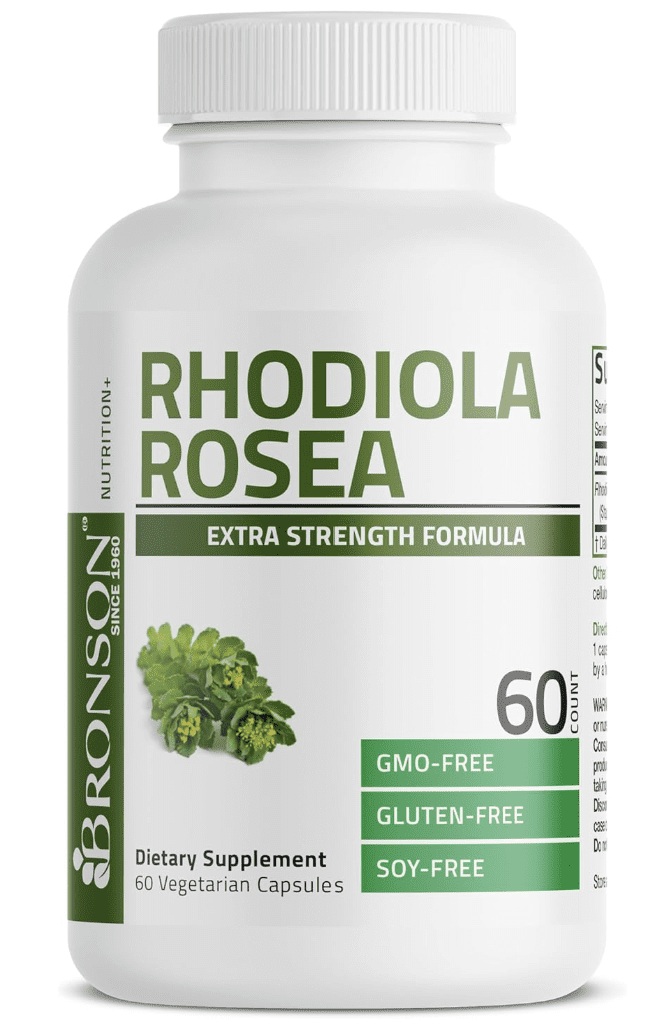
- Extract Type: Root extract, no stated compression ratio
- Standardization Floor: 0.5% rosavins, disclosed on the label
- Serving Size: 250mg in 1 capsule
- Manufacturer: Bronson Vitamins, cGMP facility in Hauppauge, New York, in operation since 1960
“A standardization percentage is like the octane rating on a gas pump. It tells you what’s guaranteed to be in the tank, not what the number means for your specific engine. A 5% floor and a 0.5% floor are two very different guarantees. Read them before you read anything else on the label.”
— Charles Damiano, B.S. Clinical Nutrition
Capsule Format, Fillers and Supply Count
The capsule shell, filler ingredients and bottle count differ almost as much as the extract specs. NutraChamps packs 120 vegan cellulose capsules with a rice flour filler, built around a 2-capsule serving. Bronson packs its rhodiola into a modified cellulose capsule with microcrystalline cellulose, magnesium stearate and silicon dioxide as flow agents, built around a single-capsule serving.
- NutraChamps (120 capsules): 60 servings at 2 capsules/day, a 60-day supply per bottle. Vegan, Non-GMO, Gluten-Free, Soy-Free, Nut-Free, Dairy-Free. Made in the USA in a cGMP facility, lab tested and verified.
- Bronson (available in 60, 120 or 250 count): 1 capsule/day serving, so a 120-count bottle runs 120 days. Non-GMO, Gluten-Free, Soy-Free. In-house laboratory tested, cGMP facility.
Neither label discloses a third-party Certificate of Analysis on the retail page. Both disclose their manufacturing certification (cGMP) directly on the bottle.
Selection Matrix: Matching the Spec Sheet to Your Buying Priority
The two labels are built for different buying priorities, not different people. Match your priority to the spec that actually addresses it.
- The Dose-Density Buyer: Wants the highest raw milligram count per serving. NutraChamps’ 1065mg 10:1 extract is the larger number on paper.
- The Single-Capsule Buyer: Wants a one-and-done serving. Bronson’s 250mg single capsule is the simpler daily routine.
- The Standardization Stickler: Wants the highest declared active-compound floor. NutraChamps’ 5% ginsenoside minimum is a higher declared percentage than Bronson’s 0.5% rosavin minimum, though the two compounds aren’t interchangeable.
- The Long-Supply Buyer: Wants the most days per bottle at the lowest cost per serving. Bronson’s 250-count bottle runs roughly $0.10 per serving, the cheapest per-serving cost of the two.
Pros and Cons: Extract Ratio vs. Standardization Percentage
NutraChamps Ginseng: Advantages
- Disclosed Extract Ratio: 10:1 is printed on the label with the raw-root equivalence spelled out.
- Broad Allergen-Free Certification: Non-GMO, Gluten-Free, Soy-Free, Nut-Free and Dairy-Free on one label.
- Made in USA: Domestic cGMP manufacturing with lab verification stated on packaging.
NutraChamps Ginseng: Trade-offs
- Two-Capsule Serving: The full 1065mg dose requires 2 capsules, not 1.
- Higher Cost Per Serving: At roughly $0.38 per 2-capsule serving, it runs more per day than Bronson’s rhodiola.
- No Public COA: “Lab Tested & Verified” is stated, but no third-party certificate is linked on the retail listing.
Bronson Rhodiola: Advantages
- Single-Capsule Serving: One capsule per day, the simplest label math of the two.
- Lowest Cost Per Serving: As low as roughly $0.10 per serving on the 250-count bottle.
- Three Size Options: 60, 120 and 250 count bottles let you match supply to budget.
Bronson Rhodiola: Trade-offs
- Lower Standardization Floor: 0.5% rosavins sits well below the 3% rosavins/1% salidroside ratio common on competing labels.
- No Salidroside Disclosure: Only rosavins are standardized on the label. Salidroside content isn’t listed.
- In-House Testing Only: The spec sheet states in-house lab testing, not third-party verification.
“A 10:1 extract ratio is orange juice concentrate. You’re compressing ten pounds of raw material into one. What actually matters on a label is whether the company tells you the ratio and the floor percentage in plain print, not just a big total milligram number on the front of the bottle.”
— Eugene Thong, CSCS
Market Contrast: How the Labels Stack Up Against the Category
Neither NutraChamps nor Bronson runs away with every category. Placed next to other labeled ginseng and rhodiola extracts on the market, each wins on some specs and loses on others.
| Product | Extract / Standardization | Serving | Testing Disclosed |
|---|---|---|---|
| NutraChamps Korean Red Panax Ginseng | 10:1 extract, min. 5% ginsenosides | 1065mg / 2 capsules | In-house, “lab verified” |
| NooMost Korean Red Panax Ginseng + Ginkgo | Root extract powder, 10% ginsenosides | 1000mg + 60mg Ginkgo | Not disclosed on listing |
| Double Wood Ginseng Capsules | Root extract, 10% ginsenosides | 1000mg | Not disclosed on listing |
| Bronson Rhodiola Rosea | Root extract, 0.5% rosavins | 250mg / 1 capsule | In-house |
| Double Wood Rhodiola Rosea | Extract, 3% salidrosides / 1% rosavins | 500mg | Third-party disclosed |
| Zazzee Organic Rhodiola | 10:1 extract, USDA organic | Not standardized to rosavins/salidrosides | Not disclosed on listing |
FAQ: Extract Ratios, Standardization and Label Terms
- What does “10:1 extract” mean on the NutraChamps label?
- It’s a compression ratio. Ten units of raw root are processed down into one unit of finished extract, which is why the label also lists a raw-root equivalence (10,650mg) alongside the 1065mg extract weight.
- Why is Bronson’s Rhodiola standardized to 0.5% rosavins instead of 3%?
- Standardization percentages are set by each manufacturer’s formulation, not by a single industry standard. Bronson’s label lists 0.5% rosavins with no salidroside standardization. Other brands in this comparison list 3% rosavins and 1% salidrosides on their panels. Both are legitimate label choices. They’re simply different numbers.
- Are either of these products third-party tested?
- NutraChamps’ retail listings state “Lab Tested & Verified” without linking a public Certificate of Analysis. Bronson’s spec sheet states its rhodiola is tested in-house at its Hauppauge, New York facility. Neither publicly links third-party COA documentation at the time of writing.
- What are the capsules made of?
- NutraChamps uses a vegan cellulose capsule with a rice flour filler. Bronson uses a modified cellulose capsule with microcrystalline cellulose, magnesium stearate and silicon dioxide as flow agents. Neither uses gelatin.
- Which one costs less per serving?
- Bronson’s Rhodiola Rosea runs cheaper per serving across all three of its bottle sizes, roughly $0.09 to $0.17 per capsule depending on count. NutraChamps’ Ginseng runs roughly $0.38 per 2-capsule serving at its 120-count list price.
Label Lexicon: Extract and Standardization Terms
- Standardization
- A guaranteed minimum percentage of a named compound in a given extract, verified and printed on the supplement facts panel.
- Extraction Ratio (10:1)
- The ratio of raw plant material to finished extract weight. A 10:1 ratio means ten parts raw root are reduced to one part concentrated extract.
- Ginsenosides
- The class of compounds ginseng extracts are standardized against, expressed as a minimum percentage of total extract weight.
- Rosavins & Salidrosides
- The two compound classes rhodiola extracts are typically standardized against, sometimes disclosed separately, sometimes only one is listed.
- cGMP
- Current Good Manufacturing Practice, a facility-level manufacturing certification stated on both labels in this comparison.
- In-House vs. Third-Party Testing
- In-house testing is performed by the manufacturer’s own lab. Third-party testing is performed by an outside, independent lab, typically with a published Certificate of Analysis.
Verdict: Two Different Spec Sheets, Same Aisle
NutraChamps Korean Red Panax Ginseng discloses a 10:1 extraction ratio and a 5% ginsenoside floor across a 2-capsule serving. Bronson Rhodiola Rosea discloses a flat 250mg extract at a 0.5% rosavin floor in a single capsule, at a lower cost per serving. Neither label is more “adaptogenic” than the other. They’re simply different numbers on different panels. Read both before you buy either.
For more standardized-extract breakdowns, see our What Are Adaptogens Guide, our Nootropics label roundup, and our Mushroom Supplements spec comparisons.