NutraChamps Korean Red Panax Ginseng delivers 1,200mg per serving via a 10:1 root extract, standardised to a minimum 5% ginsenoside concentration, in a 120-count vegan capsule bottle that is cGMP-manufactured, lab-verified for purity and heavy metals, and free from fillers, binders, and artificial additives. It is a clean-label, correctly-dosed adaptogen in the right plant species — not the watered-down American or Siberian ginseng that fills most budget bottles.

NutraChamps Korean Red Ginseng Review: Spec Profile
A 10:1 extract ratio, minimum 5% ginsenoside standardisation, and cGMP manufacturing are the three spec details that separate this from generic ginseng root powder. Each matters independently.
| Spec | NutraChamps Detail |
|---|---|
| Dose Per Serving | 1,200mg (2 capsules) |
| Extract Ratio | 10:1 (equivalent to 10,650mg raw root per serving) |
| Ginsenoside Standardisation | Minimum 5% ginsenosides |
| Capsule Type | Vegan (plant-based cellulose) |
| Count | 120 capsules (60 servings) |
| Manufacturing | cGMP facility, USA |
| Third-Party Testing | Lab-verified — purity and heavy metals |
| Certifications | Non-GMO, gluten-free, soy-free, dairy-free, nut-free |
| Additives | No fillers, binders, or artificial colours |
The 10:1 extract ratio is the most important number on the label. Ten parts raw root material are concentrated into one part finished extract. A 1,200mg dose of this extract represents the bioactive equivalent of 10,650mg of unprocessed ginseng root — the figure that places this in the clinical dose range used in published research. Raw root powder at 1,200mg produces a fraction of the ginsenoside load.
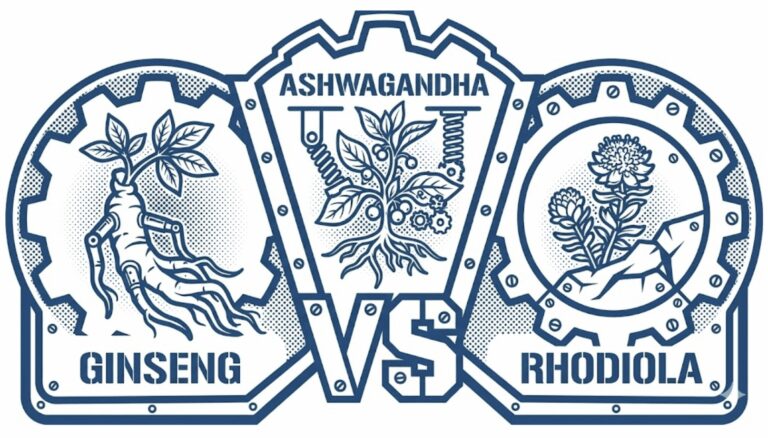
The 5% ginsenoside minimum is the honest caveat. Competitors like the NutraChamps Gold Series standardise to 20%. Five percent is adequate for a foundational daily dose — it is not the highest standardisation on the market. See our Korean Red Ginseng vs Ashwagandha vs Rhodiola comparison.
How Korean Red Panax Ginseng Works: Ginsenosides, HPA Axis, and the Red Process
Ginsenosides, HPA axis modulation, and the steaming-and-drying red process are the three mechanisms that distinguish Korean Red Panax Ginseng from both white ginseng and the entirely different plants sold as American or Siberian ginseng.
Ginsenosides: The Active Compounds
Ginsenosides are the steroidal saponins unique to the Panax species that produce the plant’s pharmacological effects. They are not one compound — over 100 distinct ginsenosides have been identified, with Rb1, Rg1, Rg3, and Rh2 the most studied for cognitive and adaptogenic activity.
The 5% standardisation on this label guarantees a minimum ginsenoside floor per serving. It does not specify the ginsenoside subtype ratio — which is the more granular label detail that premium-tier products publish. For most daily adaptogen users, the 5% floor is sufficient. For those targeting specific ginsenoside profiles (Rg3 for cognitive output, Rh2 for immune function), a higher-standardised product is the more precise choice.
The Red Process: Steaming Amplifies Potency
White ginseng is air-dried raw root. Red ginseng undergoes traditional steaming and sun-drying, a process that alters the ginsenoside profile — converting less active ginsenoside forms into the more potent Rg3 and Rh2 compounds that are largely absent in unsteamed root.
This is not a marketing distinction. It is a chemical one. The steamed product and the raw product have materially different bioactive profiles at equivalent weights. Mature roots harvested after 4-6 years produce higher ginsenoside concentrations than younger roots — NutraChamps specifies hand-selected mature roots from Korean-origin ginseng cultivation.
HPA Axis Modulation: What Adaptogen Actually Means
An adaptogen is a compound that supports the body’s normal stress response function — not a stimulant that forces energy output. The distinction matters for both efficacy and safety.
Korean Red Panax Ginseng interacts with the hypothalamic-pituitary-adrenal (HPA) axis — the neuroendocrine system governing cortisol secretion in response to stressors. The proposed mechanism is normalisation rather than suppression or stimulation: supporting cortisol levels that are already within a healthy range, not artificially capping or driving them. This is a gradual, cumulative effect — not an acute stimulant response. See our Adaptogens for Athletic Performance guide.
“Korean Red Ginseng is not a switch — it is a dial. It does not flip your energy on like caffeine. It gradually raises the floor of what your nervous system considers a baseline state. You notice it most in what stops happening: the afternoon crash, the mental fog after a hard session, the recovery debt that compounds across a training week.”
— Charles Damiano, B.S. Clinical Nutrition
Selection Matrix: Who Actually Needs Korean Red Panax Ginseng?
This is a daily adaptogen for chronic stress and sustained performance load — not an acute pre-workout tool. Match it to the right problem.
- The High-Frequency Athlete: Training 5-6 days per week accumulates HPA axis stress alongside mechanical load. Ginseng’s adaptogenic support is most relevant here — not for the occasional exerciser. See our Recovery Strategies guide.
- The Cognitively Loaded Professional: High occupational stress compounds with training stress to suppress recovery quality. Sustained mental load is a legitimate HPA stressor. See our Cortisol Management for Lifters guide.
- The Vegan or Plant-Based Athlete: The vegan cellulose capsule shell and clean allergen-free label make this one of the few adaptogen products suitable for strict plant-based protocols without ingredient compromise.
- The Adaptogen Stack Builder: Ginseng occupies a different mechanism lane than ashwagandha (cortisol suppression) and rhodiola (fatigue resistance). Running all three in rotation covers the full adaptogen spectrum. See our 8-Week Adaptogen Cycling Protocol.
The anti-fit list.
- The Acute Energy Seeker: If you want a pre-workout energy boost, this is not the mechanism. Ginseng builds over weeks, not minutes. Use caffeine for acute stimulation.
- The Highest-Ginsenoside Buyer: At 5% standardisation, this is a value-tier product. The NutraChamps Gold Series (20% ginsenosides) or competitor products at 10% standardisation serve the higher-potency use case.
- Anyone on Blood Thinners or Stimulant Medications: Panax ginseng has documented interactions with warfarin, MAOIs, and stimulant medications. Consult a medical professional before use.
NutraChamps Korean Red Ginseng Pros and Cons: Clean Label vs. Standardisation Ceiling
The Advantage (Pros)
- 10:1 Extract Ratio: 1,200mg delivers the bioactive equivalent of 10,650mg raw root — placing it in the clinical dose range.
- Lab-Verified: Third-party tested for purity and heavy metals — non-negotiable for herbal extracts from soil-grown roots.
- Vegan Capsule Shell: Plant-based cellulose. One of the few adaptogens in a fully vegan format.
- Clean Label: No fillers, binders, artificial colours, or allergens across eight common allergen categories.
- cGMP Manufacturing: US-manufactured under current Good Manufacturing Practices — a regulatory quality standard, not a marketing claim.
- 60-Day Supply: 120 capsules at the 2-per-day serving delivers a full two-month supply at a low cost-per-day.
The Trade-off (Cons)
- 5% Ginsenoside Minimum: The floor, not the ceiling. Competitors standardise to 10-20%. Adequate for daily adaptogen use — not the highest potency option in the category.
- No Ginsenoside Subtype Breakdown: The label does not specify Rg1, Rb1, Rg3, or Rh2 ratios. Subtype profile determines specific effect direction — transparency gap for precision users.
- Cumulative Effect Only: No acute stimulant response. Requires consistent daily use over 4-8 weeks before effects are meaningful.
- Drug Interaction Risk: Documented interactions with warfarin, MAOIs, and stimulant medications. Not a casual OTC supplement for medicated individuals.
Stack Protocol: Where Korean Red Ginseng Fits
Korean Red Panax Ginseng is a foundational adaptogen — it occupies a specific lane that does not overlap with most other supplements in a performance stack.
| Stack Partner | Mechanism | Why It Pairs |
|---|---|---|
| Ashwagandha (KSM-66) | Cortisol suppression via HPA normalisation | Adjacent mechanism — cycle rather than co-dose to avoid HPA over-suppression |
| Rhodiola Rosea | Fatigue resistance via AMPK activation | Complementary mechanism — supports physical endurance alongside ginseng’s cognitive layer |
| Magnesium Glycinate | CNS recovery, sleep quality, cortisol management | Non-overlapping — addresses overnight recovery that ginseng does not |
| Creatine Monohydrate | Phosphocreatine regeneration, ATP output | Entirely separate mechanism — physical performance foundation beneath the adaptogenic layer |
| High-EPA Omega-3 | Systemic inflammation management | Supports healthy inflammatory response that chronic stress and training elevate |
See our KSM-66 Ashwagandha Review, 8-Week Adaptogen Cycling Protocol, and Magnesium Glycinate for Lifters for the full stack framework.
NutraChamps Korean Red Ginseng Verdict: Clean Label, Honest Dose, One Transparency Gap
NutraChamps Korean Red Panax Ginseng is a correctly-sourced, correctly-dosed, clean-label adaptogen at a value price point. The 10:1 extract places the 1,200mg serving in the clinical range. The lab verification, cGMP manufacturing, vegan shell, and allergen-free profile cover the quality and accessibility requirements that most competitors fail on at least one of.
The honest gap is ginsenoside standardisation. Five percent is adequate. It is not leading-edge. Buyers who want 10-20% ginsenoside standardisation with a published subtype breakdown will find more precise options — at higher cost. For the daily adaptogen user who wants a clean, well-dosed foundational product without a premium price, this is a rational choice. See our Korean Red Ginseng vs Ashwagandha vs Rhodiola comparison and What Are Adaptogens guide.
Verdict: 10:1 Extract. Lab-Verified. 5% Ginsenoside Floor. Value-Tier Clean Label.
Correct plant species, correct dose format, correct manufacturing standard. The standardisation ceiling is the only limitation worth flagging.
The Ginseng Lexicon: Key Terms
- Ginsenosides
- The steroidal saponins unique to the Panax genus that produce ginseng’s pharmacological effects. Over 100 distinct ginsenosides have been identified. Rb1 and Rg1 are the most studied for cognitive function; Rg3 and Rh2 are amplified by the red steaming process.
- 10:1 Extract Ratio
- A concentration figure indicating ten parts raw root material condensed into one part finished extract. A 1,200mg dose at 10:1 represents the ginsenoside load of 10,650mg of unprocessed root per the manufacturer’s declared equivalency — the format that makes clinical dosing achievable in a standard capsule size.
- HPA Axis (Hypothalamic-Pituitary-Adrenal)
- The neuroendocrine system governing cortisol secretion in response to physical and psychological stressors. Adaptogens like Korean Red Ginseng are proposed to support normal HPA axis function — normalising cortisol response rather than suppressing or stimulating it.
- Red Process (Steaming and Sun-Drying)
- A traditional Korean method of heat-processing raw ginseng root that alters the ginsenoside profile — converting less active forms into the more potent Rg3 and Rh2 compounds largely absent in unsteamed white ginseng.
- Standardisation
- A manufacturing process that guarantees a minimum percentage of a specific active compound per serving. Ginseng standardised to 5% ginsenosides guarantees at least 5g of ginsenosides per 100g of extract. Higher standardisation percentages deliver more concentrated bioactive loads at equivalent extract weights.
- cGMP (Current Good Manufacturing Practices)
- A regulatory quality standard enforced by the FDA for supplement manufacturing facilities — covering purity, identity, strength, and composition of finished products. Not a marketing claim — a documented facility compliance requirement.
Related Adaptogen and Performance Guides
- Korean Red Ginseng vs Ashwagandha vs Rhodiola
- What Are Adaptogens
- 8-Week Adaptogen Cycling Protocol
- Best Adaptogens for Beginners
- Signs You Need an Adaptogen
- Nutricost KSM-66 Ashwagandha Review
- Rhodiola vs Ashwagandha
- Adaptogens for Athletic Performance
- Cortisol Management for Lifters
- Magnesium Glycinate for Lifters
- Nutricost Tongkat Ali Review
- Nutricost Fadogia Agrestis Review