Amino acids are the building blocks of muscle repair. But not all amino acids do the same job. Essential Amino Acids (EAAs) are the ones that actually trigger recovery. This guide breaks down the recovery cascade. It explains why EAAs matter more than BCAAs. It gives you the practical blueprint for faster repair without the bro‑science.
Medical Disclaimer: This guide is for educational purposes. The statements regarding any supplements have not been evaluated by the Food and Drug Administration. These products are not intended to diagnose, treat, cure, or prevent any disease. Always consult a qualified professional before starting a new regimen.
The Recovery Cascade: How Muscles Actually Repair
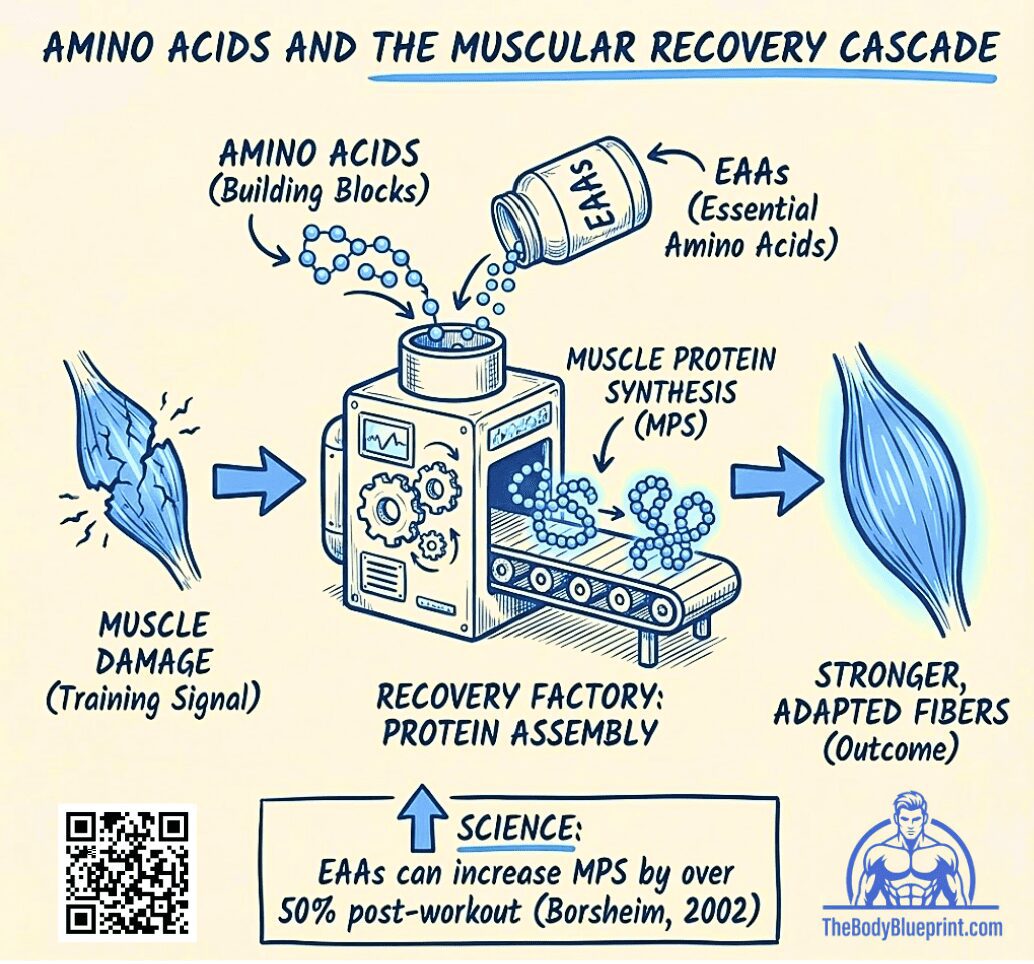
Muscle growth starts with damage. Training creates micro‑tears in muscle fibers. That damage is the signal. What happens next determines whether you get stronger or stay stuck.
The recovery process follows a clear cascade:
- Muscle Damage: Training creates the signal. Without it, no growth.
- Recovery Factory (Protein Assembly): The body mobilizes resources to repair.
- Amino Acid Delivery: EAAs arrive as the building materials.
- Muscle Protein Synthesis (MPS): New proteins are built. Fibers become stronger and adapted.
For a deeper dive into the science of growth, see our guides on muscle recovery, science of strength gains, and muscle growth supplement facts.
“Think of EAAs as the construction crew that shows up after the demolition. BCAAs are three workers. EAAs are the full crew with all the tools. Which one builds a house faster?”
Eugene Thong, CSCS
EAA vs. BCAA: Why the Full Set Matters
There are 20 amino acids. Nine are essential—the body cannot make them. They must come from food or supplements. BCAAs (branched‑chain amino acids) are three of the nine. EAAs are all nine.
Here is the difference:
- BCAAs stimulate the start of muscle protein synthesis. They flip the switch but do not provide all the materials.
- EAAs provide the full set of building blocks. They flip the switch and supply everything needed to build.
Research shows EAAs can increase muscle protein synthesis by over 50% post‑workout. BCAAs alone do not produce the same result. You are leaving gains on the table if you use BCAAs without the full EAA profile.
For more on protein science, see our whey protein types guide, and BCAA supplement myth.
The Practical Protocol: Amino Acids for Real Life
You do not need to be a scientist to use EAAs effectively. The protocol is simple. It fits into a busy life.
Here is the 3‑point lifestyle blueprint:
The Recovery Factory System™
Three Simple Rules for Faster Recovery
- Take EAAs during or immediately after training. This delivers building blocks when the recovery factory is most active. Mix with water and sip during your session.
- Use EAAs between meals when whole food is not an option. They keep muscle protein synthesis elevated without the fullness of a full meal.
- Prioritize EAAs over BCAAs for recovery. The full set of nine essential amino acids provides everything needed for repair. BCAAs alone leave the job half done.
Follow this system, and your body gets the exact materials it needs to rebuild stronger.
For timing strategies, see our protein timing guide, post‑workout nutrition, and anabolic window breakdown.
Amino Acids & Recovery: What Nobody’s Asking (But Should)
A: Yes, if your diet is dialed in. Whole protein sources like chicken, eggs, beef, and dairy contain EAAs. The challenge is timing. EAAs taken around training hit the bloodstream faster than whole food, which requires digestion.
A: Whey contains EAAs. It is a complete protein. The difference is absorption speed. EAAs in free form hit the bloodstream in minutes. Whey takes 30‑60 minutes. For immediate post‑workout, EAAs have an edge.
A: Yes. BCAAs flip the switch but do not supply materials. EAAs do both. Research shows EAAs increase muscle protein synthesis more effectively. The cost difference is small compared to the results.
A: Yes. EAAs are low calorie and do not break a fast in the same way whole food does. They provide recovery support without spiking insulin significantly.
A: 5‑10 grams is the effective range. This provides enough essential amino acids to maximally stimulate muscle protein synthesis without overdoing it.
For more on recovery supplements, see our post‑workout whey guide, glutamine for recovery, and arginine guide.
Final Verdict: EAAs Are the Recovery Tool That Delivers
Amino acids are not complicated. EAAs are the full set of building blocks your body needs to repair and grow. BCAAs alone leave the job half done. Whole food works, but timing matters.
The lifestyle blueprint is simple:
- Use EAAs during or right after training for rapid delivery.
- Use EAAs between meals when whole food is not practical.
- Skip BCAAs in favor of EAAs for complete recovery support.
For a full recovery stack, pair EAAs with creatine, omega‑3s, and quality sleep. Your muscles do the work. EAAs provide the materials.
The Bottom Line: Give Your Recovery the Full Crew.
BCAAs are three workers. EAAs are the full construction team with all the tools. Which one finishes the job faster? Your muscles already know the answer.
*Verified 2026 recovery protocols.
The Supplement Lexicon: Amino Acid Edition
- Essential Amino Acids (EAAs)
- The nine amino acids the body cannot produce on its own. They must come from food or supplements. They are the complete set of building blocks for muscle repair.
- Branched‑Chain Amino Acids (BCAAs)
- A subset of three EAAs: leucine, isoleucine, and valine. They stimulate the start of muscle protein synthesis but do not provide all necessary materials.
- Muscle Protein Synthesis (MPS)
- The biological process of building new muscle protein. Triggered by resistance training and dietary amino acids. Higher MPS rates lead to muscle growth.
- Leucine Threshold
- The amount of leucine needed to maximally stimulate MPS (approximately 2‑3 grams). EAAs naturally provide this threshold.
- Recovery Factory
- A metaphor for the cellular machinery (ribosomes, signaling pathways) that assembles new muscle proteins using amino acids as raw materials.