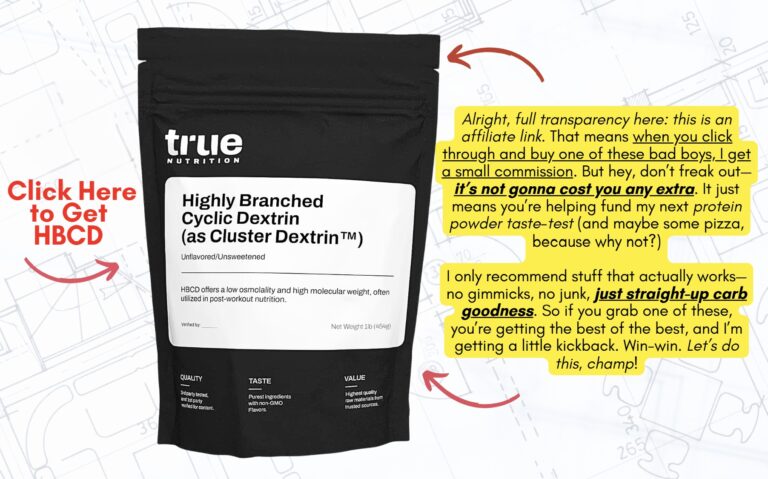
True Nutrition Highly Branched Cyclic Dextrin contains exactly one ingredient: Cluster Dextrin, a high-molecular-weight cyclic carbohydrate with a measured osmolality significantly lower than dextrose or maltodextrin when mixed at equivalent concentrations. No fillers. No flavors. No artificial sweeteners. No anti-caking agents. The label is one line long. We pulled the spec sheet to show what a single-ingredient workout carbohydrate looks like versus the maltodextrin tubs that dominate the shelf.
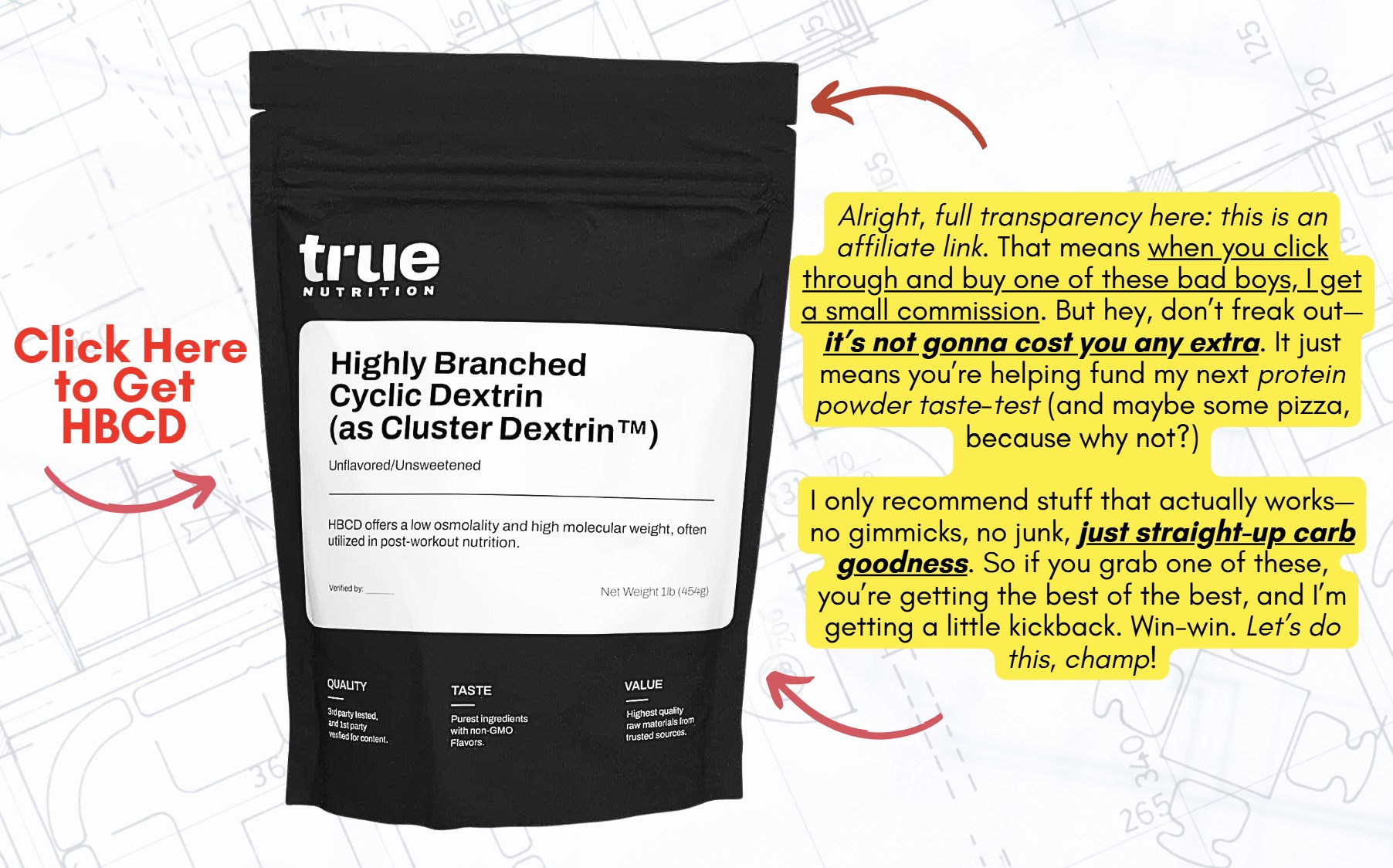
True Nutrition HBCD: The One-Line Ingredient Label
The Supplement Facts panel lists one ingredient: Cluster Dextrin (Highly Branched Cyclic Dextrin). That is the entire ingredient list. No maltodextrin filler. No dextrose cut. No silica anti-caking agent. No natural or artificial flavors. No sweeteners of any kind. If you turned the tub around and read the label, you would see a single line item under “Ingredients.”
| Spec | True Nutrition HBCD |
|---|---|
| Active Ingredient | Cluster Dextrin® (Highly Branched Cyclic Dextrin) |
| Carbohydrate per Scoop | ~25-30g (verify current label; varies by scoop size) |
| Molecular Weight | ~160,000-200,000 Daltons (high molecular weight cyclic dextrin) |
| Osmolality | Low (measurably lower than dextrose or maltodextrin at equal solution concentrations) |
| Fillers / Additives | None |
| Flavors / Sweeteners | None (unflavored) |
| Mixability | Dissolves in cold water; no clumping observed in standard shaker bottle |
| Certification | Cluster Dextrin® is a registered trademark of Glico Nutrition; manufactured in a GMP-compliant facility |
Molecular weight and osmolality are the two measurable specs that separate HBCD from other carbohydrate powders. Dextrose has a molecular weight of approximately 180 Daltons. Maltodextrin ranges from 1,000 to 10,000 Daltons depending on dextrose equivalent. Cluster Dextrin clocks in at roughly 160,000-200,000 Daltons. Higher molecular weight per particle means fewer particles per gram, which produces a lower osmolality solution at the same carbohydrate concentration. This is a physical property of the powder, not a claim about what happens after ingestion.
Comparing HBCD to maltodextrin by molecular weight is like comparing a boulder to a handful of pebbles that weigh the same total amount. Same mass on the scale. Radically different particle count in solution. The boulder produces fewer dissolved particles per gram. Fewer particles mean lower osmolality. That is a physical property of the powder, not a marketing claim.
HBCD vs. Dextrose vs. Maltodextrin: The Measurable Spec Differences
All three are carbohydrate powders sold as workout fuel. They differ on molecular weight, osmolality, ingredient purity, and sweetness.
| Spec | HBCD (Cluster Dextrin) | Dextrose | Maltodextrin |
|---|---|---|---|
| Molecular Weight | ~160,000-200,000 Da | ~180 Da | ~1,000-10,000 Da |
| Osmolality | Low | High | Moderate |
| Sweetness | Neutral (no sweetness) | High (sugar-sweet) | Mildly sweet |
| Ingredient Panel | Single ingredient | Single ingredient (if pure) | Often contains fillers or anti-caking agents |
| Price per Gram | Highest | Lowest | Low |
HBCD is the most expensive of the three per gram of carbohydrate. The price difference is driven by the manufacturing process: Cluster Dextrin is produced via an enzymatic branching reaction that creates the cyclic structure and high molecular weight, whereas dextrose is simple glucose and maltodextrin is produced through partial starch hydrolysis. You are paying for the molecular architecture, not for more carbohydrate per dollar.
Who True Nutrition HBCD Is For, Based on the Spec Sheet
Match the single-ingredient label to your buying criteria. This product is for the buyer who wants an unflavored carbohydrate powder that mixes in water and contains nothing except Cluster Dextrin.
- The Ingredient-Purity Buyer: One line on the label. Cluster Dextrin. Nothing else. If you read ingredient panels and recoil at maltodextrin, silica, sucralose, and “natural flavors” in your carbohydrate powder, this is the product built for that preference.
- The Unflavored Stacker: This powder has no flavor and no sweetness. It disappears into EAA mixes, electrolyte drinks, creatine solutions, and protein shakes without altering taste. If you already have a flavored intra-workout drink and want to add carbohydrates without clashing flavors, the unflavored spec is the reason to buy. See BCAA vs. EAA for context on amino acid stacking options.
- The High-Volume Trainer: If your training sessions run 90 minutes or longer and you consume carbohydrates during training, the per-serving carbohydrate content matters. A typical scoop delivers roughly 25-30g of carbohydrates. Verify the exact grams on the current label before calculating your intra-workout carb protocol.
- The Dextrose/Maltodextrin-Avoider: Some buyers report that dextrose and maltodextrin produce digestive discomfort during training. HBCD has a measurably different molecular weight and osmolality profile. Whether that profile change translates to a different experience during training is individual. The spec sheet shows different physical properties. That is what you are buying.
- Who Should Skip It: If you do not consume carbohydrates during training, or if your training sessions are under 60 minutes and you are not training in a fasted state, or if cost per gram of carbohydrate is your primary buying criterion, dextrose or maltodextrin deliver more carbohydrate per dollar. The HBCD premium is in the molecular structure. If that spec does not matter to your use case, the cheaper powders deliver the same macronutrient — carbohydrate — for less money.
True Nutrition HBCD: Pros and Cons, Straight from the Label
The Advantages (Product Specs)
- Single-Ingredient Label: The ingredient panel lists Cluster Dextrin and nothing else. No fillers, no anti-caking agents, no flavors, no sweeteners. One line.
- High Molecular Weight: ~160,000-200,000 Daltons per particle. Orders of magnitude higher than dextrose (~180 Da) or maltodextrin (~1,000-10,000 Da). A measurable physical property of the powder.
- Low Osmolality: Fewer dissolved particles per gram of carbohydrate in solution. A measurable physical property of the mixed drink.
- Unflavored Versatility: Mixes into any beverage without altering taste. No flavor clash with EAAs, electrolytes, creatine, or protein powders.
- Clean Mixability: Dissolves in cold water in a standard shaker bottle. No clumping. No sediment settling. Observed physical behavior in solution.
The Trade-offs (Product Specs)
- Highest Cost per Gram: HBCD is the most expensive workout carbohydrate per gram on the shelf. Dextrose and maltodextrin are cheaper routes to the same macro number.
- Unflavored Means Unflavored: There is no flavor system. No sweetness. No masking. If you expect a flavored intra-workout drink, you need to add your own flavor source or stack with a flavored product.
- Not a Complete Intra-Workout: This product is a single-ingredient carbohydrate powder. It does not contain electrolytes, EAAs, creatine, or citrulline. It is one component of an intra-workout stack, not a finished stack in a tub. Pairing with Transparent Labs Hydrate for electrolytes or a standalone EAA product is a separate purchase.
- Scoop Weight Varies by Batch: The Supplement Facts panel on the live listing is the only source for the current carbohydrate grams per serving. Do not assume 25g or 30g. Read the label you are buying.
HBCD FAQ: Label Specs, Mixing, and Comparisons
- Is True Nutrition HBCD flavored?
- No. The ingredient panel lists Cluster Dextrin only. Unflavored. No sweeteners. No natural or artificial flavors of any kind. It mixes without altering the taste of whatever beverage you add it to.
- What is the difference between HBCD and maltodextrin on the spec sheet?
- Molecular weight and osmolality. HBCD has a molecular weight of ~160,000-200,000 Daltons. Maltodextrin ranges from ~1,000-10,000 Daltons. HBCD produces fewer dissolved particles per gram in solution, resulting in lower osmolality. This is a measurable physical difference between the two powders. HBCD is also typically sold as a single-ingredient powder, whereas maltodextrin products often include anti-caking agents on the label.
- How does True Nutrition HBCD mix compared to other carb powders?
- It dissolves in cold water in a standard shaker bottle with no clumping. Observed mixability is clean. No blender required. No sediment left at the bottom of the shaker after mixing. This is a physical property of the powder’s particle structure and solubility characteristics.
- Can HBCD be used with EAAs, creatine, or electrolytes?
- Yes, it mixes without altering taste or creating solubility conflicts with other powders. Unflavored HBCD stacks into any beverage without flavor clash. The label does not specify compatibility or incompatibility with any other supplement. It is a single-ingredient carbohydrate powder. It behaves like one.
- How many grams of carbohydrates per serving?
- Check the Supplement Facts panel on the live listing. Typical scoop sizes deliver roughly 25-30g of carbohydrates, but the exact amount varies by batch and scoop size. The number on the label you are holding is the number that matters. Do not rely on a review for the current spec.
True Nutrition HBCD Final Verdict: One Ingredient, a Measurable Molecular Weight, and a Premium Price Tag
True Nutrition HBCD is the simplest supplement label you will ever read: one ingredient, one line, no asterisks. The measurable specs that separate it from dextrose and maltodextrin are molecular weight (~160,000-200,000 Da vs. ~180 Da for dextrose) and osmolality (lower dissolved particle count per gram in solution). The trade-off is cost per gram of carbohydrate, which is higher than any commodity carb powder on the shelf. You are not buying more carbohydrates. You are buying a specific molecular structure delivered in a single-ingredient format with no fillers. Whether that premium is worth paying depends entirely on whether the spec sheet differences matter to your training setup.
Verdict: The Cleanest Carb Label on the Shelf, at the Highest Price per Gram
Single ingredient. High molecular weight. Low osmolality. Unflavored. No fillers. No sweeteners. The spec sheet is one line long. The price tag reflects the manufacturing process behind that line.
*Prices, formulations, and grams per scoop subject to change. Verify the Supplement Facts panel on the live listing before purchase. Statements have not been evaluated by the FDA. These products are not intended to diagnose, treat, cure, or prevent any disease.
The Carbohydrate Powder Lexicon: Terms on the Label, Defined
- Highly Branched Cyclic Dextrin (HBCD)
- A high-molecular-weight cyclic carbohydrate produced through an enzymatic branching process applied to waxy maize starch. Not a simple sugar. Not a starch hydrolysate. A structurally distinct carbohydrate with a molecular weight of ~160,000-200,000 Daltons.
- Cluster Dextrin®
- A registered trademark of Glico Nutrition for their specific form of highly branched cyclic dextrin. All Cluster Dextrin is HBCD. Not all HBCD is Cluster Dextrin. The trademark indicates a specific manufacturing process and quality specification.
- Molecular Weight (Daltons)
- The mass of a single molecule of a compound, measured in Daltons (Da). Higher molecular weight means each individual particle weighs more. For a given gram weight of carbohydrate powder, a higher molecular weight means fewer total particles dissolved in solution. This is a measurable physical property, not a performance claim.
- Osmolality
- A measure of dissolved particles per kilogram of water, expressed in milliosmoles per kilogram (mOsm/kg). Fewer particles per gram of carbohydrate produce a lower osmolality solution. This is a measurable characteristic of the mixed drink, not a claim about biological response.
- GMP-Compliant Facility
- A Good Manufacturing Practices certification indicating the manufacturing site follows federally regulated standards for supplement production. A facility-level standard. Distinct from product-level certifications like USP Verified or Informed Choice.
Keep Reading: Workout Nutrition & Supplement Spec Comparisons
- BCAA vs. EAA: Recovery Worth It? — amino acid stacking options that pair with unflavored HBCD during training.
- Transparent Labs Hydrate Review — a fully disclosed electrolyte formula that stacks cleanly with an unflavored carbohydrate powder.
- Creatine & Beta-Alanine Stacking Guide — how intra-workout carbohydrates fit into a broader supplement stack.
- Best Pre-Workout Categories — a breakdown of stimulant, pump, and hybrid pre-workout label architectures.