Pure Encapsulations Probiotic G.I. lists eight bacterial strains and a Saccharomyces boulardii yeast at 10 billion CFU in a refrigerated acid-resistant capsule. Thorne FloraMend Prime lists one Bacillus coagulans MTCC 5856 at 5 billion CFU in a spore-form capsule that ships at room temperature. Two practitioner-channel labels. Two completely different bets on what belongs inside a probiotic capsule and how it survives the trip.
Overview: Nine Microorganisms vs. One Spore-Former
Pure Encapsulations Probiotic G.I. and Thorne FloraMend Prime are both practitioner-channel probiotic capsules sold through professional accounts and direct-to-consumer on Amazon. The labels could not be more different. Pure Encapsulations prints nine microorganisms across eight bacterial strains and one beneficial yeast. Thorne prints one spore-forming bacterium with its full taxonomic designation: Bacillus coagulans MTCC 5856. The CFU count differs. The capsule technology differs. The refrigeration requirement differs. The excipient panel differs. One product bets on breadth. The other bets on survivability. This is not a better-versus-worse comparison. It is a spec audit between two products built for different storage environments and different label philosophies. For more on the broader category, see our Garden of Life Probiotics for Men review and Goli Zero Sugar Probiotic review.
The Football Roster vs. The Navy SEAL
Pure Encapsulations Probiotic G.I. is a full 53-man roster. Eight position players. One special-teams yeast. Each microorganism wears a different taxonomic jersey. Thorne FloraMend Prime is a single Navy SEAL. One operator. Armored for the insertion. Trained to survive the stomach acid transit in a dormant spore coat and germinate on target. You do not send a football team on a solo reconnaissance mission. You do not send a SEAL to play quarterback. Match the tool to the job. The label tells you which tool you are holding.
Pure Encapsulations Probiotic G.I.: The Multi-Strain Audit
Pure Encapsulations Probiotic G.I. lists 10 billion CFU across eight bacterial strains and one Saccharomyces boulardii yeast in a hypoallergenic vegetarian capsule that requires refrigeration. The strain panel is printed on the Supplement Facts label with no proprietary blend. Each microorganism is individually named with its genus, species, and strain designation where applicable. The capsule is acid-resistant but not enteric-coated. It is a standard vegetable cellulose shell with a moisture-barrier treatment. The label directs cold storage to maintain CFU viability through the expiration date printed on the bottle.
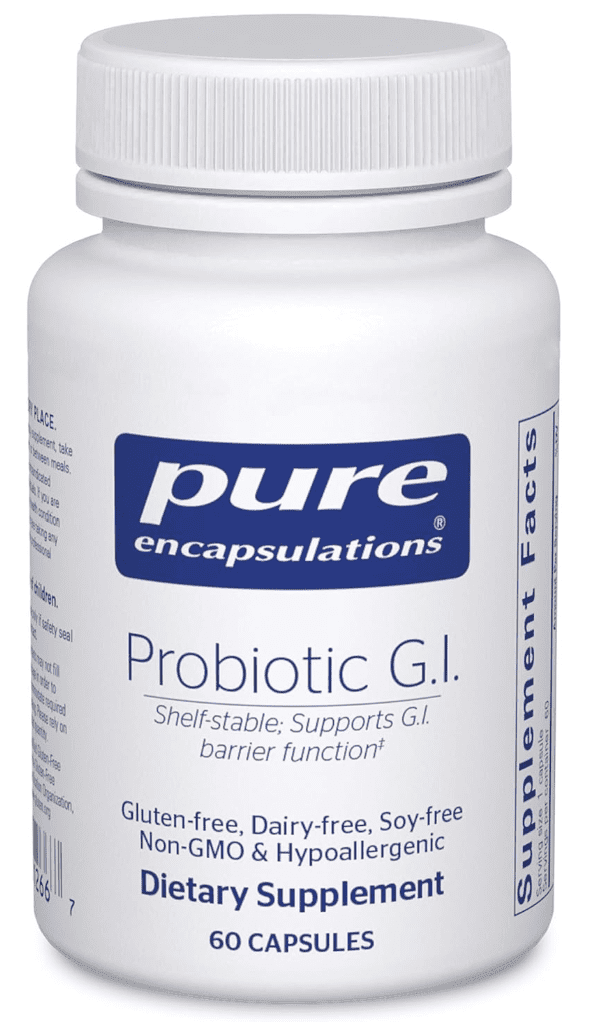
- Full Strain Panel (per label): Lactobacillus acidophilus (La-14), Lactobacillus plantarum (Lp-115), Lactobacillus rhamnosus (Lr-32), Lactobacillus salivarius (Ls-33), Bifidobacterium lactis (Bl-04), Bifidobacterium bifidum (Bb-06), Bifidobacterium longum (Bl-05), Streptococcus thermophilus (St-21), plus Saccharomyces boulardii. Nine microorganisms total. Each printed by name. No hiding behind a “proprietary blend” label.
- CFU Count: 10 billion CFU per capsule. The label states a total CFU count for the blend. It does not allocate CFU per individual strain. The number on the label is the number in the capsule at the time of manufacture. CFU degrades over time. Refrigeration slows that degradation. The expiration date is the manufacturer’s guarantee window.
- Capsule Shell: Acid-resistant vegetarian capsule made from cellulose and water. No gelatin. No enteric coating. The acid resistance comes from a treatment applied to the cellulose. It is not a separate coating layer. This is a standard hypromellose-style capsule with a pH-resistant modification.
- Storage Requirement: Refrigeration required. The label is explicit. Cold storage preserves CFU count. A capsule left in a hot car or a gym bag degrades faster than one kept at 36 to 46 degrees Fahrenheit. This is the single largest practical limitation of the product. It is a kitchen-counter supplement. It is not a go-bag supplement.
- Excipient Panel: Vegetarian capsule (cellulose, water). That is the entire list. No magnesium stearate. No silicon dioxide. No microcrystalline cellulose filler. The capsule shell is the only non-active ingredient printed on the label. This is an unusually short excipient list for a multi-strain probiotic.
- Allergen Statement: The brand positions this product as hypoallergenic based on internal formulation standards. No wheat, soy, dairy, eggs, peanuts, tree nuts, fish, or shellfish listed on the panel. No artificial colors, flavors, or preservatives.
- Manufacturing: Pure Encapsulations manufactures in a GMP-compliant facility. No NSF or USP seal appears on the label. The brand sells primarily through healthcare practitioner channels and direct-to-consumer. Each lot is assigned a batch number printed on the bottle.
The Orchestra vs. The Solo Violinist
Pure Encapsulations G.I. is a nine-piece chamber orchestra. Each strain occupies a different chair. Lactobacillus strings. Bifidobacterium woodwinds. S. boulardii on percussion. The label prints every musician’s name. The capsule is the concert hall. Refrigeration is the climate control system that keeps the instruments in tune. Let the hall get too warm and the strings go flat. Keep it cold and the orchestra plays. Pick the orchestra when you want the full arrangement. But you better own a working refrigerator.
Thorne FloraMend Prime: The Single-Strain Spore-Former
Thorne FloraMend Prime prints 5 billion CFU of a single Bacillus coagulans MTCC 5856 strain on the label. The capsule ships at ambient temperature. It stores at room temperature. Zero refrigeration required. The label is one line of active ingredient. No blend. No yeast. No second organism. One bacterium in a dormant spore state. The spore coat is a multi-layer protein shell. Think of it as natural Kevlar. It resists pH, heat, and desiccation during shelf storage. The organism stays dormant until the capsule reaches the intestinal environment. The label does not make a claim about what happens after ingestion. It simply prints the CFU count and the strain designation. The spore format is the manufacturing technology.
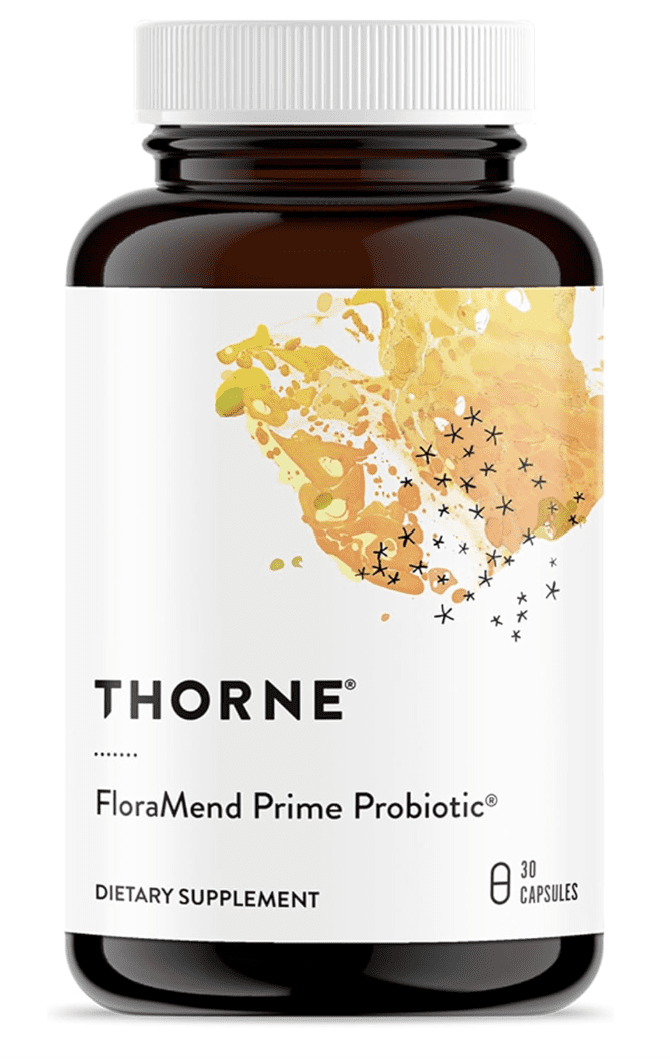
- Sole Active Ingredient: Bacillus coagulans MTCC 5856 at 5 billion CFU per capsule. The MTCC 5856 designation is the specific strain identifier registered with the Microbial Type Culture Collection in India. This is the same strain designation used in published research referencing this organism. A consumer can cross-reference the strain name on the label against a research database. That is transparency at the strain-designation level.
- Spore-Form Technology: The organism is manufactured in its spore state. The spore coat is a naturally occurring multi-layer protein structure that encapsulates the dormant bacterium. It is not a synthetic coating. It is not an enteric spray. It is the organism’s own biological armor. This is the entire competitive edge of the product. The spore coat eliminates the refrigeration requirement. It gives the product its ambient-temperature shelf stability.
- Capsule Shell: Hypromellose (vegetarian capsule). Standard vegetable cellulose. No enteric coating. The delivery technology is the spore coat itself. It is not the capsule shell.
- Storage Requirement: No refrigeration. The box ships in a standard Amazon envelope. The bottle sits on a shelf. The capsule survives a hot car. A gym bag. A suitcase. A desk drawer. This is the single largest practical advantage of the product over any refrigerated probiotic.
- Excipient Panel: Microcrystalline cellulose (inactive filler to fill capsule volume). Hypromellose (capsule shell). Magnesium stearate (flow agent to prevent capsule-filling machinery from jamming). Silicon dioxide (anti-caking agent). Four inactive ingredients. These are standard capsule-manufacturing excipients. The list is longer than the Pure Encapsulations excipient panel. The ingredients are functionally necessary for the capsule format.
- Manufacturing: Thorne manufactures in a GMP-compliant facility. Thorne holds NSF Certified for Sport certification on select products. The certification does not appear on every FloraMend Prime SKU. Verify the specific SKU on the NSF website if sport certification matters for your use case. The brand sells through healthcare practitioner channels and direct-to-consumer.
- Price Per Capsule: FloraMend Prime typically costs more per capsule than Probiotic G.I. The price premium is driven by the single-strain spore-form manufacturing process and the Thorne brand premium. Spore-form probiotics cost more to manufacture than standard vegetative-cell probiotics. The label does not hide this. The price reflects the manufacturing complexity.
The Kevlar Vest vs. The Glass Jar
Thorne FloraMend Prime ships its one soldier in a Kevlar vest. The spore coat is body armor. It eats stomach acid for breakfast. It ignores heat. It does not care about the temperature in the delivery truck. Pure Encapsulations G.I. ships its nine-member orchestra in a glass jar with a “FRAGILE” sticker. The acid-resistant capsule is the glass. The refrigeration requirement is the sticker. Both packages arrive at their destination. One survives a rougher transit. Pick the Kevlar if your supplements live in a gym bag. Pick the glass jar if they live in your refrigerator next to the almond milk.
Direct Label Comparison: Every Spec Side by Side
Each product prints a different answer to the same question: what belongs in a probiotic capsule. Strain count, CFU total, capsule technology, storage requirement, excipient panel, and strain designation granularity are the six variables that diverge.
| Label Spec | Pure Encapsulations G.I. | Thorne FloraMend Prime |
|---|---|---|
| Microorganism Count | 9 (8 bacteria + 1 yeast) | 1 (bacterium only) |
| Total CFU | 10 billion | 5 billion |
| Yeast Included | Saccharomyces boulardii | None |
| Strain Designation Granularity | Genus + species + strain ID on most organisms | Genus + species + MTCC 5856 strain identifier |
| Delivery Technology | Acid-resistant vegetarian capsule | Spore-form protein coat |
| Refrigeration | Required (per label) | Not required |
| Excipients | 2 (cellulose capsule, water) | 4 (microcrystalline cellulose, hypromellose, magnesium stearate, silicon dioxide) |
| Third-Party Certification | None displayed on label | NSF Certified for Sport on select SKUs (verify specific SKU) |
| Label Philosophy | Breadth: multiple taxonomic families | Depth: single strain, maximal shelf stability |
The CFU comparison is not a straight numbers game. 10 billion CFU across nine organisms versus 5 billion CFU of a single spore-former is a different equation than pure arithmetic suggests. The spore coat on the Thorne product means a higher percentage of the listed CFU is likely to survive the stomach acid transit intact. This is not a label claim. It is a function of the structural properties of the spore protein coat. The acid-resistant capsule on the Pure Encapsulations product provides a physical barrier that the organism itself does not possess. These are different delivery architectures serving different storage environments. Neither label is misleading. Both print accurate CFU counts at the time of manufacture. For more on how probiotics fit into a broader supplement stack, see our Pure Encapsulations Digestive Enzymes Ultra review.
Who Each Capsule Is Built For
Strain breadth, storage environment, travel frequency, and excipient tolerance point different buyers toward different bottles.
Pure Encapsulations G.I. Aligns With…
- Buyers who want nine microorganisms in a single daily capsule
- Buyers who specifically want S. boulardii, a yeast not found in most bacterial probiotics
- Buyers who prefer the shortest possible excipient list. Two ingredients. Both are capsule components.
- Buyers with reliable refrigeration access at home and no need to travel with their probiotic
- Buyers who gravitate toward broad-formulation products over single-ingredient supplements
- Buyers who value the hypoallergenic positioning of the Pure Encapsulations brand
Thorne FloraMend Prime Aligns With…
- Buyers who travel frequently and need a capsule that survives a suitcase, a car, or a gym bag
- Buyers who want a single clearly identified strain with a research-traceable MTCC designation
- Buyers who prioritize shelf stability and survivability above strain diversity
- Buyers who prefer Thorne as a brand and may already use other Thorne products with NSF certification
- Buyers without consistent refrigeration access. Dorm rooms. Offices. Travel kits.
- Buyers who want a targeted single-strain approach rather than a multi-strain blend
Pure Encapsulations vs Thorne Probiotic FAQ
- What is the core difference between these two probiotic labels?
- The strain count and the delivery technology. Pure Encapsulations prints nine microorganisms. That is 8 bacteria plus S. boulardii yeast at 10 billion CFU in an acid-resistant refrigerated capsule. Thorne prints one Bacillus coagulans MTCC 5856 at 5 billion CFU in a spore-form capsule with no refrigeration requirement. One is a roster. The other is a solo operator. Both labels are transparent. They just print different answers.
- Why does Thorne FloraMend not need a refrigerator?
- The Bacillus coagulans organism is manufactured in its spore form. This is a dormant state encased in a multi-layer protein coat that is physically resistant to heat, stomach pH, and moisture loss. The spore coat is the organism’s natural protective structure. It is not a synthetic coating. It is not an enteric spray applied to the capsule. The armor is built into the biology. The label reflects the room-temperature storage that results from that manufacturing format.
- Which label prints the higher CFU count?
- Pure Encapsulations prints 10 billion CFU. Thorne prints 5 billion CFU. The numbers are not directly comparable because the delivery systems differ. The spore coat on the Thorne product means a higher percentage of the listed CFU is likely to survive the stomach environment intact. This is due to the structural properties of the spore protein. The Pure Encapsulations product relies on its acid-resistant capsule for that protection. Different architectures. Different numbers. Read both labels.
- Does Pure Encapsulations G.I. contain a yeast organism?
- Yes. The label lists Saccharomyces boulardii as a separate microorganism from the eight bacterial strains. S. boulardii is a beneficial yeast. It is not a bacterium. It is taxonomically distinct from the Lactobacillus and Bifidobacterium strains on the panel. Thorne FloraMend Prime contains zero yeast. If S. boulardii is specifically what you want, only one of these two bottles has it.
- Are either of these probiotics third-party certified?
- Both are manufactured in GMP-compliant facilities. Thorne holds NSF Certified for Sport status on select products. The certification seal does not appear on every FloraMend Prime SKU. Verify the specific SKU on the NSF website if sport certification is relevant to your purchasing decision. Pure Encapsulations does not display a third-party certification seal on the Probiotic G.I. label. Both brands print batch numbers and expiration dates on the bottle.
- Should I speak with a professional before taking a probiotic?
- Yes. Consult a qualified healthcare professional before starting any supplement, including probiotics. This article is a label comparison. It is not medical advice. Individual circumstances vary. A professional can review the strain panel, CFU count, and excipient list against your specific situation.
Final Verdict
Pure Encapsulations Probiotic G.I. wins on strain breadth and excipient minimalism. Thorne FloraMend Prime wins on shelf stability and delivery survivability. Neither bottle is objectively better. They are different tools for different storage environments and different label philosophies.
Buy Pure Encapsulations if you want nine microorganisms including S. boulardii in a capsule with only two excipients. You must have a working refrigerator. The strain panel is printed transparently with genus, species, and strain designations. The excipient list is the shortest on the market for a multi-strain probiotic. The trade-off is the refrigeration requirement. This bottle lives in the kitchen. It does not travel.
Buy Thorne FloraMend if you want a single clearly identified spore-former that ships at room temperature, stores at room temperature, and survives in a gym bag. The MTCC 5856 strain designation is research-traceable. The spore coat is the delivery technology. The trade-off is a higher cost per capsule and four inactive excipients versus Pure Encapsulations’ two. This bottle lives wherever you put it. Refrigerator optional.
Probiotic labels print microorganisms, CFU counts, capsule materials, storage instructions, and expiration dates. That is the entire product. Everything beyond the label is individual choice. Strain preference. Refrigeration access. Travel frequency. Excipient tolerance. Match the bottle to your storage environment and your label priorities. Consult a qualified professional for guidance specific to your circumstances.
Verdict: Refrigerated Orchestra vs. Shelf-Stable Solo Operator
Pure Encapsulations G.I. for strain breadth and the shortest excipient list in the category. Thorne FloraMend Prime for spore-form survivability and zero-refrigeration storage. Match the bottle to where you store your supplements. Consult a professional.
Related Probiotic and Supplement Guides
- Garden of Life Probiotics for Men Review
- Goli Zero Sugar Probiotic Review
- Pure Encapsulations Digestive Enzymes Ultra Review
- Pure Encapsulations Daily Calm Review
- Protein Powders with Digestive Enzymes
- Best Whey Protein for Easy Digestion
- Gruns Super Greens Review
- Best Thorne Supplements for Athletes