Lou Ferrigno’s workouts and diet built one of the largest physiques the sport has ever measured, and the blueprint still reads clean in 2026. The man stood around 6-foot-5, competed near 275 to 285 pounds, trained twice a day on a classic split, and reportedly ate seven meals to feed it. Below is the full split, the reported meal plan, the macros and volume behind it, what it costs to live this way, the honest caveats, and a verdict on whether it fits you.
The Split: Six Days, Twice a Day, Golden Era Volume
The classic Lou Ferrigno training split ran six days a week and, at his peak, twice a day. He built size the Golden Era way: heavy compound lifts, high weekly volume, and short rest between sets. No wrist straps doing the job his forearms should have done. The structure is simple enough to copy and brutal enough to respect.
Each session trained two or three muscle groups with 4 to 6 exercises apiece at 4 to 5 working sets of 8 to 12 reps. Rest sat around 60 to 90 seconds. Compound movements came first, always, because that is where the load lives. Bench, row, squat, press, pull. Bricks before paint.
- Day 1: Chest and Back. A classic pairing on a push and pull split. Heavy barbell bench press and bent-over rows anchored the day, with incline work and pullovers to fill it out.
- Day 2: Legs. The barbell back squat led, followed by leg press, lunges, and calf work. He trained legs hard while plenty of his peers skipped them. That is why the silhouette worked.
- Day 3: Shoulders and Arms. Overhead press, laterals, barbell curls, and close-grip pressing. High volume on arms, which is where modern lifters usually cut corners.
- Repeat, then rest. Days four through six repeat the rotation, and the seventh day goes to recovery. Recovery is a training variable, not a reward.
Ferrigno started lifting around 13 in a basement with homemade weights, driven by comic-book heroes and Steve Reeves. He later moved to Gold’s Gym in Venice, trained beside Arnold Schwarzenegger, and landed in the 1977 documentary Pumping Iron. He took IFBB Mr. America in 1973 and Mr. Universe in 1973 and 1974, then finished behind Arnold at Mr. Olympia in 1974 and 1975. In 1977 he was cast as the Hulk. The resume explains the volume.
“Training volume is the bricks. Protein is the mortar. You can stack bricks all day, but without mortar the wall just falls over. Ferrigno stacked a mountain of bricks and never skipped the mortar.” Most people do it backwards and wonder why nothing holds.
— Eugene Thong, CSCS
The Diet: Seven Meals and Roughly 3,500 Calories
Ferrigno’s reported diet broke the day into seven smaller meals totaling around 3,500 calories in a typical mass phase. Peak bulking reportedly pushed higher. Eat big to get big was not a slogan for him. It was the shift. The seven-meal structure matters more than any single food on the list.
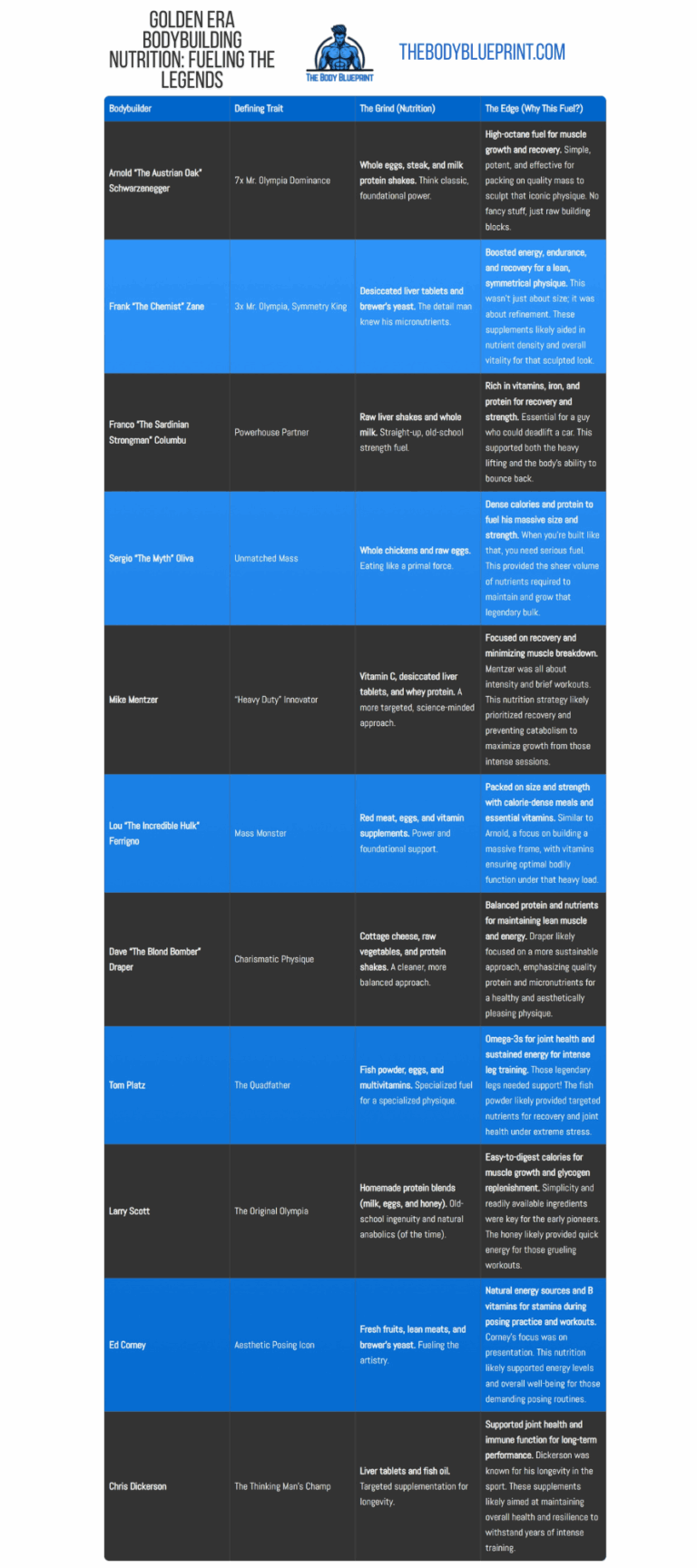
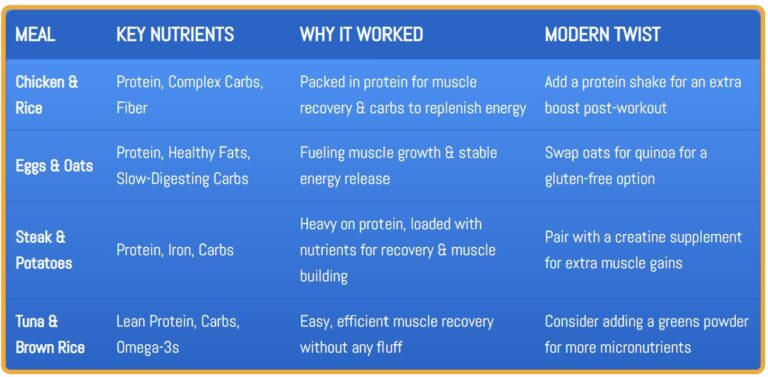
The backbone was high protein from steak, eggs, chicken, fish, tuna, milk, and cottage cheese, with carbs from rice, potatoes, oats, and bread. A typical ladder looked like this: eggs and oats at breakfast, a shake mid-morning, chicken or fish with rice at lunch, pre-workout carbs, a post-workout shake, steak or red meat with potato at dinner, and a slow protein before bed. Same foods, different clock.
- Protein first, every meal. Red meat, poultry, fish, and dairy showed up at nearly every sitting. In his later comeback through the 1990s, he reportedly trimmed to 5 to 6 meals and leaned toward lower-calorie, higher-quality sources.
- Carbs around training. Potatoes, rice, and oats clustered near the workout window to fuel the session and refill the tank after it. Timing, not just totals.
- Fats from whole food. Egg yolks, red meat, and dairy carried the fat load rather than bottled oils. Calorie-dense, nutrient-dense, and cheap.
Seven smaller meals beat three big ones for a simple reason: you can actually get the total down. A 3,500-calorie day in three sittings is a chore. In seven, it is a routine. Once you know your daily protein target, this is just how protein targets scale with bodyweight applied to a clock.
“Feeding a mass phase is like watering a garden. One flood a week drowns the roots and starves them the rest of the time. Small, steady doses actually take.” Seven meals is drip irrigation for a body that is always thirsty.
— Charles Damiano, B.S. Clinical Nutrition
Why It Worked: Overload, Protein, and Years of Consistency
Three mechanisms carried the plan: progressive overload, a calorie surplus with high protein, and absurd consistency. Volume multiplies the first two. Nothing on that list is secret. It is just rarely done for a decade.
Progressive overload means adding weight, reps, or sets over time, and his logbook did it for years. A calorie surplus lets the body store the raw material instead of rationing it. Protein supplies the amino acids to build. Sleep and recovery convert the whole pile into muscle. Skip any leg of that stool and it tips.
The Golden Era volume is the part modern lifters underestimate. Training a muscle group twice a week at 15 to 20 hard sets beats a single weekly beatdown in most published comparisons. Ferrigno ran that volume on top of a huge surplus, which is the only reason it was survivable. Volume without food is just fatigue.
How to Run It Today: Sets, Protein, and Gear
You do not need the twice-a-day schedule to borrow the method. Start with the split, cut the volume to match your recovery, and hit a protein target you can actually sustain. The plan scales. The ego does not.
- Week 1 to 4: learn the split. Run the three-day rotation with 3 to 4 sets per exercise and leave one rep in the tank. Add weight only when the top of the rep range feels repeatable.
- Protein target. General sports-nutrition guidance lands around 1.6 to 2.2 grams per kilogram of bodyweight for muscle gain. Going far beyond that band rarely helps and often crowds out carbs.
- Track the intake once. Weigh food for two weeks with a digital kitchen scale, learn your portions, then eyeball it. You cannot manage what you never measured.
- Batch the seven meals. Cook proteins in bulk, portion into meal prep containers, and stack them in the fridge. The clock does the rest.
- Options, not orders. A whey protein blend covers the shake slots, and creatine monohydrate is the most studied mass aid on the shelf, if you want one. Sleep and a weekly deload do the rest.
“Progressive overload is a mortgage, not a lottery ticket. You do not win by paying a huge lump sum once. You win by adding a little every month for years.” Ferrigno paid that mortgage in his basement when nobody was watching.
— Eugene Thong, CSCS
Is It Worth It? Find Your Row
The Ferrigno method is worth stealing if you want size, you have the recovery to pay for it, and you like training hard six days a week. It is the wrong template for a few specific people. Find your row before you drown.
Buy It If
- You want mass and can eat. The plan needs a calorie surplus to work. If you can put away seven meals, you are the target buyer.
- You recover fast. Six days a week of compound volume only makes sense if you sleep and mend quickly.
- You like structure. A fixed push and pull rotation removes the daily guesswork.
- You are patient. The look was built over years, not one 12-week block.
Skip It If
- You are time-crunched. Twice-a-day training is a part-time job. A 3 or 4 day plan fits real life better.
- You are new to lifting. Start lower volume and build. Jumping straight to Golden Era workloads is how beginners quit in month two.
- You want to get leaner. This is a surplus strategy. For fat loss, the diet is a different build entirely.
- You have health conditions. Check with a qualified professional before any big shift in training or intake. That is not negotiable.
The Field: How It Stacks Up
Frequency, volume, and food separate the training styles. No template wins every column. Match the plan to your recovery, not to a poster.
| Plan | Days / Week | Volume | Best For | Verdict |
|---|---|---|---|---|
| Ferrigno Double Split | 12 sessions | Very high | Full-time lifters | Maximum mass, maximum commitment. |
| Single Six-Day Split | 6 sessions | High | Serious mass phases | The sane version of the same idea. |
| Modern Push / Pull / Legs | 6 sessions | High | Balanced growth | Cleaner recovery than the classic split. |
| Upper / Lower | 4 sessions | Moderate | Busy schedules | Best bang for the hours you have. |
| Full Body | 3 sessions | Low | Beginners, time-poor | The honest starting line. |
Ferrigno wins on raw volume and total mass potential. Push / pull / legs wins on recovery balance. Upper / lower wins on fit into a real calendar. Full body wins on getting started without quitting. Pick the column that matches your life.
The Bottom Line
The Lou Ferrigno workout and diet is a surplus-and-volume machine built for someone whose job is getting bigger. Compound lifts, twice-daily sessions, seven meals, and a mountain of protein. Steal the structure and the protein target, then cut the volume to fit your recovery. The method travels. The schedule does not.
Six Days. Two Sessions. Seven Meals. One Surplus.
Compound first, protein at every sitting, years of consistency. The Golden Era method, no secrets attached.
Food scales, meal prep containers, and options only. Prices and availability subject to change.
The Golden Era Lexicon: Ferrigno’s Math, Translated
- Push and Pull Split
- Dividing the week by movement pattern instead of body part. Ferrigno’s era leaned on heavy pressing, rowing, and pulling, spread across two daily sessions.
- Weekly Volume
- Total hard sets per muscle group per week. The Golden Era answer was “more,” spread over six days. The modern answer is “as much as you can recover from,” which is usually fewer.
- Progressive Overload
- Adding weight, reps, or sets over time so the body has a reason to grow. Without it, a perfect split is just exercise.
- Calorie Surplus
- Eating above maintenance to supply the raw material for new tissue. Mass phases run on it. So does fat gain if you push too far.
- Mass Phase
- A deliberate stretch of eating and training aimed at adding size, accepting some fat as the cost of doing business.
- Compound Lift
- A multi-joint movement like the squat, press, row, or deadlift. It moves the most weight and drives the most total response.
- Reported Figures
- Numbers pulled from published interviews and profiles. They vary by source and by decade, so treat them as approximations, not lab data.
More Golden Era Training Guides
- The Golden Era bodybuilding guide: the hub for the whole era, training and diet in one place.
- Golden Era training archive: how the classic split and the volume survived the magazines.
- Golden Era nutrition: the eating side that fed the mass phases.
- Schwarzenegger and Ferrigno rivalry: the story that framed Ferrigno’s training years.
- Progressive overload for muscle growth: the engine that makes a Ferrigno split keep working.
- Daily protein targets: the number behind all those meals, in grams per pound.
- Build muscle guide: the full frame around training, eating, and recovery.
Sources: routine and diet details compiled from published bodybuilding interviews, magazine profiles, and reference biographies. Figures are reported approximations and vary by source. Prices and availability subject to change.