Post-workout whey protein is a fast-digesting dairy protein people drink after training to hit their daily protein target, not a magic 30-minute portal that closes if you miss it. The “anabolic window” is real, but it is a slow dimmer, not a trapdoor. We compare and analyze the published specs and the science so you can stop panic-chugging in the parking lot and figure out whether the shake actually earns its spot in your routine.
The Anabolic Window: A Dimmer Switch, Not a Trapdoor
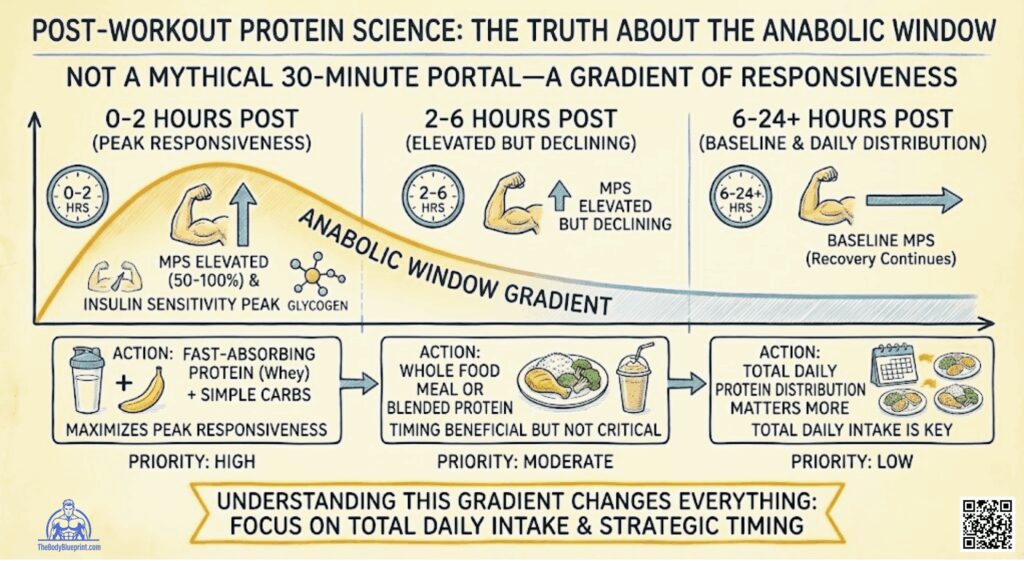
The “anabolic window” is a gradient of muscle responsiveness that peaks right after training and tapers off over roughly a day, not a 30-minute countdown to wasted gains. The popular version says your gains evaporate if the shake does not hit your lips inside half an hour. The actual research is a lot calmer than your gym bro. Here is the gradient, in plain terms.
| Time After Training | What’s Happening | Timing Priority |
|---|---|---|
| 0 to 2 Hours | Muscle protein synthesis is elevated and the body partitions nutrients well. | HIGH |
| 2 to 6 Hours | Synthesis stays raised but is on its way down. A normal meal covers it. | MODERATE |
| 6 to 24 Hours | Back to baseline. Total protein across the day is what counts now. | LOW |
The practical takeaway: the window is real, but it is wide. The faster route to a benefit only matters when you arrive at the gym already empty, which is a smaller club than the supplement industry would like you to believe.
“The post-workout window is not binary, open or closed. It is a dimmer switch. The light is brightest right after training and fades over hours. Whey just flips that switch to full the moment you rack the last rep. Miss it by twenty minutes and the lights are still very much on.”
— Eugene Thong, CSCS
Why Whey Is the Fast Option
Whey’s whole advantage is speed: it digests faster than food or other protein powders and is rich in leucine, the amino acid most associated with kicking off muscle protein synthesis. That is it. No magic, just pharmacokinetics with good marketing. Here is what the format actually brings.
- Digests Fast: Whey isolate and hydrolysate reach the bloodstream in roughly 15 to 30 minutes, versus a few hours for casein or a solid meal. It is the difference between express shipping and ground.
- Leucine-Dense: Whey runs around 11% leucine, the amino acid most tied to triggering synthesis. Hitting a meaningful leucine dose is simply easier with a scoop than with a chicken breast you have to chew.
- Convenient: A shaker is portable in a way that grilled salmon is not. The best protein source is the one you actually consume, and nobody is meal-prepping cod into a gym bag.
- Easy to Dose: A scoop is a known quantity, usually 20 to 25g of protein. No scale, no guessing, no weighing meat at the squat rack like a lunatic.
Who Benefits Most: The Recipient Matrix
Post-workout whey earns its keep most for people who train on an empty tank or train twice a day, and least for people who already eat a solid meal around their session. The urgency scales with how empty you are when you start. Match yourself to a row.
| Training Profile | Timing Benefit | A Common Approach |
|---|---|---|
| Fasted Trainee (morning training, nothing eaten) |
HIGHEST. You start empty, so getting protein in sooner has the clearest rationale. | A whey isolate shake, often with some carbs, shortly after training. |
| Two-a-Day Athlete (multiple sessions, hours apart) |
HIGH. Faster turnaround between sessions is a real logistical edge. | Fast whey after session one, a whole-food meal an hour or so later. |
| Hypertrophy Focus (high volume) |
MODERATE. Convenient way to add protein around heavy sessions. | A whey concentrate or blend post-training; many pair it with creatine. |
| Strength / Power Focus (low volume, high intensity) |
LOWER. Fatigue is mostly neural; total daily protein matters more. | A normal meal within a couple of hours usually covers it. |
| General Fitness (a few moderate sessions a week) |
CONVENIENCE. Useful only if it helps you hit your protein target. | Optional scoop if your next real meal is a while off. |
Notice that two of the five rows essentially say “a sandwich would also work.” That is not a glitch in the matrix. That is the honest answer for most people.
When Post-Workout Whey Is a Waste of Money
The shake stops earning its place the moment it is covering for a problem timing cannot fix. Whey is a tool, not a hall pass. Here are the four times it is mostly burning your cash.
- Your Total Daily Protein Is Low: If you are not hitting a solid daily protein intake, timing a single shake perfectly is rearranging deck chairs. Fix the day before you obsess over the half hour.
- You Already Ate Before Training: Had a real protein meal an hour or two pre-workout? Those amino acids are still clocked in. A second urgent shake is redundant.
- You’re Using It as a Meal Replacement: Whey is a protein supplement, not dinner. It is missing most of what an actual plate of food gives you. It supplements meals; it does not impersonate them.
- It Wrecks Your Stomach: If concentrate leaves you bloated, that is not toughness to push through. Switch to an isolate or hydrolysate, or skip it. Misery is not a macronutrient.
“People get religious about the 30-minute window, then eat like a raccoon for the other 23.5 hours. Your body is not a stopwatch, it is a ledger. The post-workout shake is one line item. It will not save a budget that is bleeding everywhere else.”
— Charles Damiano, B.S. Clinical Nutrition
Whey Protein Comparison: Four Contenders
Once you have decided a shake fits, the choice comes down to processing type, ingredient quality, and what your stomach tolerates, since every quality whey delivers protein either way. We compare and analyze the published specs below. You generally get two of three among speed, purity, and value, so pick the two that matter to you.
| Product & Profile | The Edge | Best For | The Trade-off |
|---|---|---|---|
| Naked Whey Grass-fed, single ingredient, 25g/scoop |
Minimal-ingredient label, nothing but whey. | The purist who reads every label line. | Grittier mix, higher cost per serving. |
| Ascent Native Fuel 100% whey isolate, 25g/scoop, NSF Certified for Sport |
Isolate plus a sport certification screening for banned substances. | The athlete who wants verified, fast-digesting protein. | Sunflower lecithin, fewer flavors. |
| ON Gold Standard Whey blend, 24g/scoop, everywhere |
Mixes clean, tastes good, easy to find. | The general lifter who wants a dependable first whey. | Artificial flavors; blend is slower than pure isolate. |
| Dymatize ISO100 Hydrolyzed isolate, 25g/scoop, zero sugar |
Hydrolyzed for the fastest digestion, lactose-free. | Anyone with a touchy stomach who wants protein in fast. | Premium price, slightly bitter in some flavors. |
For the wider protein-powder field, see our roundup of the best whey proteins, and if you are stacking, our creatine timeline breakdown covers the other tub most people keep next to the shaker.
“The fancy hydrolysates are great if your gut needs them, but paying triple for exotic processing when plain isolate would do is like buying a gold-plated cable for a clearer picture. The protein fills the same tank. You are often paying for the label, not the result.”
— Charles Damiano, B.S. Clinical Nutrition
Post-Workout Protein FAQ
- How long after a workout should I drink protein?
- The higher-priority stretch is the first 0 to 2 hours, but it depends on your last meal. Trained fasted? Sooner makes more sense. Ate a protein-rich meal an hour or two before? You have a comfortable buffer and no reason to sprint to the shaker.
- Can I just eat food instead of a shake?
- Yes, and for many people a whole-food meal with 30 to 40g of protein within a couple of hours is a great option, with micronutrients a scoop does not have. Whey’s edge is speed and convenience, not superiority. Use it when cooking is not practical.
- Should I add carbs to my post-workout shake?
- It depends on the goal. Endurance athletes and two-a-day trainers benefit from carbs to refill glycogen. For general training or a fat-loss phase, carbs are optional and often unnecessary if your total daily intake is handled.
- Best post-workout protein if I’m lactose intolerant?
- Whey isolate or hydrolyzed whey have most of the lactose removed. If even those bother you, egg white or beef protein isolate are fast, dairy-free, complete proteins. Pea and rice blends work too, just slower and less leucine-dense.
- What if I train late and go to bed soon after?
- A common approach is a fast whey after training, then a slower protein like casein or cottage cheese before bed for a steadier overnight amino acid supply. Talk to a professional about what fits your own needs.
The Bottom Line
Post-workout whey is logistics, not magic. It is the express delivery of protein to a body that just asked for some. Whether you need that delivery in fifteen minutes or two hours depends entirely on when your last meal landed and how hard you are training. Get your total daily protein right first, treat the shake as a convenient tool for the times a meal is not practical, and pick a whey based on whether you care most about speed, purity, or value. Then stop overthinking it and go drink the shake. It was never the secret. It was always the sandwich you could carry.
Fast Protein, Carried in a Shaker. That’s the Whole Pitch.
Speed, purity, or value: pick the two that matter to you. The shake is a tool, not a ritual.
*Prices and formulas subject to change. Verify on the live listing. General information only, not medical or nutrition advice.
The Iron Lexicon: Whey Edition
- Anabolic Window
- The post-training stretch when muscle is more responsive to protein. Real but gradual, tapering over roughly a day rather than slamming shut at 30 minutes.
- Muscle Protein Synthesis (MPS)
- The process of building new muscle protein. Training raises it; eating protein raises it further. The whole point of the protein scoop.
- Leucine
- The amino acid most associated with switching on synthesis. Whey is unusually rich in it, which is a big part of why it is a popular post-workout pick.
- Whey Isolate vs. Concentrate
- Isolate is processed further to strip most fat and lactose, digesting fast and clean. Concentrate is cheaper, slightly slower, and keeps more lactose.
- Hydrolyzed Whey
- Whey pre-broken into smaller fragments for the fastest digestion and easiest tolerance. Costs more and can taste slightly bitter.