Glute medius, quadriceps, and proprioceptive systems get hammered by the slideboard reverse lunge with offset dumbbell. The sliding surface reduces friction. Your stabilizers work overtime. The offset load creates rotational torque your core must resist. This isn’t a standard lunge. This is a functional stability drill that exposes weaknesses and builds unilateral power from the ground up.
Slideboard Reverse Lunge with Offset Dumbbell – Execution Protocol
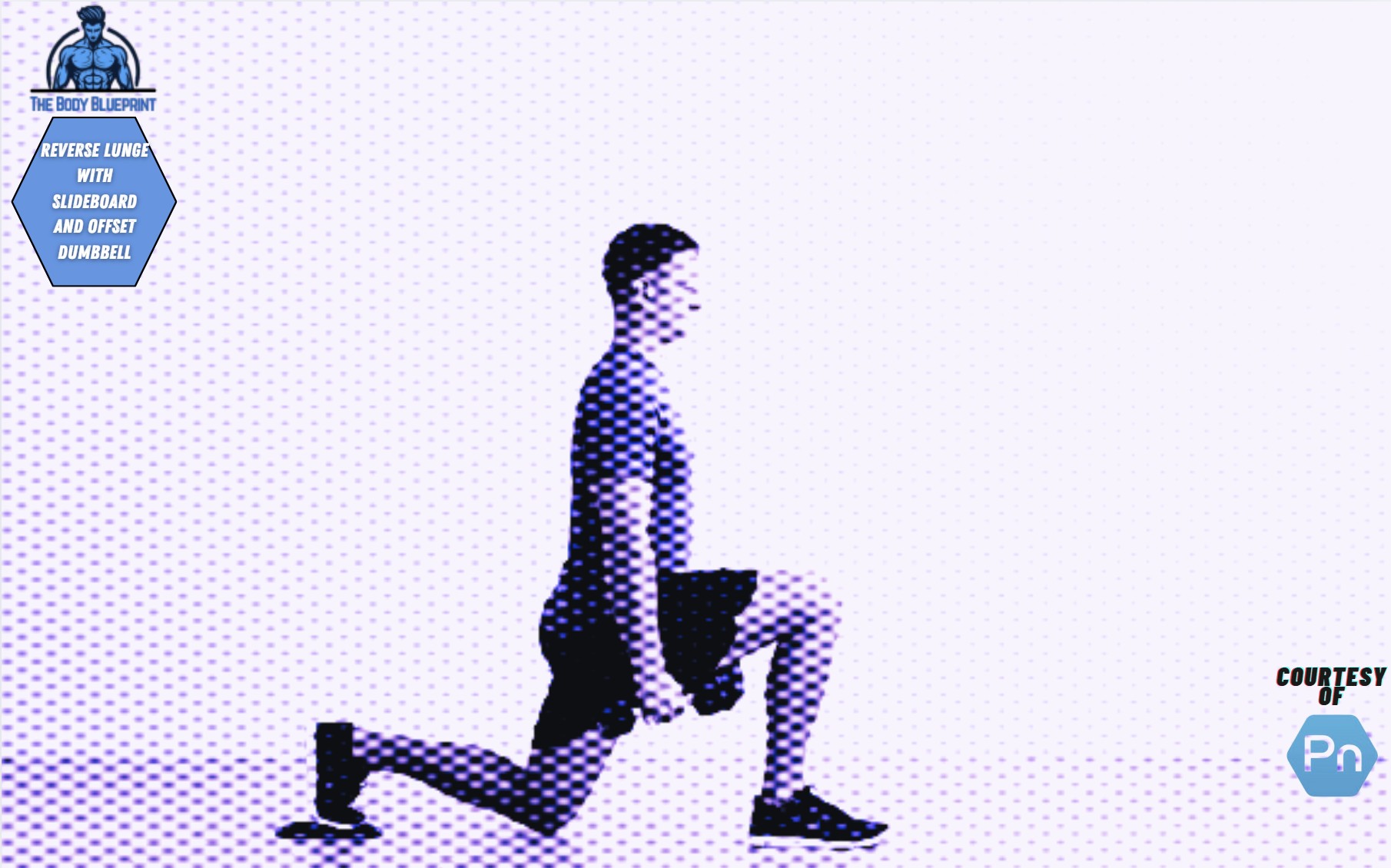
“The reverse lunge with a slideboard and offset dumbbell is like navigating a controlled landslide while wielding a wrecking ball in one hand. The slideboard challenges your stability and balance, forcing your core to work overtime, while the offset dumbbell adds an extra layer of asymmetrical strength training.”
Set up your slideboard on a flat, stable surface. Grab a single dumbbell at a moderate weight. Not heavy. Not light. Heavy enough to challenge your stabilizers. Light enough to maintain control. Place the dumbbell in one hand at shoulder height. Front-rack position. This creates the offset load.
Stand on the slideboard with your front foot planted. Your hips must stay square to the front. No rotation. No cheating. Your back foot rests lightly on the board. The sliding surface reduces friction. This forces your glute medius to work harder to maintain frontal plane stability.
Brace your core and maintain a neutral spine. Pull your ribs down. Your abs act as an anti-extension mechanism. The offset dumbbell wants to pull you into rotation. Resist this with oblique engagement. Your torso stays vertical throughout the movement.
Slide your back foot backward along the board. Control the descent. Lower into the lunge until your front thigh is parallel to the ground. Your front knee stays over your toes. No valgus collapse. The slideboard creates a continuous movement pattern. No stops. No pauses. Smooth and controlled.
Drive through your front heel to return to standing. Press the floor away. Slide your back foot forward along the board. Your quadriceps and glutes fire together. Your core stays braced throughout. The offset load remains stable in the front-rack position.
Complete equal reps on each side. Strength imbalances are common. This variation exposes them. Your weaker side will fail first. That’s the point. Build unilateral strength systematically.
Expert Analogy: “Think of the slideboard like walking on a frozen lake while holding a toolbox in one hand. Every step demands precision. One wrong move and you’re down. That’s the stimulus. That’s the adaptation.”
Key Benefits: Why This Variation Matters
The slideboard creates a low-friction environment that challenges your stabilizers uniquely. Your proprioceptive system works overtime to maintain balance. This improves body awareness and coordination in ways floor-based lunges cannot match. Your nervous system adapts to the sliding surface.
Your posterior chain fires for every controlled rep. The glutes, hamstrings, and calves all contribute. The slideboard forces a continuous eccentric phase. No rest at the bottom. No momentum. Pure muscular tension from start to finish.
Core domination is non-negotiable. The offset dumbbell forces anti-rotational work. Your abs and obliques must stabilize your torso against the asymmetrical load. This turns your core into steel. No crunches required. Functional core strength that carries over to real-world movement.
Low impact, high reward for joint health. The sliding surface reduces joint strain. Your knees experience less shear force compared to standard lunges. This is perfect for lifters avoiding impact while still chasing strength gains. For more on joint-friendly training, see our joint stability guide.
| Benefit | What It Does |
|---|---|
| Enhanced Stability | Forces balance maintenance as your back foot slides. |
| Joint-Friendly Movement | Reduces knee strain while delivering deep stretch and burn. |
| Functional Core Activation | Challenges core stabilization throughout the sliding motion. |
| Precision Muscle Engagement | Activates glutes, quads, and hamstrings with control. |
The Offset Dumbbell Advantage
Offset loading means holding weight on one side of your body. This isn’t a gimmick. It creates asymmetrical loading. Your core must resist rotational torque. Your glute medius fires harder to maintain frontal plane stability. Your lateral stabilizers get the work they deserve.
Build unilateral strength systematically. Most lifters have left-right imbalances. Offset loading exposes these. Your weaker side shows itself quickly. This allows targeted work. Balanced strength reduces injury risk. Improves athletic performance. Carries over to sport and life.
Increase core demand without adding equipment. The offset load forces anti-rotation your abs and obliques must counter. This is more effective than crunches for functional core development. Your torso stays upright. Your abs work isometrically. This builds usable core strength.
Enhance grip strength through the offset load. One-sided loading puts your grip muscles to work. Your forearm flexors and extensors stabilize the dumbbell. This is a free grip strength benefit. No extra equipment. No extra time. Just better grip with every rep.
Common Mistakes to Avoid
Rushing the sliding movement destroys the stimulus. Speed is the enemy of control. The slideboard demands deliberate movement. Slow down. Feel the slide. Control the descent. Rushing turns this into a chaotic fall. Not a controlled lunge.
Letting your front knee cave inward is an injury risk. Valgus collapse stresses the patellar tendon and ACL. Keep your knee tracking over your second and third toes. If it drifts, reduce weight. Focus on glute activation before loading. See our glute exercises for cues.
Leaning forward engages the wrong muscles. Your torso should stay vertical. Leaning forward shifts load to the lower back. This reduces quad and glute engagement. Brace your core. Keep your chest up. Drive through the heel. Vertical torso equals proper mechanics.
Not sliding far enough back limits depth. Partial reps miss the stretch-mediated hypertrophy stimulus. Your rear foot should slide back until your front thigh is parallel. If you can’t reach depth, reduce weight. The stimulus lives in the bottom position.
Expert Comparison: “Treat the slideboard like a slow-motion fall. You’re not jumping. You’re not bouncing. You’re controlling the slide down and controlling the slide up. That’s where the gains live.”
Programming the Slideboard Reverse Lunge
Strength Day: 4 sets of 8-10 reps per leg. Use a heavier offset dumbbell. Focus on controlled eccentric phases. Rest 90-120 seconds between sets. This builds raw unilateral strength. Pair with barbell back squats for balanced lower-body development.
Conditioning Finisher: 3 rounds of 10 reps per leg. Minimal rest between sides. Keep the movement smooth. Not fast. Smooth. This creates a metabolic burn. Great for fat loss phases. Pair with cardio work for complete conditioning.
Warm-up Application: 2 sets of 6 reps per leg with light weight. Use this as a dynamic warm-up before heavy lower-body work. The slideboard challenges your proprioceptive system. Activates your stabilizers. Prepares your nervous system for heavier lifts.
Frequency considerations: This is an accessory movement. Use it once or twice weekly. Don’t overdo it. The unilateral demand creates significant fatigue. Recovery is essential. For more on recovery, see our muscle recovery hub.
Variations to Progress or Regress
No Slideboard Regression: Perform the reverse lunge on the floor. Your back foot stays planted. This removes the sliding stability challenge. Good for beginners. Build foundational strength first. Then add the slideboard.
Double Offset Dumbbells Variation: Hold a dumbbell in each hand. One heavy. One light. This increases the asymmetrical load challenge. Your core works harder to resist rotation. Advanced only. Master the single offset first.
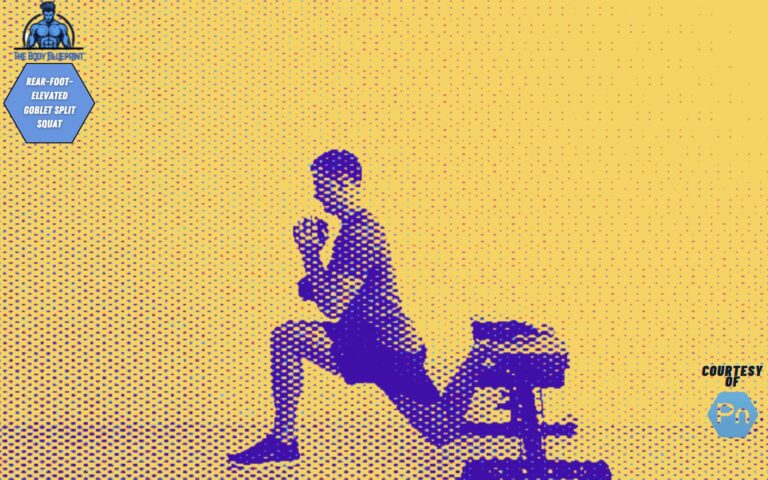
Bulgarian Style Variation: Elevate your back foot on a bench. This creates a deeper stretch in your front hip flexors. More glute and hamstring engagement. Great for hypertrophy. Requires more mobility. See our blocked knee split squat for similar stimulus.
Slideboard With Pause Variation: Pause at the bottom for 2 seconds. The isometric hold increases time under tension. Your quads and glutes experience prolonged mechanical stress. Great for hypertrophy blocks. Drop weight by 20% to maintain form.
Slideboard Reverse Lunge With Offset Dumbbell – FAQ
A: Not mandatory but highly recommended. The slideboard adds a stability and balance challenge you can’t replicate on the floor. If you don’t have one, a towel on a hardwood floor mimics the sliding surface effectively.
A: Start light. 10-20 pounds. Nail your form first. The stability demand reduces your effective working weight. Move up only after you control the slide on both sides equally. See our progressive overload guide for more.
A: Yes. Use a towel on a hardwood or tile floor for the slideboard. Use a water bottle or light household object for the offset load. The principle stays the same. Your stabilizers work against the sliding surface. Your core resists the asymmetrical load.
A: The slideboard improves deceleration control. The offset load builds lateral stability. Both are critical for cutting, changing direction, and landing. Soccer, basketball, and tennis athletes benefit directly. See our performance hub for more.
A: The slideboard reduces shear forces on the knee compared to standard lunges. However, if you have active knee pain, consult a professional first. Always warm up and maintain proper form. See our joint stability guide.
Final Verdict
The slideboard reverse lunge with offset dumbbell is a precision stability tool. The glute medius activation. The quadriceps engagement. The core anti-rotation demand. This variation builds functional strength that carries over to sport and life. It’s not the heaviest lunge. It’s not the sexiest. It is the most demanding in terms of control.
Friction is the enemy of stability. The slideboard removes friction from your back foot. Your stabilizers must compensate. This is the secret sauce. Without the slideboard, this is just a reverse lunge. With it, you get a neuromuscular challenge floor-based lunges cannot match.
Your execution determines your results. Prioritize control over speed. Maintain the offset load in a stable front-rack position. Slide with precision. Drive through the heel. Do these things consistently. Your unilateral strength and core stability will improve.
The slideboard doesn’t lie. It exposes weakness. It builds control. That is the point.
Master Your Unilateral Strength and Stability
The slideboard reverse lunge with offset dumbbell is a precision tool for building functional strength and core stability. Use it wisely. Progress slowly. Watch your control and balance improve. For more lower-body exercises and programming, explore our comprehensive guides.
Key Terms for This Slideboard Lunge Variation
- Offset Load
- Asymmetrical weight distribution. One side carries the load. This creates rotational torque your core must resist.
- Slideboard
- A low-friction surface for sliding exercises. Reduces ground contact friction. Forces your stabilizers to work harder.
- Proprioception
- Your body’s ability to sense its position in space. The slideboard challenges proprioceptive demands significantly.
- Frontal Plane
- Movement that occurs side-to-side. The offset load challenges frontal plane stability. This engages glute medius and lateral stabilizers.
- Anti-Rotation
- Core stabilization against rotational forces. The offset load creates a rotational torque. Your obliques and transversus abdominis resist this.
- Unilateral Training
- Exercises performed one side at a time. This variation addresses strength asymmetries and improves balance.