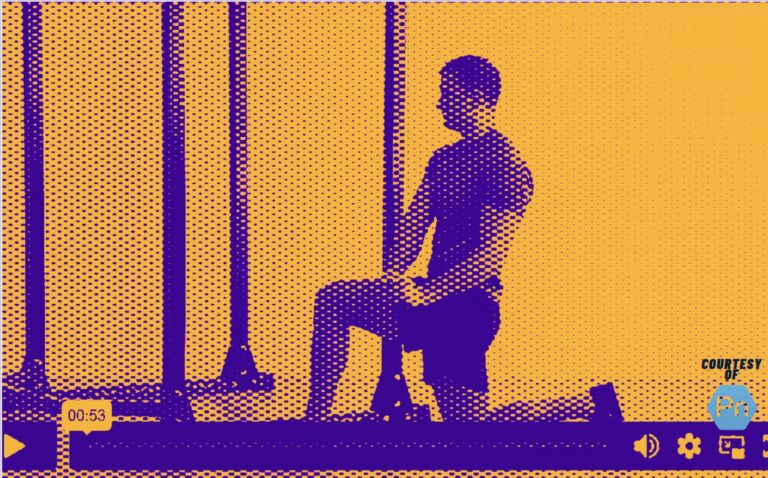
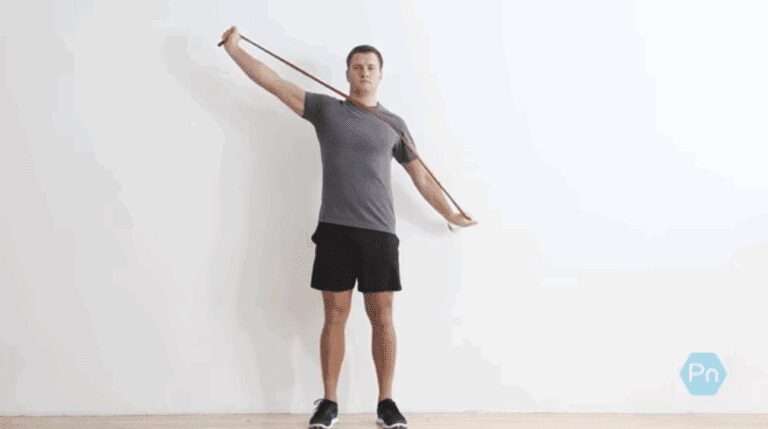
The single-arm standing split-stance band press is a high-threshold stability drill engineered to solve the “rotary leak” found in bilateral pressing. Most lifters possess a strong chest but a weak anti-rotation profile, leading to energy dissipation during overhead pressing. By utilizing a split-stance and accommodating resistance, we perform a mechanical audit on your anterior core and scapular protraction, forcing the body to resist the band’s pull while maintaining a rock-solid athletic base.
Health & Safety: For educational purposes only. Not FDA evaluated. These products and exercises carry inherent risks; results are not guaranteed and vary by individual. Always consult a professional before starting any new diet, supplement, or physical regimen.
Single-Arm Standing Split-Stance Band Presses Setup: The Anti-Rotation Anchor
The split-stance is your chassis; if it’s narrow, your power will hemorrhage. Anchor a resistance band at chest height. Step forward with the leg opposite to the pressing arm. If you feel “tippy,” check your unilateral foot mechanics. Maintain a neutral pelvis—if your lower back arches to fight the band, integrate tall kneeling Pallof presses to learn how to lock your ribcage over your hips.
Execution Cues: Punching Through the Band
The goal is a full punch that finishes with active scapular protraction. Many lifters stop the rep early to avoid losing balance. In the Engineering Dept, we look for a “reaching” sensation at the end of the press. This ensures the serratus anterior is firing, which is critical for shoulder width and density. If the band snaps back too quickly, your mind-muscle connection is failing; fight the eccentric to own the movement.
| Mechanical Check | Correction Strategy |
|---|---|
| Torso Twisting | Brace the obliques; keep the shoulders square to the “target.” |
| Elbow Flaring | Keep the elbow at a 45-degree angle; mimic proper bench press mechanics. |
| Weight Shifting Forward | Stay centered between your feet; don’t lean into the press. |
Rotary Stability: Building the Indestructible Core
A standing band press is a core exercise disguised as a chest drill. To maximize structural integrity, you must resist the band’s attempt to pull your shoulder backward. This anti-rotation demand is the “missing link” for those struggling with upper body plateaus. Support this technical work with single-arm rows to build a balanced, rotary-stable chassis.
“If you can’t press without twisting, you don’t own your strength. Engineer a core that stays quiet while your limbs move loud.” — The Body Blueprint Engineering Team
Lexicon of Mechanics: Pressing Edition
Anti-Rotation: The ability to prevent rotation of the spine while under an asymmetrical load—a hallmark of advanced core strength.
Scapular Protraction: Moving the shoulder blade away from the spine; essential for serratus activation.
Split-Stance: A staggered foot position that provides a wide base for sagittal plane stability.
Accommodating Resistance: Using bands to increase tension as the muscle enters its strongest range—perfect for explosive power development.
Engineer Rotary Power.
Stop doing standard presses and leaking energy. Master the standing band press and build the stable foundation of an elite lifter.