Building muscle does not require marathon gym sessions. It requires the right exercises, the right intensity, and the right recovery. Time in the gym is not the same as growth stimulus. This guide breaks down the efficiency toolkit. Compound lifts. Progressive overload. Strategic nutrition. Sleep as the anabolic trigger. These are the levers that deliver results without stealing your life.
Medical Disclaimer: This guide is for educational purposes. The statements regarding any supplements have not been evaluated by the Food and Drug Administration. These products are not intended to diagnose, treat, cure, or prevent any disease. Always consult a qualified professional before starting a new regimen.
The Efficiency Toolkit: Quality Over Quantity
Muscle growth is driven by mechanical tension, metabolic stress, and muscle damage. These do not require hours of fluff work. They require focused effort on movements that recruit the most muscle fibers in the least time.
The formula is simple:
- Compound movements over isolation exercises
- Progressive overload over random weight selection
- Intensity over volume
- Consistent recovery over daily grind
For a full breakdown of foundational strength, see our compound lifts guide and the Big 5 compound lifts.
“The gym is not a library. You do not get extra credit for time spent. You get results from the stress you create. Three hard sets on the squat rack are worth more than thirty minutes on the leg extension machine.”
Eugene Thong, CSCS
The Best Exercises: Compound Movements That Deliver
If time is limited, choose movements that hit multiple muscle groups simultaneously. These create the highest anabolic response per minute invested.
| Exercise | Primary Muscles | Time Efficiency |
|---|---|---|
| Barbell Squat | Quads, glutes, core, back | Full body in one movement |
| Deadlift | Posterior chain, grip, core | Maximum systemic load |
| Pull‑Up / Chin‑Up | Back, biceps, grip | Upper body pulling in one move |
| Overhead Press | Shoulders, triceps, core | Vertical pushing efficiency |
| Barbell Row | Back, rear delts, biceps | Horizontal pulling foundation |
For detailed technique guides, see our barbell back squat guide, deadlift form guide, chin‑up guide, and overhead press guide. For bodyweight alternatives when equipment is limited, check building muscle without a gym and bodyweight exercise library.
Intensity & Volume: Work Smarter, Not Longer
Volume (total sets and reps) is less important than intensity (how hard those sets are). One all‑out set to failure often stimulates more growth than three easy sets.
Key principles for time‑efficient training:
- Train within 1‑3 reps of failure on your working sets. This is where growth happens.
- Keep rest periods between 2‑4 minutes for compound lifts. This allows full ATP recovery without killing momentum.
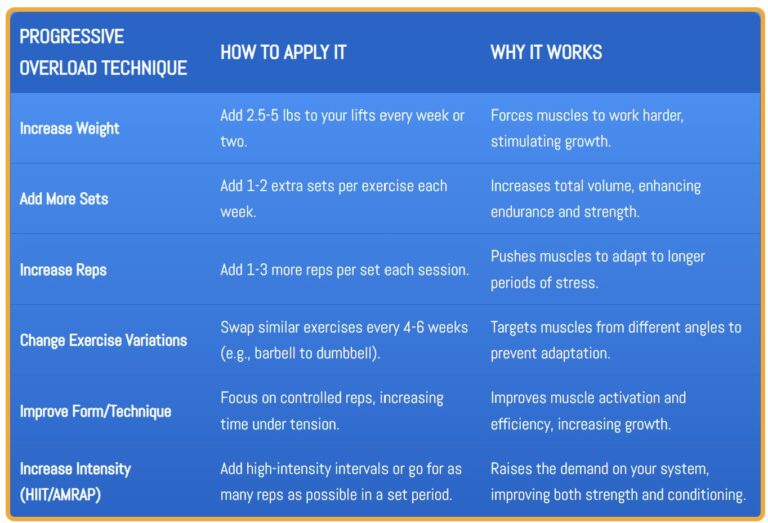
- Use progressive overload as your compass. Add weight or reps each session. If you are not progressing, you are not growing.
- Full‑body training 3x per week is more efficient than a 5‑day split. It spreads volume across fewer sessions.
For deeper dives, see our guides on progressive overload, volume vs. intensity, and full‑body vs. split routines.
“Intensity is the only variable you can truly control in a time‑crunched life. You cannot add hours to the day. But you can add effort to the sets you do. Effort is the great equalizer.”
Charles Damiano, B.S. Clinical Nutrition
Nutrition: Fuel That Does Not Waste Time
Muscle growth happens outside the gym. Nutrition is the building material. Without it, training is just damage without repair.
Efficiency rules for nutrition:
- Protein intake: 1.6‑2.2g per kg of body weight daily. Spread across 3‑4 meals. This supports muscle protein synthesis without constant eating.
- Whey protein is the fastest option post‑workout. It digests quickly and delivers amino acids when they are needed most.
- Carbs around training fuel performance. Without them, intensity drops, and the session becomes less effective.
- Hydration is non‑negotiable. Even mild dehydration reduces strength output and recovery speed.
For detailed nutrition guidance, see our best protein powder guide, whey protein types explained, post‑workout nutrition, and protein and hydration guide. For meal prep strategies, see college muscle meal prep and hardgainer diet guide.
Recovery: Where the Growth Actually Happens
Muscle is not built in the gym. It is built during recovery. Training is the signal. Sleep and nutrition are the construction crew.
Non‑negotiable recovery factors:
- Sleep: 7‑9 hours per night. This is when growth hormone peaks and muscle repair occurs. Skimping on sleep kills gains.
- Rest days: At least 48 hours between training the same muscle group. More is not better. Recovery is better.
- Active recovery: Light movement, stretching, or mobility work accelerates blood flow without adding fatigue.
- Stress management: Chronic stress elevates cortisol, which is catabolic. It works against muscle growth.
For recovery protocols, see our sleep optimization guide, rest day science, active recovery exercises, and nervous system regulation guide. For tools that support recovery, see massage gun comparison and foam roller guide.
Final Verdict: The Minimalist Muscle Blueprint
Building muscle without hours at the gym is possible. It requires a shift in mindset from “more is better” to “better is better.”
The blueprint:
- Train 3x per week with full‑body compound movements.
- Push intensity within 1‑3 reps of failure.
- Eat enough protein (1.6‑2.2g/kg) and hydrate consistently.
- Sleep 7‑9 hours and manage stress.
- Progress each session through added weight or reps.
This is not a shortcut. It is efficiency. It removes the fluff and focuses on what actually drives growth. For those with jobs, families, or limited time, it is the only sustainable approach.
If you want to build muscle but cannot spend hours in the gym, start here. For program structure, see our best workout routines for men, first workout routine, and 30‑day muscle building plan. For mindset strategies, see the iron mindset guide and why most men’s workouts fail.
The Bottom Line: Results, Not Hours.
Stop confusing time in the gym with progress. Three focused sessions per week with compound lifts, proper nutrition, and quality sleep will outperform six half‑assed sessions every time. The work is not easier. It is just more efficient.
*Verified 2026 efficiency protocols.
The Supplement Lexicon: Muscle Building Edition
- Progressive Overload
- The gradual increase of stress placed on the body during training. It is the primary driver of muscle growth. Can be achieved through added weight, more reps, or reduced rest periods.
- Compound Lift
- A multi‑joint movement that recruits multiple muscle groups simultaneously. Examples: squat, deadlift, bench press, row, overhead press.
- Mechanical Tension
- The force generated by muscles under load. It is the primary stimulus for hypertrophy. Created by lifting heavy weights with proper form.
- Muscle Protein Synthesis (MPS)
- The biological process of building new muscle protein. Elevated by resistance training and dietary protein intake. Peaks 24‑48 hours after training.
- Volume vs. Intensity
- Volume is total work (sets × reps × weight). Intensity is the percentage of one‑rep max or proximity to failure. For time‑efficient training, intensity matters more than volume.
- Anabolic Window
- The post‑workout period where nutrient delivery is prioritized for repair. Modern research shows it is wider than once thought, but fast‑digesting protein still has advantages.