You can smell it in the air—a mix of chalk dust, sweat, and blind faith.
It’s the sacred text of the gym locker room, passed down from seasoned veteran to wide-eyed newbie: the gospel of Bro Science. And nowhere is its scripture more fervently followed than in the church of protein.
We follow these rules with a religious zeal, convinced that this shake, that timing, this magical number is the key to unlocking the body of a god. But what if the very commandments you’re obeying are quietly undermining your temple? What if the noise of the crowd is drowning out the quiet, efficient truth of your own biology?
The cost isn’t just time or money. It’s muscle. Let’s dismantle the five biggest protein myths that are holding you back.

Myth 1: “More is Always Better” – The Protein Gluttony Gambit
The Bro Claim: “If 1 gram per pound is good, then 2 grams must be legendary. Shove down as much as you can, as often as you can.”
This is the granddaddy of them all, a myth built on a foundation of more. It’s the nutritional equivalent of trying to put out a campfire with a firehose. The body’s machinery for building muscle—a process called muscle protein synthesis (MPS)—is a precision instrument, not a dump truck.
There’s a hard biological ceiling on how much protein your body can actually use for repair and growth per meal. Exceed that ceiling, and the excess isn’t magically diverted to your lagging biceps. It’s largely oxidized for energy or, in a caloric surplus, converted to glucose and potentially stored as fat.
Eugene Thong, CSCS, cuts through the noise: “Think of your muscles as construction sites. Protein is the bricks. You can only use so many bricks at a time to build the wall. Piling more bricks on the site doesn’t make the wall go up faster—it just creates a cluttered, inefficient worksite. Your body is the same. You need a steady, measured delivery of bricks, not a chaotic dump truck.”
The Anabolic Sweet Spot (Per Meal)
| Goal | Protein Range | Biological Reality |
|---|---|---|
| Muscle Building | 30-50 grams | Maximally stimulates MPS. The “saturation point” for the building signal. |
| Muscle Maintenance | 20-30 grams | Sufficient to trigger a robust MPS response for most. |
| The “Waste Zone” | 60+ grams | No further increase in MPS. Excess is repurposed. |
The takeaway? Stop force-feeding. Distribute your protein intelligently throughout the day.
Myth 2: The “Anabolic Window” is a 60-Minute Ticking Time Bomb
The Bro Claim: “If you don’t chug a shake the nanosecond your last rep is done, your workout was for nothing. Your muscles will wither away.”
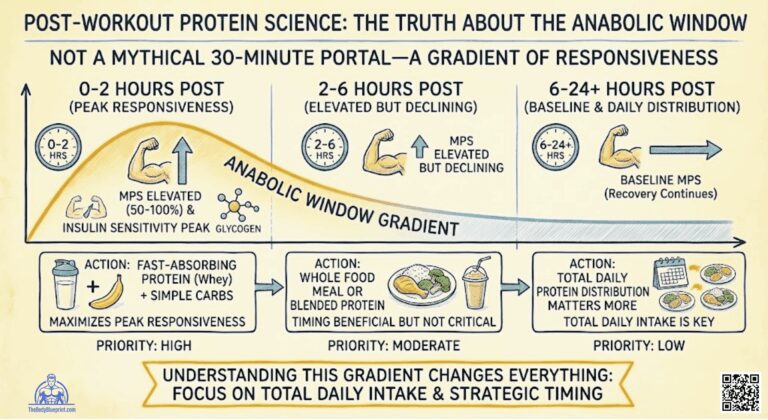
This myth creates a specific, frantic anxiety. The image of gains evaporating into the gym air is a powerful motivator—but a scientifically flawed one. The so-called “anabolic window” is less a window and more a very large, slowly closing barn door.
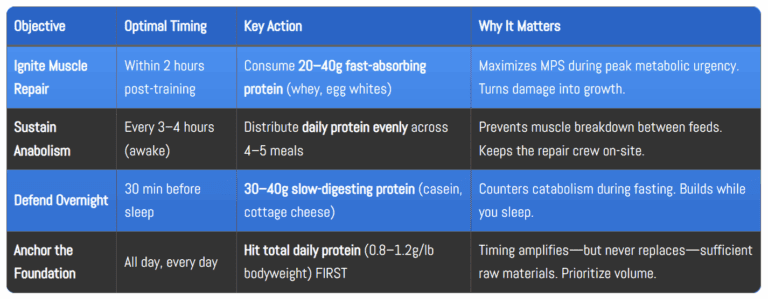
The truth is, the muscle is primed for nutrition for a significantly longer period post-workout than we’ve been led to believe—anywhere from 2 to even 6 hours, depending on the pre-workout nutrition. The most important factor for the day is your total protein intake, not the stopwatch-precision of your post-workout chug.
Charles Damiano, B.S. Clinical Nutrition, offers a calmer perspective: “You’ve just sent a powerful signal to your body to adapt and grow. It’s now listening intently. You have its attention. You don’t need to scream your instructions immediately; you have time to speak clearly and effectively. Missing the ‘window’ by an hour isn’t a catastrophe; missing your daily protein needs is.”
Myth 3: “Whey is the ONLY Post-Workout King”
The Bro Claim: “Nothing digests faster than whey. Speed is everything. Therefore, anything else is inferior.”
Whey is fantastic. It’s a complete, fast-digesting protein. But the obsession with speed is a solution in search of a problem. As we just learned, the post-workout period isn’t a frantic sprint. This opens the door to a more nuanced, and perhaps more effective, strategy.
The concept of a “protein blend” is where the real magic lies. Combining a fast-digesting protein like whey with a slower-digesting one like casein or even using whole-food sources like chicken or beef creates a more sustained release of amino acids into the bloodstream. This isn’t a sudden, brief flash in the pan; it’s a long, slow burn that can keep muscle protein synthesis elevated for hours longer.
The Post-Workup Plate Upgrade:
- The Bro Choice: Whey protein shake in water.
- The Savvy Builder: Whey protein shake in milk (adding casein).
- The Whole-Food Champion: A chicken breast with a side of Greek yogurt.
Myth 4: “Plant-Based Proteins are ‘Incomplete’ and Worthless for Building Muscle”
The Bro Claim: “You can’t get jacked on plants. The protein is low-quality and doesn’t have all the aminos you need.”
This myth is stubborn, but it’s crumbling under the weight of evidence and the biceps of vegan bodybuilders. It’s true that many individual plant proteins are lower in one or more essential amino acids, particularly leucine, which is the primary trigger for MPS. The key word there is individual.
This isn’t a biological dead end; it’s a logistical puzzle. By consuming a variety of plant protein sources throughout the day—rice and beans, hummus and pita, tofu and quinoa—you create a “complete” amino acid profile. Your body is a brilliant scavenger; it pools these amino acids from your daily intake to use for repair and growth.
Eugene Thong simplifies it: “Your body doesn’t care if the Lego bricks come from one single-color box or from a mixed bin. At the end of the day, it just needs enough of the right kinds of bricks to build the structure. With plants, you’re just pulling from a more diverse bin.”
Myth 5: “You Can’t Get Enough Protein from Real Food”
The Bro Claim: “Shakes are mandatory. You’d have to eat 10 pounds of chicken and broccoli to hit your numbers.”
This is pure, unadulterated nonsense, often perpetuated by supplement companies. It confuses convenience with necessity. Is a protein shake a convenient, efficient way to hit a protein target? Absolutely. Is it necessary? Not at all.
Whole food offers a powerful, synergistic package that no powder can replicate: protein bundled with micronutrients, healthy fats, and fiber that aid in digestion, hormone regulation, and overall health. Relying solely on shakes can leave you nutrient-deficient and chronically unsatisfied.
Charles Damiano drives it home: “Supplements are called ‘supplements’ for a reason. They are meant to supplement a solid whole-food foundation, not replace it. A shake is a tool. A chicken breast is a foundation. You build a house on a foundation, not on a pile of tools.”
The Whole-Food Protein Blueprint
Here’s how to build a protein-rich day without living out of a shaker bottle:
- Breakfast: 3 whole eggs + 1 cup Greek yogurt (~40g protein)
- Lunch: 6oz grilled chicken breast over a large salad (~45g protein)
- Dinner: 8oz lean sirloin steak with roasted vegetables (~60g protein)
- Snack: 1 cup cottage cheese with berries (~25g protein)
That’s 170 grams of high-quality protein from real, satisfying food—and we haven’t even factored in a single shake.
The Takeaway: Build with Intelligence, Not Just Effort
The path to a powerful physique is paved with more than just sweat and protein powder. It’s paved with precision. By letting go of these Bro Science myths, you stop fighting your own biology. You move from a place of anxious superstition to one of calm, confident execution.
Stop listening for the echo in the locker room and start listening to the quiet hum of your own, efficiently-recovering body. The gains you save will be your own.