
YOSUDA PRO 010C Review: 48 lb Flywheel, 350 lb Capacity
The YOSUDA PRO 010C is a 350 lb capacity silent belt-drive indoor cycle built around a 48 lb flywheel and a reinforced commercial-grade steel frame. It is designed for athletes over 200 lb who need a bike that does not flex, wobble, or scream during max-effort sprints. We stripped the spec sheet and tested the 100-level magnetic resistance to see where this bike dominates and where it gets lapped.
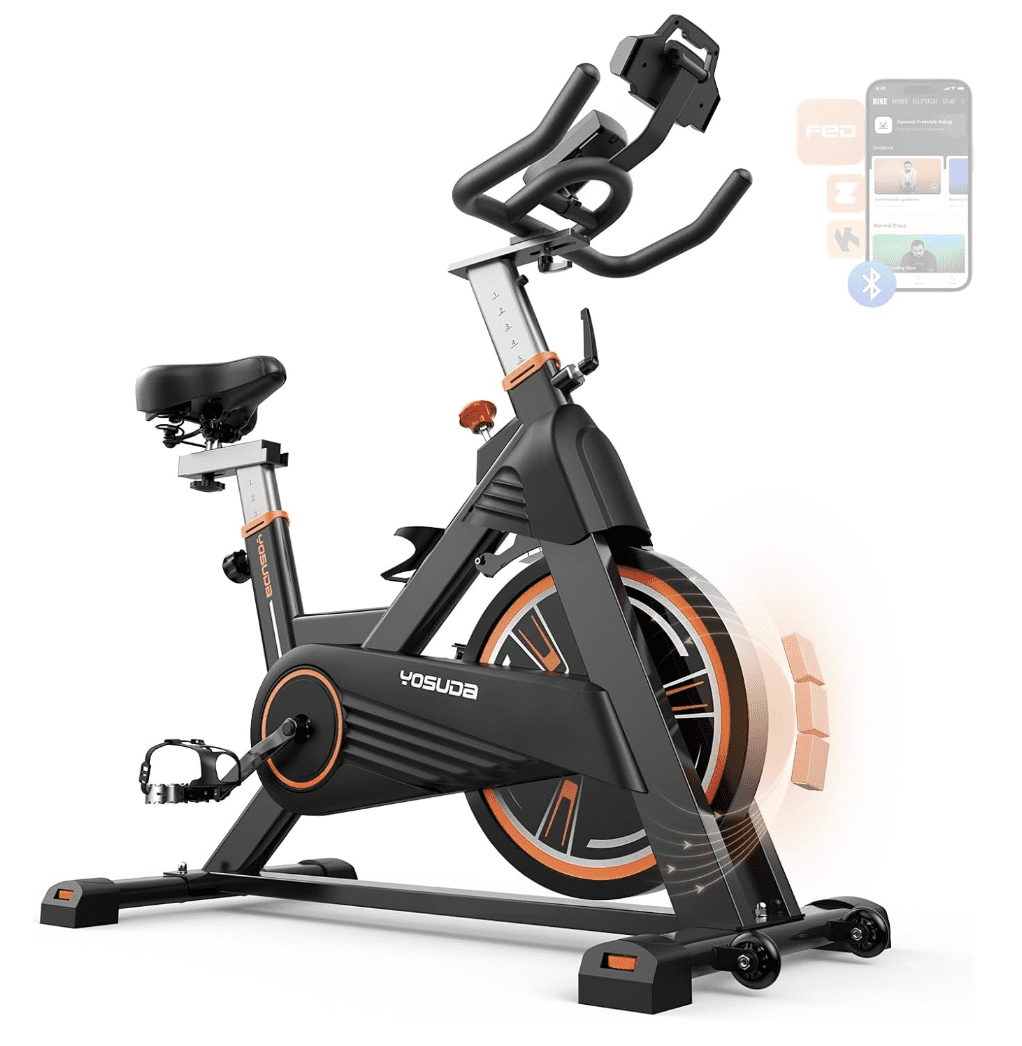
Overview: The Heavy-Duty Spec Sheet
The YOSUDA PRO 010C packs a 48 lb chromed flywheel, a poly-V silent belt drive, and a 350 lb user weight capacity into a reinforced steel frame that uses commercial-grade tubing. This is not a compact apartment bike. It is a full-size indoor cycle built for athletes who outgrow budget machines after six months. The footprint is substantial. The flywheel is heavy enough to mimic a road bike’s momentum curve. For a broader look at how indoor cycles fit into a home training setup, see our best stationary bike guide and our home gym equipment overview.
- Resistance System: 100-level micro-adjustable magnetic resistance. No friction pads. No wear surfaces. The magnet array moves closer to or farther from the flywheel with a knob turn.
- Flywheel: 48 lb chromed steel. A heavier flywheel creates a smoother, more realistic pedal stroke with less dead-spot hesitation at the top of each crank cycle.
- Drive System: Silent belt drive. No chain. No lubrication required. Zero metal-on-metal contact noise.
- Frame: Commercial-grade steel tubing. The bike weighs enough that it does not rock during out-of-saddle sprints.
- Adjustability: 4-way adjustable seat (height and fore/aft). Multi-grip handlebars for aero, climb, and wide grip positions.
- Tech: Basic LCD monitor displaying time, speed, distance, calories, and RPM. Bluetooth connectivity for Kinomap and Zwift pairing via tablet or phone.
The 48 lb Flywheel and Silent Belt Drive: What “Pro” Actually Means
A 48 lb flywheel and a poly-V belt drive are the two hardware components that separate the YOSUDA PRO 010C from sub-roughly $300 magnetic bikes. The flywheel weight determines how smooth the pedal stroke feels. A 20 lb flywheel produces a choppy, stop-start rotation. A 48 lb flywheel carries momentum through the dead zone at the top and bottom of each pedal revolution. The result is a fluid, road-bike-adjacent feel that makes both steady-state zone 2 and HIIT intervals feel natural. The belt drive is the home gym hack. No chain means no metal grinding against metal. No lubrication schedule. No noise through the floor. It is functionally silent during seated pedaling and barely audible during standing sprints.
The Flywheel vs. The Chain Analogy
A 20 lb flywheel on a budget bike is a go-kart engine. It starts and stops with every pedal stroke. A 48 lb flywheel is a locomotive. It builds momentum and carries it through the dead zones. A chain drive screams like a circular saw. A belt drive whispers like a ceiling fan. Both spin a wheel. One makes you fight the machine. The other makes the machine disappear. The YOSUDA PRO is built on the second philosophy.
Real-World Performance: HIIT, Endurance, and Tech
The YOSUDA PRO 010C handles 30-second max-effort sprint intervals and 60-minute zone 2 steady-state rides with the same structural composure. The 100-level magnetic resistance knob controls tension instantly. A quarter-turn spikes resistance by 10 to 15 levels. A micro-adjustment of two or three levels dials in exact wattage-equivalent effort for sustained climbs. The bike stays planted during standing sprints. No side-to-side rock. No front-to-back wobble. The 350 lb capacity frame is the reason.
- HIIT Sessions: 20 to 30 second max-effort sprints with 40 to 60 second recovery. The magnetic resistance changes are instantaneous. No lag. The belt drive does not protest under rapid cadence shifts. For structured HIIT programming, see our Tabata guide and high intensity training guide.
- Endurance Rides: 45 to 90 minutes at moderate resistance. The 4-way adjustable seat and multi-grip bars allow position changes to reduce fatigue on long sessions. The seat is functional but not exceptional. Riders logging 90-plus minutes per session may upgrade to a gel saddle.
- Bluetooth and Apps: The LCD monitor is a basic data display. It shows time, speed, distance, calories, and RPM. It does not have a touchscreen. Bluetooth pairs with a tablet or phone running Kinomap or Zwift. The bike transmits cadence and estimated power data. For connected cardio comparisons, see our smart gym comparison guide and Peloton Tread review.
“The difference between a 20 lb and a 48 lb flywheel is the difference between pedaling a toy and driving a train. The heavier flywheel on the YOSUDA PRO builds leg-burning momentum that forces you to produce real power, which is exactly what you want for metabolic conditioning.”
Eugene Thong, CSCS
YOSUDA PRO 010C Pros and Cons
The trade-off is a 48 lb flywheel, 350 lb capacity frame, and belt-drive silence against a substantial footprint, a basic LCD monitor, and a functional but replaceable stock seat.
Pros
- 48 lb flywheel: Smoother pedal stroke than any sub-40 lb flywheel bike. Road-bike-adjacent momentum.
- 350 lb capacity: Commercial-grade steel frame. Zero flex during standing sprints.
- Silent belt drive: No chain noise. No lubrication. Apartment-friendly.
- 100-level magnetic resistance: Granular control. Instant changes. No friction pad wear.
- 4-way adjustable seat: Height and fore/aft adjustment. Fits a wide range of rider heights.
- Multi-grip handlebars: Aero, climb, and wide grip positions. Not just one fixed bar.
- Bluetooth connectivity: Pairs with Kinomap and Zwift on a tablet or phone.
- No subscription required: The bike works as a standalone machine. Apps are optional.
Cons
- Footprint: Full-size indoor cycle. Not a compact or foldable bike. Measure your space before ordering. See compact cardio machines for small spaces if footprint is a constraint.
- Two-person assembly: The frame and 48 lb flywheel are heavy. A second set of hands makes assembly manageable.
- Basic LCD monitor: Displays data. Does not stream classes. No built-in touchscreen.
- Stock seat: Functional for rides under 60 minutes. Riders logging 90-plus minutes may upgrade.
- No built-in fan, speakers, or water bottle cage: Accessories you will need to add separately.
Who the YOSUDA PRO 010C Is For (And Not For)
Match the bike to your training profile. User weight, noise tolerance, flywheel weight requirement, and tech preferences point different buyers toward different machines.
Good Fit
- Lifters and athletes over 200 lb who have felt lighter bikes flex
- Apartment and condo dwellers who need silent operation
- HIIT and metabolic conditioning focused trainers
- Buyers who want a 48 lb flywheel without a roughly $2,000 price tag
- Anyone who wants a bike that does not require a subscription to function
- Riders who do 30 to 60 minute sessions and value stability over tech
Not the Best Fit
- Peloton-class loyalists who want a built-in touchscreen and live leaderboards
- Minimal-space buyers needing a foldable or compact bike (see compact cardio machines)
- Riders who want automatic resistance changes driven by an app (this is a manual knob)
- Ultra-budget buyers under $300
- Anyone unwilling to spend 45 minutes on two-person assembly
How the YOSUDA PRO 010C Compares to the Competition (2026)
Each indoor cycle has a different balance of flywheel weight, drive type, user capacity, tech integration, and price. No single bike sweeps every column.
| Bike | Flywheel | Drive | Capacity | Where It Wins | Where It Loses |
|---|---|---|---|---|---|
| YOSUDA PRO 010C | 48 lb | Belt | 350 lb | Heaviest flywheel, silent, highest capacity, best stability | Largest footprint, basic monitor, two-person assembly |
| Sunny SF-B1805 | 40 lb | Chain | 300 lb | Budget price, decent flywheel for the cost | Chain drive is noisy, lower capacity, less stable |
| Schwinn IC4 | 40 lb | Belt | 330 lb | Integrated app ecosystem, better tech, better monitor | Lighter flywheel, lower capacity, higher price |
| Peloton Bike | 38 lb | Belt | 297 lb | Best-in-class touchscreen, live classes, ecosystem | Highest price, $44/month subscription, lowest capacity, lightest flywheel |
| Concept2 BikeErg | Air resistance (damper) | Chain | 300 lb | PM5 monitor, concept2 ecosystem, wattage accuracy | Noisy, different resistance feel, expensive. See Concept2 comparison |
The YOSUDA PRO 010C owns the flywheel weight and user capacity columns. No competing bike at this price matches the 48 lb flywheel or 350 lb frame rating. The Schwinn IC4 and Peloton prioritize tech integration over raw hardware specs. The Concept2 BikeErg is a different resistance category entirely (air versus magnetic). For more indoor cycle comparisons, see our YOSUDA exercise bikes overview and our Merach exercise bike review. For the rowing alternative, see Concept2 Rowerg vs SkiErg vs BikeErg.
“For body composition and cardiovascular health, consistency in cardio is key. A bike that’s silent, stable, and comfortable removes the friction that causes people to skip sessions. You’re more likely to do the work if the machine itself isn’t a battle.”
Charles Damiano, B.S. Clinical Nutrition
YOSUDA PRO 010C FAQ
- How does the 48 lb flywheel feel compared to a 40 lb flywheel?
- Heavier. Smoother. An extra 8 lb of rotating mass carries more momentum through the dead zone at the top and bottom of each pedal stroke. The difference is most noticeable during steady-state riding and standing climbs. A 40 lb flywheel is smooth for the price. A 48 lb flywheel feels closer to a road bike.
- Is the YOSUDA PRO 010C really silent?
- Yes, in seated pedaling. The poly-V belt drive produces no metal-on-metal contact noise. During standing max-effort sprints, the bike produces a faint whoosh from the flywheel moving through air. There is zero chain noise at any intensity level. Floor vibration is minimal.
- How long does assembly take?
- The frame and flywheel are heavy. Budget 45 to 60 minutes with two people and the included tools. The flywheel comes pre-mounted to the frame, which eliminates the hardest single step. One person can manage but a second set of hands makes it significantly easier.
- Does the YOSUDA PRO 010C work with Zwift?
- Yes, via Bluetooth to a tablet or phone. The bike transmits cadence data. It does not automatically adjust resistance based on Zwift terrain. You turn the resistance knob manually to match grade changes. This is a manual bike with Bluetooth, not a smart bike with auto-resistance.
- Can the stock seat be replaced?
- Yes. The seat uses a standard rail mount that accepts any aftermarket bike saddle. Unscrew two bolts and swap. Riders logging 60-plus minute sessions commonly upgrade to a gel or wider saddle.
- How does this compare to a Peloton?
- The YOSUDA PRO 010C wins on flywheel weight (48 lb vs 38 lb), user capacity (350 lb vs 297 lb), price (lower upfront, no $44/month subscription), and silence (belt drive only, Peloton uses belt plus magnetic). Peloton wins on integrated touchscreen, live classes, leaderboard, and ecosystem. Pick hardware specs or pick ecosystem. They are different products for different buyers. See our Peloton Tread review for the same trade-off applied to treadmills.
- What is the wattage equivalent of the 100 resistance levels?
- There is no built-in power meter. The 100 levels are arbitrary units on the resistance knob. Apps estimate wattage from cadence and a resistance curve approximation. For accurate wattage, you need a bike with a real power meter like the Concept2 BikeErg or a smart trainer setup. This bike delivers effort levels. It does not deliver lab-grade power data.
- How much floor space does it require?
- The bike’s footprint is roughly 4 feet by 2 feet. You need additional clearance around the bike for mounting, dismounting, and standing sprints. Budget a 5-by-3-foot minimum dedicated space. For smaller footprints, see our compact cardio machines guide and walking pad vs treadmill comparison.
Final Verdict
The YOSUDA PRO 010C is the best heavy-duty indoor cycle for lifters and athletes who need a 350 lb capacity frame, a 48 lb flywheel, and a silent belt drive without paying for a touchscreen they do not want. It is built for max-effort sprints that stay planted. It is built for apartments where chain noise would get you evicted. It is built for riders who want hardware specs, not a content subscription.
The bike is not for everyone. If you want a built-in touchscreen, automatic resistance changes, live leaderboards, and a polished app ecosystem, buy a Peloton or Schwinn IC4. If you want accurate wattage data without estimation, buy a Concept2 BikeErg with its PM5 monitor. If your floor space is under 4 by 2 feet, this bike will not fit.
For the buyer who values flywheel weight, frame capacity, and silence above all else, the YOSUDA PRO 010C is the answer. It is a hardware-first bike in a market that increasingly sells software subscriptions disguised as fitness equipment. That is the product. Everything else is preference.
An indoor cycle is a conditioning tool, not a medical device. Calories burned, distance traveled, and wattage estimated are approximations based on the bike’s algorithm. Use the data to track trends. Do not use it for clinical precision. The YOSUDA PRO 010C delivers the heaviest flywheel and highest capacity in its price bracket. That is the spec. Everything else is marketing.
Verdict: Heaviest Flywheel, Highest Capacity, Best Stability in Class
48 lb flywheel. 350 lb capacity. Silent belt drive. 100-level magnetic resistance. Bluetooth to Kinomap and Zwift. The YOSUDA PRO 010C is the hardware-first indoor cycle for lifters who want a planted, silent bike that never wobbles during a sprint.
Related Home Gym and Cardio Guides
- Best Stationary Bikes for Home Gyms
- YOSUDA Exercise Bikes: Full Lineup Overview
- Best Compact Cardio Machines for Small Spaces
- Concept2: Rowerg vs SkiErg vs BikeErg Comparison
- Merach Exercise Bike Review
- Peloton Tread Review
- Home Gym Equipment Overview
- Max Output Home Gym Under 100 Sq Ft
- High Intensity Training Guide
- Tabata Guide: Protocols and Workouts
- Smart Gym Comparison Guide
- Hate Cardio But Need to Cut: A Practical Guide