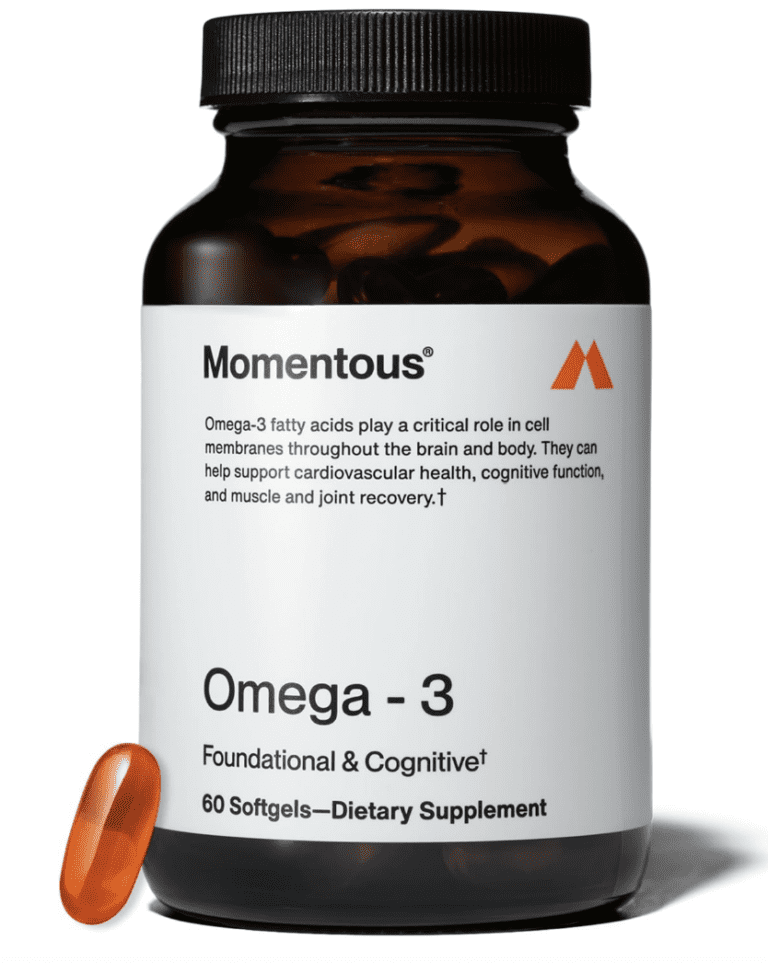
Triglyceride fish oil carries a TG or rTG label claim on the Supplement Facts panel. Ethyl ester fish oil carries an EE label claim. The difference is printed on every bottle. It changes the manufacturing process, the cost per gram of EPA and DHA, and which third-party certifications each form typically earns. We broke down both forms by label specs, production methods, and price to show exactly what that label code means for your wallet.
Overview: What the TG, rTG, and EE Labels Actually Mean
Fish oil supplements list their molecular form on the label in one of three ways: TG (natural triglyceride), rTG (re-esterified triglyceride), or EE (ethyl ester). The form is not always printed prominently. It is often buried in the Supplement Facts panel or the ingredient list. Checking for it before you buy tells you how the oil was manufactured and roughly what to expect on price.
- TG (Triglyceride): The molecular structure found in raw fish oil. Minimally processed. The label may say “natural triglyceride form” or simply list “fish oil” without specifying EE.
- rTG (Re-esterified Triglyceride): Molecularly distilled to strip contaminants, then enzymatically rebuilt back into triglyceride form. The label typically states “rTG” or “triglyceride form.” This is the manufacturing path for most premium fish oil products.
- EE (Ethyl Ester): Produced by binding EPA and DHA to ethanol during molecular distillation. The label may say “ethyl ester” or list “fish oil ethyl esters” in the ingredients. This is the standard form for many mass-market and budget fish oils.
The Cold-Pressed Olive Oil vs. Refined Vegetable Oil Analogy
TG fish oil is cold-pressed extra virgin olive oil. Minimally processed. Costs more. EE fish oil is refined vegetable oil. Chemically processed. Costs less. Shelf-stable. Both come from a raw source. Both sit on the same shelf. The label tells you which extraction path the oil took. One manufacturing process skips fewer steps. The other adds an ethanol binding stage that makes large-scale production cheaper. Pick what matches your budget and your label standards.
What Triglyceride Fish Oil Is: TG and rTG Labels
Triglyceride fish oil, labeled as TG or rTG on a Supplement Facts panel, is the molecular configuration found in raw fish tissue. It arrives in two manufacturing variants. Natural TG is minimally processed oil pressed from fish. rTG is molecularly distilled to remove heavy metals and contaminants, then rebuilt back into triglyceride form through an enzymatic re-esterification step.
- Natural TG: Cold-pressed or gently heated fish oil. Retains the original triglyceride backbone. Fewer processing steps. Typically found in liquid fish oils and some softgel products. The label lists “fish oil” without an EE designation.
- rTG (Re-esterified Triglyceride): Starts as raw fish oil. Gets molecularly distilled to concentrate EPA and DHA and strip contaminants. The distillation process temporarily converts the oil to ethyl ester form. An enzymatic step then re-attaches the fatty acids to a glycerol backbone, restoring the triglyceride structure. The label states “rTG” or “triglyceride form.” This is the manufacturing path behind premium brands like Sports Research and Carlson.
Label indicators of TG/rTG products:
- Supplement Facts panel lists EPA and DHA per serving
- Ingredient list states “fish oil” or “purified fish oil” without ethyl ester language
- Front label may state “triglyceride form,” “rTG,” or “natural fish oil”
- Typically costs more per gram of EPA/DHA than EE equivalents
- Often packaged in darker bottles or opaque softgels to protect against oxidation
“The triglyceride form is what you find in the fish itself. rTG products take that oil, purify it, and rebuild it into the same structure. You pay for the extra manufacturing steps. The label tells you whether those steps happened.”
— Charles Damiano, B.S. Clinical Nutrition
What Ethyl Ester Fish Oil Is: EE Labels
Ethyl ester fish oil, labeled as EE on a Supplement Facts panel or ingredient list, is produced by binding EPA and DHA molecules to ethanol during molecular distillation. This manufacturing step makes large-scale production less expensive. The ethanol backbone stabilizes the fatty acids. The result is a more shelf-stable oil that costs less per gram of EPA/DHA to produce.
- Manufacturing Process: Raw fish oil undergoes molecular distillation. Ethanol is introduced. The EPA and DHA fatty acids detach from their natural glycerol backbone and bind to ethanol. The resulting ethyl ester oil is concentrated, purified, and encapsulated. No re-esterification step is performed. The final product remains in ethyl ester form.
- Label Indicators: The ingredient list may say “fish oil ethyl esters,” “EPA ethyl ester,” “DHA ethyl ester,” or simply list the concentrated oil with an EE designation on the manufacturer’s specification sheet. The front label rarely advertises EE status. It is typically identified by what it does not say: no “triglyceride” claim anywhere on the bottle.
- Cost Difference: EE fish oil typically costs 30-50% less per gram of EPA/DHA than rTG equivalents. The ethanol binding step is cheaper to run at scale than the enzymatic re-esterification required for rTG. This is the primary reason budget fish oils use the EE form.
“EE fish oil is not a fake product. It is a different manufacturing path. The ethanol step makes it cheaper. The label typically lists the same EPA and DHA milligrams. The form code is the variable most buyers miss.”
— Eugene Thong, CSCS
Top Fish Oil Picks by Form (2026)
Best Triglyceride (rTG): Sports Research Omega-3

Sports Research Omega-3 lists rTG triglyceride form on its label with 1,250mg total fish oil per softgel. The Supplement Facts panel shows EPA and DHA broken out separately. The softgel uses carrageenan-free gelatin. Third-party testing is standard. The rTG manufacturing path means this oil went through molecular distillation plus enzymatic re-esterification. Price per serving runs roughly $0.30-$0.40. For a full breakdown, see our Sports Research Omega-3 review.
| Form | rTG (re-esterified triglyceride) |
| Total Oil/Softgel | 1,250mg |
| Third-Party Testing | Yes, batch-level |
| Cost/Serving | ~$0.30-$0.40 |
Best Natural Triglyceride (TG): Carlson Liquid Fish Oil

Carlson Fish Oil is a natural triglyceride (TG) liquid, not an rTG softgel. The label lists “fish oil” without ethyl ester language. The oil is bottled in a dark glass container to limit light exposure and oxidation. Liquid format means dosing is flexible by the teaspoon rather than fixed by softgel count. Carlson uses nitrogen flushing during bottling to displace oxygen from the headspace, which extends shelf life. For the full review, see our Carlson Fish Oil review.
| Form | Natural TG (triglyceride) |
| Format | Liquid (teaspoon dosing) |
| Packaging | Dark glass bottle, nitrogen flushed |
| Cost/Serving | ~$0.40-$0.60 |
Best Ethyl Ester (EE): Momentous Omega-3

Momentous Omega-3 uses the ethyl ester (EE) manufacturing path and carries NSF Certified for Sport certification. This is the key trade-off. The ethanol binding step makes production less expensive than rTG. The NSF certification means every batch passes third-party testing for banned substances, which matters for tested athletes. The label lists EPA and DHA per serving. The ingredient panel states ethyl esters. Cost per serving runs roughly $0.50-$0.70. For a deeper spec breakdown, see our Momentous Omega-3 review.
| Form | EE (ethyl ester) |
| Certification | NSF Certified for Sport |
| Target Buyer | Tested athletes |
| Cost/Serving | ~$0.50-$0.70 |
Best Phospholipid Alternative: Bronson Antarctic Krill Oil
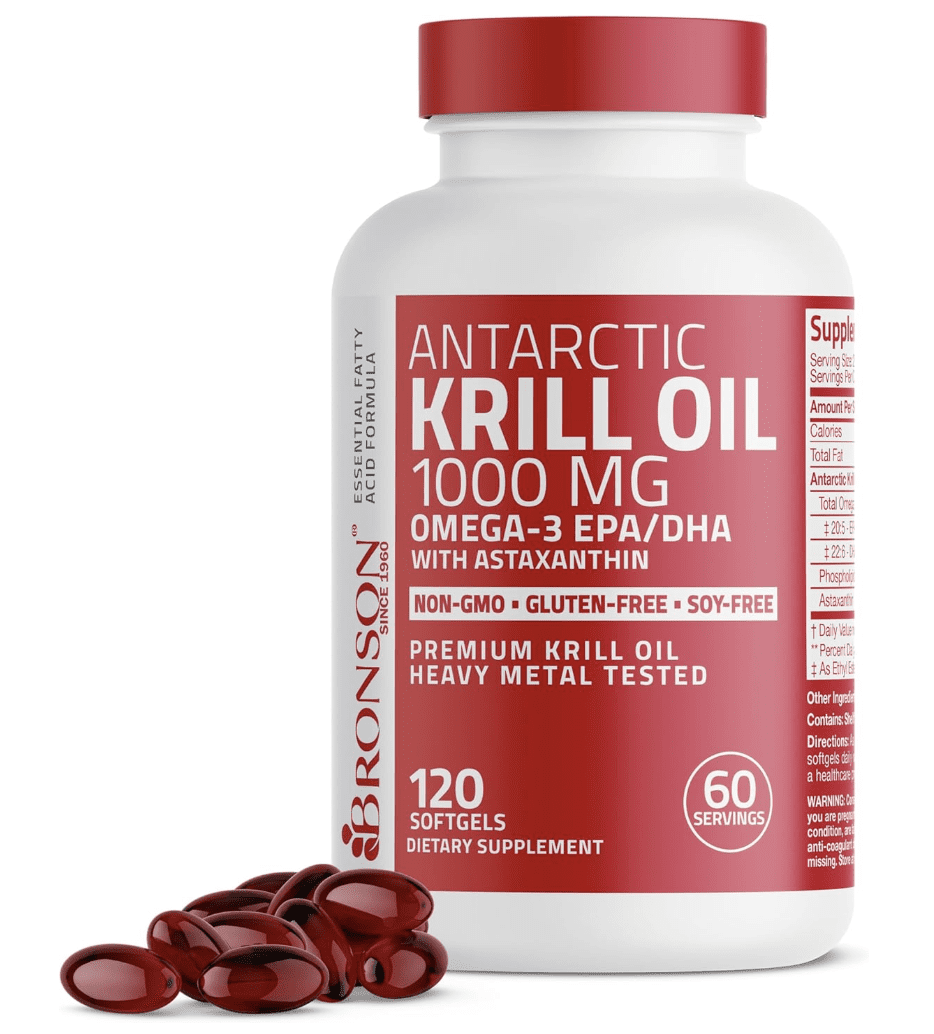
Bronson Antarctic Krill Oil uses a third molecular form: phospholipid-bound EPA and DHA, which is the form naturally present in krill, not fish. This is not TG or EE. It is a separate category. Phospholipid-bound omega-3s are water-dispersible, which changes how the oil behaves in a softgel. Krill oil also naturally contains astaxanthin, a carotenoid that gives the oil a red color and functions as a natural preservative. The label lists “krill oil” without TG, rTG, or EE designations. Cost per serving runs higher than standard fish oil.
| Form | Phospholipid (krill oil) |
| Total Oil/Serving | 1,000mg |
| Preservative | Astaxanthin (naturally occurring) |
| Cost/Serving | ~$0.40-$0.60 |
Triglyceride vs Ethyl Ester: Side-by-Side Label and Manufacturing Comparison
TG/rTG and EE fish oils differ on four spec-level variables: manufacturing process, label designation, cost per gram, and which certifications each form typically carries. No single form wins every column.
| Feature | Triglyceride (TG/rTG) | Ethyl Ester (EE) |
|---|---|---|
| Label Designation | “Triglyceride,” “rTG,” “TG,” or “natural fish oil” | “Ethyl ester,” “EE,” or no triglyceride claim |
| Manufacturing Path | Natural expression or molecular distillation + enzymatic re-esterification | Molecular distillation with ethanol binding step |
| Processing Steps | More (rTG); fewer (natural TG) | Fewer than rTG, more than natural TG |
| Cost Per Gram EPA/DHA | Higher | Lower |
| Common Certifications | IFOS, GOED, third-party purity | NSF Certified for Sport, GOED |
| Oxidation Sensitivity | More sensitive; typically packaged in dark bottles or opaque softgels | Less sensitive; ethanol backbone adds stability |
| Example Products | Sports Research, Carlson, Nordic Naturals | Momentous, many mass-market brands |
| Best For | Buyers prioritizing minimally processed oil and willing to pay the premium | Buyers prioritizing cost per gram or NSF certification for sport |
The TG/rTG column costs more because the manufacturing path adds steps. The EE column costs less because ethanol binding is cheaper at scale. Both produce oil with EPA and DHA listed on the label. The form code is a manufacturing variable, not a purity variable. For broader omega-3 guidance, see our Sports Research Omega-3 review and Carlson Fish Oil review. For the phospholipid alternative, see our krill oil guides.
Triglyceride vs Ethyl Ester FAQ
- How do I tell if my fish oil is triglyceride or ethyl ester?
- Check the Supplement Facts panel and ingredient list. TG/rTG products typically state “triglyceride form,” “rTG,” or simply list “fish oil” without ethyl ester language. EE products may state “fish oil ethyl esters” in the ingredient list. If the label makes no triglyceride claim, it is likely an EE product. When in doubt, check the manufacturer’s website for the form specification.
- Is ethyl ester fish oil lower quality than triglyceride?
- Not necessarily. EE fish oil is a different manufacturing path, not an inherently inferior one. The ethanol binding step makes large-scale production less expensive. The EPA and DHA milligrams listed on the label are the same molecules regardless of form. The difference is the manufacturing cost, the shelf stability, and the molecular backbone the fatty acids are attached to. Momentous Omega-3 uses the EE form and carries NSF Certified for Sport, which is a rigorous quality certification.
- Why does triglyceride fish oil cost more?
- The enzymatic re-esterification step required to rebuild rTG oil after molecular distillation adds manufacturing cost. Natural TG oil skips distillation entirely, but yields are lower and sourcing costs are higher. EE oil uses ethanol as the binding agent, which is a cheaper process to run at scale. The price difference is a manufacturing cost reflection, not necessarily a quality hierarchy.
- Does krill oil count as triglyceride or ethyl ester?
- Neither. Krill oil uses a phospholipid molecular structure, which is a third category entirely. EPA and DHA in krill are bound to phospholipids rather than triglycerides or ethanol. The label lists “krill oil” without TG, rTG, or EE designations. Krill oil also naturally contains astaxanthin, which functions as a preservative and gives the oil its red color.
- Which form should I buy in 2026?
- It depends on your priority. If you want the least-processed oil and are comfortable with the higher cost, pick a TG or rTG product like Sports Research or Carlson. If you are a tested athlete who needs NSF Certified for Sport, Momentous EE is a strong option. If you want a phospholipid alternative, Bronson Krill Oil is the third path. Read the label. Match the form to your budget and your certification requirements. Consult a qualified professional for personalized guidance.
Final Verdict
Triglyceride fish oil (TG/rTG) costs more because its manufacturing path skips the ethanol binding step or reverses it through enzymatic re-esterification. Ethyl ester fish oil (EE) costs less because ethanol binding makes large-scale production cheaper. Both list EPA and DHA on the label. The form code is a manufacturing variable that changes the price, the shelf stability, and which certifications the product can carry.
Sports Research Omega-3 (rTG) is the best triglyceride pick for most buyers. Batch-tested. Reasonable cost per gram. Clear form designation on the label.
Carlson Liquid Fish Oil (natural TG) is the best minimally processed option. Dark glass bottle. Nitrogen flushed. Flexible dosing.
Momentous Omega-3 (EE) is the best ethyl ester option for tested athletes. NSF Certified for Sport outweighs the form variable when drug-tested competition is on the line.
Fish oil form is not a quality hierarchy. It is a manufacturing variable that changes what you pay and what certifications the bottle carries. Read the label. Match the form to your budget and your requirements. That is the entire decision.
Verdict: TG Costs More for Fewer Processing Steps. EE Costs Less. Labels Tell the Difference.
Sports Research for rTG quality. Carlson for natural TG liquid. Momentous for NSF-certified EE. Bronson for phospholipid krill. Read the form code on the label. Match it to your budget. Consult a professional.
Related Fish Oil and Omega-3 Guides
- Sports Research Omega-3 Review
- Carlson Fish Oil Review
- Momentous Omega-3 Review
- Nutricost K2 + D3 Review
- Sports Research D3 + K2 Review
- Best Thorne Supplements for Athletes