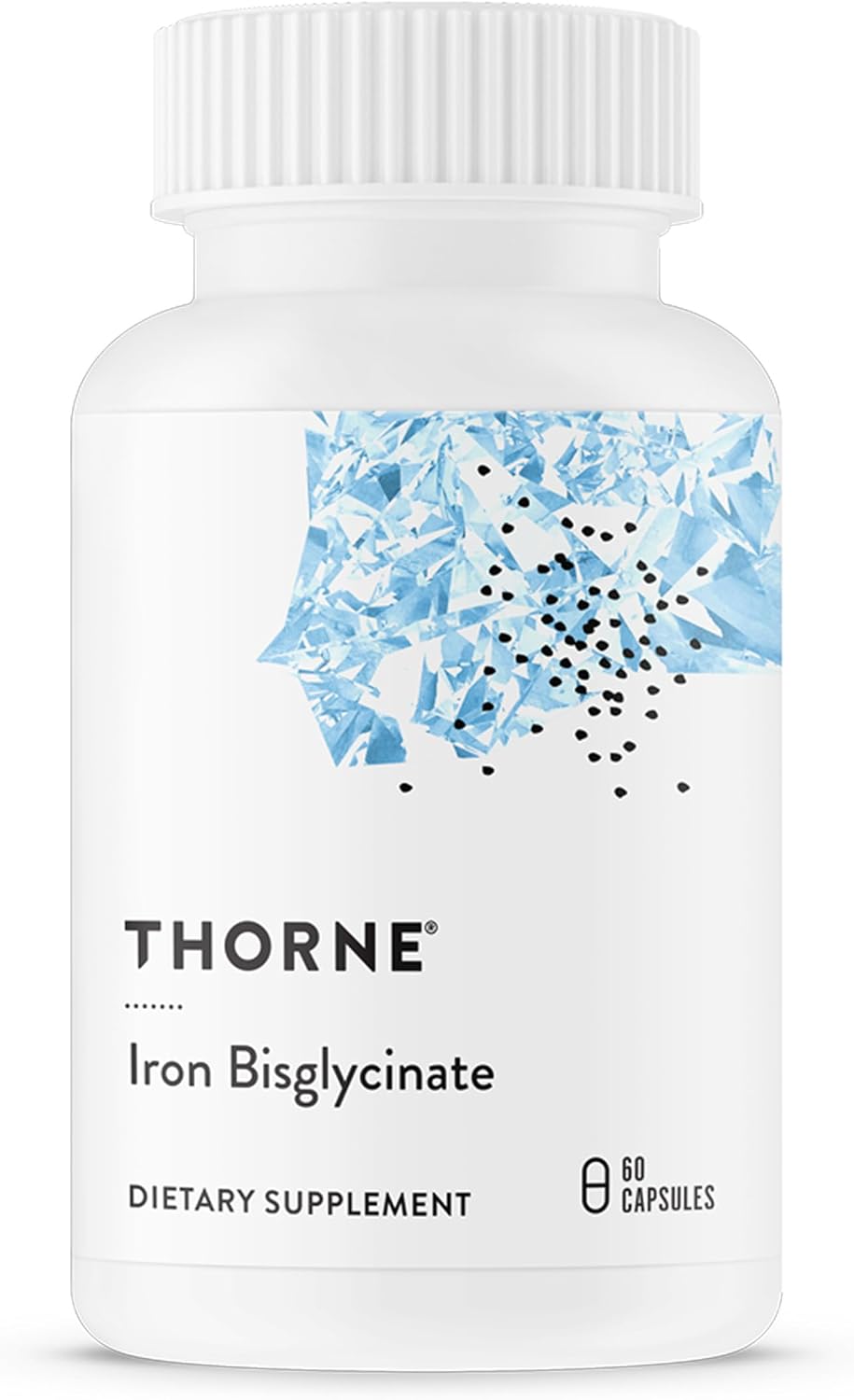
Thorne Iron Bisglycinate delivers 25mg of elemental iron per capsule as Ferrochel ferrous bisglycinate chelate, NSF Certified for Sport against 290 banned substances, with a 75% documented bioavailability advantage over standard pharmacy iron forms. Iron deficiency is the most common nutritional gap worldwide. The form determines whether the gap closes or whether your money exits the GI tract alongside the iron. This is the 2026 breakdown.
The Price: Patented Chelate Precision at a Defensible Cost
Thorne Iron Bisglycinate typically retails between roughly $18 and roughly $24 for 60 capsules, delivering 25mg of elemental Ferrochel ferrous bisglycinate chelate at roughly $0.30 to $0.40 per serving. Standard ferrous sulfate tablets cost less. That comparison is irrelevant. Ferrous sulfate bioavailability runs 10 to 28% in clinical research. Ferrochel runs 75%. You are not buying more iron. You are buying iron that arrives.
NSF Certified for Sport verification against 290 banned substances is included. GMP-compliant manufacturing. Four rounds of internal quality testing. Gluten-free, dairy-free, soy-free. One capsule per serving. No complexity. No compromise.
The Ferrochel Chelate: Why This Form Wins
Thorne Iron Bisglycinate uses Ferrochel, a patented ferrous bisglycinate chelate by Albion Minerals, in which elemental iron is covalently bound to two glycine molecules forming a stable, neutral-charge mineral-amino acid complex. That neutral charge is everything. Standard inorganic iron salts carry an ionic charge. They irritate the intestinal mucosa. They trigger inflammatory responses. They stimulate hepcidin secretion. Hepcidin is the hormone that blocks iron absorption. Ionic iron essentially tells your body to absorb less of it. It is self-defeating by design.
Ferrochel bypasses this cascade entirely. It absorbs intact through amino acid transport channels. No inflammatory trigger. No hepcidin spike. No GI damage. The clinical data backs it up:
- 75% bioavailability versus 27.8% for ferrous sulfate in a controlled comparative trial. A 2.7-fold absorption advantage at the same nominal dose.
- 64% lower GI side effect rate in a meta-analysis comparing ferrous bisglycinate to standard iron forms. No constipation. No nausea. No dark stools for the majority of users.
- Phytate resistance. Phytates in grains, nuts, and seeds reduce ionic iron absorption by up to 60%. Ferrochel’s chelated structure is phytate-resistant. It absorbs regardless of what is in the meal alongside it.
Other ingredients are clean and minimal: hypromellose vegetarian capsule, microcrystalline cellulose, leucine, silicon dioxide. No allergens. No fillers worth naming. One capsule. One job. Done.
Taking ferrous sulfate is like mailing a check through a neighborhood where 75% of the mailboxes are on fire. Technically something gets delivered. But most of it never makes it. Ferrochel skips the postal system entirely. It goes door to door, hand delivery, directly to the intestinal wall. — Charles Damiano, B.S. Clinical Nutrition
Four Mechanisms: What Iron Bisglycinate Supports
Iron is required for hemoglobin synthesis, myoglobin oxygen storage, mitochondrial Fe-S cluster function, and dopamine and serotonin neurotransmitter synthesis. Deficiency degrades all four simultaneously. It looks like overtraining. It looks like chronic fatigue. It is usually a correctable gap.
- Hemoglobin Synthesis and Oxygen Transport: Iron is the functional core of the heme group. Without it, red blood cells cannot carry oxygen efficiently to working muscle. Ferritin below 30 to 35 ng/mL impairs hemoglobin production before clinical anemia appears. This is iron deficiency without anemia. It is the most common missed presentation in athletes. Aerobic capacity drops. Perceived exertion rises. Performance degrades invisibly.
- Myoglobin Oxygen Storage in Skeletal Muscle: Myoglobin buffers oxygen supply within muscle fibers between heartbeats. Iron deficiency reduces myoglobin concentration directly. The result is impaired anaerobic-to-aerobic transition during repeated high-intensity efforts. Recovery between sets slows. Power output ceiling drops.
- Mitochondrial Iron-Sulfur Clusters and ATP Synthesis: Iron is embedded in Fe-S clusters in mitochondrial complexes I, II, and III of the electron transport chain. These clusters are required for oxidative phosphorylation. Deficient iron impairs ATP synthesis at the cellular level. This happens before hemoglobin changes appear on a blood panel. It is the earliest and most invisible performance consequence of low iron.
- Dopamine and Serotonin Synthesis via Tyrosine and Tryptophan Hydroxylase: Iron is a required cofactor for both rate-limiting neurotransmitter synthesis enzymes. Low iron suppresses dopamine and serotonin production. The result is cognitive fog, low motivation, and irritability that looks psychiatric but is nutritional.
Iron deficiency in an athlete is like running a V8 engine with only six cylinders firing. Everything technically works. The car moves. But you will never hit redline, the idle is rough, and no amount of tuning elsewhere fixes a fuel delivery problem. Fix the fuel first. — Eugene Thong, CSCS
Dosing Protocol: Timing, Maximizers, and Blockers
Thorne recommends 1 capsule daily as the standard protocol, with a range of 1 to 3 capsules daily as directed by a healthcare practitioner. Do not self-escalate beyond 1 capsule without confirmed deficiency and physician oversight. Iron toxicity is real. The goal is repletion, not excess.
Timing for Maximum Absorption
- Take on an empty stomach in the morning, at least 6 hours after your last hard training session. Hard exercise elevates hepcidin for up to 6 hours post-workout. Hepcidin actively blocks intestinal iron absorption via ferroportin receptor downregulation. Taking iron immediately post-workout is the single most common athlete dosing error. Morning fasted timing avoids this window entirely.
- Stack with 100 to 200mg of vitamin C. Ascorbic acid reduces ferric iron to ferrous form and chelates it against inhibitory compounds. Even Ferrochel’s absorption improves with co-ingestion of vitamin C.
What Blocks Absorption
- Calcium and dairy: compete directly at intestinal transport sites. Separate by at least 2 hours.
- Coffee and tea: polyphenols and tannins bind iron. Take iron at least 1 hour before or 2 hours after caffeine.
- Other mineral stacks: zinc and magnesium compete for the same DMT-1 divalent metal transporter pathway. Take iron separately from your mineral stack.
Is It Worth It? The Calculation
Thorne Iron Bisglycinate is the correct choice for confirmed iron insufficiency requiring NSF Certified for Sport verification, phytate-resistant absorption, and GI tolerability that standard pharmacy forms cannot provide. It is not an over-the-counter daily add-on. Confirm deficiency first. Then buy this.
Buy It If
- Your serum ferritin is confirmed below 30 to 35 ng/mL and you need a GI-tolerable form you can stay on for 8 to 16 weeks without stopping. Compliance is the limiting factor in iron repletion. Bisglycinate eliminates the side effects that break it.
- You are a menstruating woman, endurance athlete, vegan or vegetarian, or frequent blood donor. All four are highest-risk groups per the CDC. Dietary intake rarely meets their elevated daily requirements consistently.
- You are a competitive athlete subject to drug testing. NSF Certified for Sport is the non-negotiable minimum. This is the only chelated iron supplement in the premium category that carries it.
- You have quit ferrous sulfate due to GI side effects before your ferritin recovered. This is the clinical-grade fix for that problem.
Skip It If
- You have not confirmed deficiency via serum ferritin, CBC, and CRP. Iron is not a supplement to run prophylactically. Excess iron generates oxidative stress and carries hepatic toxicity risk. Test first. Always.
- You have hemochromatosis or any iron overload condition. Consult your physician before any supplemental iron regardless of form or dose.
Thorne Iron Bisglycinate vs. The Field
| Product | Iron Form | Elemental Iron | Certification | 2026 Verdict |
|---|---|---|---|---|
| Thorne Iron Bisglycinate | Ferrochel bisglycinate chelate | 25mg per capsule | NSF Certified for Sport | Gold standard for athletes. Patented Ferrochel. Maximum bioavailability. Zero GI friction. |
| Pure Encapsulations Iron-C | Iron bisglycinate | 15mg per capsule | Third-party tested | Co-formulated with vitamin C. Lower dose. No NSF sport certification. |
| Ferrous Sulfate (Pharmacy) | Ferrous sulfate (inorganic) | 65mg per tablet | Self-declared | High nominal dose. Low actual delivery. 10 to 28% bioavailability. Most patients stop before ferritin recovers. |
| Generic Iron Bisglycinate | Non-patented bisglycinate | Varies | Independently lab tested | Comparable mechanism. No NSF sport certification. Adequate for non-tested individuals. |
Ferritin repletion is a marathon, not a sprint. Most people quit ferrous sulfate at week three because their gut is in revolt. They spent the money, did three weeks of work, and got nothing. Bisglycinate is what finishes the race. You cannot win a marathon you abandoned at mile four. — Charles Damiano, B.S. Clinical Nutrition
The Bottom Line
Thorne Iron Bisglycinate is the clinical-grade iron supplement for confirmed-deficient athletes, menstruating women, and plant-based eaters who need NSF Certified for Sport verification, phytate-resistant Ferrochel absorption, and GI tolerability that standard pharmacy iron cannot offer. 25mg per capsule. 75% documented bioavailability. One capsule. Sixty days.
Test your ferritin first. If the gap is confirmed, this is how you close it. Without stopping. Without side effects. All the way to repletion.
Verdict: 75% Bioavailability. Zero GI Friction. One Capsule Daily.
Ferrochel bisglycinate chelate. NSF Certified for Sport. 25mg elemental iron. Phytate-resistant. The form that actually closes the ferritin gap.
*Prices subject to change. Verified 2026 clinical review. Sources: Ferrochel bioavailability data (Albion/Balchem), Fischer et al. (2023) Nutrition Reviews, Stoffel et al. (2017) Lancet Haematology.