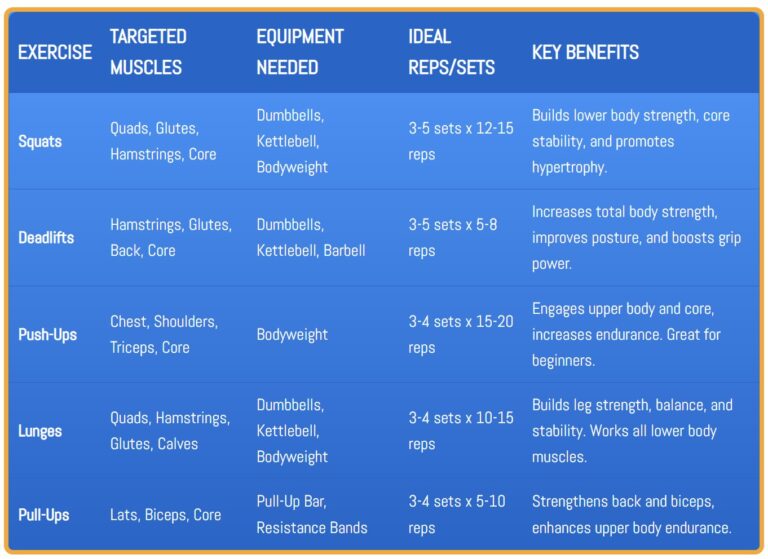
Tall lifters face a mechanical disadvantage. Long limbs mean longer levers. Longer levers mean more torque on joints and less mechanical efficiency in lifts. The barbell does not care about your height. It only responds to physics. This guide breaks down the training strategies that turn long limbs from a disadvantage into a strength. Leverage. Technique. Exercise selection. Recovery. These are the tools that level the playing field.
Medical Disclaimer: This guide is for educational purposes. The statements regarding any supplements have not been evaluated by the Food and Drug Administration. These products are not intended to diagnose, treat, cure, or prevent any disease. Always consult a qualified professional before starting a new regimen.
The Mechanical Reality: Why Long Limbs Change the Game
Physics is not fair. For tall lifters, every movement requires more work. A taller lifter with a longer femur must move the barbell a greater distance in the squat. A longer arm means the bench press travels farther. More distance equals more time under tension and more fatigue per rep.
This does not mean tall lifters cannot be strong. It means the training approach must account for leverage differences. The same program that works for a 5’8″ lifter will not translate directly to a 6’4″ lifter.
Key mechanical challenges:
- Longer range of motion on every lift
- Increased torque on joints, especially hips and shoulders
- Higher fatigue accumulation per set
- Different ideal positions for each exercise
For foundational concepts on compound exercises for mass and progressive overload, see our core strength guides. Understanding fast‑twitch vs. slow‑twitch muscle fibers also helps tailor volume for longer‑limbed athletes.
“Being tall in the gym is like being a semi truck instead of a sports car. You cannot take the same corners at the same speed. But you can carry a hell of a lot more weight once you learn to use your leverage.”
Eugene Thong, CSCS
Squat Solutions: Work With Your Femur Length
The squat is where long femurs create the most obvious challenge. A longer femur forces the hips farther back to maintain balance. This increases forward lean and puts more load on the lower back.
Solutions for tall lifters:
- Widen your stance. A wider stance reduces the horizontal travel of the knees and allows a more upright torso.
- Elevate your heels. Weightlifting shoes or a small plate under the heels shifts the center of gravity and allows for better depth with less forward lean.
- Try low‑bar position. The low‑bar squat reduces the moment arm between the hips and the bar, making the lift more efficient for long femurs.
- Consider front squats. The front squat forces a more upright torso and can be more comfortable for some tall lifters.
For detailed technique, see our barbell back squat guide, front squat guide, and box squat guide. For unilateral variations that reduce spinal load, check split squat mastery and rear‑foot elevated split squat.
Deadlift Solutions: Sumo Is Your Friend
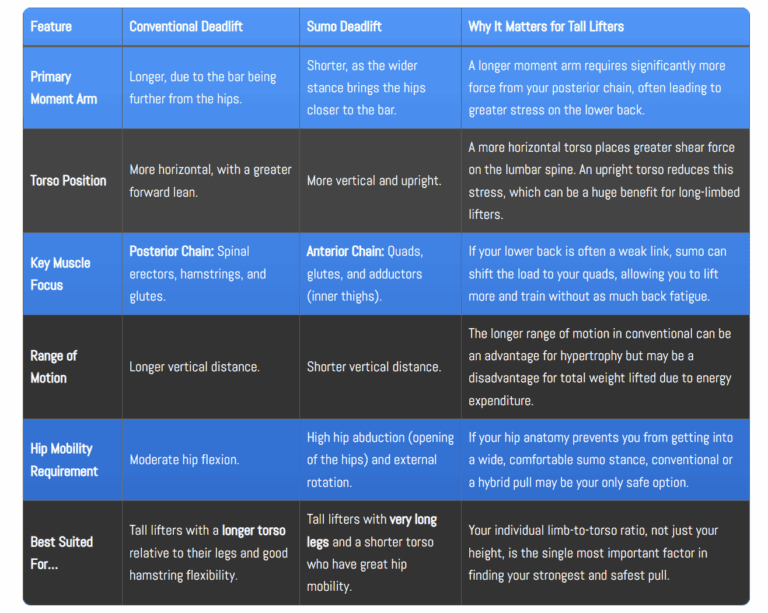
Long arms are an advantage in the deadlift. They reduce the distance the bar must travel. But long femurs create a difficult starting position in conventional deadlifts.
Solutions for tall lifters:
- Try sumo stance. Sumo reduces the distance the hips travel and allows a more upright starting position. It is often a game‑changer for tall lifters.
- Use trap bar if available. The trap bar deadlift puts the lifter in a more neutral position and reduces stress on the lower back.
- Pull from blocks or deficits strategically. Deficit deadlifts build strength through a longer range of motion. Block pulls reinforce lockout strength.
- Strengthen the posterior chain relentlessly. Glutes and hamstrings are the engine. For tall lifters, they need extra attention.
For technique breakdowns, see our deadlift form guide, sumo deadlift benefits, and trap bar deadlift guide. For accessory work, see Romanian deadlift guide and single‑leg RDL guide.
Press & Bench: Manage the Range of Motion
Long arms make pressing movements more demanding. The bar travels farther, and the leverage disadvantage is significant.
Solutions for tall lifters:
- Bench press: Use a wider grip. This reduces the distance the bar must travel. Stay within competition legal limits if competing, but widen your grip for training.
- Bench press: Arch your back. A well‑developed arch reduces the range of motion and protects the shoulders.
- Overhead press: Avoid excessive layback. Tall lifters are prone to lumbar extension. Keep the core braced and use leg drive sparingly.
- Incorporate incline and dumbbell variations. These variations reduce joint stress while building pressing strength.
For technique, see our bench press guide, overhead press guide, and dumbbell bench press guide. For shoulder health, see shoulder exercise list and correcting rounded shoulders from benching.
“Tall lifters need to stop trying to fit into the same mold as shorter lifters. Your leverage is different. Your technique should be different. The goal is not to copy—it is to optimize.”
Charles Damiano, B.S. Clinical Nutrition
Recovery Considerations: Longer Limbs Mean More Systemic Fatigue
Every rep demands more from a tall lifter. The total work per set is higher. This means fatigue accumulates faster. Recovery is not optional. It is the foundation.
Key recovery strategies:
- Manage volume carefully. Tall lifters often need fewer working sets to achieve the same stimulus. More is not better.
- Prioritize sleep. This is where the nervous system recovers. Without it, performance degrades and injury risk rises.
- Use active recovery. Light movement, mobility work, and blood flow help clear fatigue without adding stress.
- Address joint stress proactively. Long limbs put more torque on hips, knees, and shoulders. Joint health work pays dividends.
For recovery protocols, see our sleep optimization guide, active recovery exercises, and joint stability exercises. For mobility specific to tall lifters, see hip flexor stretch guide and thoracic mobilization guide.
Final Verdict: Leverage Your Leverage
Tall lifters have a different path to strength. It is not harder. It is different. The barbell does not care about excuses. But it does respond to smart programming.
The tall lifter blueprint:
- Accept the mechanical reality. Your technique will look different. That is fine.
- Use variations that fit your anatomy. Sumo deadlift. Low‑bar squat. Wide‑grip bench. These are tools, not compromises.
- Manage volume like it matters. Because it does. Fewer hard sets, more recovery.
- Build your posterior chain. Glutes and hamstrings are the foundation for tall lifters.
- Stay consistent. The tall lifter path takes longer to show results. But the ceiling is just as high.
For program structure, see our best workout routines for men, full‑body vs. split routines, and periodization training guide. For mindset strategies, see the iron mindset and why most men’s workouts fail.
The Bottom Line: Different, Not Disadvantaged.
Your height is not a limitation. It is a variable. Learn the mechanics. Choose the right variations. Manage fatigue. And let your leverage work for you, not against you.
*Verified 2026 training protocols for tall lifters.
The Supplement Lexicon: Tall Lifter Edition
- Moment Arm
- The perpendicular distance between a joint axis and the line of force acting on it. Longer limbs create longer moment arms, increasing joint torque and mechanical disadvantage.
- Sumo Deadlift
- A deadlift variation with a wider stance and arms inside the legs. It reduces the distance the hips must travel, often benefiting lifters with long femurs.
- Low‑Bar Squat
- A squat variation where the bar rests lower on the back, between the rear delts and the spine of the scapula. It reduces the moment arm between the hips and the bar, making the lift more efficient for long‑limbed lifters.
- Range of Motion (ROM)
- The distance a joint or body part travels during a movement. Taller lifters have longer ROMs on most lifts, which increases total work per rep.
- Systemic Fatigue
- Cumulative fatigue that affects the entire body rather than a specific muscle group. Tall lifters often experience higher systemic fatigue due to greater total work per session.
- Torque
- A force that produces rotation around an axis. In lifting, longer limbs create more torque on joints, requiring greater muscular force to overcome the lever disadvantage.