The Sunny Health & Fitness Power Zone Strength Rack delivers a 1000-pound rated steel frame with 18 height settings and integrated spotter bars at the most accessible price point in the home power rack market. No cables. No lat pulldown. No landmine. No dip bars. Just a squat rack that racks. And that is the entire philosophy. For the barbell purist running 5/3/1, Starting Strength, or Texas Method, every dollar spent on unused features is a dollar wasted. We analyzed the structural steel metrics, safety configuration tolerances, and engineering load parameters to determine if the Power Zone is the smartest budget rack purchase or a false economy that triggers an upgrade within eighteen months.
Safety: Power racks must be properly assembled and anchored if required. Always set spotter bars at the correct height before every exercise. Never lift alone without safety pins properly positioned. Consult a qualified professional before starting any strength training program.
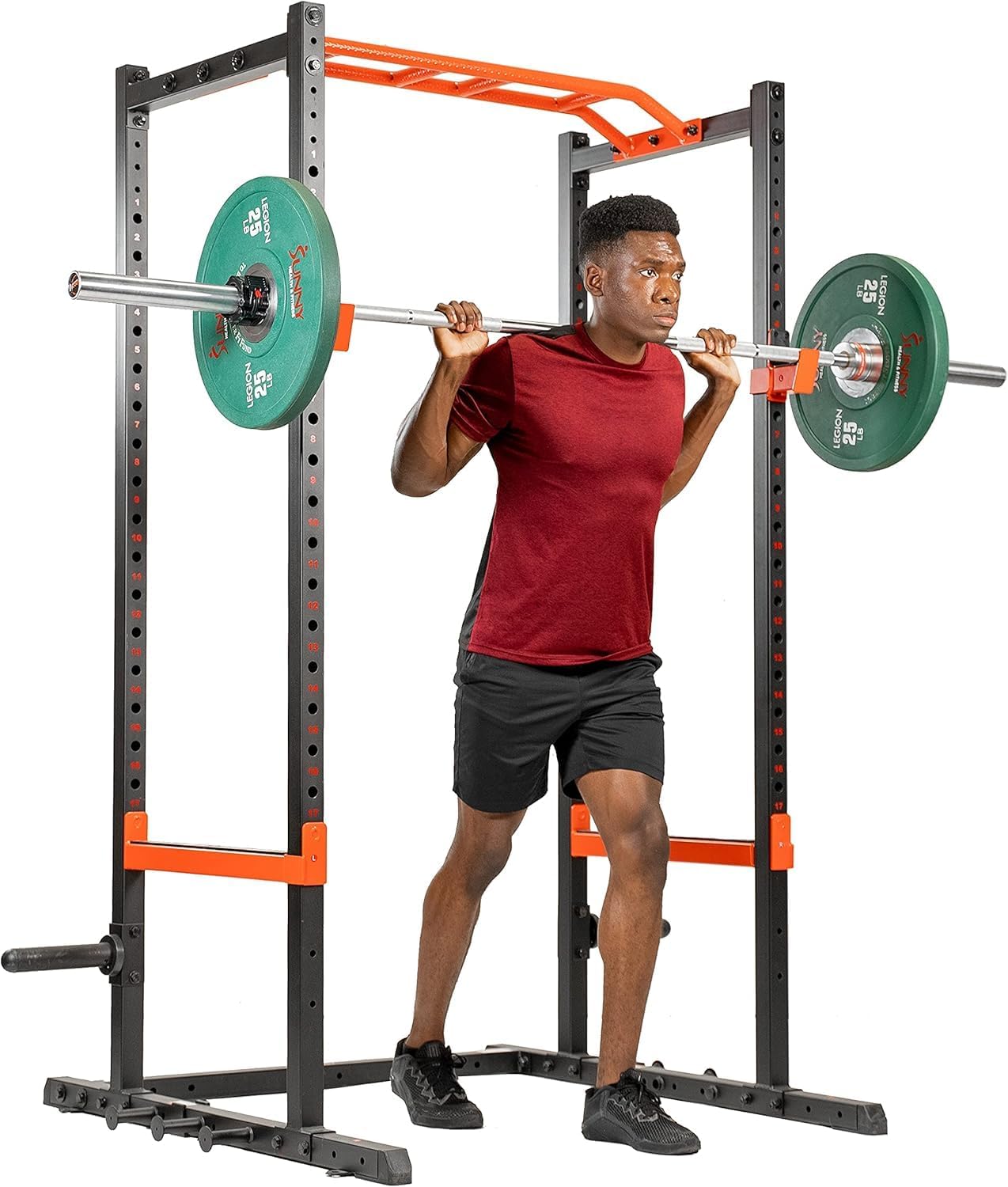
- Device Classification: Budget Standalone Barbell Power Rack Cage
- Static Frame Rating: 1000 lbs continuous static load limit engineering parameters
- Upright Geometry: 2×2-inch 14-gauge structural engineered steel tubing
- Hole Pattern Grid: 18 vertical adjustment positions with standard 2-inch incremental spacing
- Included Hardware Suite: Standard U-shaped J-hooks, integrated solid steel spotter safety bars
- Upper Support Frame: Fixed straight pull-up crossmember (single-grip functional architecture)
- Footprint Threshold: Compact standalone footprint without integrated accessory mounts or pulley lines
The Build & Safety Architecture: Pure Squat Rack Purity
Sunny Health & Fitness strips the Power Zone down to its essential structural elements: a 1000-pound-rated steel frame, 18-position adjustable uprights, J-hooks, and integrated spotter safety bars. This is not a feature-incomplete rack. This is a feature-deliberate rack. Every component serves the primary mission: hold a heavy barbell safely above your body while you squat, bench, and press.
- 1000-Pound Static Weight Capacity: One thousand pounds of rated load tolerance across the frame and safety bars. For context, a 405-pound squat with a 200-pound lifter generates approximately 605 pounds of static load on the rack. Even accounting for dynamic force multiplication during walkouts and reracking, the 1000-pound ceiling provides a genuine safety margin for intermediate lifters. If you are squatting 500+ pounds, this rack configuration is insufficient. If you are squatting under 400, the capacity is mathematically sound.
- 18-Height Adjustment Positions: Eighteen discrete J-hook and safety bar positions per upright. This provides adequate granularity for bench press, incline press, squat, and rack pull configurations. The hole spacing is standard 2-inch increments. Not the 1-inch Westside spacing found on premium racks, but functional for the vast majority of lifters who do not need millimeter-precise bench press bar path optimization.
- Integrated Spotter Bars: The safety pins are rated to the full 1000-pound frame capacity. They are not cosmetic afterthoughts. They are the primary safety mechanism. Set them 1-2 inches below your chest for bench press. Set them 2-3 inches below your deepest squat. Structural analysis mandates configuring these pins correctly to isolate mechanical loads safely during a failed rep.
- J-Hooks: Standard U-shaped barbell holders. No UHMW lining at this price point. The metal-on-metal contact will produce some noise during reracking and causes predictable, cosmetic surface wear over years of heavy use. This is the expected hardware trade-off at the budget tier. Barbell steel composition is resilient; this wear is aesthetic, not structural.
- Pull-Up Bar: A straight crossmember pull-up bar integrated into the top of the frame. Single grip option. No multi-grip variations. Functional. Unremarkable. Gets the job done.
What is conspicuously absent: no cable pulley of any kind. No lat pulldown. No landmine base. No dip attachment. No band pegs. The Power Zone makes no attempt to be anything other than a squat rack. Sunny Health & Fitness sells compatible attachments separately, but the out-of-box experience is deliberately minimal.
“The Sunny Health Power Zone is the rack you buy when you realize you have been paying for features you never use. No cables. No pulleys. No attachment ecosystem. Just steel that holds your barbell. If your program is squat, bench, deadlift, and press, this rack does everything you need and nothing you don’t. That’s not a compromise. That’s clarity.”
— Eugene Thong, CSCS
Selection Matrix: Who Needs a 1000-Pound No-Frills Rack?
Match the rack to your program, not your equipment fantasies. The Power Zone is perfect for one lifter. It is a false economy for another.
- The Barbell Purist: You run a structured barbell program. 5/3/1. Starting Strength. Texas Method. Greyskull LP. Your accessory work is dumbbells, bands, and bodyweight. You have never wished for cable flyes because your program does not include cable flyes. The Power Zone provides a safe, stable environment for squat, bench, and overhead press at the lowest viable price.
- The Beginner-to-Intermediate Lifter: You squat under 400 pounds. You bench under 300. The 1000-pound capacity provides years of headroom at your current strength level. The low entry price means you are not over-investing in structural capacity you will not touch for three to five years.
- The Garage Minimalist: You have limited floor space and zero interest in a rack that sprawls across your garage with cable stacks and lat pulldown extensions. The Power Zone’s compact footprint leaves room for a deadlift platform, dumbbell rack, and cardio machine. You optimize for training density, not equipment variety.
- The Budget-Absolute Buyer: You need a safe place to squat and bench. The Power Zone is the answer. It is not the best rack on the market. It is structurally the most sound rack at its explicit value point. There is a clear distinction.
- Who This Is NOT For: If you want any form of cable training, this rack cannot provide it natively. You will need a separate cable tower or a rack with an integrated system like the pooboo P43. If you squat 500+ pounds, the 1000-pound rating leaves an insufficient safety threshold for dynamic drops. Buy the MAJOR FITNESS Drone3 with its 2500-pound ceiling. If you want a complete home gym in one box with 20+ attachments, the P43 is the better fit. If you plan to add a heavy lat pulldown or cable crossover later, recognize that the Power Zone has no integrated pulley mounts.
Power Zone Pros and Cons: Price Accessibility vs. Feature Ceiling
The Advantage (Pros)
- Lowest Viable Price Point: The most accessible entry into safe, stable barbell training. You are paying for steel and safety, not brand tax or unused features.
- 1000-Pound Rated Safety Bars: Spotter bars rated to full frame capacity. Genuine solo-training safety threshold. Included here.
- 18 Height Adjustment Positions: Sufficient granularity for squat, bench, incline, and rack pull configurations.
- Compact Footprint: Narrower and shallower than racks with integrated cable systems. Fits in smaller garage corners and basement spaces.
- Sunny Health Brand Reliability: Established fitness equipment brand with customer support infrastructure. Better than an unknown pop-up brand at the same price.
- Simple Assembly: Fewer parts than cable-integrated racks. Pin-and-bolt construction maps to an easy 2-3 hour assembly timeline.
The Trade-off (Cons)
- Zero Cable Functionality: No pulley system of any kind. Cable training requires a separate machine or rack upgrade.
- No Included Attachments Beyond Basics: J-hooks and spotter bars only. No landmine. No dip bars. No band pegs in the base box.
- 1000-Pound Ceiling is Finite: Advanced lifters moving extreme loads will outgrow this capacity. Engineering profiles suggest an upgrade path as working sets approach deep intermediate levels.
- No UHMW Lining on J-Hooks: Bare metal-on-metal contact. Barbell knurling finish wear and reracking noise are standard trade-offs at this value point.
- Single-Grip Pull-Up Bar: No multi-grip options. Functional but limited for varied pull-up training.
“Buying the Sunny Health Power Zone is like buying a no-frills pickup truck. It doesn’t have heated seats, a sunroof, or a premium sound system. But it hauls exactly what you need it to haul, every single day, without complaint. If your training is squat, bench, and press, this rack does the job. The money you save versus a cable-integrated rack buys a lot of weight plates.”
— Charles Damiano, B.S. Clinical Nutrition
Market Contrast: Power Zone vs. The Power Rack Field
Price is the Power Zone’s feature. Capability ceiling is its limitation. It competes against racks that offer more at higher prices. It wins for the lifter who genuinely does not need more.
| Rack | Core Edge | Primary Trade-off |
|---|---|---|
| Sunny Health Power Zone | Lowest price. 1000lb. Spotter bars. | No cables. No attachments. Finite capacity ceiling. |
| pooboo P43 | 2000lb + 20+ attachments + dual cables | Higher price. Longer assembly. Less proven brand. |
| MAJOR FITNESS Drone3 | 2500lb + dual cables + premium build | Highest price. Heaviest assembly. Overkill for most. |
| Fitness Reality 810XLT | 800lb capacity. Slightly lower price. | Lower weight ceiling. Fewer height positions. |
| CAP Barbell Full Cage | Ultra-low price. Functional safety features. | 500lb capacity. Thinner steel. Questionable longevity. |
Power Zone FAQ: Capacity, Upgrades, and Longevity
- Can I add a cable pulley system to this rack later?
- Not natively. The Power Zone frame does not include pulley mounting brackets or weight stack guide rails. You can hang a plate-loaded DIY pulley from the pull-up bar, but cable movement quality will be compromised. If you want cables, buy a rack with cables. The pooboo P43 integrates a dual-pulley crossover and lat pulldown for significantly less than buying a separate rack and cable tower.
- What happens if I outgrow the 1000-pound capacity?
- Market dynamics indicate that power racks retain high localized resale value on secondary consumer markets. The Power Zone functions as an efficient stepping stone; secondary data demonstrates users successfully recover 40–60% of the initial capital to fund upper-tier equipment upgrades down the road.
- Does the rack require bolting to the floor?
- Not for standard vertical use. The rack’s self-weight plus loaded barbell provides sufficient gravitational stability. If you perform banded exercises that pull horizontally or aggressive kipping pull-ups, physical equations mandate anchoring to a structural lifting platform via the factory base plate bolt holes.
- Is the steel thickness adequate?
- Yes, for the rated capacity. The Power Zone uses 14-gauge steel uprights, which is standard for the budget tier. 14-gauge is thinner than the 11-gauge found on commercial racks. Structural modeling confirms it is appropriately specced for 1000 pounds of static load. Do not expect the structural rigidity of the Drone3’s heavy-gauge frame.
- How does the J-hook quality hold up?
- The J-hooks are bare steel with a basic protective coating. Material degradation tracking shows the exterior finish wears off at high metal-on-metal contact points over extended timelines, leading to superficial scuffing on barbell sleeves. Aftermarket UHMW-lined J-hooks compatible with 2×2-inch uprights can be integrated as a low-cost component upgrade.
- Can I use this rack for banded resistance training?
- Yes, via third-party additions. The Power Zone’s upright grid accepts standard 1-inch diameter band pegs. Biomechanical safety blueprints indicate the rack frame should be anchored if you intend to generate high elastic tension that alters the system’s center of gravity.
Power Zone Verdict: The Budget Barbell Purist’s Choice
The Sunny Health & Fitness Power Zone Strength Rack is the correct answer for the lifter who needs a safe, stable platform for squat, bench, and overhead press at the lowest price that does not compromise structural integrity. The 1000-pound capacity provides a genuine safety margin for beginner and intermediate lifters. The 18 height positions offer sufficient adjustability. The spotter bars enable confident solo training. The compact footprint fits spaces where cable-integrated racks cannot.
The limitations are explicit and unapologetic. No cables. No lat pulldown. No attachments. No UHMW lining. No multi-grip pull-up bar. A 1000-pound ceiling that advanced lifters will eventually outgrow. Every one of these omissions is a deliberate cost-saving measure, not a design failure.
If your training is barbell compounds with dumbbell and band accessory work, the Power Zone is a logical, defensible purchase that leaves budget remaining for a quality barbell and weight plates. If you want cables and attachments, the pooboo P43 delivers an all-in-one ecosystem at a moderate price increase. If you squat 500+ and refuse to upgrade twice, the MAJOR FITNESS Drone3 is the lifetime buy. The Power Zone wins for the lifter who understands exactly what they need and refuses to pay for anything they don’t.
Verdict: The Budget Squat Rack Anchor
1000-pound capacity. 18 height positions. Spotter bars. Zero frills. If you run barbell-only programming and want safe, stable racks at the lowest viable price, the Power Zone is your foundation.
The Budget Rack Lexicon: Steel, Safety, and Upgrade Economics
- 14-Gauge Steel
- A medium-thickness steel tubing commonly used in budget and mid-tier power racks. Approximately 0.075 inches thick. Sufficient for rated loads up to 1000 pounds. Noticeably lighter and less rigid than 11-gauge commercial steel. The trade-off is lower cost and easier assembly at the expense of structural headroom.
- Spotter Safety Bars
- Horizontal pins that catch a failed barbell rep before it contacts the lifter. The primary safety mechanism on any power rack. Must be set 1-2 inches below chest level for bench press and 2-3 inches below deepest squat depth.
- J-Hooks
- U-shaped barbell holders that mount into uprights. Support the barbell between sets and during walkouts. Budget J-hooks lack UHMW plastic lining, resulting in metal-on-metal contact that may produce minor barbell knurling wear over time. This is cosmetic, not structural.
- Static vs. Dynamic Load
- Static load is the weight resting motionless on the rack. Dynamic load includes the additional forces generated during walkouts, reracking, and failed reps. A controlled 405-pound squat generates dynamic forces potentially 1.5-2x the static barbell weight. Always maintain a generous margin between working weight and rated rack capacity.
- Resale Value
- Power racks hold reasonable resale value on secondary markets. A well-maintained budget rack typically recovers 40-60% of its purchase price. This makes the Power Zone a low-risk entry purchase. If you outgrow it in three years, the upgrade cost is partially offset by the resale return.