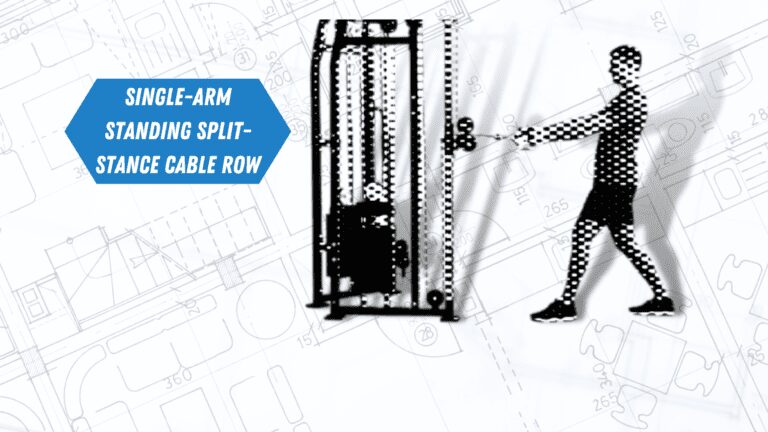
The Single-Arm Standing Cable Row is the ultimate test of “functional” back strength because it removes the bench support. While seated rows allow you to lazy-boy your way through a set, this movement forces your entire kinetic chain to stabilize the load.
Most lifters have strong lats but a weak connection between their back and their hips. This disconnect leads to injury. This exercise fixes that. It creates an “anti-rotation” demand—the weight tries to twist your torso, and your core must fight to stay square. This builds a V-taper that isn’t just for show; it’s capable of generating force while standing on two feet. Stop sitting down. Stand up and pull.

Important: Do not use momentum. If you have to twist your torso to start the pull, the weight is too heavy. The goal is to keep the shoulders square, not to simulate a lawnmower.
Why Standing Cable Rows Beat Dumbbell Rows
Dumbbells rely on gravity (downward force); cables provide a horizontal force vector that matches the function of the latissimus dorsi. This keeps constant tension on the muscle through the full range of motion.
The Benefits at a Glance
| Advantage | The Payoff |
|---|---|
| Anti-Rotation | Forces the obliques and transverse abdominis to resist twisting. |
| Constant Tension | Unlike free weights, the cable pulls you forward at the stretch, maximizing hypertrophy. |
| Symmetry | Working one arm at a time exposes and fixes strength imbalances. |
How to Perform Standing Cable Rows Correctly
You must be a statue; only the arm moves. Establish a wide base, lock your ribcage down, and own the position.
Step-by-Step Execution
- The Setup: Set the cable to chest height (or slightly lower). Attach a D-handle.
- The Stance: Athletic stance (feet shoulder-width) or split stance (opposite leg forward) for balance. Knees bent.
- The Brace: Exhale. Pull ribs down. Squeeze the glutes. You are now anchored.
- The Reach: Let the cable pull your arm forward. Feel the lat stretch around the ribcage. Do not rotate the torso.
- The Pull: Drive the elbow back towards the hip. Think “elbow to pocket.”
- The Squeeze: Pause at the back. Do not shrug the shoulder. Keep it low.
“Imagine there are headlights on your chest and hips. They must shine straight ahead the entire time. If the beams move side to side, you are cheating the core component.”
— Eugene Thong, CSCS
Common Mistakes That Kill Back Gains
Most people turn this into a rotational exercise; don’t do that. If you twist, you are letting the core off the hook.
- The Lawnmower: Yanking the torso back to move the weight. Fix: Drop the weight. Isolate the lat.
- The Shrug: Shoulders creeping up to ears. Fix: Depress the scapula. Keep the neck long.
- Short Range: Not letting the arm fully extend. Fix: The stretch is the most anabolic part. Reach forward.
Programming & Optimization
This is an accessory movement best used for volume and connection. It fits perfectly after heavy deadlifts or rows.
Sample Protocol
| Goal | Sets/Reps | Context |
|---|---|---|
| Hypertrophy | 3 x 12-15 | Slow tempo (3 sec negative). |
| Core Stability | 4 x 10 | Heavier load. Square stance. |
Performance Stack
The back is a massive muscle group requiring blood flow and recovery support.
- The Pump: To feel the lat, you need blood. Nutricost Nitric Oxide Booster enhances vascularity and mind-muscle connection.
- Joint Health: Shoulders are vulnerable. Protect them with Collagen and Fish Oil to keep inflammation low.
- Tissue Recovery: Lats get tight. Use a Hypervolt Go 2 to release the fascia under the armpit.
- Cellular Health: Older lifters need mitochondrial support. NAD+ Cell Regenerator helps maintain endurance.
Tech Alternative
No cable machine? Smart gyms are superior for this movement.
Digital weights allow for “eccentric overload” modes that cables cannot match. Compare Speediance vs Tonal vs Vitruvian or read our guide on best smart home gyms to find the right setup.
The Verdict
The Single-Arm Standing Cable Row is the bridge between aesthetic muscle and functional strength. It builds a back that looks good and a core that actually works. Square up, brace hard, and pull.