You’ve seen them on every playground bar, in every gritty gym corner, and as the ultimate litmus test in every Special Forces selection—pullups, the upper-body rite of passage that separates the physically competent from the truly formidable. A single, strict rep weaves a tapestry of muscle across your lats, biceps, and forearms, forging a back that ripples with purpose under a t-shirt. But why do most people stall at three shaky reps? And more critically—how do you construct an unassailable pyramid of strength from the ground up?
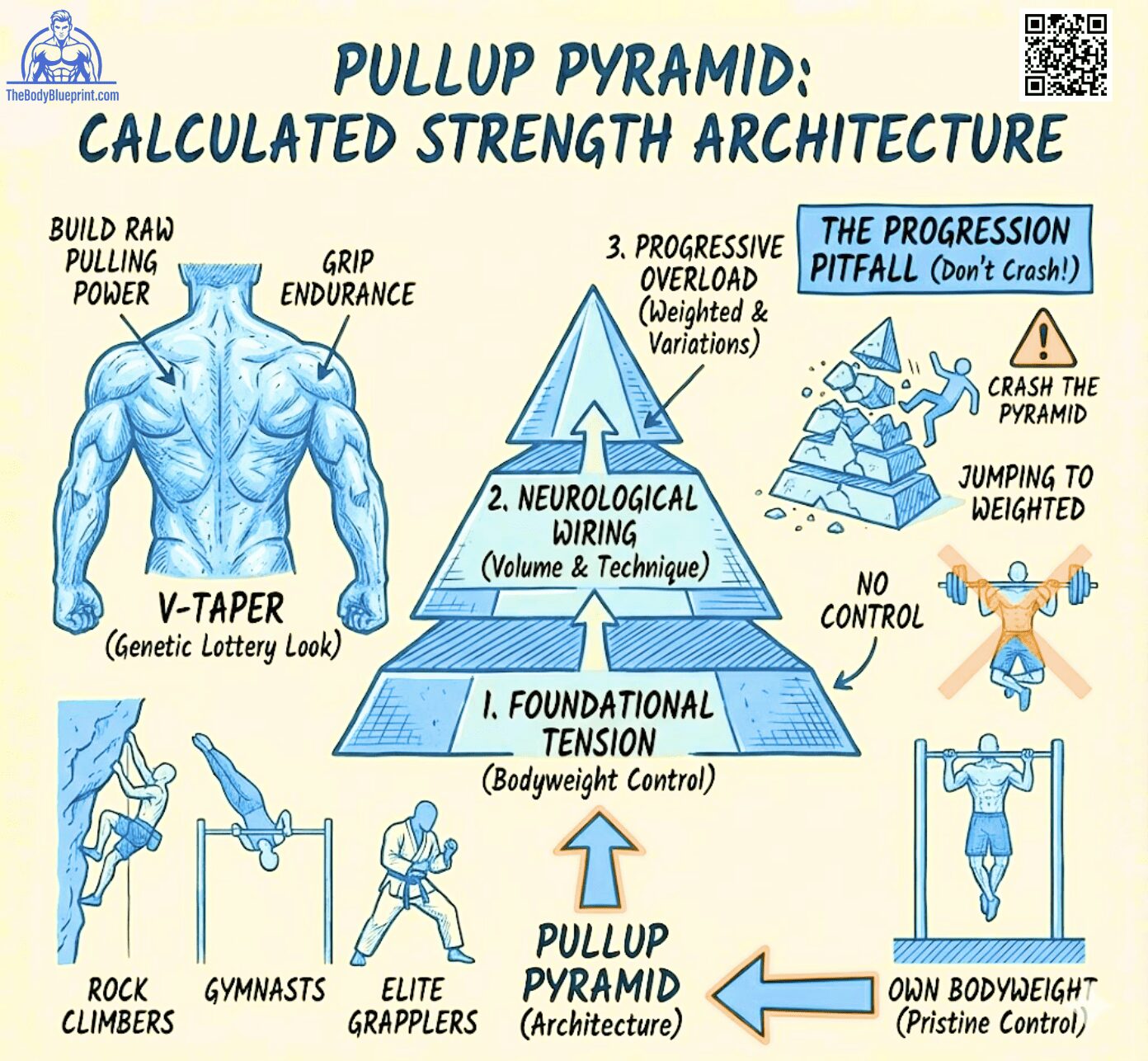
The Pullup Pyramid isn’t about kipping for volume; it’s a deliberate architecture of strength, layering foundational tension, neurological wiring, and progressive overload into an unshakeable structure. It’s used by rock climbers, gymnasts, and elite grapplers because it builds raw pulling power, grip endurance, and a V-taper that screams genetic lottery. But most lifters crash the pyramid—attempting weighted reps before they can own their own bodyweight with pristine control.
Let’s deconstruct the ego and rebuild with stone and mortar: the foundational form, the systematic progression, and the programming that turns a weak link into your greatest asset.
The Foundational Pullup: Own the Movement Pattern
- Grip the Bar: Hands just outside shoulder-width, pronated (overhand). Squeeze as if crushing the bar.
- Create Full-Body Tension: Hang with shoulders down, chest up, core braced, legs slightly forward (hollow body).
- Initiate with the Lats: Pull elbows down and back, imagining bending the bar around your chest.
- Touch the Bar to Your Chest: Drive upward until the bar touches your upper chest or collarbone.
- Control the Descent: Lower with the same intent, fighting gravity for 2-3 seconds to the dead hang.
“A true pullup isn’t an arm exercise. It’s a full posterior chain engagement—from your lats and rhomboids down through your glutes. If your hips are loose, you’re just doing a bicep curl on a bar.” — Eugene Thong, CSCS
Muscles Worked: The Anatomy of a Pull
| Phase | Movement | Prime Movers | Stabilizers & Synergists |
|---|---|---|---|
| Initiation (From Dead Hang) | Scapular depression & retraction | Lower Trapezius, Latissimus Dorsi (Inferior Fibers) | Rhomboids, Teres Major, Infraspinatus, Core |
| Ascent (Elbow Flexion) | Pulling elbows down and back | Latissimus Dorsi, Brachialis, Biceps Brachii | Posterior Deltoids, Trapezius (Mid), Forearm Flexors |
| Top Contraction (Chest to Bar) | Retraction and external rotation | Rhomboids, Middle Trapezius, Teres Major/Minor | Brachioradialis, Rear Delts, Deep Spinal Stabilizers |
| Eccentric (Controlled Descent) | Resisting extension | All prime movers under tension (isometric/eccentric) | Rotator Cuff, Serratus Anterior (for stability), Obliques |
The pullup is the keystone exercise for upper-body structural integrity. It teaches your shoulder blades to move with power and grace, protecting your joints while building a back that looks and functions like a suit of armor.
Who Should (and Shouldn’t) Scale This Pyramid?
Built for This:
✔ The Aspiring Athlete—foundation for all explosive power.
✔ The Desk-Bound Professional—corrects kyphosis and builds posture.
✔ The Strength Purist—seeks the ultimate bodyweight strength credential.
✔ The Aesthetic Seeker—crafts the coveted V-taper and thick rear delts.
Tread Carefully:
✖ Active Shoulder Labrum Tears—requires professional rehab first.
✖ Chronic Elbow Tendinopathy—regress to isometrics and rows.
✖ Those Unwilling to Regress—ego is the sand that crumbles the pyramid’s base.
The Pullup Pyramid: Your Progression Blueprint
This is not a random assortment of exercises. It is a deliberately sequenced pyramid. Master each level—achieving 3 clean sets of 5-8 reps—before placing the next stone. There are no shortcuts, only structural integrity.
| Pyramid Level | Variation/Modification | The Setup & Execution | Strength Focus & Benchmark |
|---|---|---|---|
| Level 1: Foundation | Scapular Pullups (Dead Hang Activation) | From passive hang, depress and retract shoulder blades only. Do not bend elbows. | Neuromuscular control. Benchmark: 3×10-12 crisp reps. |
| Level 2: Assisted | Band-Assisted or Foot-Assisted Pullups | Use a heavy resistance band or place feet on a box to offset 30-50% of bodyweight. | Full range of motion patterning. Benchmark: 3×8 with minimal assistance. |
| Level 3: Negative | Eccentric-Focused Pullups | Jump or use a box to achieve the top position. Lower with brutal control for 5-10 seconds. | Eccentric strength and tendon resilience. Benchmark: 3×5 with 5-second negatives. |
| Level 4: Standard | The Strict Pronated Pullup | The full movement as described above: chest to bar, full control. | Absolute strength standard. Benchmark: 3×5-8 perfect reps. |
| Level 5: Volume | Bodyweight Accumulation | Increase total weekly reps. Use ladders (1,2,3,4,5) or density blocks (AMRAP in 10 min). | Work capacity and muscular endurance. Benchmark: 50+ total reps in a session. |
| Level 6: Grip Variation | Chin-Ups, Neutral-Grip, Wide-Grip | Vary hand position to emphasize biceps (chin-up), shoulders (neutral), or lat width (wide). | Comprehensive muscle development. Benchmark: 3×5-8 in each major grip. |
| Level 7: Density | Cluster Sets & L-Sit Pullups | Perform reps in clusters (e.g., 5x[2,2,2] with 10s rest) or with legs raised to 90 degrees. | Strength under fatigue and core integration. Benchmark: 15 reps in 5 minutes (L-Sit). |
| Level 8: Loaded | Weighted Pullups | Add external load via dip belt, vest, or dumbbell between feet. Maintain perfect form. | Maximal strength. Benchmark: 3×3-5 with +25% bodyweight. |
| Level 9: Asymmetric | Archer & Typewriter Pullups | Wide grip, shift horizontally; Archer: one arm straight, other does the work. | Unilateral strength and connective tissue prep. Benchmark: 3×3 per side (Archer). |
| Level 10: Mastery | One-Arm Progression (Assisted) | Use a band or hold the wrist of the inactive arm. Progress to lowering assistance. | The ultimate bodyweight pulling achievement. Benchmark: 1×1-3 per side with minimal aid. |
The Two Structural Flaws That Collapse Progress
❌ Incomplete Range of Motion: Partial reps build partial strength and guarantee a partial physique.
❌ Using Momentum as a Crutch: Kipping is a skilled variation, not a progression cheat code for strict strength.
“People chase the weighted pullup while their bodyweight rep looks like a dying fish. Mastery is not about what you can lift, but how you lift it. Control the movement, and the muscles will have no choice but to grow.” — Charles Damiano, B.S. Clinical Nutrition
Programming Your Ascent For Monumental Gains
For the Foundation Builder (Levels 1-3):
- Frequency: 3-4x weekly. Grease the groove with submaximal sets.
- Structure: 5-8 sets of 1-3 reps (80% of max) throughout the day, focusing on quality.
- Rule: Never train to failure. You’re building a skill, not testing it.
For the Strength Seeker (Levels 4-7):
- Frequency: 2-3x weekly, as a primary movement.
- Structure: Use a weekly wave. Day 1: Heavy (5×3). Day 2: Volume (4×8). Day 3: Density (EMOM 10 min).
- Rule:** Pair with heavy horizontal rows. Your back can handle—and needs—the volume.
For the Mastery Chaser (Levels 8-10):
- Frequency: 1-2x weekly, as a peak performance skill.
- Structure: Low reps, high intensity. Use rest-pause (e.g., 1xMax, rest 20s, repeat for 3 clusters).
- Rule: Deload every 4th week. Tendon strength lags behind muscle. Respect the process.
The Structural & Aesthetic Payoff
This pyramid doesn’t just add reps; it architects a new physique and fortifies your frame:
✅ The Cobra’s Hood (Lats): Develops the sweeping wing that defines an athletic silhouette.
✅ Boulder-Shifter Forearms: Grip strength that transfers to every lift and real-world task.
✅ Posture of a King: Pulls rounded shoulders back, opening the chest and standing taller.
✅ Armor-Plated Rotator Cuffs: Resilient shoulders that laugh off bench press and overhead strain.