Life Extension Neuro-Mag lists Magnesium L-Threonate under the Magtein trademark (AIDP Inc.) at 2,000mg per three-capsule serving, with a vegetable cellulose capsule and an excipient panel of microcrystalline cellulose, silica, and vegetable stearate. The active ingredient is the same patented Magtein molecule found in Double Wood and Nutricost. The label differentiators are capsule efficiency, excipient choices, and the Life Extension brand name on the bottle. We pulled the Supplement Facts panel to show exactly what you are buying per capsule — and how the excipient architecture compares to the next Magtein bottle on the shelf.
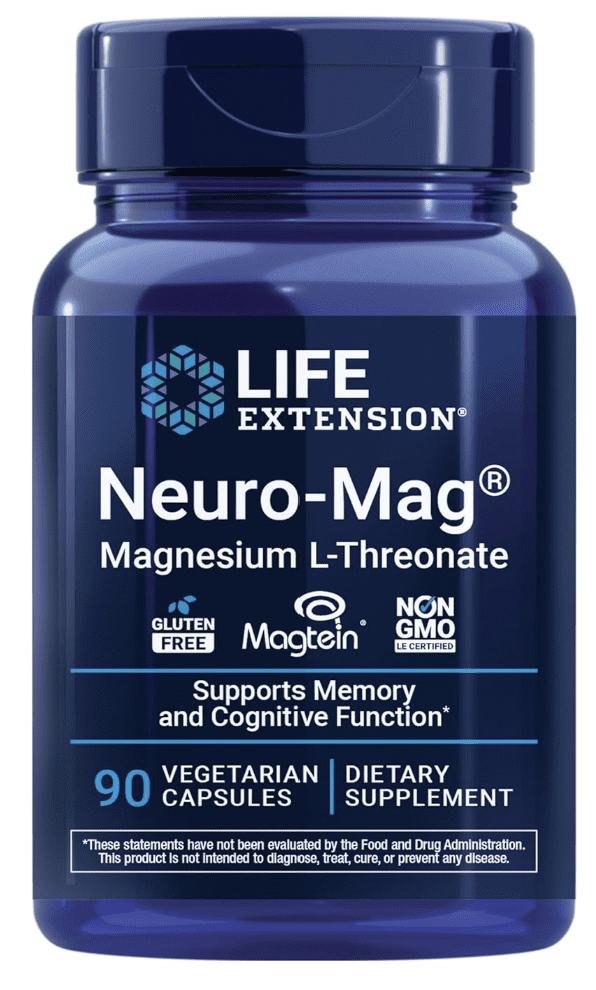
Life Extension Neuro-Mag: The Supplement Facts Panel, Line by Line
Life Extension Neuro-Mag lists Magnesium L-Threonate (as Magtein) at 2,000mg per three-capsule serving on the Supplement Facts panel, with a 90-capsule bottle yielding 30 servings per container. The active ingredient is sourced under the Magtein trademark from AIDP Inc., the U.S. patent holder for this specific magnesium compound. The per-capsule Magtein density is approximately 667mg, the highest among the three major Magtein brands on the market.
| Label Spec | Life Extension Neuro-Mag |
|---|---|
| Active Ingredient | Magnesium L-Threonate (as Magtein) |
| Magtein per Serving | 2,000 mg (3 capsules) |
| Approx. Elemental Mg per Serving | ~144-160 mg (Magtein is ~7-8% elemental magnesium by weight) |
| Magtein per Capsule | ~667 mg (highest per-capsule density among major Magtein brands) |
| Capsules per Serving | 3 |
| Capsules per Bottle | 90 capsules (30 servings) |
| Capsule Material | Vegetable cellulose |
| Excipients | Microcrystalline cellulose, silica, vegetable stearate |
| Magtein Trademark on Label | Yes (prominently displayed) |
| Brand Testing Disclosure | Life Extension quality standards; third-party tested |
| Format Options | Capsules; powder option also available (verify current SKU) |
The 667mg per-capsule Magtein density is the label spec that separates Neuro-Mag from Double Wood and Nutricost, both of which pack approximately 500mg per capsule. Three Neuro-Mag capsules deliver the 2,000mg serving. Four capsules are required from the other two brands to reach the same Magtein total. Same active ingredient. Same 2,000mg per serving. Different capsule count printed on the label.
Life Extension packing 667mg per capsule versus the competition at 500mg is like two gas stations selling the same fuel but one using a larger nozzle. Same octane rating. Same fuel. One pump fills your tank in fewer squeezes. The gasoline is identical. The nozzle diameter printed on the spec sheet is different.
The Excipient Panel: Vegetable Cellulose, Silica, and Vegetable Stearate
Life Extension Neuro-Mag uses a vegetable cellulose capsule shell with an excipient panel listing microcrystalline cellulose as a filler/binder, silica as a flow agent, and vegetable stearate as a lubricant. These are standard supplement manufacturing excipients. The capsule material and flow agent choices differ from the competition.
| Excipient | Life Extension Neuro-Mag | Double Wood Magtein | Nutricost Magtein |
|---|---|---|---|
| Capsule Material | Vegetable cellulose | Hypromellose | Hypromellose |
| Filler / Binder | Microcrystalline cellulose | Microcrystalline cellulose | None listed |
| Flow Agent | Silica | None listed | Silicon dioxide |
| Lubricant | Vegetable stearate | Magnesium stearate | Magnesium stearate |
The excipient panel differences are material choices, not quality indicators. Vegetable cellulose and hypromellose are both plant-derived capsule materials serving the same function. Silica and silicon dioxide are the same compound listed under different naming conventions on Supplement Facts panels. The active ingredient is identical. The excipient packaging around it varies by brand manufacturing preference.
Who Life Extension Neuro-Mag Fits, Based on the Label
Life Extension Neuro-Mag delivers the same Magtein molecule as Double Wood and Nutricost at a higher per-capsule density (667mg vs. 500mg) with a vegetable cellulose capsule and fewer capsules per serving (3 vs. 4). The brand carries decades of supplement formulation history with published quality standards.
- The Capsule-Count Buyer: Neuro-Mag requires three capsules per serving versus four for Double Wood and Nutricost. If swallowing fewer capsules matters to your buying decision, the per-capsule Magtein density on the Neuro-Mag label is the spec differentiator.
- The Brand-Longevity Buyer: Life Extension has been formulating and manufacturing supplements since 1980 with published quality standards and third-party testing disclosures. If the brand name on the bottle is a buying criterion, Life Extension has the longest track record among the three major Magtein brands.
- The Capsule-Material Buyer: Neuro-Mag uses a vegetable cellulose capsule. Double Wood and Nutricost use hypromellose capsules. Both are plant-derived. Both are alternatives to gelatin. Different materials on the ingredient panel serving the same capsule function.
- The Budget Buyer: Neuro-Mag is not the lowest-cost Magtein option. Nutricost leads on cost per gram of Magtein. See the full Magtein brand comparison for cost-per-gram math across all three products. See Nutricost Magtein for the budget-focused alternative.
- Who Should Skip Neuro-Mag: If you need high elemental magnesium intake, Magtein in any brand is the wrong magnesium form. Magnesium L-Threonate yields roughly 144-160mg of elemental magnesium per 2,000mg serving. Magnesium glycinate and magnesium citrate deliver more elemental magnesium per gram. Magtein is a specific patented compound bought for the L-threonate carrier. It is not a general-purpose magnesium supplement.
Life Extension Neuro-Mag: Pros and Cons, from the Supplement Facts Panel
What’s on the Label
- Highest Per-Capsule Magtein Density: ~667mg per capsule versus ~500mg for Double Wood and Nutricost. Three capsules per 2,000mg serving. Fewest capsules of the three major Magtein brands.
- Magtein Trademark Verified: Active ingredient listed as Magnesium L-Threonate (as Magtein). Trademark displayed prominently on the label. Indicates AIDP-sourced raw ingredient.
- Vegetable Cellulose Capsule: Plant-derived capsule material. Alternative to hypromellose and gelatin capsules used by competitors.
- Life Extension Brand Manufacturing: Brand founded in 1980. Published quality standards. Third-party testing disclosure. Longest track record among the three major Magtein supplement brands.
- Multiple Format Options: Capsules available as the primary SKU. Powder format also listed on some retailer pages. Verify current format availability on the live listing.
The Trade-offs
- Higher Cost per Gram: Neuro-Mag costs more per gram of Magtein than Nutricost. The Life Extension brand premium and the higher per-capsule density are the line items that justify the price difference on the spec sheet.
- Low Elemental Magnesium Yield: Magtein is ~7-8% elemental magnesium by weight. A full 2,000mg serving delivers roughly 144-160mg of elemental magnesium. True for all Magtein products. Not unique to Neuro-Mag.
- Standard Excipient Load: Four listed excipients in the other ingredients panel. Nutricost lists two. Double Wood lists three. The Neuro-Mag excipient panel is slightly longer.
- 30 Servings per Bottle: The 90-capsule bottle is a 30-day supply at three capsules per day. Larger bottle counts are available from Double Wood and Nutricost on some SKUs.
Life Extension Neuro-Mag FAQ: Label Specs, Excipients, and Ingredient Verification
- How does the per-capsule Magtein density on Neuro-Mag compare to Double Wood and Nutricost?
- Neuro-Mag lists approximately 667mg of Magtein per capsule. Double Wood and Nutricost list approximately 500mg per capsule. The per-capsule density is roughly 33% higher on the Neuro-Mag label. The total Magtein per serving is identical at 2,000mg. The difference is in how many capsules it takes to get there: three for Neuro-Mag versus four for the competition.
- What capsule material does Life Extension Neuro-Mag use?
- The Supplement Facts panel lists vegetable cellulose as the capsule material. This is a plant-derived alternative to gelatin capsules. Double Wood and Nutricost use hypromellose capsules, which are also plant-derived but listed under a different material name on the ingredient panel.
- Does Life Extension Neuro-Mag list the Magtein trademark on the label?
- Yes. The label displays the Magtein trademark and lists the active ingredient as Magnesium L-Threonate (as Magtein). The trademark indicates the raw ingredient is sourced from AIDP Inc., the U.S. patent holder for this specific Magnesium L-Threonate compound.
- What is the elemental magnesium content in one serving of Neuro-Mag?
- Magtein (Magnesium L-Threonate) is approximately 7-8% elemental magnesium by weight. A 2,000mg serving yields roughly 144-160mg of elemental magnesium. Compare to magnesium glycinate at roughly 14-18% elemental magnesium by weight. Magtein is not purchased for high elemental magnesium content.
- Is there a powder version of Life Extension Neuro-Mag available?
- Life Extension has listed a powder format of Neuro-Mag on some retailer pages. Capsules remain the primary SKU. Verify current format availability on the live listing. The Supplement Facts panel on a powder SKU will differ from the capsule panel in excipients and serving format.
Life Extension Neuro-Mag Final Verdict: Capsule Efficiency and Brand Equity
Life Extension Neuro-Mag contains the same patented Magtein molecule as Double Wood and Nutricost, differentiated by per-capsule density (667mg vs. 500mg), vegetable cellulose capsule material, a four-ingredient excipient panel, and the Life Extension brand name on the bottle. Three capsules per serving versus four. The active ingredient is identical. The brand has been manufacturing supplements since 1980. Neuro-Mag is not the cheapest Magtein product on the shelf. It is the Magtein product with the highest per-capsule density and the longest brand track record behind it.
Verdict: Three Capsules, Not Four. Same Magtein Molecule.
667mg of Magtein per capsule. Vegetable cellulose shell. Life Extension brand manufacturing since 1980. The active ingredient is the same as every other Magtein product. The capsule math and the brand name are what you pay for.
*Prices, capsule counts, and formulations subject to change. Verify the Supplement Facts panel on the live listing before purchase. Statements have not been evaluated by the FDA. These products are not intended to diagnose, treat, cure, or prevent any disease.
The Neuro-Mag Label Lexicon: Terms on the Supplement Facts Panel
- Magnesium L-Threonate (Magtein)
- A patented magnesium compound consisting of magnesium bound to L-threonic acid, a vitamin C metabolite. Listed on the Neuro-Mag Supplement Facts panel under the Magtein trademark from AIDP Inc. Roughly 7-8% elemental magnesium by weight. The remaining 92-93% is the L-threonate carrier molecule.
- Vegetable Cellulose
- A plant-derived capsule material listed in the other ingredients section of the Neuro-Mag label. Used by Life Extension as an alternative to gelatin and hypromellose capsules. Functionally equivalent to hypromellose as a capsule delivery format.
- Microcrystalline Cellulose
- A plant-derived excipient listed on the Neuro-Mag label as a filler and binder. Inert. Non-caloric. Used to give the capsule contents physical structure during manufacturing.
- Silica (Silicon Dioxide)
- A flow agent listed on the Neuro-Mag label to prevent powder clumping during the encapsulation process. Listed as “silica” on Life Extension labels and as “silicon dioxide” on Nutricost labels. Same compound. Different naming convention on the ingredient panel.
- Vegetable Stearate
- A plant-derived lubricant listed on the Neuro-Mag label. Used to prevent the powder from sticking to manufacturing equipment during encapsulation. Double Wood and Nutricost use magnesium stearate for the same function. Different compound on the ingredient panel. Same manufacturing purpose.
- Life Extension
- A supplement manufacturer founded in 1980 with published quality standards and third-party testing disclosures. The brand name on the Neuro-Mag bottle. Not a certification mark. A manufacturer designation with decades of formulation history behind it.
Keep Reading: Magtein & Supplement Label Spec Comparisons
- Magtein Brand Comparison: Life Extension vs. Double Wood vs. Nutricost — the full three-brand head-to-head on Magtein per capsule, excipient panels, and cost per gram.
- Double Wood Magtein Review — the Supplements Facts panel breakdown for the Double Wood Magtein SKU.
- Nutricost Magtein Review — complete ingredient panel and cost-per-gram analysis for Nutricost Magtein.
- What Is Magnesium L-Threonate? — the structural breakdown of the Magtein molecule and the AIDP patent.
- Sports Research D3 + K2 Review — a common stacking partner across magnesium supplementation protocols.