For dedicated men focused on body composition, the core dilemma is this: how do you shed fat without sacrificing the hard-earned muscle underneath? Two dominant nutritional strategies, intermittent fasting and the ketogenic diet, promise exactly that. This analysis cuts through the hype to examine the nuanced science of intermittent fasting vs keto for muscle preservation, providing a clear framework for choosing the right tool for your physique goals.
The Foundation: What is Muscle Preservation, Really?
Before we pit these diets against each other, let’s define the mission. Muscle preservation isn’t just about avoiding the scale weight of “muscle loss.” It’s the active, metabolic process of maintaining your body’s prime engine for strength, metabolism, and vitality. It boils down to one critical biological balance: Muscle Protein Synthesis (MPS) vs. Muscle Protein Breakdown (MPB).
Your goal is to keep MPS higher than MPB. This is governed by three non-negotiable pillars:
- Adequate Protein Intake: The raw building blocks for repair and growth.
- Progressive Resistance Training: The essential signal that tells your body to keep the muscle.
- Hormonal Environment: Factors like insulin, cortisol, and human growth hormone that influence whether your body is in a building or breaking-down state.
Both intermittent fasting and keto attempt to manipulate that third pillar—hormonal environment—while ideally supporting the first two.
Intermittent Fasting: The Strategic Pause
Intermittent fasting isn’t a diet in the traditional sense; it’s an eating pattern. You cycle between periods of eating and fasting. The most popular method for muscle-minded individuals is the 16/8 protocol: a 16-hour fast followed by an 8-hour eating window.
How It Aims to Preserve Muscle
The muscle-preservation power of IF is rooted in hormonal manipulation and cellular cleanup.
- Boosted Growth Hormone: Fasting triggers a significant spike in human growth hormone (HGH)—as much as 5-fold. HGH is a potent fat-burning and muscle-preserving hormone. It helps protect lean tissue and tells your body to utilize fat stores for energy.
- Insulin Sensitivity: The fasting period gives your insulin levels a chance to plummet and stay low. When you break your fast, your body is primed to shuttle nutrients into muscle cells more efficiently, a state known as improved insulin sensitivity. This is a powerful anabolic (building) window.
- Autophagy: This is the body’s innate housekeeping process. During a fast, cells break down and recycle old, damaged proteins and cellular components. For a lifter, this means clearing out cellular debris, potentially improving muscle cell function and recovery.
The Nuances and Risks
The potential pitfall of IF is in the execution. A compressed eating window can make it challenging to consume enough calories and protein to support muscle mass. If you’re not meticulous about hitting your macro and calorie targets during your feeding window, your body may start to look for energy elsewhere—namely, your muscle tissue.
Key Takeaway: IF is a powerful tool, but it demands discipline. It is not a license to undereat. It amplifies the importance of your food choices during the eating window.
The Ketogenic Diet: The Metabolic Shift
The ketogenic diet is a high-fat, very low-carbohydrate dietary approach. By severely restricting carbs (typically to 20-50 grams net per day), you deplete the body’s stored glucose (glycogen) and force your liver to produce ketones from fat. These ketones then become the primary fuel source for your body and brain.
How It Aims to Preserve Muscle
Keto’s approach is more metabolic than hormonal.
- Protein-Sparing Effect: When carbs are absent and ketones are high, the body becomes exceptionally good at preserving its existing protein stores. Ketones provide a clean, efficient fuel that the brain and muscles can use, reducing the need to break down amino acids from muscle for glucose (a process called gluconeogenesis).
- Stable Energy & Appetite Control: The dramatic reduction in blood sugar and insulin spikes leads to remarkably stable energy levels and a natural suppression of appetite. For many, this makes maintaining a caloric deficit—the true driver of fat loss—much easier without the feeling of deprivation. A successful deficit is the first step to revealing muscle.
- Reduced Inflammation: A well-formulated keto diet can lower systemic inflammation, which may create a better environment for recovery and muscle repair.
The Nuances and Risks
The major hurdle for muscle growth on keto is the lack of glycogen. Glycogen is the preferred fuel for high-intensity, anaerobic activity like heavy weightlifting. Without it, your performance in the gym can suffer. You might find your strength drops, your reps feel harder, and your pumps are non-existent. This can blunt the primary stimulus for muscle growth: progressive overload.
Furthermore, the initial adaptation phase, often called the “keto flu,” can be brutal, sapping energy and motivation for weeks.
Key Takeaway: Keto is effective for fat loss and can be muscle-sparing, but it may come at the cost of top-end gym performance, which is crucial for long-term muscle maintenance and growth.
Head-to-Head: The Critical Comparison
| Feature | Intermittent Fasting (IF) | Ketogenic Diet (Keto) |
|---|---|---|
| Primary Mechanism | Hormonal timing (HGH, insulin) | Metabolic substrate (ketones) |
| Diet Structure | When you eat | What you eat |
| Gym Performance | Typically maintained if fed-state training | Often impaired due to low glycogen |
| Flexibility | High (any diet can be IF) | Low (strict macronutrient rules) |
| Ease of Meeting Protein | Can be challenging in a short window | Generally easy (protein is a goal) |
| Best For | Those who dislike dieting all day & love big meals | Those who crave metabolic stability & dislike carbs |
The Synergy: Could You Combine Them?
This is the advanced play. Combining a ketogenic diet with intermittent fasting is a potent one-two punch for accelerating fat loss. By already being fat-adapted on keto, the transition into a fasted state is often smoother, with fewer hunger pangs and energy crashes.
However, for muscle preservation, this combination is a double-edged sword. You are now layering a diet that can impair gym performance (keto) with an eating pattern that makes consuming sufficient protein difficult (IF). This approach is high-risk, high-reward and is generally not recommended for those whose primary goal is adding or even maintaining significant muscle mass. It’s a tool for pure fat loss phases, to be used cautiously and with extreme attention to protein intake.
The Final Rep: Which is Right For You?
The answer isn’t in the diet itself, but in you.
- Choose Intermittent Fasting if: You enjoy larger, more satisfying meals. You don’t want to give up carbohydrates around your workouts. Your primary focus is body recomposition (losing fat while gaining or maintaining muscle) and your gym performance is non-negotiable.
- Choose the Ketogenic Diet if: You are highly sensitive to carbohydrates and experience big energy crashes. You have a lot of weight to lose and crave the appetite suppression and steady energy keto provides. You are willing to potentially trade some peak performance for metabolic efficiency.
The most powerful strategy of all may be to stop seeing them as competing religions. Your best bet for ultimate muscle preservation is to master the fundamentals: consume a high-protein diet, engage in consistent and challenging resistance training, and manage your total calorie intake based on your goal. Use intermittent fasting as a convenient scheduling tool. Use cyclical or targeted keto strategies around workouts if you experiment with low-carb. Stop looking for a magic diet and start building a sustainable, strategic metabolic toolkit. The muscle you save will be your own.
Your Muscle Preservation Diet Cheat Sheet (DOWNLOAD)
This table cuts through the noise and gives you a direct, actionable comparison. Print it out, save it to your phone, and use it to align your diet with your fitness goals.
How to Use This Table: Identify your primary goal in the left column. Scan across to see which diet is generally more effective for that specific aim and, most importantly, why. Use the “Key Consideration” to avoid common pitfalls.
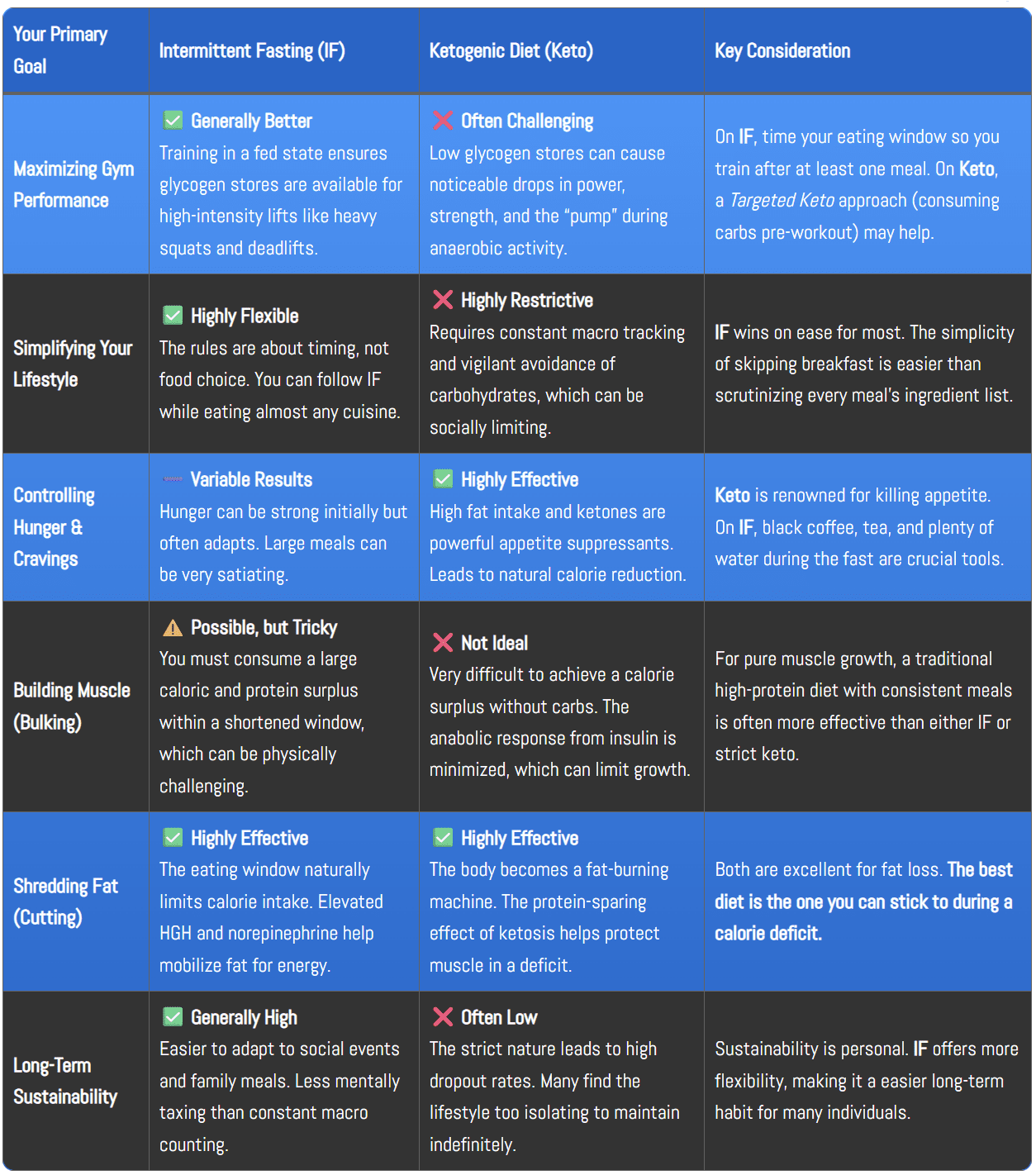
Download this table as a high-resolution image.
Download Tip: To save a copy for yourself, simply highlight the table, right-click, and select “Copy.” You can then paste it into a Word document, Google Doc, or spreadsheet to print or keep as a reference.