Forearm training splits into four distinct movement categories: crush grip, pinch grip, wrist flexion and extension, and brachioradialis hammer work. Most lifters do zero of them. They finish a set of deadlifts, feel their grip slip, and blame the bar instead of their neglected forearm program. We broke down every forearm muscle group, matched exercises to each function, and built a programming blueprint that turns noodle forearms into steel cable grip without adding an extra hour to your split.
Forearm Anatomy: The Four Muscle Groups You Need to Hit
The forearm contains four muscle groups visible on any detailed anatomy chart: the forearm flexors on the palm side, the forearm extensors on the back side, the brachioradialis running along the thumb-side ridge, and the intrinsic hand muscles that control finger movement. Every grip exercise targets one or more of these groups. If your program only hits one, you build an incomplete forearm.
- Forearm Flexors (palm side): These muscles run from the inner elbow down to the wrist and fingers. They control wrist flexion and finger curling. This is the muscle group that pops when you flex your wrist forward. Wrist curls and crush grip work hit the flexors directly.
- Forearm Extensors (back of forearm): These muscles run from the outer elbow down the back of the forearm. They control wrist extension and finger opening. Wrist extensions and finger extension bands target this group. Most lifters have underdeveloped extensors because curling movements dominate every program.
- Brachioradialis (thumb-side ridge): This muscle runs along the top of the forearm from the elbow toward the thumb. It pops visually during hammer curls and reverse curls. It is the muscle that gives the forearm its “thick from the side” look.
- Intrinsic Hand Muscles (palm and fingers): These small muscles control fine finger movement, pinch grip, and thumb opposition. Pinch plate holds and finger-specific grippers target this group. They do not add visible mass, but they are the foundation of every grip movement.
For the full exercise directory organized by muscle group, see our exercise list with muscles targeted reference. For the broader arm development picture, see science-backed arm exercises for men.
The Four-Cylinder Engine Analogy
Your forearm is a four-cylinder engine. Wrist curls are cylinder one. Reverse wrist curls are cylinder two. Hammer curls are cylinder three. Grip and pinch work is cylinder four. Most lifters fire two cylinders and wonder why their forearms look the same after two years. A deadlift holds the bar. That fires cylinder four. It does not fire one, two, or three. Fire all four cylinders in a single workout and your forearms will look like an engine that actually runs.
Crush Grip: The Foundation of Forearm Mass
Crush grip is the handshake between your fingers and palm that closes around a barbell, dumbbell, or grip trainer. It is the grip style used on deadlifts, rows, pull-ups, and farmer’s walks. It is the largest contributor to overall forearm mass because it recruits both the forearm flexors and the intrinsic hand muscles simultaneously.
Key Crush Grip Exercises
- Farmer’s Walk: Pick up a heavy dumbbell or farmer’s walk handle in each hand. Walk 40-60 meters. Put them down. Repeat 3-4 times. This is the single most effective full-forearm exercise. It loads the crush grip, wrist stability, and brachioradialis simultaneously. For carry-specific programming, see our loaded carry exercise guide.
- Dead Hang: Hang from a pull-up bar for time. Start with 30 seconds. Build to 90 seconds. Add weight via a dip belt when bodyweight becomes easy. This is a pure crush-grip endurance exercise with zero equipment beyond a bar. For more bodyweight programming, see our bodyweight exercise library.
- Grip Trainer Holds: Use an adjustable grip strength trainer set to a resistance you can close fully. Squeeze and hold for 10-30 seconds. The hold is more effective for hypertrophy than rapid reps. Reps build endurance. Holds build mass.
- Fat Gripz on Every Pull: Slide a pair of Fat Gripz Pro onto any dumbbell, barbell, or cable handle. The thicker diameter forces your hand to work harder on every rep. This turns every pulling exercise into a crush-grip exercise without adding a single movement to your program.
Pinch Grip: The Thumb-Side Mass Builder
Pinch grip is the thumb-and-finger clamp that holds a weight plate by its edge, a pinch block, or the narrow side of a dumbbell head. It targets the intrinsic hand muscles and the thumb adductor in a way crush grip cannot. Pinch work adds thickness to the thumb side of the hand and builds the kind of functional strength that carries over to every sport that requires gripping an object, a ball, or an opponent.
Key Pinch Grip Exercises
- Plate Pinch Hold: Pinch two smooth weight plates together, smooth sides facing out. Hold for time. Start with two 10-pound plates. Build to two 25s. The smooth plate surface removes friction. Your thumb and fingers do all the work.
- Pinch Block Carry: A pinch block attaches to a loading pin. Load plates. Pinch the block and carry it for distance or hold for time. This isolates the pinch grip without the barbell or dumbbell component.
- Hex Dumbbell Head Pinch: Grab a hex dumbbell by the head, not the handle. Pinch the flat sides. Hold for time. This is a zero-equipment pinch option using the dumbbells already in your gym.
For dedicated finger and pinch tools, see our best finger exercisers guide. For more detail on hand strength development, see improve finger dexterity and improve grip strength.
Wrist Flexion and Extension: The Popeye Curl
Wrist curls and reverse wrist curls isolate the forearm flexors and forearm extensors respectively. These are the exercises that produce the “Popeye” forearm look — the bulbous muscle belly on the palm side of the forearm that pops when you flex your wrist. Wrist curls build the flexors. Reverse wrist curls build the extensors. You need both. Training only wrist curls creates a muscle imbalance between the front and back of the forearm.
Key Wrist Exercises
- Barbell Wrist Curl (Flexion): Sit on a bench. Rest your forearms on your thighs, wrists hanging off the knees, palms up. Curl a barbell using only wrist movement. The forearm flexors do all the work. Keep the rep range at 15-20. This is a high-rep isolation movement. Loading too heavy turns it into a momentum exercise.
- Barbell Reverse Wrist Curl (Extension): Same setup, palms down. Curl the barbell upward using the back of the forearm. Use roughly half the weight of your wrist curl. The forearm extensors are smaller and weaker than the flexors. Do not ego-load this movement.
- Cable Wrist Curl: Attach a straight bar to a low cable. Same movement pattern as the barbell version, but constant cable tension removes the rest point at the top and bottom of the ROM. For more cable exercise variations, see our cable exercise category.
- Wrist Roller: A wrist roller is a short bar with a rope attached to a loading pin. Roll the weight up by twisting your wrists, then roll it back down. This alternates wrist flexion and extension under continuous tension. It is the single most brutal forearm exercise. Three sets of wrist roller will make your forearms burn in under two minutes.
The Door Analogy
Your forearm flexors are the front door. Your forearm extensors are the back door. Most lifters paint the front door bright red with wrist curls and leave the back door unpainted plywood. Turn the forearm around. If the back is flat and the front is thick, you trained one door. Reverse wrist curls are the paint for the back door. Buy the paint.
Brachioradialis: The Hammer Curl Muscle
The brachioradialis is the thumb-side forearm muscle that crosses the elbow joint and pops during hammer curls, reverse curls, and any neutral-grip pulling. It is the most visible forearm muscle from the front and side. When someone has “thick forearms,” the brachioradialis is the muscle doing most of the visual work.
Key Brachioradialis Exercises
- Hammer Curl: Dumbbells held in a neutral grip, thumbs pointing forward. Curl both dumbbells simultaneously. The brachioradialis is the prime mover. The biceps assist. Keep the rep range at 8-12 with controlled eccentrics. For more biceps programming, see our best biceps exercises for mass and biceps exercise directory.
- Reverse Curl: Barbell or EZ bar, palms down. Curl the bar toward your shoulders using only elbow flexion. The brachioradialis and forearm extensors share the load. Use roughly 60% of your barbell curl weight.
- Rope Hammer Curl: Attach a rope to a low cable. Neutral grip, thumbs up. Curl with constant cable tension. The rope allows a natural wrist position that reduces joint stress compared to a fixed bar.
- Neutral-Grip Pull-Up: Palms facing each other. This grip angle shifts emphasis from the lats to the brachioradialis and forearm flexors relative to a pronated pull-up. For more pull-up variations, see our upper body pull exercises guide.
For the broader arm development picture, see triceps exercises and top triceps exercises for thickness. The forearm is one-third of a complete arm. Biceps and triceps are the other two-thirds.
Programming: How to Slot Forearm Work Into Your Split
Forearm training fits into a push-pull-legs split, an upper-lower split, or a full-body routine at the end of the workout, not the beginning. Forearms recover relatively quickly compared to larger muscle groups. Training forearms 2-3 times per week at the end of your sessions is sustainable. Training forearms at the beginning of a deadlift or row session sabotages your pulling performance.
The 2-Day Forearm Split (Push-Pull-Legs Compatible)
- Pull Day (End of Session): Farmer’s walk: 3 rounds of 40-60 meters. Barbell wrist curl: 3 sets of 15-20 reps. Dead hang: 1 set to failure. Total time added: 8-10 minutes.
- Push Day or Arm Day (End of Session): Hammer curl: 3 sets of 8-12 reps. Reverse wrist curl: 3 sets of 15-20 reps. Plate pinch hold: 3 sets of 20-30 second holds. Total time added: 8-10 minutes.
The 3-Day Forearm Split (Higher Frequency)
- Pull Day: Fat Gripz dead hang + farmer’s walk.
- Push or Arm Day: Hammer curl + reverse wrist curl.
- Leg Day or Rest Day: Wrist roller + plate pinch holds.
The daily Fat Gripz method: Slide Fat Gripz Pro onto every dumbbell and cable handle for all pulling movements. You add zero minutes to your workout. Every set of rows, pull-downs, and curls becomes a forearm set. For the full list of compound movements that benefit from grip work, see our compound exercises directory and compound exercises for mass.
For isometric grip programming that pairs with this routine, see our isometric exercises guide. For classic strength training integration, see classic strength training and Heavy Duty training philosophies.
Equipment: The Tools That Build Forearms Faster
A barbell and dumbbells are all you need to start. Fat Gripz, a wrist roller, grip trainers, and farmer’s walk handles are the four upgrades that accelerate forearm development. These tools add loading options that a standard barbell and dumbbell cannot replicate.
- Fat Gripz Pro: Rubber sleeves that slide onto standard dumbbell and barbell handles. Increase grip diameter from roughly 1 inch to 2.25 inches. This forces the forearm flexors and intrinsic hand muscles to work harder on every rep. $30-40. See our Fat Gripz Pro full review.
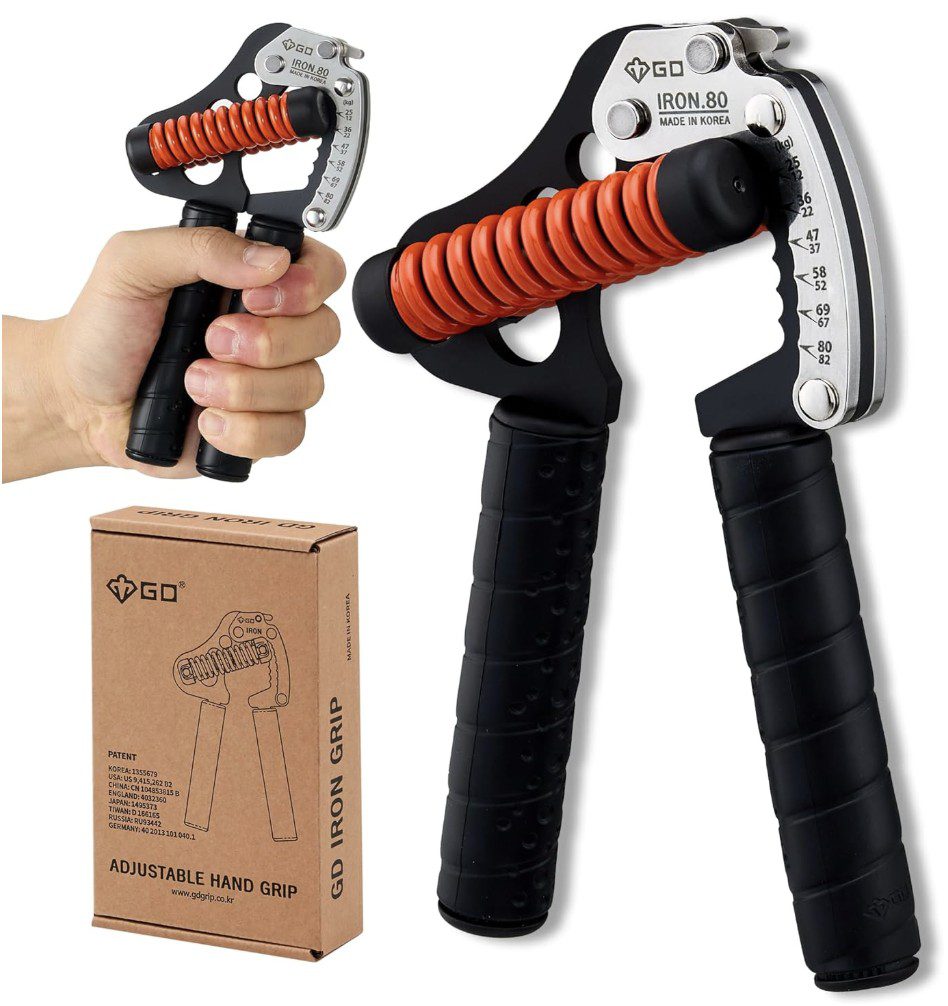
- Adjustable Grip Trainer: A spring or torsion-spring hand gripper with adjustable resistance. Use it for crush grip holds, not rapid reps. Holds in the 10-30 second range build forearm mass. Reps in the 50+ range build endurance but not size. See our best grip strength trainers comparison and best adjustable grip strength trainers.
- Wrist Roller: A bar with a rope and loading pin. Roll a weight up and down using wrist flexion and extension. Under $20. The most forearm-specific tool available. Three sets of wrist roller produce more forearm fatigue than five sets of wrist curls.
- Heavy-Duty Grip Trainer: Metal grip trainers with 100+ pound resistance levels for advanced crush grip work. See our best heavy-duty metal grip trainers guide. For individual tool reviews, see GD Iron Grip review, Hozzen grip strength review, and Hozzen vs GD Grip comparison.
- Farmer’s Walk Handles: Dedicated handles with a loading pin. More stable than dumbbells for heavy carries. The elevated handle height prevents the plates from hitting the floor on each step.
- Figure-8 Lifting Straps: The counterpoint tool. Use straps on your heaviest deadlift and row sets when grip fatigue limits back training. Train grip separately. Do not let grip be the reason your back does not grow. See our Gymreapers figure-8 straps review.
Forearm Training Mistakes: What Not to Do
Ego-loading wrist curls, skipping extensors, training grip before deadlifts, and using grip trainers for speed reps instead of holds are the four mistakes that stall forearm growth.
- Ego-loading wrist curls: Wrist curls are a high-rep isolation movement. Loading 135 pounds on a barbell wrist curl turns it into a momentum exercise that uses the shoulders and hips. Keep the weight at 15-20 rep max. The forearm flexors are small. They respond to controlled tension, not heavy half-reps.
- Skipping extensors: Training wrist flexion without wrist extension creates a muscle imbalance. The top of the forearm stays flat. The bottom grows. Over time, this imbalance can contribute to elbow discomfort. Train reverse wrist curls with the same frequency as wrist curls.
- Training grip before deadlifts or rows: Fatiguing your grip before a heavy pulling session reduces your deadlift and row performance. Slot forearm work at the end of the session. Use lifting straps on your heaviest sets if grip is the limiting factor.
- Speed reps on grip trainers: Rapid open-close cycles on a grip trainer build endurance, not mass. Crush the gripper, hold for 10-30 seconds, release slowly. The hold is the hypertrophy stimulus. The rapid rep is cardio for your hands.
- Never training heavy carries: Farmer’s walks are the highest-return forearm exercise. They load the crush grip, wrist stability, and brachioradialis simultaneously under walking tension. If your forearm program does not include loaded carries, you are leaving the most efficient tool in the drawer. See our carry exercise category for programming.
The Bucket and Hose Analogy
Forearm training is filling a bucket with a garden hose. Wrist curls fill it. Reverse wrist curls fill it. Farmer’s walks fill it. Grip holds fill it. Speed reps on a gripper are flicking droplets at the bucket. You can flick droplets for an hour and the bucket stays empty. Turn on the hose with heavy holds and loaded carries. The bucket fills in ten minutes.
Forearm Training FAQ
- How often should I train forearms?
- 2-3 times per week, at the end of your workout sessions. Forearms recover faster than larger muscle groups. Training them at the start of a pulling session reduces grip performance on deadlifts and rows. Place forearm work last in the session. 8-10 minutes per forearm session is sufficient.
- Do deadlifts and rows build enough forearm mass on their own?
- No. Deadlifts and rows train crush grip endurance. They do not train wrist flexion, wrist extension, or pinch grip. A lifter who only deadlifts and rows will develop grip endurance but not the full forearm muscle mass that comes from direct isolation work. Deadlifts are one cylinder. You need all four.
- Should I use lifting straps for deadlifts if I want bigger forearms?
- Use lifting straps on your heaviest deadlift and row sets when grip limits back training. Train forearms separately with dedicated grip work. Do not let grip be the reason your back does not grow. The purpose of a deadlift is back and posterior chain development, not forearm training. Use straps when needed. Train forearms at the end of the session. See our Gymreapers figure-8 straps review.
- Are grip trainers worth buying?
- Yes, if used for timed holds, not rapid reps. An adjustable grip trainer allows you to set resistance at a level you can close fully and hold for 10-30 seconds. This builds crush grip mass. Rapid reps build endurance but not size. See our best grip strength trainers comparison for the full market breakdown.
- How long until I see visible forearm growth?
- Forearms are dense, small muscle groups. They grow slowly. With consistent direct training 2-3 times per week including wrist curls, reverse wrist curls, hammer curls, and loaded carries, visible changes typically take 8-12 weeks. The brachioradialis tends to show growth first because it is the most superficial forearm muscle from the front and side view.
- Can I train forearms with bodyweight only?
- Yes. Dead hangs build crush grip. Towel hangs build crush grip with a thicker grip diameter. Fingertip push-ups load the wrist extensors and finger stabilizers. Bodyweight-only forearm training is effective for endurance but harder to progressively overload for mass. For bodyweight programming, see our bodyweight exercise library and isometric exercises guide.
The Forearm Blueprint: Complete Weekly Protocol
A complete forearm program hits all four movement categories — crush grip, pinch grip, wrist flexion and extension, and brachioradialis — across 2-3 sessions per week at the end of your workouts. The tools are a barbell, dumbbells, a pull-up bar, and optionally Fat Gripz, a wrist roller, and an adjustable grip trainer. The time commitment is 8-10 minutes per session. The result, over 12 weeks of consistent training, is a forearm that looks like it actually belongs on an arm that deadlifts.
| Movement Category | Exercise | Sets x Reps | Frequency | Equipment |
|---|---|---|---|---|
| Crush Grip | Farmer’s Walk | 3 x 40-60m | 1-2x/week | Dumbbells or farmer’s handles |
| Crush Grip | Dead Hang | 1 x failure | 1-2x/week | Pull-up bar |
| Pinch Grip | Plate Pinch Hold | 3 x 20-30 sec | 1-2x/week | Two smooth weight plates |
| Wrist Flexion | Barbell Wrist Curl | 3 x 15-20 | 1-2x/week | Barbell or dumbbells |
| Wrist Extension | Reverse Wrist Curl | 3 x 15-20 | 1-2x/week | Barbell or dumbbells |
| Brachioradialis | Hammer Curl | 3 x 8-12 | 1-2x/week | Dumbbells |
| Optional: Full Forearm | Wrist Roller | 3 x roll up/down | 1x/week | Wrist roller + loading pin |
A forearm is not a side effect of deadlifts. It is a muscle group that responds to direct training with the same rules as any other: progressive overload, full range of motion, all four movement categories, and consistency. Train it directly. Train it after your main work. Train it 2-3 times per week. The Popeye look is not a mystery. It is a program.
The Forearm Blueprint: Four Movements, 8 Minutes, 2-3 Times Per Week
Crush grip. Pinch grip. Wrist curls. Reverse wrist curls. Hammer curls. Farmer’s walks. Dead hangs. Eight to ten minutes at the end of your session. Add Fat Gripz to every pull for zero extra time. Trained consistently, this builds the kind of forearms that look like they belong on an arm that deadlifts.
Related Forearm, Grip, and Arm Training Guides
- Best Grip Strength Trainers Compared
- Best Adjustable Grip Strength Trainers
- Best Heavy-Duty Metal Grip Trainers
- Best Finger Exercisers for Dexterity and Strength
- How to Improve Grip Strength: Complete Guide
- Improve Finger Dexterity: Exercises and Tools
- Fat Gripz Pro Review
- GD Iron Grip Review
- Hozzen Grip Strength Trainer Review
- Hozzen vs GD Grip Comparison
- Gripzilla Tornado Review
- Gripzilla Dynamo Review
- FitBeast Grip Strengthener Review
- Gymreapers Figure-8 Lifting Straps Review
- Gymreapers Arm Blaster Review
- Science-Backed Arm Exercises for Men
- Best Biceps Exercises for Mass
- Biceps Exercise Directory
- Triceps Exercises: Complete Directory
- Top Triceps Exercises for Thickness
- Arm Exercise Category
- Loaded Carry Exercise Guide
- Compound Exercises for Mass
- Cable Exercise Directory
- Isometric Exercises Guide
- Sandbag Training Guide
- Classic Strength Training
- Heavy Duty Training Philosophy
- Exercise List with Muscles Targeted
- Bodyweight Exercise Library